Review of Middle Woman by Orson Scott Card

SFFaudio Review

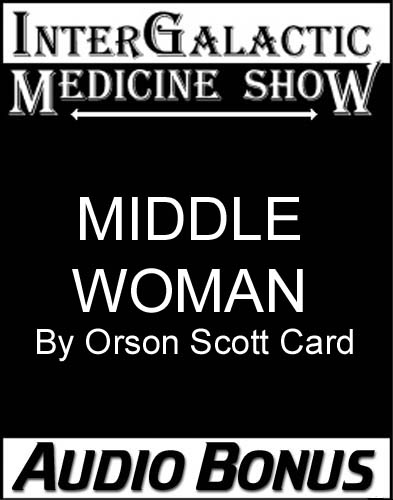
Orson Scott Card's InterGalactic Medicine Show Audio Bonus - Middle WomanMiddle Woman
By Orson Scott Card; Read by Mary Robinette Kowal
1 MP3 File – 9 Minutes 57 Seconds [UNABRIDGED]
Publisher: Orson Scott Card’s InterGalactic Medicine Show
Published: March 2006
Themes: / Fantasy / Fable / Dragons / 3 Wishes /Immortality /

This is the second “Audio Bonus” from Orson Scott Card’s InterGalactic Medicine Show online magazine, the plan appears to be to offer one bonus MP3 story per issue. Cool!

Orson Scott Card’s short fiction is connected to people in ways that other speculative fiction often isn’t. Realistic character psychology always takes the lead over scenarios, but his scenarios always test his characters’ psychologies – it makes for a special completeness rarely found in Speculative Fiction. Combine this with a refinement of prose, where every word is perfectly placed, and you get a little piece of magic in every OSC story. In this case, “Middle Woman” is a fable style fiction, another variation of that old saw “the three wishes”. Originally published under OSC’s pseudonym “Byron Walley”, it takes the idea of moderation, something almost always absent from fables, and runs with it. It reminded me of a kinder, gentler version of Robert Bloch’s classic That Hellbound Train. Interestingly, it also offers a more restive solution to W.W. Jacobs’ The Monkey’s Paw. The setting is Eastern, and given the “middle” of the title I suspect it is working in the ‘middle kingdom’ style of storytelling. Whether I’m right about that or not you’ll have to check it out yourself to decide.

Quite short, only 9 minutes, this is ably read by Mary Robinette Kowal who manipulates her voice in all the right ways to lend classic fairy tale reading to this modern fable. In addition to being a terrific narrator, Kowal is a professional puppeteer who also moonlights as speculative fiction author. “Middle Woman” is the Audio Bonus found in Issue Two of the online magazine Orson Scott Card’s Intergalactic Medicine Show.

DISCLAIMER: Mary Robinette Kowal, when not reading stories aloud is an SFFaudio reviewer.

Posted by Jesse Willis

Voices: New Media Fiction is the first podiobook…

news

Voices New Media Fiction LogoVoices: New Media Fiction is the first podiobook anthology, the brainchild of podcast legend Mur Lafferty. Chock full of spec-fic goodness this is a new collection of previously podcast fiction. When completed there will be stories from Jared Axelrod of The Voice Of Free Planet X, Patrick McLean of The Seanachai, Paul S. Jenkins of The Rev-Up Review, James Patrick Kelly of Free Reads, Jason Erik Lundberg of Lies and Little Deaths and J.R. Blackwell of 365 Tommorows, as well as the ubiquitous Cory Doctorow, and another 10 more!

The official Podiobooks.com announcement reads as follows:

“Milestone! We’re very happy to announce the release of Voices: New Media Fiction. Voices is edited by Mur Lafferty, and is only available from Podiobooks.com. It is also our 30th book

Voices: New Media Fiction brings together the pioneer short fiction podcasters. Experimenting from putting short-short fiction to novellas over their podcasts, these writers were the first to test the new medium for storytelling. Some wrote specifically for podcasts, some read previously published fiction, and some read entirely new stories. Some listeners asked if they could get just the stories in audio form, and that request brought about this podiobook. Cory Doctorow tells us a story about a post-apocalyptic government run by sysadmins and James Patrick Kelly narrates a story of a strange reconciliation. We’ve collected 18 stories for you, the first short fiction to go out over podcast, and look forward to bringing you more.”

Stories already available from the collection include:

Wolf in the Park
By Patrick McLean
A man is hunted – or is it haunted – by a monstrous wolf.

Barry Koleman, Hero
By Mur Lafferty
Barry grows up a bitter man, denied the superpowers that are his birthright.

The Journey of Jonathan Cave
By Paul S. Jenkins
Jonathan awakens from stasis to discover he’s on the last journey of his life.

Pandas Just Want to be Dogs
By Jared Axlerod
A man discusses desires and extinction with a panda.

Anda’s Game
By Cory Doctorow
A young girl realizes there’s more to her online gameplaying than just looting and leveling.

Review of A Wrinkle in Time by Madeleine L’Engle

SFFaudio Review

Fantasy Audiobook - A Wrinkle in Time by Madeline L'EngleA Wrinkle in Time
By Madeleine L’Engle; Read by Madeleine L’Engle
5 CDs – Approx. 5 Hours 17 Minutes [UNABRIDGED]
Publisher: Random House/Listening Library
Published: 2005
ISBN: 0307243230< Themes: / Fantasy / Space travel / Family / YA / Psychic Abilities / Newberry / The elementary school I attended as a kid had a big poster in the library showing the covers of all the Newberry Medal award winners. I remember A Wrinkle in Time by Madeleine L’Engle jumping off of the poster; the cover featured an almost photo-realistic mother-of-pearl centaur that was pretty damn cool looking to a ten year-old. I checked the book out, read it, and loved it, but my recent listen of the new audio edition of A Wrinkle in Time (Listening Library, 2005) made me wonder how much of the book I really understood as a kid. I’ve often thought that they should just come right out and say that books win the Newberry Medal not because they are outstanding children’s books, but rather outstanding children’s books for adults. A Wrinkle in Time definitely falls within this category. The fast-moving story and sympathetic characters definitely make it appealing to kids, but, like Philip Pullman’s stuff , there are thematic elements that are very mature, and maybe even a little subversive. If the book were any less intelligently or subtly written, I wouldn’t be surprised to see it show up on banned-book lists.

L’Engle reads the book herself, and does a fine job. She obviously has an intimate understanding of the material, and her expressive voice lets her keep the story flowing without having to use different voices to distinguish the characters. L’Engle apparently suffered a cerebral stroke in 2002, the effects of which are obvious in her voice; it’s slurred a lot like Johnny Cash’s on his later albums. The only criticism I have of this production is of the decision to use an echo effect for the dialogue of Ms. Which. In the book all of this character’s dialogue appeared in italics, but the in the audio book, the effect comes off as a little cheap.

The audiobook starts off with an introduction explaining how L’Engle read the story to her children as she was writing it. Those were some lucky kids. Hop in bed with A Wrinkle in Time, some cocoa and some good headphones and you’ll probably come pretty close to recreating that experience.

A few readers have emailed asking where I got th…

news

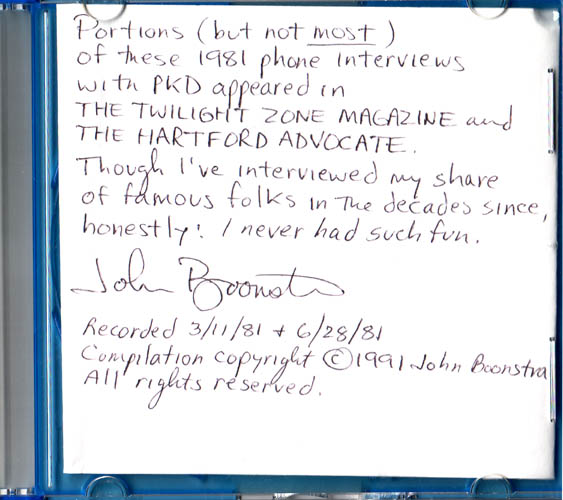
A few readers have emailed asking where I got the cool 2-CD set of John Boonstra interviewing Philip K. Dick. You know the one I reviewed last fall? I got it from Zack Wood, proprietor of ThePhilDickian.com who also has a few other rare PKD gems for sale on audio as well. Wood actually sells 3 different audio interviews with Philip K. Dick and 2 other related audio Dickiana products:

Philip K Dick Interview Conducted by John Boonstra1. The one I reviewed last fall is called Philip K. Dick Telephone Interviews and was conducted by John Bonnstra. This one was thrilling, like you’d tapped into a conversation between PKD and a big fan. The closest thing to being in the room with the man himself. Definitely a must listen for any fan.

Philip K. Dick interview PIPER IN THE WOODS conducted by Gregg Rickman2. Another is entitled Piper In The Woods (taking its name from a PKD story) which was conducted by Gregg Rickman. I haven’t heard this one myself but am hoping, maybe someday. Hint hint.

Philip K Dick Interview Conducted by Paul Williams3. The one by Paul Williams of Rolling Stone magazine. This one was used by Williams to do the amazing Rolling Stone article on PKD back in the 1970s. That article was probably the biggest boost to Dick’s forunes after his Hugo win for The Man In The High Castle up to that point. This cassette was actually an issue of the Philip K. Dick society fanzine back in the 1980s. Cool huh?

X Minus One's two Philip K. Dick adaptations of COLONY and THE DEFENDERS4.Wood also sells the two X-Minus One 1950s radio dramas based on PKD short stories (both of which are now in the public domain) one’s called Colony and the other is The Defenders. I beleive the Spaceship Radio podcast has released one of these, and the Sci-Fi Friday podcast has released them both. Definitely worth a listen, nicely adapted though as usual the stories themselves work even better. Neither is available on audio in any other form at this time though.

VALIS The Opera5. And lastly he’s got VALIS: The Opera a 2 CD set created by Tod Machover. This is music inspired by Dick’s V.ast A.lien L.iving I.ntelligence S.ystem and the novel of the same name (VALIS). I haven’t heard it but somebody out there seems to like it. Anybody heard it?

Hey kids, Dragon Page Cover To Cover, the weekly…

Online Audio

Dragon Page Cover To Cover LogoHey kids, Dragon Page Cover To Cover, the weekly podcast that talks to Science Fiction and Fantasy authors has an AWESOME guest this week! Hosts Michael and Evo are talking with Grandmaster of Science Fiction Larry Niven who’s got a new book out, The Draco Tavern, also up for discussion are Lucifer’s Hammer, the Ringworld series and plenty more! Click HERE to download Show #207 directly. Or subscribe to the show’s XML feed:

http://www.dragonpage.com/podcastC2C.xml

Octavia Butler 1947-2006 Science fiction has lost…

Octavia Butler 1947-2006

Science fiction has lost one of its most precious voices this weekend. Octavia Butler’s body of work is outstanding, and she will be missed.

On audio, Recorded Books has three of her best titles; Kindred, Parable of the Sower, and Parable of the Talents.

An obituary can be found at the Seattle Post-Intelligencer. From that obit: “Butler’s work wasn’t preoccupied with robots and ray guns, Howle said, but used the genre’s artistic freedom to explore race, poverty, politics, religion, and human nature.”