
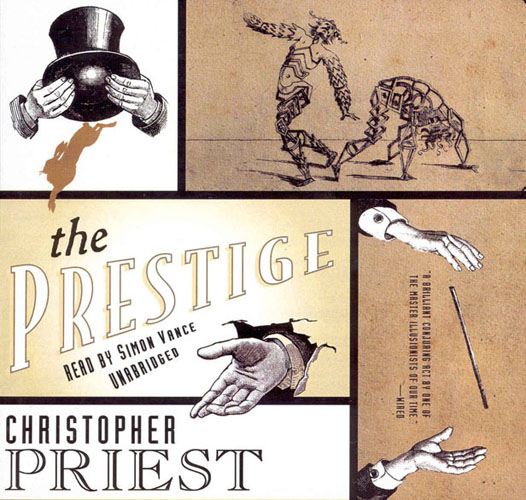
Review of The Prestige by Christopher Priest

SFFaudio Audiobook Review

Fantasy Audiobook - The Prestige by Christopher PriestThe Prestige
By Christopher Priest; Read by Simon Vance
10 CDs – 12 Hours [UNABRIDGED]
Publisher: Blackstone Audio
Published: 2006
ISBN: 0786168412
Themes: / Science Fiction / Magic / Magicians / 19th Century / Electricity / World Fantasy Award /

It’s difficult to say how long it’s been since I’ve been so enthralled with an audiobook as I was with this unabridged version of the World Fantasy Award-winning The Prestige. In very few words, the production was excellent. Simon Vance narrated, and since the story is primarily told through journal entries of the two main characters, he was basically called upon to portray these two dark, intricate magicians. He unreservedly succeeded – his performance was stellar. Because of his subtle care, the surprises of the novel were enhanced by his reading. And there are many surprises.

The main characters are late 19th century stage magicians (or “prestidigitators”, as they call themselves) named Alfred Borden and Rupert Angier. They perform in London, but at the height of each magician’s popularity, they tour America and Europe. But not together. No, these two guys are mortal enemies, out to better the other by whatever means necessary. Each one in turn performs a trick on stage that seems impossible to the other, and their personal quests are rooted in finding out how the other does it, and then to perform it better.

The novel is filled with fascinating detail about these magicians and their tricks. But even more interesting are the journals themselves. It becomes quickly apparent that the journal writers are not reliable. Christopher Priest was masterful in the way he made sure that the journal writers were speaking squarely from their own point of view, which was not always technically true; rather, like journal writers everywhere, they would write something about their own motives that justified events to themselves. The result is an intricate web that is slowly unraveled throughout the book. It’s an audiobook that merits a second listen; knowing what I know now, having finished, a second listen would reveal the breadcrumbs I missed along the way. I suspect I left several on the trail.

Also prominent is Priest’s portrayal of life in the 19th century. The values, the language, and the daily life of the characters all feel accurate, though I am no 19th century historian. The world’s reaction to the advent of electricity is a fascinating example. I couldn’t help but to think of modern parallels with the advent of the internet.

At first glance, this novel is fantasy. It even won the World Fantasy Award in 1996. But is this a fantasy novel? It really isn’t. Yes, there are magicians here, but they are stage magicians. As such, their tricks have perfectly reasonable explanations. Each of the main characters do specific remarkable things, but the reasons given for the way these things work are not magical, but scientific. More, I will not say, because this is a novel to be discovered for yourself, not to be read about. After I finished the book, I watched the recent film version. Be assured that there are enough major differences that a listen to this book will be a different (though similar) and very worthwhile experience – worthwhile enough to be the latest addition to SFFaudio’s Essential List.

Audio Sample: LINK

Posted by Scott D. Danielson

Review of To Say Nothing Of The Dog by Connie Willis

Science Fiction Audiobooks - To Say Nothing of the Dog by Connie WillisTo Say Nothing Of The Dog – Or How We Found The Bishop’s Birdstump At Last
By Connie Willis; Read by Steven Crossley
15 cassettes – 21.25 hours [UNABRIDGED]
Publisher: Recorded Books
Published: 2000
ISBN 0788755498
Themes: Science Fiction / Time-travel / Comedy / Romance / Mystery / 19th Century /England / Near Future /

The story involves Coventry Cathedral (old, new and burned down), pen wipers, a breach in the space-time continuum, boating on the Thames, evolution, and bulldogs.
– Connie Willis in a Science Fiction Weekly Interview

For such a stunningly popular Science Fiction author Connie Willis has some very unusual obsessions: Churches, England, a neurotic lead character and cats. But then again if you take away the churches and the England all you’ve got left is Robert A. Heinlein, so don’t complain. Now before I get all reviewing let me first say that the Science Fiction elements in this novel are truly paper thin. The closest we come to real SF meat is the many characters thinking about time travel paradoxes and how to prevent them. The plot resolution, without giving anything away, centers around the reason time travel works the way it does in these Connie Willis time travel books and that revelation felt not just un-science fictiony but also down-right un-scientific. But on the other hand it has a neatly tied up happy ending, and we all need a nice happy ending now and then.

This is the third time travel story set in a near future where an Oxford history don named Dunworthy sends his undergraduates back in time to visit historical English churches. But unlike Fire Watch and Doomsday Book, To Say Nothing of the Dog is also a romantic comedy and a mystery. Instead of sending his students to WWII London (as in Fire Watch), or Middle Ages England (as in Doomsday Book), Dunworthy sends them to 19th century Oxford for a little R&R, and while they are there would they “mind finding the bishop’s birdstump?” – whatever that is. Now don’t get me wrong, I actually enjoyed this novel, quite a lot in fact! It’s just that Willis is such a very strange writer…. her characters, for example, they think a lot, no strike that. They think way too much. They are always overthinking every possibility of what could go wrong and then thinking it again just for luck, which is truly infuriating. Thankfully, this characteristic is slightly less apparent in this novel than it was in Doomsday Book and this book benefits from that slight reduction. No doubt this was due in part to the first person perspective. Keep writing first person Connie!

The mystery element is also rather weak. Are we really supposed to care what happened to the bishop’s birdstump? We don’t even find out what the damn thing is until about two thirds of the way through the book! What really saves this novel from becoming utterly unlistenable is the author’s attention to light humor and the characters. These are nice people, and the situations they are in are for the most part quite cute. The romantic angle is also sweet, and the text is rife with evidence that Willis really researches the heck out of the settings she writes about. I don’t recall ever laughing out loud, though many sections were quite amusing, or ever being so caught up in the romance that I couldn’t stop listening if I needed to, though I did like the way that all played out – it snuck up on me. What I liked most about To Say Nothing Of The Dog – Or How We Found The Bishop’s Birdstump At Last was the literary references included. There are characters who act like they’re in a P.G. Wodehouse Jeeves and Wooster story, the mystery element is obviously quite Dorothy L. Sayers inspired and Willis even named the novel after the biggest influence, Jerome K. Jerome’s Victorian comic novel Three Men In A Boat – To Say Nothing Of The Dog! Narrator Steven Crossley has the prototypical English accent you associate with Masterpiece Theater and costume drama. He’s called upon to stretch only a little with this one, playing mostly upper and middle class English gentlefolk from the 21st and 19th centuries. Nicely done too. Recorded Books has chosen some neat art for the cover, depicting an hourglass and a bulldog. As usual the packaging is absolutely top notch, you won’t find a more durable or attractive case for an audiobook from another publisher.

So with such a mixed review can I recommend this book? Absolutely I can, for of all Connie Willis’ weirdness, she is as gosh darned friendly and smart as you and me, just maybe a little smarter and definitely a little weirder, and I would never ever hesitate to recommend a novel that can trace its origins back to one line in Robert A. Heinlein’s Have Space Suit, Will Travel. To Say Nothing Of The Dog – Or How We Found The Bishop’s Birdstump At Last is recommended as a tonic for the weary traveler, or just as a lighthearted vacation from Hard SF.

Posted by Jesse Willis