
Review of Little Fuzzy by H. Beam Piper

SFFaudio Review
littlefuzzyLittle Fuzzy
By H. Beam Piper; Read by Jim Roberts
Publisher: Brilliance Audio
Publication Date: 11 February 2014
[UNABRIDGED] – 7 hours

Themes: / alien intelligence / human intelligence / corporate greed / pipe smoking / science fiction / aliens /

Publisher summary:

On the planet Zarathustra, a sunstone prospector named Jack Holloway receives a strange guest at his door one night – a mysterious, small, fuzzy alien – which promptly makes itself at home. Before long, “Little Fuzzy’s” whole family joins him. Hardened Jack is transformed into their “pappy” and chief protector, and his life is forever changed. The creatures, however, turn out to be quite intelligent. Sapient life on Zarathustra, however, would be disastrous; this leads Jack and his friends on a quest to discover the answer. The quest becomes a matter of urgency when the company that has been growing rich from mining the planet decides to exterminate the Fuzzies to protect their contract. What follows is murder, deceit, kidnapping and intrigue at its best.

Jack Holloway is a human prospector on the planet Zarathustra. As Holloway works his claim, he encounters an indigenous life form dubbed Little Fuzzy. These creatures appear quite intelligent. But if the Little Fuzzy proves to hold sapient intelligence, it’ll cram a giant monkey wrench into the industrial machine that is planetary mining and mineral extraction. It’s Little Fuzzy verses big money in this quaint 1962 SF adventure.

While H. Beam Piper’s Little Fuzzy might show its age, its message still holds an edge. At what point do we as sentient beings stop exploiting natural resources/habitat for profit. Since we are still struggling to come to terms with this question today, it’s fun to examine this problem when set against a distant planet with cute fuzzy tool-wielding prawn-eating creatures.

I discovered Piper’s Little Fuzzy through John Scalzi’s Fuzzy Nation. Scalzi wrote his book in tribute to Piper’s work, and I can see why. Piper writes a fun SF story that evokes thought and problem solving. Scalzi’s book possesses more immediacy than Piper’s Little Fuzzy, and Scalzi creates a character in Holloway that is less heroic than Piper’s Pappy Jack. I prefer Scalzi’s interpretation to Piper’s, but that is due to writing style more than anything else. Piper’s work possesses more content while Scalzi’s work holds more character intimacy and action.

Jim Roberts narrates this audiobook, and initially I wasn’t thrilled with his slow-paced delivery. It seemed too deliberate and too aged for my perception of Holloway. But then I realized that my mental image of Jack Holloway was from Scalzi, and Piper’s Pappy Jack is different. When I concluded this, I realized that Roberts was a great match for Piper’s Holloway. And while the POV doesn’t entirely rest upon Pappy Jack’s shoulder, it does for the majority of the story. Roberts and Holloway became one, and I came to truly enjoy the reading style of Jim Roberts.

I recommend this to anyone who enjoys classic SF. It’s more thought-provoking than action driven, and in this light, it succeeds.

Posted by Casey Hampton.
Review of To Honor You Call Us by H. Paul Honsinger

SFFaudio Review

tohonorTo Honor You Call Us (Man of War #1)
By H. Paul Honsinger; Read by Ray Chase
Publisher: Brilliance Audio
Publication Date: 18 February 2014
[UNABRIDGED] – 13 hours

Themes: / military SF / swords in space / rat-faced aliens /

Publisher summary:

The Terran Union is engaged in a vast interstellar war against the KragRuthless aliens intent on exterminating humankind. In 2315, the wily Max Robichaux is given command of the USS Cumberland, a destroyer with state-of-the-art capabilities but a combat record so bad, she’s known as the “Cumberland Gap.”Capt. Robichaux’s first mission: to take his warship to the Free Corridor, where the Krag have secretly been buying strategic materials, and to seize or destroy any ships carrying enemy cargo. Far from the fleet and under enforced radio silence, Max relies only on his determination and guile…and the support and friendship of his chief medical officer, the brilliant Dr. Sahin.Because even as he deals with the ship’s onboard problems and the stress of carrying out her risky assignment, Max and the doctor discover that the Cumberland and her misfit crew are all that stands in the way of a deadly Krag attack that threatens to end the war—and humanity—once and for all.A far-future story in the tradition of “ships of wood, men of iron” novels, To Honor You Call Us and the Man of War series combine the adventure of exploration, the excitement of war, and the dangers of the unknown through the eyes of a ship and her crew.

H. Paul Honsinger’s To Honor You Call Us is on the softer side of Military SF. Rat-faced aliens religiously motivated and determined to exterminate humans play the role of villain. The stage is the stars, and the stars teem with alien life. Some species resemble catfish; others appear to mirror carnivorous teddy bears.

The year is 2315. Rough and tumble Max Robichaux is promoted to Captain, and the story follows his journey into deep space to fight the dreaded rat-faced Krag. In this era of FTL (Faster Than Light) space jumps, pulse cannons, and universal interspecies translators, we also encounter boarding parties, cutlasses, traditional firearms, beer and liquor rations, and battle-axes.

I struggled with this book. The characters are not very engaging, the dialogue feels clunky, and neither of these are helped by a novel written entirely in passive voice. Honsinger overloads his prose with anachronistic stumbling blocks jarring the reader from the 2315 present-day. I didn’t want to at first, but I was willing to accept sword wielding boarding parties in space. I drew the line at the ships commissary selling t-shirts (all sizes), ball caps, pins, coffee mugs, pillowcases, pendants, charm bracelets, polo shirts, shotglasses, workout shorts, throw pillows, Christmas tree ornaments, etc. When I encounter a character saying, “Maybe Santa Claus will come by in his sleigh and act as a missile decoy,” I stop and scratch my noggin. The year is 2315, what character drops this antiquated holiday reference? And why does a character observe, “The sounds reminded Max of a child playing with his oatmeal by using a drinking straw to make bubbles.” Are there really still straws and oatmeal in 2315? Don’t get me wrong, I like oatmeal, but I’ve never used a straw with it before.

The struggle lies in Honsinger’s earnest desire for his story to be taken seriously. If this had been presented as a farce, a jape upon the genre of Military SF like the film Galaxy Quest poked good-naturedly at its contemporary counterparts, I could have better rolled with the punches. Unfortunately, that is not the case. Honsinger’s incessant desire to drop knowledge in the form of military history on the reader is tiring, and does nothing to advance the story. When it’s all said and done, this reads like fanfic, poorly written fanfic.

I listened to the audiobook. Ray Chase is the narrator, and damned if he didn’t make this book better.

Since To Honor You Call Us is the first in the Man of War series, I fully expect Honsinger’s writing to improve as the story continues. And while I do feel burned by this book, I might be willing to pick up the next volume, in time, if Honsinger figures out what he is writing, drops the passive voice, and commits to more intensive revision.

Posted by Casey Hampton.


The SFFaudio Podcast #256 – READALONG: Have Space Suit—Will Travel by Robert A. Heinlein

TheSFFaudioPodcast600The SFFaudio Podcast #256 – Jesse, Tamahome, Luke Burrage, Seth, and Mark Turetsky talk about the audiobook of Have Space Suit—Will Travel by Robert A. Heinlein (as narrated by Mark Turetsky for Blackstone Audio)!

Talked about on today’s show:
On the book title’s proper spacing and hyphenation; Have Gun, Will Travel TV show; Heinlein’s last “juvenile” novel; Mark “over the moon” about the opportunity to record the book; novel nominated for Hugo in 1959; parts of the novel are hard SF; Philip K. Dick’s completely unrelated story The Father Thing; ways of manipulation in the novel; Mark’s favorite character voices; correlations between the Earth characters and space characters; debunking the possibility that the story was all a dream or imaged à la Wizard of Oz; cross-novel characters in Heinlein’s novels i.e. Space Family Stone; novel followed up by Starship Troopers; detailed description of the space suit possibly inspired by Heinlein’s work on bomber pilot pressure suits during World War II; The Martian by Andy Weir; casual drug use in the novel; Mark didn’t do the helium voice in space suit scenes; comparison to full cast audio version; Kip’s conversations with inanimate space suit bear resemblance to Gravity; on the novel’s setting in time and its world building flaws; slip sticks and slide rules; slide rule “the best invention since girls”; Kip’s dad should “get off his ass and get a job”; Jerome K. Jerome’s Three Men in a Boat and its inspiration on Connie Willis’s To Say Nothing of the Dog via its appearance in this novel’s opening lines; Heinlein’s infallibility; going Galt; the father is an asshole; the father is Heinlein; money in fiction; money baskets in Stranger in a Strange Land; old men hooking up with young women in Heinlein; Podkayne of MarsTime for the StarsTunnel in the Sky is a mash-up of Lord of the Flies and The Hunger Games; the story’s narrative perspective; on learning outside of school, “I’m gonna learn this shit on my own”; novel encapsulates Luke’s life philosophy, “There’s no such thing as luck. There is only adequate or inadequate preparation to cope with a statistical universe.”; the novel’s accelerating plot; The Puppet Masters; on adapting the novel to the silver screen; PBS’s adaptation of Ursula K. Le Guin’s Lathe of Heaven; the relative weakness of the novel’s last section; Bill and Ted’s Excellent Adventure; time travel “breaks” fiction; Lisa Simpson would read this book; John Scalzi’s blog post An Anecdotal Observation, Relating to Robert Heinlein and the Youth of Today; people today don’t read books (or read the wrong kind of books); is science fiction the most enlightened of fiction genres?; phone books are useful for starting fires; Luke tells an inspiring story about the Magellanic Cloud; “the cure for boredom is curiosity”; where animals keep their brains.

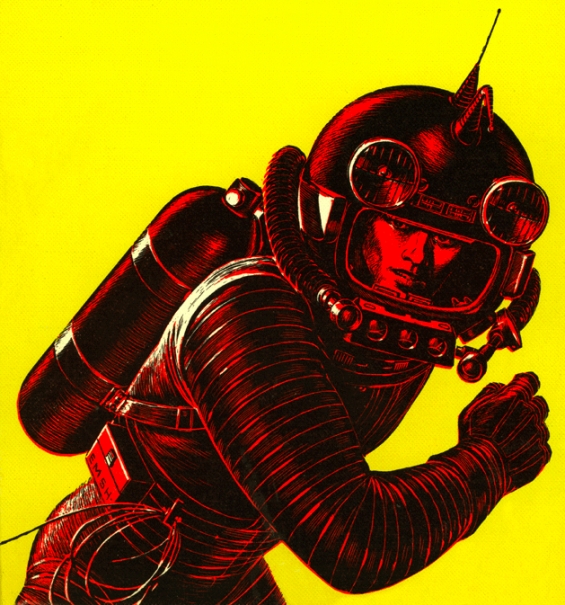
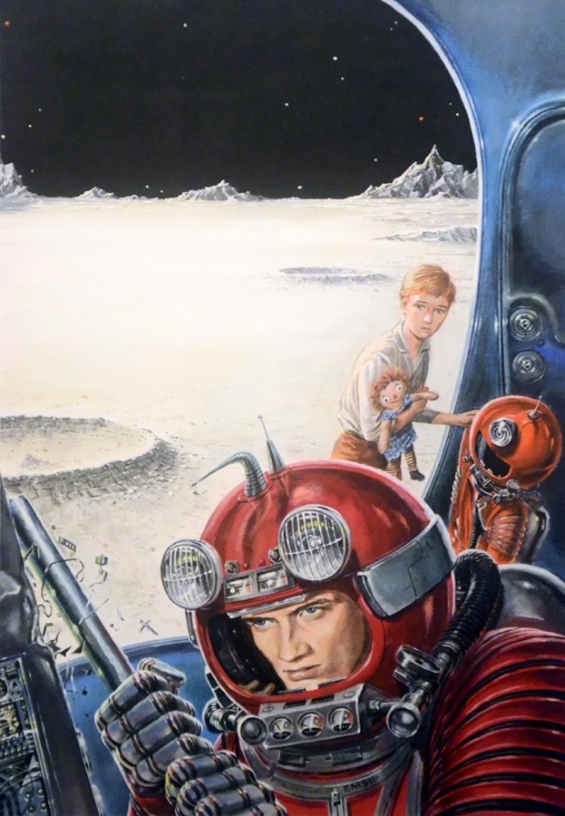
Have Spacesuit - Will Travel - illustration by Ed Emshwiller

Emsh interior illustration for HAVE SPACE SUIT - WILL TRAVEL

Ed Emshwiller illustration of Have Spacesuit, Will Travel

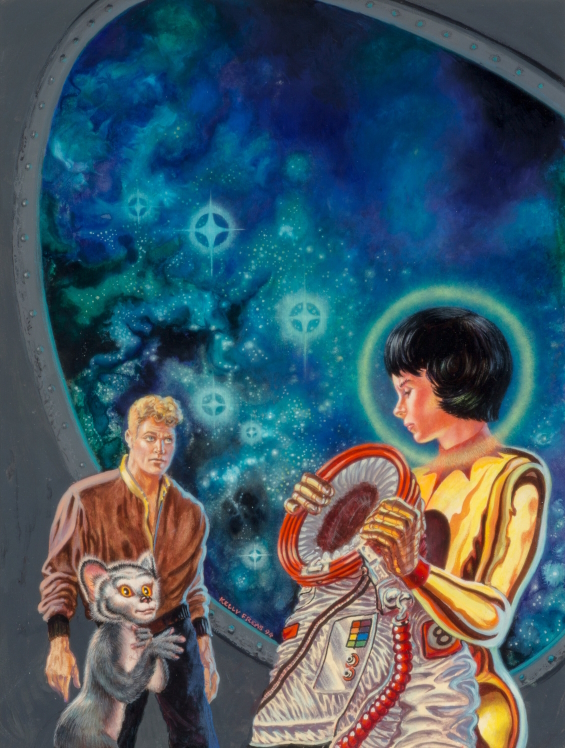
Kelly Freas -  Have Spacesuit, Will Travel

Posted by Jesse Willis

Review of Lines of Departure by Marko Kloos

SFFaudio Review

Lines of Departure by Marko KloosLines of Departure
By Marko Kloos, read by Luke Daniels
Publisher: Brilliance Audio
Publication Date: 28 January 2014
[UNABRIDGED] – 8 discs; 10 hours

Themes: / military sf / basic training / overpopulated earth / battle armor combat / aliens / marriage / mutiny / mathematics /

Publisher summary:

In the sequel to Terms of Enlistment, a desperate battle for interstellar supremacy pits man against man and humanity against aliens in an epic tale of vicious combat and political deception.

Vicious interstellar conflict with an indestructible alien species. Bloody civil war over the last habitable zones of the cosmos. Political unrest, militaristic police forces, dire threats to the solar system…

Humanity is on the ropes, and after years of fighting a two-front war with losing odds, so is Commonwealth Defense Corps officer Andrew Grayson. He dreams of dropping out of the service one day, alongside his pilot girlfriend, but as warfare consumes entire planets and conditions on Earth deteriorate, he wonders if there will be anywhere left for them to go.

After surviving a disastrous spaceborne assault, Grayson is reassigned to a ship bound for a distant colony—and packed with malcontents and troublemakers. His most dangerous battle has just begun.

In Lines of Departure, Marko Kloos picks up where Terms of Enlistment left off. Earth is overpopulated, various terrestrial governments are still warring with one another in space as people colonize the stars, and there’s a new nearly indestructible alien species that appears determined to exterminate mankind.

The combat scenes are crisp and the action flows at a nice clip. For the majority of the narrative, we tag along with Andrew Grayson as he along with his fellow NAC troopers battle the Lanky, the new aliens on the block. Again we are plunged into a universe where the Chinese, Russians, and North American Commonwealth manage to still fight one another in space as they simultaneously battle the eighty-foot tall Lanky.

Kloos writes a nice sequel, but unlike many others, I didn’t feel that Lines of Departure was as strong as Terms of Enlistment. Still, this is a good Military SF book and worth your time. I like the military hardware, interactions between troops and civilians, and the realistic paradoxical bureaucracy that apparently still plagues humanity’s future.

My favorite scene? Andrew Grayson having breakfast with his mother in a small Vermont diner. I like Military SF combat, and Kloos writes good combat scenes. But the breakfast is something special. Character development happens seamlessly, dialogue feels effortless and natural, and there is some genuine emotional growth occurring. I could almost taste the food, smell the coffee, and feel the heft of the menu and napkins.

The ending is good, maybe not surprising, but it’s true to the story and well written. Nice Job, Mr. Kloos. Thank you for not overreaching. You gave me what the story needed, and you resisted the temptation of adding too many whirly-bangs.

Luke Daniels narrates the audiobook, and turns in another outstanding reading.

I’m looking forward to the next book in the series. If you’ve read Terms of Enlistment, you’ll want to give this a go.

Posted by Casey Hampton.

Review of Terms of Enlistment by Marko Kloos

SFFaudio Review

Terms of EnlistmentTerms of Enlistment
By Marko Kloos, read by Luke Daniels
Publisher: Brilliance Audio
Publication Date: 28 January 2014
[UNABRIDGED] – 8 discs; 11 hours

Themes: / military sf / basic training / overpopulated earth / battle armor combat / aliens /

Publisher summary:

The year is 2108, and the North American Commonwealth is bursting at the seams. For welfare rats like Andrew Grayson, there are only two ways out of the crime-ridden and filthy welfare tenements, where you’re restricted to 2,000 calories of badly flavored soy every day. You can hope to win the lottery and draw a ticket on a colony ship settling off-world, or you can join the service. With the colony lottery a pipe dream, Andrew chooses to enlist in the armed forces for a shot at real food, a retirement bonus, and maybe a ticket off Earth. But as he starts a career of supposed privilege, he soon learns that the good food and decent health care come at a steep price . . . and that the settled galaxy holds far greater dangers than military bureaucrats or the gangs that rule the slums.

The genre is Military SF. The year is 2108. Andrew Grayson, a welfare kid from the slums, enlists in the armed forces, and the journey begins.

In Terms of Enlistment, Marko Kloos fails to score any points for originality. But I’m okay with that, and you should be too. Yes, Kloos appears to reboot Heinlein’s Starship Troopers. So much so, that some of the similarities are awkward and eerie (see basic training and the coed showers). The big difference between Heinlein and Kloos is that Heinlein was deliberately hyperbolic, whereas Kloos is not. In Heinlein’s universe, humanity fights bugs. With Kloos, we see an overpopulated Earth, the Chinese and Russians still battle the West, and humans have begun to colonize other worlds; we are the bugs now.

Kloos writes in the present tense, and barring a few anachronistic banana peal phrases, the writing is solid and strikes a brisk pace. I liked discovering a narrative where future humans have shed Earth’s gravity but still cling to terrestrial grudges. Kloos doesn’t write a unified humanity gathered in a handholding sing-along, rather, government’s war over resources, and the only way out is bound to military service or the space colony lottery.

I listened to the audiobook, and Luke Daniels delivers another standout reading. Keep up the good work, Mr. Daniels. Each audio cd begins and ends with a musical track overlay, and while it doesn’t completely ruin the audiobook experience, the music is distracting.

If you’re a fan of Military SF, battle armor, and combat, then you’ll probably enjoy this book. Be aware that this story ends on a bit of a cliffhanger, which is picked up in Lines of Departure, the second book in this series by Marko Kloos. No spoilers here, but I absolutely love the aliens that Kloos creates.

Posted by Casey Hampton.

Review of Geomancer by Ian Irvine

SFFaudio Review

GeomancerGeomancer (Well of Echoes #1)
By Ian Irvine; Read by Grant Cartwright
Publisher: Bolinda Audio via Brilliance Audio
Publication Date: July 2013
[UNABRIDGED] – 23 hours, 47 minutes

Themes: / fantasy / magic / crystals / visions / aliens /

Publisher summary:

Two hundred years after the Forbidding was broken, Santhenar is locked in war with the lyrinx – intelligent, winged predators who will do anything to gain their own world. Despite the development of battle clankers and mastery of the crystals that power them, humanity is losing. Tiaan, a lonely crystal worker in a clanker manufactory, is experimenting with an entirely new kind of crystal when she begins to have extraordinary visions.

The crystal has woken her latent talent for geomancy, the most powerful of all the Secret Arts – and the most perilous. Falsely accused of sabotage by her rival, Irisis, Tiaan flees for her life. Struggling to control her talent and hunted by the lyrinx, Tiaan follows her visions all the way to Tirthrax, greatest peak on all the Three Worlds, where a nightmare awaits her.

The start of this book was promising, but things went off the rails. Then, just as they seemed to be recovering, I found the end to be awful. I think my main problem this book is the characters and their dialogue. In part one of the book Mr. Irvine introduces us to several characters that I despised almost immediately. In part two he seems to be trying to elicit sympathy from the reader via self-pity from internal monologue and sympathetic back story. It might work for some readers, but not for me. At best instead of coming around to like the characters as complex and flawed, I find myself mostly indifferent about what might happen to them.

The main character is mostly likable, although some of her thoughts rubbed me the wrong way. I assume this is another attempt to give her depth through flaws instead of being a hero trope. Maybe my dislike of almost all the characters is just an inability for me to understand their society, but I doubt it. The most likable characters are minor ones who don’t seem to stick around very long. It’s really hard for me to enjoy a book when I don’t like the people I’m reading about.

The main story is interesting. The world is at war with much more powerful alien creatures. Humanity have built machines called clankers in order to be able to fight back, but they are still mostly outmatched. At first this seems more like sci-fi than fantasy, but the clankers are powered by crystals and there a mostly unexplained magical system based on them and their connection to power nodes around the world. So really it’s some sort of mix that has more of a fantasy feel than science fiction.

There are a lot of political and social issues that play into things. With so many young men dying in a seemingly endless war, everyone is expected to produce children to essentially provide the next generation of fodder. Anyone accused of a crime is sent to one of two places depending on their gender. Males are sent to the front lines where they will likely die in short order. Women are sent to “breeding factories” which are exactly what they sound like. Entirely too much time was spent on the breeding factories, and the notion of a society so desperate to survive they force women to sleep numerous partners in the hopes of producing the most helpful offspring as frequently as possible is downright horrifying to me.

This is apparently the second series of Mr. Irvine’s Three Worlds sequence. Having never read the first (The Mirror Quartet), I’m sure I’m missing some references to things from that series. My understanding is this is set hundreds of years later, and possibly on a different world. I never felt lost but it’s possible I would understand more about the crystals and their powers if I had read that series first.

Overall it wasn’t a very good book and it was not as well executed as I would have liked. I found myself cringing at some of the writing in places, especially the dialogue. The ending of the book really was really off-putting – it felt like a bad soap opera on television.

Grant Cartwright, the narrator, is the only bright spot of the book, and a large part of me being able to get through the worst parts. I’m not sure if he exclusively reads books targeted at an Australian audience, but if so that’s a shame. He does a good amount of voices for the various characters and his normal reading voice is clear and easy to understand. Some of his voices are grating, but I think that’s fitting for the characters he is portraying. Maybe this partnership between Bolinda and Random House will bring more of his work to North America. I’d like to see what he does with a better book.

Review by Rob Zak.