
The SFFaudio Podcast #228 – READALONG: Last And First Men by Olaf Stapledon

Podcast

The SFFaudio PodcastThe SFFaudio Podcast #228 – Jesse and Jenny talk about the Last And First Men by Olaf Stapledon.

Talked about on today’s show:
the near and far future, not a novel, an imagined planetary history, the scope, Penguin Books, philosophy, the introduction, The Iron Heel by Jack London, a future history, human civilizations, two thousand million years (two billion years), universes => galaxy, man is a small part of the universe, Starmaker by Olaf Stapledon, Doctor Who, 2001: A Space Odyssey, what the plot would look like if there was one, the eighteen periods of man, evolution and construction, it’s set in 1930, is there ever an end to humanity?, Last Men In London by Olaf Stapledon, Last And First Men was popular in its day, Stapledon served in the ambulance service in WWI, plotlessness, period themes, the flying theme, the depletion of fossil fuels, The Mote In God’s Eye by Larry Niven and Jerry Pournelle, Venus, Mars, Neptune, the Martians, the Venusians, the genocide on Venus, Luke Burrage (the Science Fiction Book Review Podcast), racism, a Science Fiction mythology, the poetic musical ending, deep time, to the end of the Earth and beyond, Stapledon as an historian, civilizations always fall, there’s no one thing that ends civilizations, humanity as a symphony, the returns to savagery, establishing the pattern, Arthur C. Clarke, The House On The Borderlands by William Hope Hodgson, The Night Lands, The Time Machine by H.G. Wells, H.P. Lovecraft and cosmicism, the Wikipedia entry for Last And First Men, Fritz Leiber, Forrest Ackerman, scientificion, matchless poignancy, S. Fowler Wright, Lovecraft’s love of the stars (astronomy), one of the species of man is a monkey, another a rabbit, no jokes but perhaps humour, a cosmic joke, monkeys have made human their slaves, Planet Of The Apes, an ability to hear at the subatomic level, intelligence, a fourteen foot brain supported by ferroconcrete, obsession with gold, obsession with diamonds, pulping people, it’s written like a history textbook or essays, the Patagonia explosion, the upstart volcanoes, Earth Abides by George R. Stewart, The Scarlet Plague by Jack London, chiseling knowledge into granite, Olaf loved coming up with different sexual relationships, the 20 year pregnancy, suicide, euthanasia, an unparalleled imagination, groupthink, telepathy, oversimplification, we must press on, the baboon-like submen, the seal-like Submen, the divergence of man into other ecological niches, the number of ants in New York, ecosystems, nuclear weapons, robots are missing, where is the robot man?, the over-emphasis on fossil fuels as the only source of energy, if you could see us now, post-humans, ultimately a love letter to humanity, not aww but awwww!, Starmaker as a masterpiece, Sirius, uplifting a dog, a fantasy of love and discord, dog existentialism, who am I and where is my bone?, Olaf Stapledon in the PUBLIC DOMAIN, influential vs. famous, a very different read.

Last And First Men by Olaf Stapledon

Olaf Stapledon illustration by Neil Austin

Posted by Jesse Willis

Review of Rebellion by B.V. Larson

SFFaudio Review

rebellionRebellion (Star Force #3)
By B.V. Larson, Performed by Mark Boyett
Publisher: Brilliance Audio
[UNABRIDGED] – 12 hours

Themes: / aliens / military sci-fi / fighting bugs / machines /

Publisher summary:

Rebellion is the turning point in the great interstellar war between all living creatures and the machines. Star Force is on the side of the machines – but for how long? In the third book of the Star Force series, Kyle Riggs learns just what kind of war Earth is caught up in. At the mercy of the Macros, his marines fight against new alien races, big and small. They battle the innocent and the vile alike, until their situation becomes grim.

Rebellion is the third novel in B. V. Larson’s Star Force series starring computer science professor turned interstellar marine Kyle Riggs. It stands on its own better than the previous novel, Extinction, but I would still recommend reading the previous books first as the plot throughout the series thus far has been mostly linear. In Rebellion, Larson takes his Star Force formula, throws in a couple new atomic grenades, and keeps blasting right along with the story of humanity’s fight against alien machines known as the Macros.

Given the title, it should come as no surprise that in this novel Kyle Riggs leads the battered remnants of his Star Force marines in a rebellion against their Macro masters. His reasons for this are many, but the decision point comes when he discovers that, while the Macros are scrupulous in abiding by the letter of their agreements, they have no compunction in their networked silica minds against taking advantage of every loophole in an agreement. In this case, they use Riggs’s nanotized marines to attack a race that had failed to include a prohibition against indirect assault using mercenaries in their peace treaty. Riggs concludes that the Macros will employ similar tactics against Earth and the near future and determines that it is better to restart the war now. On his own terms. With only five thousand men. With no way of alerting Earth.

Draw your own conclusions about Kyle Riggs’s big-picture tactical planning capabilities but, as in the previous novels, it is hard to fault his individual decisions in the heat of the moment. Indeed, I’m starting to wonder if Larson intends his hero to be an object lesson in the difficulty of making good choices under stress.

The structure of the Macro / Nano division continues to frustrate me. I’m beginning to accept that Nanos can not simply swarm a Macro and take it apart, though this acceptance is less for any logical reason than just because it continues to not happen, even though there are specific scenes of destroyed Macros being disassembled by Nanos and reprocessed. Perhaps my worst gripe along these lines for Rebellion is the revelation that Macro ships are difficult to pilot because the cockpits are built for pilots with seven arms. Now, I’ll accept that there is some sort of fundamental programming element that requires all Macros to be large, but when their entire command structure is built on networked parallel processing, why aren’t the ships just built into that network? There is simply no reason for the Macros to have physical ship controls, any more than there is a need for their ships to have pressurized compartments.

All complaints aside, I was pleasantly surprised to discover that Rebellion features more, and far more interesting, revelations about the Star Force universe than its predecessor. The best of these are the emergence of a new machine intelligence and Sandra finally coming into her own as a character. This new intelligence starts off as little more than another of the nanobot “brain boxes” that Riggs uses in every aspect of his military. Riggs names the over-achieving brain box Marvin, in what I can only hope is an unacknowledged tip of the hat to The Hitchhiker’s Guide to the Galaxy, and the interactions between Marvin and the human characters are probably the best part of this novel. As for Sandra, she spends half the novel in a coma, then wakes up just in time to reprise her roll as Riggs’s shallow, hot-tempered girlfriend. Literally her first action after waking up is to punch another woman for kissing Riggs in a moment of desperation. Fortunately, Sandra seems to blow most of her daft behavior allocation in that first moment as, with the help of some sentient microbes who have been tortured into assisting Starforce, she quickly evolves into a strong, self-motivated character.

Development of characters other than Kyle Riggs has been a weakness for this series from the beginning, and Rebellion does little to change this. Other than the introduction of Marvin and the growth in Sandra, the only supporting characters to see a change are Jasmine, who develops a crush on Riggs, and Kwan, who gets a girlfriend and learns a few new English idioms. But you don’t read Star Force novels for character development or fully coherent plot. If you are a fan of fast-paced science fiction featuring liberal quantities of bloody, laser-scorched human versus robot combat, Rebellion will quench your thirst for action.

The audiobook narrated by Mark Boyett has the usual quality of production and performance. Three books into the series, I do have to admit that I am starting to get annoyed by the accents of characters other than Kyle Riggs, as it seems that any human character who merits a name also has an accent. Mark Boyett does a fine job with his reading, and I do appreciate that B. V. Larson is attempting to show the global nature of Star Force, but the continual shifting of accents and genders from a single male reader grows tiresome after about six hours.

Posted by Andrew Linke

Review of The Humans by Matt Haig

SFFaudio Review

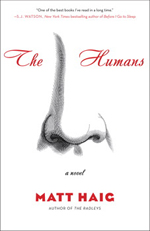
The Humans by Matt HaigThe Humans
By Matt Haig; Read by Mark Meadows
Publisher: Simon & Schuster
Published: July 2013
ISBN: 9781442366497
[UNABRIDGED] – 8 hours, 11 minutes
Excerpt: |MP3|

Themes: / aliens / ethnography / humanity /

Publisher summary:

“I know that some of you reading this are convinced humans are a myth, but I am here to state that they do actually exist. For those that don’t know, a human is a real bipedal life form of mid-range intelligence, living a largely deluded existence on a small waterlogged planet in a very lonely corner of the universe.”

When an extraterrestrial visitor arrives on Earth, his first impressions of the human species are less than positive. Taking the form of Professor Andrew Martin, a prominent mathematician at Cambridge University, the visitor is eager to complete the gruesome task assigned him and hurry back home to the utopian world of his own planet, where everyone enjoys immortality and infinite knowledge.

He is disgusted by the way humans look, what they eat, their capacity for murder and war, and is equally baffled by the concepts of love and family. But as time goes on, he starts to realize there may be more to this weird species than he has been led to believe. Disguised as Martin, he drinks wine, reads poetry, develops an ear for rock music and a taste for peanut butter. Slowly, unexpectedly, he forges bonds with Martin’s family, and in picking up the pieces of the professor’s shattered personal life, he begins to see hope and beauty in the humans’ imperfections and begins to question the mission that brought him there.

This book couldn’t be anything other than fiction, since it is from the perspective of an alien who was sent to earth to hold back dangerous scientific progress, but it has a feeling of ethnography to it from the alien’s perspective. As he becomes an insider, he discovers that what is assumed or known about humans around the universe – their selfishness, their monetary motivation – isn’t accurate. His commentary is more about what it is to be human, and the story was really secondary, in the sense that the story in Among Others is a secondary framework. The stories aren’t the same, but they seem to serve the same purpose.

If you’re looking for a rousing story of alien invasion and infiltration, this isn’t for you. But if you are interested in reflecting on the human condition, this will be right up your alley.

I had the luxury of listening to this entire book in one day. The narrator, Mark Meadows, does a good job of reading and drew me right in, keeping my attention for the entire book. In fact, I hardly thought about him at all, a quality I prefer in my readers!

Posted by Jenny Colvin

Silly Asses by Isaac Asimov

SFFaudio Online Audio

Silly Asses by Isaac Asimov

Maissa Bessada narrates for us Silly Asses a one page (400 word) satirical short story by Isaac Asimov.

|MP3|

Also available is a |PDF| made from a scan of the original publication in Future Science Fiction, February 1958.

And here is the complete text:

Silly Asses by Isaac Asimov

Naron of the long-lived Rigellian race was the fourth of his line to keep the galactic records.

He had a large book which contained the list of the numerous races throughout the galaxies that had developed intelligence, and the much smaller book that listed those races that had reached maturity and had qualified for the Galactic Federation. In the first book, a number of those listed were crossed out; those that, for one reason or another, had failed. Misfortune, biochemical or biophysical shortcomings, social maladjustment took their toll. In the smaller book, however, no member listed had yet blanked out.

And now Naron, large and incredibly ancient, looked up as a messenger approached.

“Naron,” said the messenger. “Great One!”

“Well, well, what is it? Less ceremony.”

“Another group of organisms has attained maturity.”

“Excellent. Excellent. They are coming up quickly now. Scarcely a year passes without a new one. And who are these?”

The messenger gave the code number of the galaxy and the coordinates of the world within it.

“Ah, yes,” said Naron. “I know the world.” And in flowing script he noted it in the first book and transferred its name into the second, using, as was customary, the name by which the planet was known to the largest fraction of its populace. He wrote: Earth.

He said, “These new creatures have set a record. No other group has passed from intelligence to maturity so quickly. No mistake, I hope.”

“None, sir,” said the messenger.

“They have attained to thermonuclear power, have they?”

“Yes, sir.”

“Well, thats the criterion.” Naron chuckled. “And soon their ships will probe out and contact the Federation.”

“Actually, Great One,” said the messenger, reluctantly, “the Observers tell us they have not yet penetrated space.”

Naron was astonished. “Not at all? Not even a space station?”

“Not yet, sir.”

“But if they have thermonuclear power, where do they conduct the tests and detonations?”

“On their own planet, sir.”

Naron rose to his full twenty feet of height and thundered, “On their own planet?”

“Yes, sir.”

Slowly Naron drew out his stylus and passed a line through the latest addition in the small book. It was an unprecedented act, but, then, Naron was very wise and could see the inevitable as well as anyone in the galaxy.

“Silly asses,” he muttered.

Asimov wrote Silly Asses on July 29, 1957. To put that in context, just ten days earlier (July 19, 1957), as a part of Operation Plumbbob the USAF filmed five Air Force officers standing directly under an atmospheric nuclear detonation. The idea was to demonstrate the safe usage of nuclear weapons over civilian populations.

Silly asses.

Posted by Jesse Willis

Sentry by Fredric Brown

SFFaudio Online Audio

Sentry by Fredric Brown

Scott D. Danielson narrates this short short story (320 words) by Fredric Brown. I think it encapsulates much of what Science Fiction is about – teaching by thought experiment. It may be that stories of this kind work almost like an inoculative vaccination, preventing certain mental processes that lead to damaging behavior.

|MP3|

And here’s a |PDF| made from a scan of the original magazine publication in Galaxy Science Fiction, February 1954.

Sentry by Fredric Brown

He was wet and muddy and hungry and cold, and he was fifty thousand light-years from home.

A strange blue sun gave light and the gravity, twice what he was used to, made every movement difficult.

But in tens of thousands of years this part of war hadn’t changed. The flyboys were fine with their sleek spaceships and their fancy weapons. When the chips are down, though, it was still the foot soldier, the infantry, that had to take the ground and hold it, foot by bloody foot. Like this damned planet of a star he’d never heard of until they’d landed him there. And now it was sacred ground because the aliens were there too. The aliens, the only other intelligent race in the Galaxy … cruel, hideous and repulsive monsters.

Contact had been made with them near the center of the Galaxy, after the slow, difficult colonization of a dozen thousand planets; and it had been war at sight; they’d shot without even trying to negotiate, or to make peace.

Now, planet by bitter planet, it was being fought out.

He was wet and muddy and hungry and cold, and the day was raw with a high wind that hurt his eyes. But the aliens were trying to infiltrate and every sentry post was vital.

He stayed alert, gun ready. Fifty thousand light-years from home, fighting on a strange world and wondering if he’d ever live to see home again.

And then he saw one of them crawling toward him. He drew a bead and fired. The alien made that strange horrible sound they all make, then lay still.

He shuddered at the sound and sight of the alien lying there. One ought to be able to get used to them after a while, but he’d never been able to. Such repulsive creatures they were, with only two arms and two legs, ghastly white skins and no scales.

Sentry by Fredric Brown - illustration by David Stone

Posted by Jesse Willis

Review of Extinction Machine by Jonathan Maberry

SFFaudio Review

Horror Audiobook - Extinction Machine by Jonathan MaberryExtinction Machine: The Joe Ledger Novels, Book 5
By Jonathan Maberry; Narrated By Ray Porter
14 hrs and 58 mins – [UNABRIDGED]
Publisher: Macmillan Audio
Published: 2013
Themes: / Science Fiction / Horror / Aliens /

“So, basically if we keep trying to save the country and maybe the world from a bunch of murderous assholes with outer space weapons, then we’re the bad guys?”

“In a nutshell.”

“Then, hey … let’s be bad guys.”

Joe’s back.

Pulled off vacation, Joe Ledger and Echo Team are knocking on research lab doors, looking into cyber-attacks so clever they can’t be tracked back to anyone. But no one’s answering, even though all the lights are on. Until a couple of strangely inhuman Men In Black step onto the loading dock.

Mayhem ensues.

Of course, anyone who is this far into the Joe Ledger series knows that whenever Joe is called in mayhem is always going to ensue, all to help save the good ol’ U. S. of A. Jonathan Maberry has tackled zombies, vampires, the seven plagues of Egypt and more, but this is the first time he’s gone beyond so-called supernatural creatures. Crop circles, space ships, and aliens are the topic of investigation.

And I (mostly) loved it for all the reasons I have enjoyed the entire series. These are adrenaline rides with Joe getting into and out of increasingly impossible, perilous situations while the reader hangs on by their fingernails wondering just how he can possibly escape. Meanwhile, Maberry weaves intriguing mysteries which may not keep us guessing since he enjoys giving us both sides’ points of view, but they do keep us wondering if Joe can stop the bad guys.

What kept me from completely loving this book?

I am as ready for a good invading aliens story as the next person, but at one point the action came to a grinding halt as Maberry wove together two story lines in a gigantic “aliens among us” info-dump. Indeed, this went on for so long and contained enough duplicate information that I began to wonder if the author had fallen into “true believer” status and wanted to be sure we came away converted. Whether that was his motive or it was simply imperfect editing, I wearied of the information long before it ceased flowing.

On the other hand, Maberry is going to have to work hard to top Joe’s accomplishment in the light house. I won’t say more so I don’t spoil it but I was literally laughing with delight as I heard what was happening. Adrenaline rush achieved!

Speaking of listening, Ray Porter does his usual excellent narration and is the reason I wait for the audio books rather than pick up print copies. As I’ve said before Ray Porter IS Joe Ledger. So let me say it again — Porter’s direct, blunt delivery can go from sarcastic to heart-felt to outraged in 60 seconds. Believably. That’s good because sometimes that’s the way Joe’s day goes.

Complaints aside, this book is great fun. Definitely recommended.

Posted by Julie D.