Review of Ender’s Game Alive by Orson Scott Card

SFFaudio Review

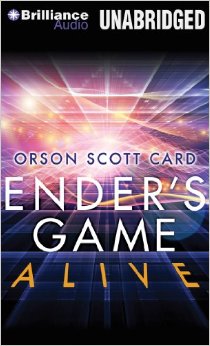
Cover for Ender's Game Alive

Ender’s Game Alive
By Orson Scott Card; Performed by a full cast
Publisher: Skyboat Media
Published: 2013
7 hours 24 minutes [UNABRIDGED]
Themes: / science fiction / childhood / aliens

Sometimes you hear about something and can’t wait to get your hands on it because you want to experience it, to touch it, see it, whatever. You have expectations and hope like mad that in the end, you won’t be disappointed.

for me, the new audio drama adaptation of Orson Scott Card’s novel Ender’s Game fits the above description perfectly. The fact that Card wrote the script himself only made the anticipation worse because the bar went higher. It was raised further when I found out who was producing it: the folks at Skyboat Media. To find out whether or not they succeeded, the end result, (enemy’s gate), is down.

An important note for Ender’s Game fans, I am going to be limiting my scope to the book when reviewing this audio play. For the purposes of this review, the film does not exist. I want to tackle that challenge under its own merits. Any references to it will be made in passing if at all. With that said, our gate is open; on with the review.

The setup: a young boy at the age of six is taken from his home to attend a school for brilliant minds; to turn the “little dorklings” into soldiers and commanders because there is a war going on. This is the third such conflict with this alien race and our protagonist (unknown to him at the onset), is being groomed to be the commander that leads the entire fleet, hopefully, with good results. If not, the human race is doomed.

Our story follows Andrew Wiggin (nicknamed “Ender” by his sister) from the very beginning of his journey; even before that when the decision is made by his parents to have him with the full knowledge that this goes against the population policy in place.

“No more thirds.”

Of course, because this is the international fleet (I.F.) making the request; the rules are bent. All they have to do is sign on the dotted line and fill out the forms. If they don’t, genetic material will be seized and used until the right child is born and sent to battle school; a space station that prepares its students for lives spent as part of the fleet.

Ender’s parents are a special case because their first two children , Peter and Valentine, are geniuses. Why the first wasn’t chosen for the school, (as explained by the commander in charge), is because the kid is plum psycho. Why the sister isn’t picked is because she’d break under actual battle pressure when real losses come her way. And thus the fleet wants the parents to give it another go or else. This is the world Ender is born in. He’s at a disadvantage from the start. The running theme is, “Let’s see how ender handles it.”

The audio play does a great job of setting the appropriate pieces on the chessboard and letting the game play out. The story to tell is Ender’s story. Where it deviates from the book is the fleshing out of the interactions between the staff observing his progress. This is a necessary change since the book mostly takes place from Ender’s mind and point of view. This may seem like The Cabin in the Woods kind of gimmick but it is an important evolution in the way the story is being told. The play has to present things from a different angle and come to the same conclusions; adjusting things as needed to fit the plot’s progression.

the second major deviation is the focus on the other Wiggin children subplot. There are hints to it but it is treated almost as an afterthought. The reasoning for this change is sound; political debates and research would only drag down the story and make the listening experience tedious in places.

All in all, the major plot points of the novel are hit home like a well-aimed shot. There are subtle clues to other works that have been written since Ender’s Game came out in 1985. There are adjustments to some scenes to give the audio play a different feel than just a retreading of the original story step for step. This gives us something a little unexpected and fresh as we take the 7 hour, 24 minute journey.

If you have listened to the audio book of Ender’s Game, several of the casting choices will be no surprise. You hear a particular person’s voice and feel a sense of familiarity that makes the experience that much more enjoyable. Each character is brought to life. You know them, understand them, will not always agree with them or the decisions they make, but can listen to these portrayals and feel like you are the proverbial fly on the wall throughout the story. And when you listen to a scene as heart-felt as when Ender breaks down before his next assignment to command school, you really connect with the emotions in the room. This is how good storytelling becomes great by simply allowing the actors to raise the bar by their performances. The scenes before build up to a moment that is devastating in its impact.

The sound design and score never distract from the dialogue. And for the most part, the editing of the words spoken is top notch. Occasionally, you will hear the hum of the studio where lines were being recorded. If this issue were a constant refrain, I wouldn’t have enjoyed the play as much. As it stands, I only noticed such things myself when listening to the play a second time. That just shows you how engaging the whole packages when listening to it. Even though I noticed these issues, I wasn’t distracted.

At the end of the original audio book, Orson Scott Card said that it was the definitive way to experience his novel. With Ender’s Game Alive, that statement may (and should) be revised. It is a masterful work of audio fiction. Of course, this is in part to the source material. But the transformation from novel to audio play is not an easy undertaking. Orson Scott Card’s background in theatre shines through in this presentation; letting the dialogue drive the story forward. The many actors take on the roles and bring them to life. You won’t mind when adults are playing children. You just want to hear where the story goes. Aside for the minor audio issues, (studio hum in a couple scenes which I won’t spoil here and the inconsistent panning of characters when talking to each other), the production is definitely a recommended listen if you are a fan of Ender’s Game. I give it five out of five toon leaders; that’s one victory ritual.

Posted by Allen Sale
Review of The Gods Themselves by Isaac Asimov

SFFaudio Review

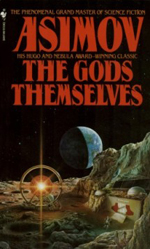
asimovThe Gods Themselves
By Isaac Asimov, read by Scott Brick
Publisher: Random House Audio
Publication Date: January 2014
[UNABRIDGED] – 11 hours, 26 minutes

Listen to an excerpt: | MP3 |

Themes: / aliens / electron pump / cosmic egg / multiple universe theory / sex in space /

Publisher summary:

Only a few know the terrifying truth – an outcast Earth scientist, a rebellious alien inhabitant of a dying planet, a lunar-born human intuitionist who senses the imminent annihilation of the Sun… They know the truth – but who will listen? They have foreseen the cost of abundant energy – but who will believe?These few beings, human and alien, hold the key to the Earth’s survival.

– Disclaimer –
I’m no physicist. This book, in parts, kind of torqued my noggin.

Isaac Asimov’s The Gods Themselves won the 1972 Nebula then the 1973 Hugo. The premise? Pretty straight forward. Will we destroy the universe?

I like this book. The first 2/3 kept me running. The last 1/3, I slowed to a stroll and enjoyed the pace change. The time spent with the aliens was intriguing, both in the differences and similarities to humanity. Asimov packs a punch, tackling the question of energy versus environmental cost. In some ways it’s comforting imagining that even in the future, we humans still salivate over a dangled free lunch. The characters in the other universe are stunning. I could have read twice the content volume on that environment alone. When I reached the lunar colony, it took some time to cultivate an interest in the people and their situation. By the time I was interested, it was ending. This left me feeling off-kilter and only slightly irritated. Don’t ask me to explain, but I found the chocolate bar with almonds scene very touching.

Scott Brick narrates this release. Early on, I didn’t know if I could handle listing to Brick’s performance. He has a nice voice, but he has a habit of injecting unneeded drama into almost anything he reads. Fortunately, within the first twenty minutes, I found Brick’s style quite suited to the content. After finishing and reflecting, I think Brick was the right choice for narrator.

Posted by Casey Hampton.

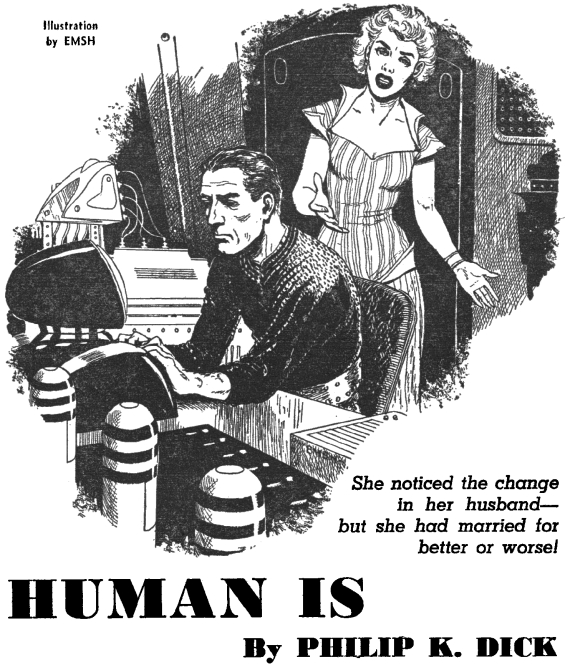
Human Is by Philip K. Dick

SFFaudio Online Audio

Human Is by Philip K. Dick - illustration by Ed Emshwiller

Here is the first second ever audio publication of Human Is by Philip K. Dick.

1 |MP3| – Approx. 33 Minutes [UNABRIDGED]

Narrated by Morgan Scorpion, this story of a dissatisfied housewife and her unfeeling husband has a very 1950s domesticity feel to it – that is until the husband returns from an interplanetary work trip with an entirely new personality.

First published in Startling Stories, Winter 1955.

And here’s a |PDF| of the story.

Posted by Jesse Willis

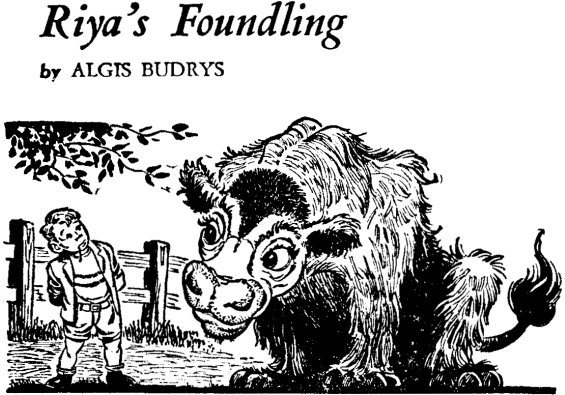
Riya’s Foundling by Algis Budrys

SFFaudio Online Audio

Riya's Foundling by Algis Budrys

Julie Hoverson recently recorded Riya’s Foundling. It’s a little Science Fiction gem from the hands of Algis Budrys and the pages if Science Fiction Stories, #1 (1953).

It’s a story about an intelligent cow (actually a cow-like alien being) that adopts a young human calf.

I’m not very much interested in the earthbound setup – frankly it’s weak – but there’s something very Alfred Besterian about the writing and the alien POV is really fascinating (and somehow familiar).

Here’s the audio, |MP3| Approx. 19 Minutes [UNABRIDGED]

And here’s the |PDF| version!

Posted by Jesse Willis

Review of Conquest by B.V. Larson

SFFaudio Review

ConquestConquest – (Star Force #4)
By B.V. Larson, Performed by Mark Boyett
Publisher: Brilliance Audio
[UNABRIDGED] – 12 hoursThemes: / aliens / military sci-fi / fighting bugs / machines / invasion /

Publisher summary:

Conquest is the next chapter in the great interstellar war between all living creatures and the machines. Star Force must stop the machine invaders once again – but how? In the fourth book of the Star Force series, Kyle Riggs has freed Earth from the chains of the Macros – but at what cost? The Macros no longer trust him. He is a mad dog that must be put down – and all Star Force must be stamped out with him. The war expands in this story, and mankind is once again faced with annihilation.

Conquest is the fourth book in the Star Force series by B. V. Larson and, while it continues the well-established tradition of this series for thrilling military action, it also brings several of the flaws of the series into sharp focus.

Over the course of the previous three novels in the Star Force series, Kyle Riggs has made some bad calls. He has sworn Earth to provide troops for a dangerous enemy, ordered thousands of his troops to their deaths, and cast aside strategic alliances with little thought to the long-term consequences of his actions. Throughout it all, I continued to root for Riggs and the rest of his band, even as I questioned his actions. Now, though, I can’t help but wonder if Star Force is the right team for the job.

Of course, they never were supposed to be the first best choice. Riggs and Crow, the co-leaders of Star Force, were plucked from their homes by brutal machines and only came to command the most technologically advanced army in human history because they managed to survive a brutal series of tests, so it should come as little surprise that these two often resort to brute force to solve their problems. Still, I couldn’t help feeling that these two men were woefully unfit for command when the first few chapters of this book consisted of little more than a super-powered grudge match between them. Riggs, as the narrator and protagonist, does his best to justify his actions to the reader, but many of his arguments can be boiled down to, “I did my best, but I’m not really a soldier.” Meanwhile, Crow is written as a chameleon who repeatedly vacillates between careless pirate and brilliant strategist, with little to no transition between.

One might expect that the return of the giant Macro robots would bring some unity to Star Force, or at least some sound strategic planning, but it doesn’t. Instead, Crow runs away (as usual) and Riggs comes up with some brilliant modifications to the Star Force battle equipment, then fails to use them to their potential (as usual). The one piece of brilliant strategizing that Riggs does manage to pull off, which results in the Macros focusing their attacks on Star Force’s home base rather than assaulting the entire planet, backfires spectacularly when he forgets the lessons learned in his previous fights against both the Macros and the Helios Worms. Riggs knows the Macros are underground, but makes no plans to defend against an attack from below. He gives his troops the ability to fly, but rarely uses that to his strategic advantage. Mistake compounds mistake until only nuclear weapons and convenient force-field failures can save Earth.

Apparently I am not the only one dissatisfied with the leadership of Kyle Riggs, as the author included a subplot of ongoing assassination attempts in Conquest. Obviously, I won’t say who or what was behind the attempts, but I like to imagine that there was some level of symbolism to B. V. Larson’s decision to introduce this plot element. I have to wonder if maybe there is some chance that, by the time he reached this book, Larson had realized that Riggs needs to develop further as a leader and a character.

Mark Boyett does an admirable job narrating this series, navigating the wide range of accents with ease. I did think, as I listened, that I caught a few errors, but I am more inclined to believe that these were missed during the editing of the book, rather than introduced in the recording of the audio. At a running time of just over eleven hours, spanning ten CDs, the book is just long enough to tell the story of the second invasion of Earth without overstaying its welcome. I plan to continue reading this series, but I truly hope to see some growth in strategic thinking from Riggs, or I could see myself beginning to feel sympathetic towards Conquest’s failed assassins.

Posted by Andrew Linke

Protecting Project Pulp: Letter From The Stars by A.E. van Vogt

SFFaudio Online Audio

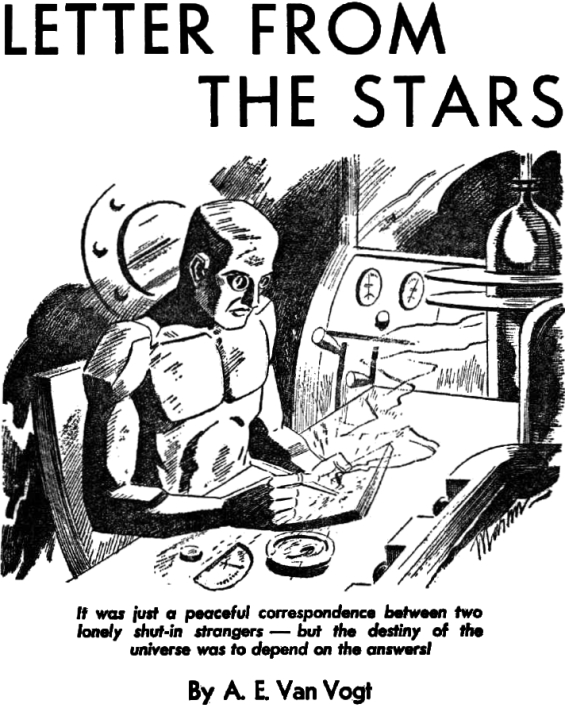
Letter From The Stars by A.E. van Vogt

This short epistolary Science Fiction story, Letter From The Stars (aka Dear Pen Pal), is about a foolish person who writes to an alien criminal. Like many episodes of PPP lately it is straight-up pulpy fun, but with a twist.

Protecting Project PulpProtecting Project Pulp No. 60 – Letter From The Stars
By A.E. van Vogt; Read by Josh Roseman
1 |MP3| – Approx. 18 Minutes [UNABRIDGED]
Podcaster: Protecting Project Pulp
Podcast: September 17, 2013
It was just a peaceful correspondence between two lonely shut-in strangers — but the destiny of the universe was to depend on the answers! First published in The Arkham Sampler, Winter 1949.

Posted by Jesse Willis