The SFFaudio Podcast #166 – TOPIC: SFF FORMS (Short Story, Novella, Novellete, Novel, Fix-up, Trilogy, World)

Podcast

The SFFaudio PodcastThe SFFaudio Podcast #166 – Jesse, Luke Burrage, and Eric S. Rabkin discuss, at length, the SFF FORMS (Short Story, Novella, Novellete, Novel, Fix-up, Trilogy, World). Here’s the premise:

Science Fiction Forms: Short Story, Novella, Fix-Up, Novel, Trilogy, and World. Respectively, they might be exemplified thus: Short Story (“Mars Is Heaven!“), Novella (“Flowers for Algernon“), Fix-Up (The Martian Chronicles, which contains a revised version of “Mars Is Heaven!” or The Seedling Stars, Accelerando, and Beggars In Spain, all of which began as novellas), Novel (originals, like 1984, and derivatives like Flowers for Algernon or Varley’s novel Millennium coming from his short story “Air Raid“), Trilogy (original Foundation series), World (the ultimate Foundation world or Heinlein’s Future History [shared with others] or Banks’s Culture or LeGuin’s Hainish series [created just for the authors, but let’s not forget about fan fiction]). What are the special challenges and rewards in reading and writing in these diverse forms? What special challenges or rewards attend on reusing material in another form? Is the formal plasticity of SF unique among literary genres?

Talked about on today’s show:
Eric’s suggestion, literature with a capital “L”, The Dead by James Joyce, The Portrait Of The Artist As A Young Man, Doomsday Book by Connie Willis, Luke’s Science Fiction Book Review Podcast, the format, the themes, the variability of short story form, the feghoot, Day Million by Frederik Pohl, Accelerando, Stories Of Your Life And Others by Ted Chiang, The Tower Of Babel, stripped away vs. embellished to the nth degree, Flowers For Algernon by Daniel Keyes, Understand by Ted Chiang, The Bells by Edgar Allan Poe, The Black Cat, fantasy, the unexplicit story, valid reactions, the etymology of “text”, Earth Abides by George R. Stewart, a persuasive existential journey, The Scarlet Plague by Jack London, San Fransisco, short stories as objects of frivolity or training, the brilliance of an idea is not always enough, a novel can act as a community to an individual, Fahrenheit 451 by Ray Bradbury vs. The Fireman by Ray Bradbury, is the novel inherently more participatory than a short story?, the failure of technology vs. the power of nature, The Masque Of The Red Death, teaching Science Fiction with short stories and novels, The Science Fiction Hall Of Fame (Volume 1), the composite novel, Winesburg, Ohio by Sherwood Anderson, A.E. van Vogt, the fix-up, The Martian Chronicles by Ray Bradbury, Accelerando by Charles Stross, Lobsters by Charles Stross, the cat changes function, “an intellectual framework”, Robert A. Heinlein’s future history, the composite novel, Isaac Asimov, future history vs. psychohistory, Michael Moorcock, I, Robot, Robbie, the three laws, Stephen Byerly and Susan Calvin, unAsimovian assumptions, the full dose of SF, Reason, The Evitable Conflict, is Stephen Byerly a robot or a man?, the Mérode Altarpiece (a medieval iconographic trope), art history, Luke doesn’t think Asimov is that clever, R. Daneel Olivaw, the three laws are fairytale laws, positronic brains are positive, the three laws are for people (not just robots), The Bicentennial Man, Asimov’s powers, Asimov’s business acumen, Brandon Sanderson, shared worlds, gods, Mormonism, Daniel Clowes, The Death Ray, Elantris, “The Alexandria Quartet” by Lawrence Durrell, reading The Martian Chronicles backwards, Luke’s fiction, Alastair Reynolds, Sherlock Holmes, Baker Street Irregulars, whodunit ain’t the attraction, The Adventure Of The Speckled Band, a matter of cutting, A Clockwork Orange, it’s better without the extra chapter, the commercial effect (or the effect of commercialism), popular literature, the flabby novel, Robert J. Sawyer, Hominids, Calculating God, William Shakespeare, The Royal Ontario Museum, horse evolution, God needs a starship!?, where to find a paleontologist, “a hundred pages of nothing happening”, a circular argument, writing to the story’s demands, Kevin J. Anderson, commercial constraints shouldn’t be points of pride, the thickness of books, The Lord Of The Rings, does more succinct = more better?, novellas are novels with threads missing?, The Hobbit, the ambition of the author, Luke is rejecting the basic premise, The Stand by Stephen King, is it a better story short or long?, changes and updates and additional material, don’t let Asimov near a typewriter unless you want something written, Against The Fall Of Night by Arthur C. Clarke, The City And The Stars, expanding everything, Monster Story, “it came to me in a dream”, Minding Tomorrow, Nightfall (the short story) vs. Nightfall (the novel), “it’s a lot like a perfectly nice novel that eventually becomes a masterpiece”, The Lion of Comarre, it’s not a commercial podcast, a civil rowdiness, Eric’s Coursera course: Fantasy and Science Fiction: The Human Mind, Our Modern World, rechunking, forums, essays, 18,000 registered students, University of Michigan, only the competitors are qualified to judge the competitors, a history of the U.S. Civil War, Luke’s kitchen, grades, “there is no absolute abstract grade for anything”, Science Fiction and Politics (Courtney Brown), the governor of a steam engine, Luke confuses two professors, “yes, by golly, that was a very good thing of it’s kind”, The Odyssey by Homer, a foundational classic, The Bible, the Benjamin Franklin bible, there should be an SFBRP review of The Odyssey, Luke’s Matthew Mark Luke Skywalker, Star Wars, Joseph Campbell, time for coffee!

The Mérode Altarpiece

Startling Stories, November 1948 - Against The Fall Of Night by Arthur C. Clarke

Against The Fall Of Night by Arthur C. Clarke (page 11 of Startling Stories, November 1948)

Against The Fall Of Night by Arthur C. Clarke (page 12 and 13 of Startling Stories, November 1948)

Posted by Jesse Willis

If Only We Had Taller Been by Ray Bradbury

SFFaudio News

November 12, 1971, on the eve of Mariner 9 going into orbit at Mars, Ray Bradbury took part in a symposium at Caltech with Arthur C. Clarke, journalist Walter Sullivan, and scientists Carl Sagan and Bruce Murray. In this excerpt, Bradbury reads his poem, “If Only We Had Taller Been.”

[via BoingBoing]

Posted by Jesse Willis

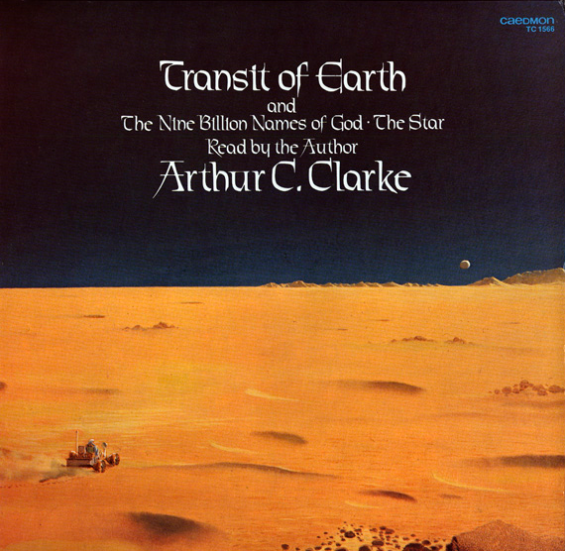
The Transit Of Earth by Arthur C. Clarke
SFFaudio Online Audio

Here’s a rather timely re-post, one based on a post prompted back in 2006 by an astronomer at the University of Hawaii. Professor Esther M. Hu, pointed me towards this reading of an Arthur C. Clarke classic, one read by Clarke himself!

Listening to it again today, and thinking about the significance of science and history of such an event, and the related event happening today, I found Clarke’s reading of The Transit Of Earth to be an incredibly moving experience.

CAEDMON - The Transit Of Earth by Arthur C. Clarke

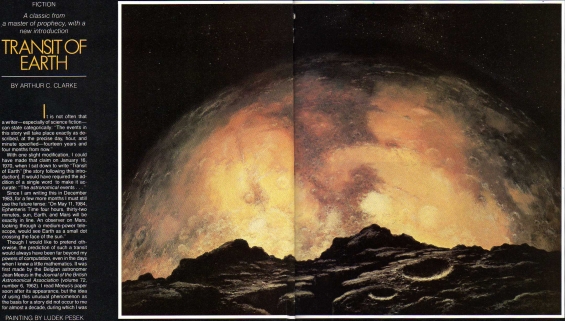
Since then I’ve noticed that there was an introduction written for it too, which appeared in the May 1984 issue of Omni. It’s rather timely, considering that Clarke mentions today’s transit of Venus (which will be the last until 2117):

The Transit Of Earth - illustration by Ludek Pesek

Here is that issue of Omni in the |CBR| format.

And here are the scans: |Page 70|Pages 71 and 72|Page 108|Page 110|Page 112|Page 113|Page 116|

CAEDMON - The Transit Of Earth by Arthur C. ClarkeSFFaudio EssentialThe Transit Of Earth
By Arthur C. Clarke; Read by Arthur C. Clarke
1 |MP3| – Approx. 30 Minutes [UNABRIDGED]
Publisher: Caedmon
Published: 1975
Product #: TC-1566

[via the still awesome Record Brother blog and hugely resourceful Typnet.net]

Posted by Jesse Willis

The SFFaudio Podcast #149 – TOPIC: METAPHOR in Science Fiction and Fantasy

Podcast

The SFFaudio PodcastThe SFFaudio Podcast #149 – Jesse, Luke Burrage, and Professor Eric S. Rabkin talk about METAPHOR in Science Fiction and Fantasy.

Talked about on today’s show:
Science Fiction and Fantasy sort of undercut the scholastic meaning of metaphor, my friend Bill, metaphors come in two parts – the vehicle and the tenor, giants vs. ogres, denuding the metaphor, Aldebaran 6 has astonishingly beautiful humanoids, unknown vehicles deliver us, The Monsters by Robert Sheckley, The War Of The Worlds, a Tolkienesque task, A Voyage To Arcturus by David Lindsay, Dark Universe by Ron Goulart, Plato’s cave, blindness, dead metaphors, the Burning Bush, Saul vs. Paul, a sound idea, Germanic grounds for divorce, Star Maker by Olaf Stapledon, The Door Into Summer by Robert A. Heinlein, 1984 by George Orwell, “the clock stuck thirteen”, constructing meaning, William Shakespeare, awful as in creating awe, Moses and Mount Sinai, “shining like the sun”, a sun god, Sampson, hairy like the sun, bald like the moon, Genesis, “you may look upon my hindparts”, Childhood’s End by Arthur C. Clarke, unconscious metaphors, Frankenstein by Mary Shelley, wretch, catwomen from Venus, voluptuous sex objects, building up the vocabulary, Halting State by Charles Stross, Neuromancer‘s opening line, text adventure, Enoch lived 365 years (the sun god), The Tower Of Babel by Ted Chiang, comparing the constructed worlds of video games with the constructed worlds of Science Fiction, Battlefield 2, a meta-metaphor for understanding what Science Fiction does for understanding our world, hamartia needs range finding, The Time Machine by H.G. Wells, “any fool can see”, a system of metaphors for the characters and the reader provides meta-uses, metaphor means “carry across”, Greek moving vans are called metaphore, the Morlocks are the workers, the Eloi are the owners, the Time Traveler is the manager, Get That Rat Off My Face by Luke Burrage, Science Fiction as thought experiment, Michael Crichton, deus ex machina, The War With The Newts by Karel Čapek, Finnegan’s Wake, experimental novels, Germinal by Émile Zola, Flatland by Edwin A. Abbott, allusion vs. metaphor, Sampson vs. Goliath, Luke and Eric prime each other, is Science Fiction useful?, should SF be useful?, Science Fiction and Personal Philosophy (SFBRP #100), reading only the Bible, The Cold Equations by Tom Godwin, the hard lesson namely: “sometimes you’re just fucked”, Star Trek II, cannibalism, Eric objects, the physical world vs. unconditional love, NASA staff need to read The Cold Equations, Steve Jobs (and his reality distortion field), a world full of things other than minds, smart by accident, Apollo 13, give the astronauts poetry, the title itself crystallizes the meaning, The Scarlet Letter by Nathaniel Hawthorne, a parametric center, how do we maintain individuality in the face of fascism?, the vehicle/tenor heuristic, The Great Gatsby by F. Scott Fitzgerald, Nick Carraway, the car is the parametric central of The Great Gatsby, martian vampires, Apollo 1 disaster, Velcro and oxygen, “a failure of imagination”, learning from the past, the metaphor falls and leaves behind a lesson about reality.

Posted by Jesse Willis

The SFFaudio Podcast #143 – NEW RELEASES/RECENT ARRIVALS

Podcast

The SFFaudio PodcastThe SFFaudio Podcast #143 – Scott, Jesse, Tamahome, and Kristin (A.K.A Terpkristin) talk about recently arrived audiobooks, new releases and more.

Talked about on today’s show:
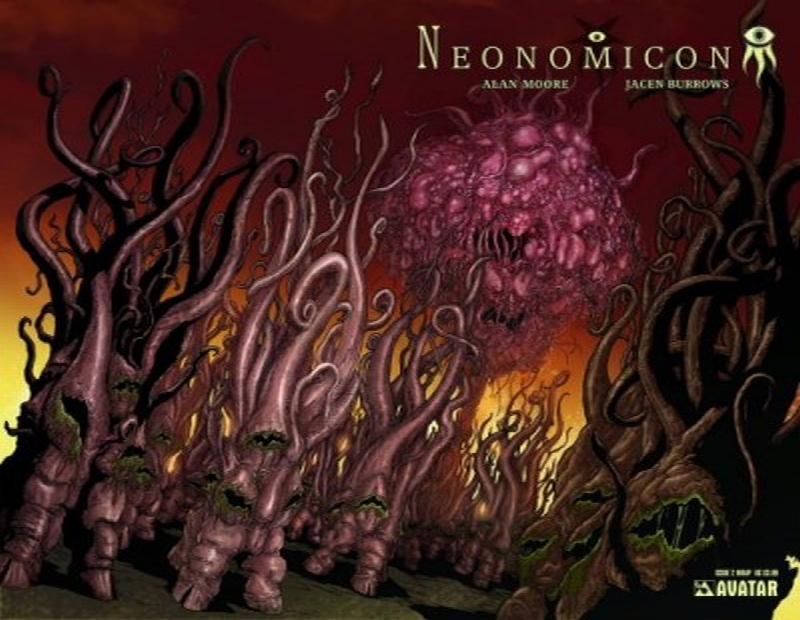
The origin of the name ‘Terpkristin’, Scott has a pile of audio, (see also the NewAudioBookIn twitter feed), Hominids and Humans from Robert J. Sawyer, evolved Neanderthals, Farseer (the dinosaur book), Flashforward, Kristin’s scientific evaluations, “needs more ego”, Pamela Sargent’s Earthseed (Seed, #1), Greg Bear’s Forge of God, memorable earth destruction, Peter F. Hamilton’s Void Trilogy (‘Hawking m-sink’ weapon), the Star Trek movie, Burning Chrome anthology by William Gibson includes Johnny Mnemonic, when will they list all the short stories on the audiobook package?, precursor to Neuromancer, William Gibson’s non-fiction Distrust That Particular Flavor is out from Tantor (Jesse will establish later), he’s a crossover, who will read Sisterhood Of Dune?, extending a series, Zelazny’s Amber series, Glasslands (Halo, #8) by Karen Traviss (she also did a lot of Star Wars books), “stuff happens fiction”,  Eve Online, “gateway books”, James Blish Star Trek books, Splinter Of The Mind’s Eye, The Thirteen Hallows by Michael Scott and Colette Freedman, I Am Number Four, YA series, “contractual sweatshop”, Infernal Devices by K.W. Jeter, a steampunk pioneer, “quick off the mark”, Little Big by John Crowley narrated by the author, Stephan Rudnicki was denied Aegypt (at 43 min), the legend of the Cottingley Fairies, Sir Arthur Conan Doyle believed it, “the Fairy Gap”, Larry Niven’s The Ringword Engineers and The Ringworld Throne, The Protector, the Security Now science fiction episode, “The Ringworld is unstable!  The Ringworld is unstable!”, A Canticle For Leibowitz by Walter M. Miller Jr., NPR dramatized it, good for Scott and Julie’s A Good Story Is Hard To Find podcast?,  Working For The Devil (Dante Valentine, #1) by Lilith Saintcrow, Dante is a woman?, Neal Stephenson’s Currency (The Baroque Cycle, Book 3, Vol. 7), they broke it down, Kristin read the whole thing!, Tantor has drm-free downloads, A Fall Of Moondust by Arthur C. Clarke, a Poseidon adventure on the moon, BBC Radio drama version, Timecaster by Joe Kimball, sounds like Minority Report, an idea for someone else to write, the Assassin’s Creed game, Brent Weeks’s Night Angel trilogy, hoodies are popular, the comic Chew‘s gruesome premise, Mur Lafferty likes it (5 stars on Goodreads!), Aces High (Wild Cards, #2) edited by George R.R. Martin, Jenny’s special message about A Wrinkle In Time, the 50th anniversary, a parallel world thing, the Pern series, The Greg Mandel trilogy by Peter F. Hamilton, my review of Mindstar Rising (Greg Mandel, #1), psychic powers, Lady And The Tramp, Scott’s box of audio has become infected with a zombie virus, Rise by Gareth Wood, “we’re not desolate or empty!”, entering New Releases territory, Blackstone, Raylan by Elmore Leonard, Justified tv show does a good Leonard, style, Out Of Sight movie and book, it was J-lo’s best, Sixth Column by Heinlein, Jesse can’t remember it, The Voice From The Edge series by Harlan Ellison, he’s got a passion, I Have No Mouth And I Must Scream was dramatized on BBC radio too, Robert Sheckley’s Immortality, Inc. (our readalong should be out next week), Bronson Pinchot narrated, (I think this is where I lost my mic because I was trying to say “transplant!” from that audiobook), A Door Into Ocean by Joan Slonczewski, a classic feminist science fiction novel, no men needed, Brilliance audiobooks are cheap!, “Someone explain the point of Audible” (at least I can still text), “What’s the fascination with zombies?”, societal significance or commercial? (I’m starting to think they’re ignoring me), Twilight and their ilk, Night Of The Long Knives by Fritz Leiber, how these subgenres are grouped together, vs the U.K., Dragonflight by Anne McCaffrey is fantasy or science fiction?, Star Wars gadgetry, Alan Moore’s Lovecraft salute comic Neonomicon, the Audible app, Tamahome is in the hole

Posted by Tamahome

BBC ONE (TV): The Sky At Night – Bases On The Moon – a 1963 interview with Arthur C. Clarke

SFFaudio News

The Sky At NightThe Sky At Night is a monthly documentary television programme on astronomy produced by the BBC. The show has had the same presenter, Sir Patrick Moore, from its first airing on 24 April 1957. This is the longest-running programme, with the same host, in television history. I discovered it only recently, via torrent, and have become utterly smitten with its sciencey goodness. Here’s the latest broadcast, actually a repeat from 1963 with Arthur C. Clarke!

Here’s the official description:

Many of the early Sky at Night programmes were destroyed or lost from the BBC library. Recently this early and very rare programme from 1963 with Arthur C Clarke, was discovered in an African TV station. Patrick and Arthur were both members of the British Interplanetary Society and here they discuss bases on the Moon and Mars. Arthur C Clarke made very few interviews, so this really is a broadcasting gem- once lost, but now found.

The programme is also available via |TORRENT|.

[Thanks African TV station!]

Posted by Jesse Willis