Review of The Broken Sword by Poul Anderson

SFFaudio Review

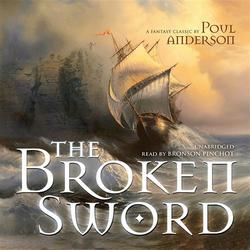
Fantasy Audiobook - The Broken Sword by Poul AndersonThe Broken Sword
By Poul Anderson; Read by Bronson Pinchot
7 CDs – 8 Hours – [UNABRIDGED]
Publisher: Blackstone Audio
Published: 2011
ISBN: 9781441786876
Themes: / Fantasy / Vikings / Myth / Battle /

The Viking Age of England offers fertile ground for storytelling. It was a time of strong men, beautiful fair-haired women, and bloody raids for plunder. Christianity was the new religion on the block, striving to make inroads on the old pagan beliefs—and often at the point of a sword. Gods were said to mingle with men and the world lay poised on the edge of Ragnarok, a final battle and fiery conflagration that would end the world.

Poul Anderson drew on the best of this wild and poetic age, stirred it up with myth and fantasy, and the result was his 1954 novel The Broken Sword. Its like has rarely been matched in the annals of fantasy literature.

I’ve read The Broken Sword previously and knew what a wonderful book it was, but TV and film actor Bronson Pinchot’s narration in this new Blackstone Audio, Inc. production added a new dimension to the novel. I had first heard Pinchot in a reading of Stephen King’s Eyes of the Dragon. While he was wonderful there he ups his game in The Broken Sword, reading with a spite and fury in his voice that perfectly matches the book’s unrelenting grimness and battle fury. Pinchot breathes life into beautiful maidens and proud warriors, deep-throated trolls, and ancient elven warrior-kings whose voices are like winds sighing through treeless leaves.

Oddly enough there is exactly one sound effect in the entire recording—an echo effect used to convey the cold, cruel laughter of Odin—and it’s on the final disc. It was cool but rather jarring, considering it’s on the last disc and there’s no precursor. But on to the tale.

In The Broken Sword the land of Faerie exists alongside the lands of men, invisible save to those with the witch sight. Faerie is a land of bright castles and achingly lovely elves, of the gods of Odin and Tyr, the giants of Jotunheim, black-eyed trolls, and other, fouler monsters.

Pride and ambition touches off the events of The Broken Sword. Orm the Strong is the fifth son of Ketil Asmundsson and thus low in the totem pole of inheritance. Rather than accept a smaller share of wealth Orm seeks his own fortune by going a–viking. On one of his raids he kills a husband and his sons, burning their hall to the ground. The man’s mother, a witch, escapes and swears revenge: She bestows a curse that Orm’s eldest son will be fostered beyond the world of men, while he in turn will foster a wolf that will one day rend him.

The elf-earl Imric travels to the lands of men and sets the witch’s curse in motion. Imric takes Orm’s unbaptized infant son Skafloc and replaces him with Valgard, a changeling, whom Imric himself has fathered by raping a captive troll woman. Valgard’s dark ancestry is evident when he bites his unknowing mother’s breast and grows restless and violent in Orm’s care. Skafloc, raised among the elves, is fair haired and fair of spirit, though equally mighty and otherwise a mirror image of his dark changeling “brother.”

After he discovers his true half troll, half-elf heritage, Valgard embarks on a mission of revenge, killing several members of his foster family. Aided with an army of trolls he then launches a war of annihilation on the elven lands of Alfheim. Skafloc and the elves are beaten back by the initial assaults and all seems lost. Only by going on a quest to reforge a powerful ancient weapon—the eponymous broken sword, a weapon of terrible demonic power that demands blood each time it is drawn and ultimately turns on its wielder—can Skafloc save Alfheim and avenge his family.

Though The Broken Sword seems largely forgotten these days it remains influential. The elf Imric for example reveals the clear stylistic (and thematic) influence The Broken Sword had on subsequent authors like Michael Moorcock. Moorcock (a big fan of the book, who once wrote thatThe Broken Sword “knocked The Lord of the Rings into a cocked hat”) based his Melniboneans heavily on Anderson’s elves. Imric is (largely) Elric of Melnibone, not only in similarity of name, but in appearance and even character. Anderson’s Elves are darker than those in The Lord of the Rings (though I would point out that Tolkien’s elves closely resembled Anderson’s in his source material; see the prideful warrior Feanor from The Silmarillion). They are haughty, prideful, shun the sunlight, and if not malicious are certainly mischievous. These traits have their roots in Norse myth, which both Tolkien and Anderson drew upon.

Everything about the book is wonderfully northern. Characters mingle soaring verse with common speech in conversation. Anderson weaves old northern vocabulary into the tale, evocative words like “Fetch,” “Fey,” and “Weird” (the latter is a fate from which no man escapes), which lend The Broken Sword a hard northern ethos to match its flavor. In this pagan hierarchy the Norns are higher than the towering Jotuns or even the Aesir. Even the gods will die in the fires of Ragnarok at their appointed time. That grimness bleeds through into The Broken Sword as its protagonists are slowly crushed beneath the merciless wheel of fate.

“Throw not your life away for a lost love,” pleaded Mananaan. “You are young yet.”

“All men are born fey,” said Skafloc, and there the matter stood.

This is hard stuff and an unforgiving outlook on life, though not incompatible with that other somewhat famous work that debuted in 1954—Tolkien’s Fellowship of the Ring. No matter what Moorcock—he of the tin ear when it comes to Tolkien analysis—may tell you.

The writing in The Broken Sword is top-notch, really and truly great stuff. A small sample of dialogue uttered by the troll-woman Gora:

“The world is flesh dissolving off a dead skull,” mumbled the troll-woman. She clanked her chain and lay back, shuddering. “Birth is but the breeding of maggots in the crumbling flesh. Already the skull’s teeth leer forth and black crows have left its eye sockets empty. Soon a barren window will blow through its bare white bones.”

One final, important note about the Blackstone recording: The text is Anderson’s original from the 1954 version of the book, which Anderson updated in 1971 for republication in the Ballantine Adult Fantasy line. This is not immediately apparent from the description on the Blackstone website. I’ve only read the 1971 version, so for those who haven’t had the chance to experience The Broken Sword in its earliest and rawest incarnation you now have another chance.

Posted by Brian Murphy

Free Listens review: Fantomas by Marcel Allain and Pierre Souvestre

Review

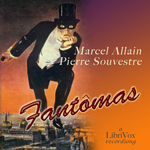
Fantômas by Marcel Allain and Pierre Souvestre

Source: LibriVox (zipped mp3s or M4B)
Length: 10 hrs, 11 min
Reader: Alan Winterrowd

The book: Literature is full of great detectives; less so with great criminals. The criminal masterminds that take center stage in novels are often either effeminate plotters or crooks-with-a-heart-of-gold types. Fantômas is the rare criminal genius with the brawn and cold-heartedness to carry out gruesome murders, yet the charm to seduce a princess as he robs her. Close on his heels is the detective Juve of the Paris police, a master of disguise with the intelligence to almost, but not quite, catch up with Fantômas.

In France, Fantômas stars in over 40 books by Allain and Souvestre; the authors’ system of working together on the plot, then dividing the writing of the chapters led to this astounding productivity. Fantômas’s criminal exploits and his pursuit by Juve make for an entertaining read, but the characters do not have the brilliance of Sherlock Holmes nor the humor of Arsene Lupin.  Although the characters are not so deep, the plot twists so much that even when I thought I knew the identity of Fantômas, there were still several more surprises. Fantômas belongs in the middle ground between the pulps and the great classics of the crime genre.

Rating: 7 / 10

Reader: Allan Winterrowd has a strong American baritone that does not distract from the story. He varies his tone slightly for the various characters, without going so far as to perform voices. As far as I could tell, he pronounces the French place-names correctly, though I’m no expert in French. Winterrowd speaks in a steady pace that allows the listener to keep up. The recording itself is well-done and clear.

posted by Seth

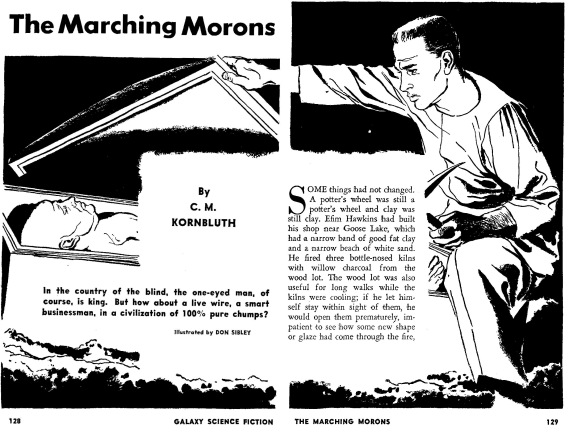
The SFFaudio Podcast #112 – AUDIOBOOK: The Marching Morons by C.M. Kornbluth

Podcast

The SFFaudio PodcastThe SFFaudio Podcast #112 – a complete and unabridged reading of The Marching Morons by C.M. Kornbluth. It is wonderfully narrated for us by William Coon of Eloquent Voice.

The Marching Morons is a Science Fiction novella written by Cyril M. Kornbluth, originally published in Galaxy Science Fiction’s April 1951 issue. It has been famously anthologized in The Science Fiction Hall of Fame, Volume Two (B).

The story is set hundreds of years in the future: the date is 7-B-936. Its protagonist is John Barlow, a man from the past put into suspended animation by a freak accident involving a dental drill and anesthesia. He is revived in a dystopic future where the dysgenic breeding of humans has, in combination with intelligent people not having many children, overwhelmingly populated the world with morons. An elite few non-idiots must work slavishly to keep the world productive. Barlow, who was a shrewd con man in his day, has a solution to sell to the elite.

In his introduction to The Best Of C.M. Kornbluth Frederik Pohl explains some of the inspiration to The Marching Morons. Apparently the work was written after Pohl suggested that Kornbluth write a follow-up story to The Little Black Bag (a classic Kornbluth short story). In contrast to the “little black bag” arriving in the past from the future, Kornbluth wanted to write about a man arriving in the future from the past. To explain sending a man to the future, Kornbluth borrowed from David Butler’s Just Imagine (1930) science fiction film in which a man is struck by lightning, trapped in suspended animation, and reanimated in the future.”

The Marching Morons by C.M. Kornbluth - illustrated by Don Sibley

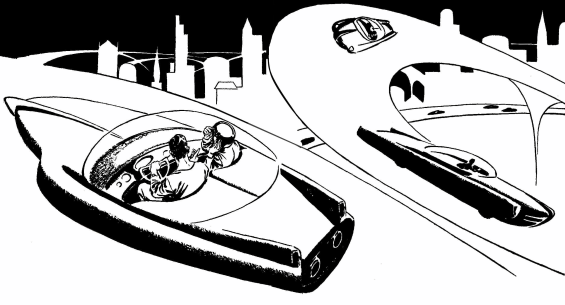
The Marching Morons by C.M. Kornbluth - illustrated by Don Sibley

Posted by Jesse Willis

New Releases: Solaris by Stanislaw Lem

New Releases

Audible FrontiersSteve Feldberg, a past guest on the SFFaudio Podcast (#40), writes in to tell us about a new Audible Frontiers audiobook:
Hi Jesse –

I wanted to draw your attention to our all-new, unabridged recording of Stanislaw Lem’s Solaris. Not only is this the first time in audio for this classic – and not only is it narrated wonderfully by Alessandro Juliani of Battlestar Galactica – and not only is 2011 the 50th anniversary of the book’s publication – but this is a brand-new translation – and the first time the book has been translated directly from Polish to English. (The existing book is a translation from Polish to French and then to English; Lem always disavowed it as being incomplete.) Audible, in cooperation with the Lem Estate, commissioned this new translation by Bill Johnston of the Univ. of Indiana.

This is an audio exclusive; there are no current plans to publish this translation in any other form.

We’re really excited about this project. I hope you’ll give it a listen!

Thanks Steve!

And yeah, Solaris looks like it will make a really terrific listen. Early reviews are positively glowing. Check out including this compelling quote from Jason (in Kansas City, MO):

“Wow! Wow! and Wow! Brainy stuff for thinking people.”

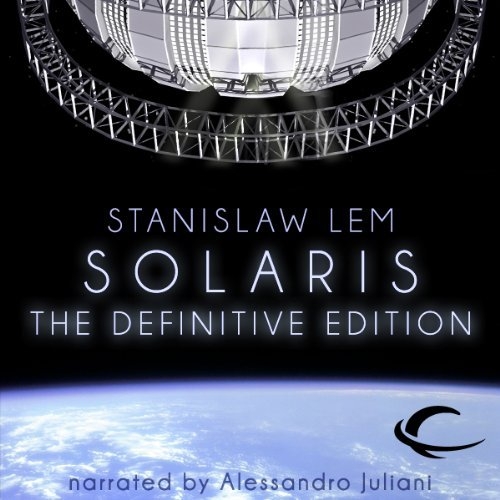
AUDIBLE FRONTIERS - Solaris by Stanislaw LemSolaris: The Definitive Edition
By Stanisław Lem; Translated by Bill Johnston; Read by by Alessandro Juliani
Audible Download – Approx. 7 Hours 48 Minutes [UNABRIDGED]
Publisher: Audible Frontiers
Published: June 7, 2011
At last, one of the world’s greatest works of science fiction is available – just as author Stanislaw Lem intended it. To mark the 50th anniversary of the publication of Solaris, Audible, in cooperation with the Lem Estate, has commissioned a brand-new translation – complete for the first time, and the first ever directly from the original Polish to English. Beautifully narrated by Alessandro Juliani (Battlestar Galactica), Lem’s provocative novel comes alive for a new generation. In Solaris, Kris Kelvin arrives on an orbiting research station to study the remarkable ocean that covers the planet’s surface. But his fellow scientists appear to be losing their grip on reality, plagued by physical manifestations of their repressed memories. When Kelvin’s long-dead wife suddenly reappears, he is forced to confront the pain of his past – while living a future that never was. Can Kelvin unlock the mystery of Solaris? Does he even want to?

Posted by Jesse Willis

iambik audio: 50% off all audiobooks

SFFaudio News

Iambik AudiobooksHey this is a great deal! Use this promotional code at the checkout point to get a 50% discount off of iambik audio‘s already incredibly great prices:

#jiam2011

And, be sure to include the pound sign.

Here are a few of purchase suggestions:

The Man Who Folded Himself by David Gerrold

Fade to Blonde by Max Phillips
Alcestis by Katharine Beutner

Posted by Jesse Willis

Tantor Media: FREE AUDIOBOOK: The Memoirs Of Sherlock Holmes by Sir Arthur Conan Doyle

Aural Noir: Online Audio

Tantor MediaTantor Media is releasing another new limited time FREE MP3 audiobook download. Despite what it looks like on the cover (apparently Sherlock Holmes had a Macbook Air) The Memoirs Of Sherlock Holmes is an all original, un-remixed, collection of Sherlock Holmes stories, first collected in 1894.

You will need to have an account with Tantor Media, and to login to it. Start by clicking HERE. Accounts are free and do not require a credit card. The free audiobook should be available through the end of June 2011. I know some folks have had difficulty figuring out how to either “log in” or “create an account.” You must have an account and be logged in to get to the download. It is a two step process as illustrated below.

Step 1: Create An Account And Log In

First Create An Account Or Log In

Step 2: After Signing In, You Get Your Download Link

After Signing In Get Your Download Link

As usual there was a bit of trouble the first couple of times I downloaded the zipped file, but it now works and downloads. You will, of course, also need to unzip the MP3s once the download completes.

TANTOR MEDIA - The Memoirs Of Sherlock Holmes by Sir Arthur Conan DoyleThe Memoirs Of Sherlock Holmes
By Sir Arthur Conan Doyle; Read by Simon Prebble
11 Zipped MP3 Files – Approx. 8 Hours 30 Minutes [UNABRIDGED]
Publisher: Tantor Media
Published: March 2010
Sample: |MP3|
|ETEXT|
The Memoirs Of Sherlock Holmes are overshadowed by the event with which they close—the meeting of the great detective and Moriarty, the Napoleon of Crime. When The Final Problem was first published, the struggle between Holmes and his arch nemesis, seemingly to the death, left many readers desolate at the loss of Holmes, but it also led to his immortality as a literary figure. The stories that precede it included two narratives from Holmes himself—on a mutiny at sea and a treasure hunt in a Sussex country house—as well as a meeting with his brilliant brother Mycroft.

Stories included: Silver Blaze, The Yellow Face, The Stock-Broker’s Clerk, The ‘Gloria Scott’, The Musgrave Ritual, The Reigate Puzzle, The Crooked Man, The Resident Patient, The Greek Interpreter, The Naval Treaty, and The Final Problem.

I should also point out that like most publications of this collection in the USA, over that last 117 years, this collection omits The Adventure Of The Cardboard Box for what Wikipedia indicates are reasons of morality.

If you’re not quite so squeamish The Adventure Of The Cardboard Box is available through LibriVox as two MP3 Files (Part 1 |MP3| Part 2 |MP3|). |ETEXT|

Posted by Jesse Willis