Aural Noir review of Downtown by Ed McBain

Aural Noir: Review

Here’s the first review by a long time internet ally, fellow proponent of all things Donald E. Westlake, and soon a guest on The SFFaudio Podcast.

BOOKS ON TAPE - Downtown by Ed McBainSFFaudio EssentialDowntown
By Ed McBain; Read by Michael Prichard
8 Cassettes – Approx. 8 Hours [UNABRIDGED]
Publisher: Books On Tape
Published: 1992
ISBN: 0736621423
Themes: / Crime / New York / Humor / Murder / Mistaken Identity /

Michael Barnes is in New York on business. He has a couple of hours to kill before his plane leaves. It’s Christmas Eve. When he stops for a drink, he finds a young woman very attracted to him. He swells with masculine pride. But soon Michael’s wallet and then his rented car are stolen – only to resurface on the other side of town in unexpected company – a corpse!

There’s nothing quite like picking up a book (metaphorically) you’ve never heard of and know nothing about and discovering that you’ve stumbled across a classic. This was my experience with Ed McBain’s Downtown.

A classic? Strong words, there, Trent. But I mean it. I just recently read Donald Westlake’s The Hot Rock, which I loved and which is considered the classic comic crime novel. Downtown is nearly if not just as good (although very different).

Our protagonist is Michael Barnes, an orange-grower from Florida who is about to fly out of New York City on Christmas Eve, after a meeting with his advertising agency, when he gets hustled by a gorgeous woman and her fake police detective accomplice in an airport bar. His drivers license, credit cards, and money now gone, he goes downtown to report the crime to the police, getting his rental car stolen along the way. From there, he ends up on the lam accused of murder, running hither and thither meeting all sorts of strange people and ending up in all sorts of strange situations as he tries to figure out just what the hell is going on.

Tempering this craziness is the fact that Michael Barnes has some serious emotional baggage–he’s a cuckold and bitter about it, has issues with his mother, and was scarred by his combat experience in Vietnam (although he’s not an offensive psycho stereotype, thank God). These emotional scars are played upon masterfully by McBain, for dark humor or for grounding moments of pathos as appropriate, and they give Downtown a humanity that makes the whole farce unexpectedly powerful.

I don’t know why Downtown isn’t better known. Maybe Ed McBain just pumped out so many books that lots of his stuff falls through the cracks while readers get stuck trying to read the 87th Precinct and Matthew Hope novels in order. Maybe it’s because nobody made a movie out of it (although see below). Maybe, and this is a strong possibility, the style of humor doesn’t appeal to a broad enough audience.

Whatever the reason, Downtown deserves much better than obscurity. It’s clever, witty, touching, and terrific.

That’s the book review portion of this write-up, but I don’t want to end without bringing up something that struck me while listening to Downtown.

With a movie director figuring prominently in the plot, Downtown is loaded with film references (including to Evan Hunter/Ed McBain films The Birds and Fuzz). A movie not mentioned is one that Downtown bears a great resemblance to–Martin Scorsese’s After Hours.

If you’re not familiar with this film (too few people are), After Hours is a comedy about a fairly-average Joe who meets all sorts of strange people and ends up in all sorts of strange situations in late-night Manhattan. Oh, and he also gets accused of a crime he didn’t commit.

The setting and several story elements in After Hours are very similar to Downtown. The style of humor (dry with repetitive absurdity) also bears a marked resemblance. Both even feature prominent references to The Wizard Of Oz.

Coincidence? Homage? Rip-off (I doubt that)? Subconscious borrowing? We’ll likely never know. But if you liked After Hours, you’ll probably like Downtown, and vice versa. And if you’re not familiar with either, do yourself a favor and check them both out.

I listened to the 1992 edition of Downtown from Books on Tape, read by Michael Prichard. When I started the book, I thought his reading was stiff, but I quickly recognized that he had done a great job capturing the somewhat-uptight, neurotic lead character. Mr. Prichard is also quite skilled in creating voices to distinguish the many other characters without resorting to ridiculous exaggerations or outrageous accents (in a book with a lot of ethnic characters, no less). Downtown is written in a highly rhythmic style, with lots of short sentences and lots of repetition. Prichard grasps this and captures the novel’s rhythms superbly. It’s a really good reading.

There are two other editions of Downtown (both available at Audible.com), an abridged version from Phoenix Books read by Stephen Macht and an unabridged version from Brilliance Audio read by David Regal. For the sake of comparison, I listened to the available samples of both.

Downtown is a lousy candidate for abridgment, but even if it wasn’t I wouldn’t care for Stephen Macht’s reading, which is overdramatic.

David Regal’s reading is considerably better. His interpretation is quite different from Michael Prichard’s, making Michael Barnes sound like a traveling salesman. I would have to hear more to have a real sense of how well this works but I heard enough that I think I can judge it a solid effort. Go with the Books on Tape edition if you can find it, but if you can’t, Regal’s version will likely do as a substitute.

Posted by Trent Reynolds

Markheim by Robert Louis Stevenson

SFFaudio Online Audio

William Coon, who appeared on SFFaudio Podcast #063, has a terrific sounding UNABRIDGED recording of Markheim by Robert Louis Stevenson over on LibriVox. Here’s what one of the proofers said about Bill’s narration:

“[Markheim] is GREAT! You’ve got just the right balance of shrewdness and madness and you really bring it off well. I listened to it over and over, catching new things every time. Thanks for several wonderful days of listening!”

Myself I’ve also been enjoying this narration as well as an abridged reading I found over on RadioArchive.cc (Markheim was also recorded for the first episode of a four part BBC Radio 7 Drama series entitled Short History of Gothic).

In a strange way Markheim is a kind of hardboiled/noir version of Charles Dickens’ A Christmas Carol. Like Scrooge, Markheim is a sinner who at Christmas, finds himself confronted by the consequences of his sin. But whereas 19th century miserliness is Scrooge’s big problem, Markheim’s issue is of a more alarming type. His petty crimes have slowly accelerated from his youth, until now, when he finds himself, in this tale, a bloody-handed murderer. But like A Christmas Carol, both characters (Scrooge and Markheim) find their hinge points only when confronted by a visit from the supernatural.

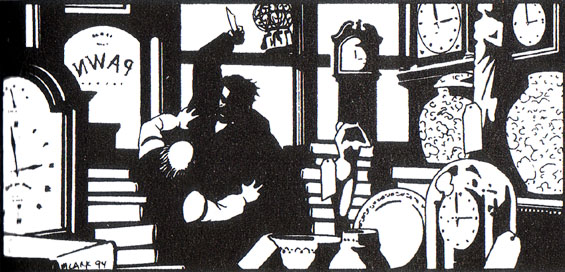
Markheim as illustrated by Michael Lark

Illustration by Michael Lark, found in The Essential Dr. Jekyll And Mr. Hyde – The Definitive Annotated Edition.

LibriVoxMarkheim
By Robert Louis Stevenson; Read by William Coon
1 |MP3| – Approx. 44 Minutes [UNABRIDGED]
Publisher: LibriVox.org
Published: 2006
|ETEXT|

BBC Radio 7 - BBC7A Short History Of Gothic – Markheim
By Robert Louis Stevenson; Read by Hugh Bonneville
1 Broadcast – Approx. 30 Minutes [ABRIDGED]
Broadcaster: BBC Radio 7
Broadcast: December 12, 2009
Provider: RadioArchive.cc
“Hugh Bonneville reads Robert Louis Stevenson’s macabre tale charting one man’s rapid fall from grace.”

The Weird CircleWeird Circle – Markheim
Based on the short story by Robert Louis Stevenson; Performed by a full cast
1 |MP3| – Approx. 25 Minutes [RADIO DRAMA]
Broadcaster: MBS, NBC, ABC
Broadcast: May 20, 1945
Provider: Archive.org
This is a radical adaptation, set in a contemporary (to 1945) setting, and providing much of the presumed back-story (stuff that isn’t actually in the text of Stevenson’s original tale).

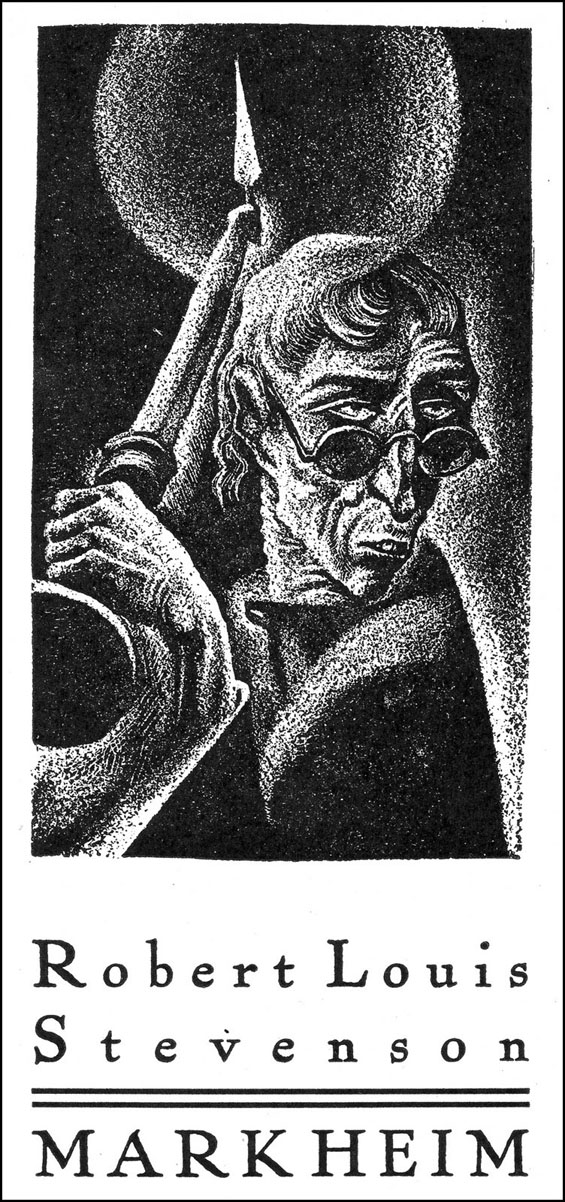
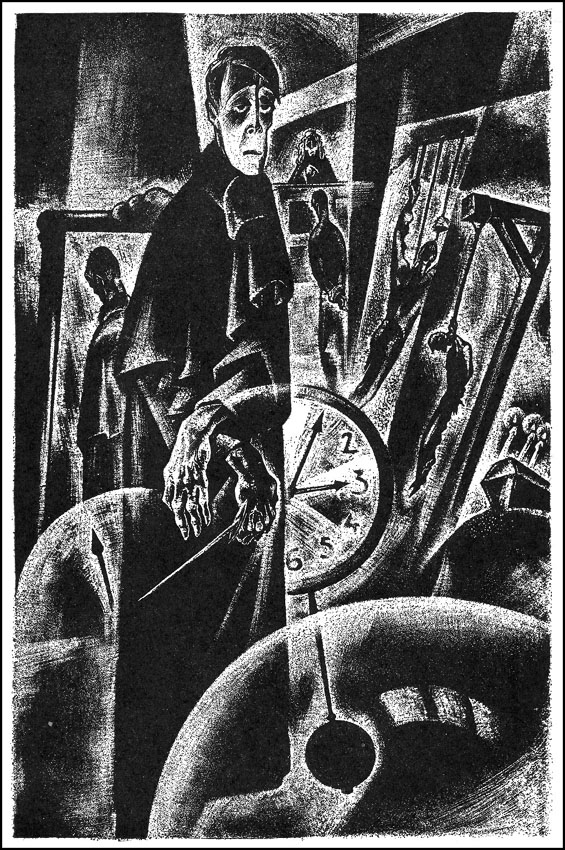
Here are a couple more Markheim illustrations [this time by Lynd Ward – found in The Haunted Omnibus (1937)]

Robert Louis Stevenson's Markheim as illustrated by Lynd Ward - from The Haunted Omnibus (1937)

Robert Louis Stevenson's Markheim as illustrated by Lynd Ward - from The Haunted Omnibus (1937)

[also via Golden Age Comic Book Stories]

Posted by Jesse Willis

LibriVox: Let’em Breathe Space by Lester del Rey

SFFaudio Online Audio

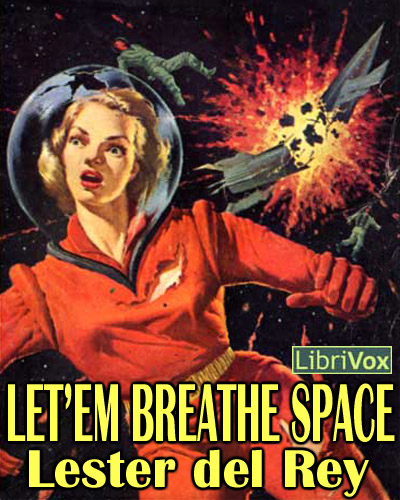
Who’s up for a little locked spaceship murder mystery? It’s a 1953 novella by Lester del Rey…

LIBRIVOX - Let'em Breathe Space by Lester del ReyLet’em Breathe Space
By Lester del Rey; Read by Gregg Margarite
2 Zipped MP3 Files or Podcast – Approx. 1 Hour 47 Minutes [UNABRIDGED]
Publisher: LibriVox.org
Published: October 7, 2010
The old space freighter Wahoo is all Dr. Pietro can afford for his expedition to the rings of Saturn. Although built for a crew of 6 the good doctor crams 19 people into the Wahoo, and after 5 months they are really getting on each other’s nerves. Then someone starts killing people and poisoning the air giving plants in the hydroponics bay. Can our hero Paul Tremaine find the killer before he suffocates? Perhaps you should hold your breath. First published in the July 1953 edition of Space Science Fiction magazine.

Podcast feed: http://librivox.org/rss/4745

iTunes 1-Click |SUBSCRIBE|

[Thanks also to Betty M.]

Posted by Jesse Willis

Review of The Loving Dead by Amelia Beamer

SFFaudio Review

BRILLIANCE AUDIO - The Loving Dead by Amelia BeamerThe Loving Dead
By Amelia Beamer; Read by Emily Durante
7 CDs or 1 MP3-CD – Approx. 8 Hours [UNABRIDGED]
Publisher: Brilliance Audio
Published: July 2010
ISBN: 9781441868343 (cd), 9781441868367 (mp3-cd)
Themes: / Horror / Zombies / Sex / Airships / Humor / San Fransisco / California /

Kate and Michael, twenty-something housemates working at the same Trader Joe’s supermarket, are thoroughly screwed when people start turning into zombies at their house party in the Oakland hills. The zombie plague is a sexually transmitted disease, turning its victims into shambling, horny, voracious killers. Thrust into extremes by the unfolding tragedy, Kate and Michael are forced to confront the decisions they’ve made, and their fears of commitment, while trying to stay alive. Michael convinces Kate to meet him in the one place in the Bay Area that’s likely to be safe and secure from the zombie hordes: Alcatraz. But can they stay human long enough?

Beamer creates scenes, and cuts adequately between them, but when confronted by the surrealistic circumstances she provides (like being trapped in a Zeppelin bathroom with two lesbian zombies) her characters seem more like emotional marionettes, than like real people. It’s almost as if Beamer was actually role-playing a series of improvised scenarios, rather than plotting it out like a novel. When one of the characters discovers that these zombies respond to the crack of a whip, for example, Kate downloads an “Indiana Jones App” to her iPhone and subdues them with it. Clever? Sure. Novelistic? Notsomuch. Thus the tension of a zombie confrontation – will she or won’t she be able to get 3G service high above Oakland – isn’t very satisfying.

Shortly after this audiobook arrived I listened to it’s author, Amelia Beamer, being interviewed on the SFSignal Podcast #006. She talked about how she found the relentlessness of zombies almost endearing. It was a neat idea. And then she said she intended it to be a romantic comedy with zombies. And that was enough to put it in my bathroom audiobook stack. So, for the last week or so I’ve been brushing and flossing my teeth to this novel. I didn’t go in expecting much other than zombies and loving and a few laughs. It has the first two. The loving is actually sex and the zombies are less dead and rotting than they are contagious and sex crazed. If you did a count you’d probably find as many individuated zombies as there are sex scenes. Come to think of it there were probably about just as many tattoos as there were sex scenes and zombies. Where this novel really doesn’t fulfill it’s promise is in the humor department. I didn’t laugh, or smile, or even smirk. Thinking about it, it wasn’t that there were jokes and they weren’t funny, but rather I that the humor was supposed to come from the absurd situational specifics and the slacker/poser cast’s bumbling their way through it all. It has relationships, and people thinking about their relationships, and it has some zombies but I didn’t find it funny.

Getting into specifics now – there’s something odd going on with the meta-Americanness, or rather some subset of it, within the novel’s characters and setting. Even though both Kate and Michael both pretty quickly recognize the infected as zombies, Beamer’s characters seem highly reticent to kill them. Instead they far prefer restraining their wrists, sitting on them – any form of bondage – as in, tie them up or tie them down. Yeah … well … okay. So, I have to think that, in combination with the whips, and the sex and all the tattoos, that taken as a whole this is not so much a zombie novel as a kind of contemporary fiction novel, set in a slacker BDSM San Fransisco subculture, with some zombie additions. Maybe that’s what I signed up for, but I was wrong to do so.

At first I liked some of the references to local stores and products. This is something that is done far too little in most fiction, as far as I’m concerned. It’s one of the things I like most about William Gibson’s prose, he has a reverence to specifics. But as it all went on in The Loving Dead, and as the characters repeatedly reminded each other that they’d read Max Brooks (World War Z |READ OUR REVIEW|), worked at Trader Joe’s or Whole Foods, it seemed like it wasn’t so much fun – instead it became increasingly clear that it was what was on their minds all the time. It seemed like the real zombies in this audiobook were the characters, living their quiet lives of desperate consumption, performing a narrative for themselves and expressing it in text messages. If I believed in a soul I’d call it a soul-numbing audiobook.

On the final disc we get a flash cut to ten years after the zombie apocalypse first hits. It’s an interesting experiment, to take a doomsday scenario way down the road and see what life is like in the aftermath. One of the redeeming features, of David Moody’s otherwise lackluster Hater |READ OUR REVIEW|, is also in The Loving Dead too. The author takes one significant aspect of a premise to it’s logical and (hopefully inevitable) conclusion. As such, it has some novelty value if only for that. For some true vanilla zombie goodness I’ll get back to reading Robert Kirkman’s The Walking Dead.

Narrator Emily Durante, a new voice to my ears, is a good reader, I can see that, even despite my not loving The Loving Dead, she provided a steady voice to a patchy and punctuated narrative.

Posted by Jesse Willis

LibriVox: White Fang by Jack London

SFFaudio Online Audio

LibriVoxI’m not much for re-reading books. I will do it, but I usually prefer a new book to even a fondly remembered one. But I do make exceptions, now and again. One book, which I re-read on what is fast becoming a seasonal basis is Jack London’s The Call Of The Wild. I can’t say I get more and more out of it every time I read it, but I do find that it’s many charms are highly resilient to repeated reading, that its lessons are true, in a way only fiction can deliver, and that it makes for a terrific source of entertainment when read aloud. Go on, read this passage aloud:

Buck staggered over against the sled, exhausted, sobbing for breath, helpless. This was Spitz’s opportunity. He sprang upon Buck, and twice his teeth sank into his unresisting foe and ripped and tore the flesh to the bone. Then François’s lash descended, and Buck had the satisfaction of watching Spitz receive the worst whipping as yet administered to any of the teams.

“One devil, dat Spitz,” remarked Perrault. “Some dam day heem keel dat Buck.”

“Dat Buck two devils,” was François’s rejoinder. “All de tam I watch dat Buck I know for sure. Lissen: some dam fine day heem get mad lak hell an’ den heem chew dat Spitz all up an’ spit heem out on de snow. Sure. I know.”

From then on it was war between them.

Another part of my love for The Call Of The Wild probably comes from my personal connection to the landscape and the romanticism of it all – and frankly that’s completely crazy! I’ve never mushed a dogsled, never faced a starving pack of rabid huskies and have never even been to the Yukon Territory! But, in my defense, I’ve known dog-sledders, lived in a remote northern British Columbia community, and made personal contact with hungry black-bears (on more than one occasion). Heck, I even had partial ownership of two Siberian Huskies for a while. Jack London is a smashing writer and I’m still rather embarrassed to admit there’s one book of his that I’m pretty sure I haven’t read (at least since I was a kid). And that’s this one, White Fang, the spiritual sequel, the opposite number, the bloody companion book to my beloved The Call Of The Wild!

So, now I have a question. Who will take up this adventure with me, listening or reading, for perhaps the first time, to Jack London’s immortal novel White Fang? Leave a comment, let me know if you’d like to participate in an upcoming SFFaudio Podcast Readalong for White Fang.

LIBRIVOX - White Fang by Jack LondonWhite Fang
By Jack London; Read by Mark F. Smith
25 Zipped MP3 Files or Podcast – Approx. 7 Hours 44 Minutes [UNABRIDGED]
Publisher: LibriVox.org
Published: October 03, 2010
When White Fang is birthed in a cave to a wolf sire and a wolf/dog halfbreed dam, he is heir to two traditions. At first he is content to explore and learn laws of the Wild. But then his mother is caught and held by old memories of a past relationship with Man, and White Fang follows her into service with the Indians. Life among sled dogs is hardly less cruel and dangerous than living in the Wild, but brutality notches upward when his drunken master sells him to a nasty, twisted hanger-on at a riverside town of white men. He is stripped of everything soft and gentle when forced to fight to the death for a crowd of bettors. Taming this savage spirit and reclaiming the nobility within looks impossible. Fortunately, and heart-warmingly, a man arrives in White Fang’s life to try. “White Fang” is often called the mirror image of Jack London’s acclaimed “The Call of the Wild” in which a dog follows the reverse arc from tame to free.

Podcast feed: http://librivox.org/rss/4677

iTunes 1-Click |SUBSCRIBE|

[Thanks also to James Christopher and J.M. Smallheer ]

Posted by Jesse Willis

Naxos Audiobooks: Dagon by H.P. Lovecraft

SFFaudio Online Audio

Free, for a limited time, from the new Naxos Audiobook entitled The Call of Cthulhu and Other Stories comes this unabridged reading of Dagon by H.P. Lovecraft! It’s read by the talented William Roberts. Cha-ching!

NAXOS AUDIOBOOKS - The Call Of Cthulhu And Other Stories by H.P. LovecraftDagon
By H.P. Lovecraft; Read by William Roberts
1 |MP3| – Approx. 17 Minutes [UNABRIDGED]
Publisher: Naxos Audiobooks
Published: October 2010
The testament of a tortured, morphine-addicted man who plans to commit suicide over an incident that occurred early on in World War I when he was a merchant marine officer. First published in 1919.

And check out the also excellent Audio Realms version HERE.

Posted by Jesse Willis