Review of Thinner by Stephen King

SFFaudio Review

Thinner by Stephen KingThinner
By Stephen King; Read by Joe Mantegna
9 CDs – 10 Hours [UNABRIDGED]
Publisher: Penguin Audio
Published: 2009 (reissue from 1984)
ISBN: 9780143143901
Themes: / Fantasy / Horror / Gypsies / Curses / Magic /

I put off reading Stephen King’s Thinner for the better part of two decades. The dust jacket description—lawyer runs down gypsy and is cursed to become, well, thinner—seemed like a decent short story stretched out into a novel. The premise just didn’t grab me.

As it turns out, my fears proved ill-founded. Thinner is an entertaining little novel that is, at its heart, about big concepts, including guilt, the dangers of not accepting responsibility for one’s actions, and the ruinous, generation-spanning cycle of destruction wrought by revenge. Thinner is positively short by King standards (about 300 pages), moves quickly, and contains a couple nasty little shocks that keep you on your toes and leave you feeling unsettled.

I’ve stated before that Stephen King was, in his early career, batting very nearly 1.000 as a writer. If you take a look at his work from 1973’s Carrie through 1987’s Misery and The Eyes of the Dragon, King was consistently great. I submit that The Tommyknockers (1988), written at the height of his drug and alcohol problems, was the first true misstep in King’s career. Now that I’ve finally read Thinner (released in 1984), I find that my rule holds true. It’s a fine book from King’s classic period.

Thinner tells the story of Billy Halleck, an overweight lawyer who gets distracted while driving home (his wife is giving him a handjob) and accidentally runs down an old gypsy woman crossing the street. Halleck avoids what should have a manslaughter conviction because the judge is an old golfing buddy and lets him off the hook. But Halleck can’t escape the scales of justice. The ancient father of Halleck’s victim curses Halleck by laying a scaly finger upon him and uttering the single word, “thinner.”

In the coming weeks, Halleck’s weight begins to drop alarmingly. When the doctors rule out cancer, Halleck realizes that the gypsy’s curse has taken root. The rest of the novel features Halleck chasing down the gypsies to get the curse lifted as his weight plunges from a high of 252 pounds to half that.

King has the problem of trying to convince the reader that a steadily weakening lawyer from a wealthy Connecticut suburb is capable of exerting enough pressure on a stubborn gypsy clan to lift the curse. He neatly sidesteps this problem by introducing the character of Richie “The Hammer” Ginelli, a minor mafia boss and a former client of Halleck’s. Ginelli assists Halleck by lending his unique and persuasive “services” learned in the hard-knock school of organized crime.

There’s a lot to recommend in Thinner. Taduz Lemke, the old gypsy with the power to curse, is a wonderful character, an ancient soul (over 100 years old) from the old world, the last of the Magyar chiefs. Although he’s initially unlikeable, King renders Lemke and the rest of his gypsy clan sympathetic. Though they are dirty and uneducated, and routinely skirt (and cross) the boundaries of the law, the gypsies are treated with open hostility from the hypocritical communities that they visit. Men like Halleck view the gypsies as an unwelcome disease in their safe and pure suburban communities, which are actually corrupt at the core with their unequal systems of justice, “old boy” networks, and inherent prejudices. When Halleck claims that Lemke’s daughter is equally at fault for the accident, since she didn’t look before crossing the street, he shows his unwillingness to accept responsibility for his own actions. Worse, Halleck took advantage of an unfair system of justice and never had to pay for his (and his wife’s) carelessness. Lemke’s curse is a painful lesson in admitting one’s guilt: “There is no push, white man from town,” Lemke says, again and again throughout the story. “No push.”

If you’re a Generation X-er you’ll appreciate the 1980’s time machine that is Thinner. In it you’ll find references to Apples and TRS-80s, Thunderbirds and Novas. Halleck’s family physician casually blows cocaine during a checkup and it doesn’t seem out of place here, given the period. Halleck’s daughter is mentioned as playing a year long game of Dungeons and Dragons.

Thinner contains very little horror until the end and is more accurately classified as a thriller, which may be why King adopted his (unsuccessful) pseudonym Richard Bachman during the book’s initial release. In Thinner, King was attempting something a bit outside his reputation as a horror author.

Veteran actor Joe Mantegna provides the narration for Thinner and he is magnificent, particularly in his portrayal of Ginelli (no surprise here, given that Mantegna has appeared in various gangster films). I’ve previously railed against the inclusion of music in audio books, but this version by Penguin makes excellent use of it, in particular its use of a chilling, off-putting theme whenever the gypsies—or Halleck’s alarmingly plunging weight—are mentioned.

Posted by Brian Murphy

Commentary: Where are all the Charles Stross audiobooks?

SFFaudio Commentary

Charles StrossHere’s a question nobody’s been asking (but should have). Where are all the Charles Stross audiobooks?

Seriously, the guy is super talented. There have only been three commercially released Charlie Stross audiobooks (all from Infinivox). The were terrific, but they’re not enough.

If Saturn’s Children and Halting State were available as audiobooks they’d shoot up to the top of my listening stack.

Forget individual testimony for a minute, let’s just look at the awards…

Stross’ novella The Concrete Jungle won the Hugo award for its category in 2005. Accelerando won the 2006 Locus Award for best science fiction novel.Glasshouse won the 2007 Prometheus Award. The novella Missile Gap won the 2007 Locus Award for best novella. His novels Singularity Sky and Iron Sunrise garnered back to back Hugo Award nominations in 2004 and 2005. Am I missing something here? Is Stross not due for some more professionally made audiobooks?

In anticipation of a big flood of Strossian goodness over the next couple of years I’ve just now made a CHARLES STROSS author’s page, where I’ll put up details of all the Strossian audio we know about.

Posted by Jesse Willis

LibirVox: This Crowded Earth by Robert Bloch

SFFaudio Online Audio

LibriVoxLibriVox is really picking up the pace of audiobook production. Happily, more and more of these free public domain audiobooks being released have a single narrator. This latest audioboo is a title listed in our 3rd Annual SFFaudio Challenge, it’s a cool short novel by the legendary Robert Bloch – that makes it’s narrator, Gregg Margarite, eligible for a prize! Wanna prize Gregg?

Incidentally, I’ve now put up a ROBERT BLOCH author’s page, where you can find more Bloch on audio, and I’ve added a 1-click subscribe version to our LibriVox + SFFaudio = Instant iTunes Audiobook page too.

LibriVox Science Fiction - This Crowded Earth by Robert BlochThis Crowded Earth
By Robert Bloch; Read by Gregg Margarite
12 Zipped MP3 Files or Podcast – Approx. 3 Hours 35 Minutes [UNABRIDGED]
Publisher: LibriVox.org
Published: March 05, 2009
Robert Bloch (1917 – 1994) was a prolific writer in many genres. As a young man he was encouraged by his mentor H. P. Lovecraft, and was a close friend of Stanley G. Weinbaum. He also wrote many screenplays including Hitchcock’s Psycho, and scripts for the original Star Trek. He received the Hugo Award, the World Fantasy Award, the Bram Stoker Award, and he is a past president of the Mystery Writers of America. Published in Amazing Stories in 1958, This Crowded Earth is a thriller set on an overpopulated Earth of the future.

Podcast feed:

http://librivox.org/bookfeeds/this-crowded-earth-by-robert-bloch.xml

Posted by Jesse Willis

Review of Starman Jones by Robert A. Heinlein

SFFaudio Review

Blackstone Audio - Starman Jones by Robert A. HeinleinStarman Jones
By Robert A. Heinlein; Read by Paul Michael Garcia
7 CDs – 8.5 Hours [UNABRIDGED]
Publisher: Blackstone Audio
Published: 2008
ISBN: 9781433230387
Themes: / Science Fiction / Space Travel / Aliens / Dystopia /

It was a desperate time, when one’s next meal and the comforts of home couldn’t be taken for granted. Max Jones, a practical, hard-working young man, found his escape in his beloved astronomy books. When reality comes crashing in and his troubled home life forces him out on the road, Max finds himself adrift in a downtrodden land. Until an unexpected, ultimate adventure carries him away as a stowaway aboard an intergalactic spaceship—but to where? And when? And how could he ever get back? With the ship’s pilot dead and his charts and tables all destroyed, Max must call upon all of his untested knowledge and skills in order to survive.

There’s nothing like going back to that old-time Science Fiction. Heinlein’s novels are steeped in the inspissate brew of American idealism. Puritanical hard work, honesty and humility are mixed with the libertarian and the liberal, the conservative and the anarchistic. These aren’t just the bywords of Heinleinian characters, they’re the fundamentals of their character – all that, and tempered too with happy portions of both skepticism and hucksterism. A Heinlein character is just as likely to be a gruff middle aged con-man (honest in his own fashion) as a naive wundderkind. The naive wundderkind is often found with a variously doting, tolerant, and even brighter sweetheart. We find all three, the canny conman, the boy genius and his devoted young woman, along with a whole lot more in Starman Jones.

There are three main sections of Starman Jones. Most of the folks who talk about the novel talk about the middle section – where Max works his way up the chain of command in a luxury spaceliner. Indeed, this is what gives the novel its title. The third section, set on board a primitive alien planet has some nicely interesting aliens (a whole novel could have been done there). Personally I liked the first third, set on a vaguely dystopic planet Earth. This is a land of no-opportunity, in order to get a decent job you have to inherit it. Vested interests, taking the form of professional guilds, seem to have staked out every possible avenue for advancement. Sure, there are people there willing to bend the rules to kind-hearted kids like Jones, but the general rule is a complacency towards pervasive corruption. At one point during this first third a kindly truck driver, hopped up on amphetamines, gets Max to help him break the rules of the road (that you have to pull over and sleep once in a while). That scene and another, gives an odd kind of atmosphere of low-level-corruption that Heinlein seems fairly comfortable with. Later still, with the only ticket off the sewed-up planet Earth is via false documents and bribery – Max goes for it, to the detriment of his conscience only after the fact.

In other juvenile novels, like Citizen Of The Galaxy, a Heinleinian protagonist will stay “dirtside” where he’ll grift and finagle his way through life – justifying each action step by step – here and frankly in every single Heinlein story that I’ve ever read, the bad guys are never bad because of the greed or corruption per se, but rather because they are dumb, ignorant and vain.This is a Heinlein failing I think. His cardboard cut-out villians are too dim, too dull-humored and too officious to be any real threat. There are at least two of these lame-brains in this novel. That got me to thinking. If one were to rewrite a Heinlein novel from the strawman’s point of view – it’d be extremely obvious who Heinlein had meant the hero to be [namely Heinlein’s own ideas and values – however ambivalent they are]. But, don’t let this criticism let you think I don’t like Starman Jones because, warts and all, I really did enjoy it.

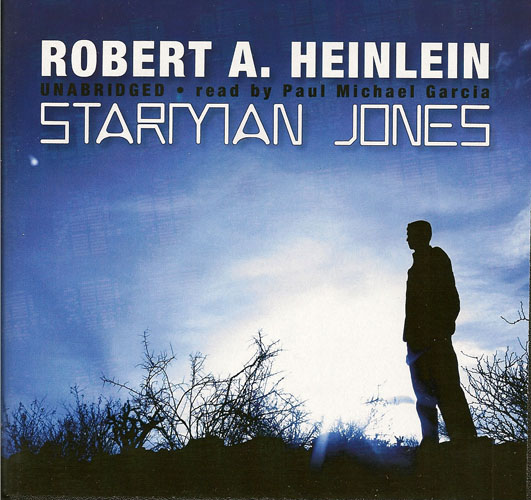
Paul Michael Garcia is ably suited to reading Heinlein’s well chosen words – giving the dialogue-heavy prose a banter-like give and take. Garcia’s range too is very impressive, voicing Max Jones as youthful and energetic, his older pal Sam as languid and confident, the girl, the mom, the step-dad, the alien spacepet, and everyone else – all in unique voice. It really is the ideal reading. I’ve been a fan of Garcia’s narration since Blackstone picked him for Kirinyaga. Despite a lot of technical jargon, especially while talking astrogation, I only heard one tiny mispronunciation in the whole novel. Concomitant meaning “occurring or existing concurrently.” Garcia read it as “konk-mittant.” The original art that Blackstone has given Starman Jones looks good, if a bit generic, but a closer inspection – past the silhouetted landscape and into the roiling clouds will admit a bit more detail in the night’s overcast sky.

Posted by Jesse Willis

Review of January Dancer by Michael Flynn

SFFaudio Review

The January Dancer by Michael FlynnThe January Dancer
By Michael Flynn; Read by Stefan Rudnicki
1 MP3-CD or 9 CDs – Approx. 10.5 Hours [UNABRIDGED]
Publisher: Blackstone Audio
Published: 2008
ISBN: 9781433250996 (MP3-CD), 9781433250972 (CD)
Themes: / Science Fiction / Space Opera / Aliens / Space Flight /

Captain Amos January, and crew, are forced to look for ship repair materials on an unknown planet. There they discover an alien ship filled with fascinating artifacts, among them a shape-changing sculpture that becomes known as “The Dancer.” We learn of some of The Dancer’s attributes as known in ancient legends and confirmation is received as we watch the story unfold. It is sought by cabals, pirates, governments, and other powers who unleash different characters to acquire The Dancer. Not unexpectedly these characters are scoundrels, idealists, and romantics whose tracks intersect and form their own sort of dance as they maneuver to best one another. This tale is told to us as a story within a story as a Harper hears the tale, a bit at a time, from the Scarred Man. This is an interesting device as not only are we told the story but Flynn uses the framing story to give us his ideas about storytelling as an art.

It is a trend these days, or so it seems to me, for modern science fiction authors to attempt to write “space opera.” As an aficionado of that subgenre who has recently been browsing among the past masters of the art (in large part thanks to Librivox), my view is that the modern take tends to be drawn-out, unfocused, and sprawling by comparison. Sadly, although I also am an aficionado of Michael Flynn’s work, I believe he has fallen prey to the desire to expand the story past the demands of the genre. The original writers wrote snappy, bold, romantic adventures that did not worry overmuch about expostulation and got to the point. Flynn, on the other hand, gives a bewildering combination of too much philosophical conversation and not enough details about the characters’ lives. There is a plethora of characters as well, almost too many to track, and this often leaves the listener bewildered as to just who has suddenly popped up unexpectedly in a scene. As well, in the last couple of chapters the tone shifts unexpectedly, as if Flynn suddenly was told he had to finish up, and thus the novel swung into abrupt action and snapped out a strangely sparse finale. The revelations were not illogical or even unsatisfying. However, after dragging on and on in the middle of the book it was quite disconcerting to suddenly be flung headlong into the finish in the style of “a shot rang out and everyone fell dead.”

Stefan Rudnicki narrates with his usual expertise, adroitly affecting slight voice changes that communicate character when voicing dialogue. One wishes that the editors had added a slight aural indicator when there were scene changes. In a book of many characters who are flung from one exotic location to another at a second’s notice, it is very difficult to tell when there is a scene change immediately with nothing other than a slight pause between sections. I must also note, that my above complains about Flynn’s book overall may have been due to the fact that a complex book is necessarily more difficult to grasp when listening rather than reading as it was written. In this instance, the editors would have done well to help the listener all they could.

If you are a Michael Flynn fan, this book will not be a complete waste. I did enjoy it initially, but I simply wished it had been truly the space opera that it purported to be.

Note: should readers think that there are no modern writers capable of space opera that is worthy of comparison with those of older times, I refer you to the “Agent of Change” series by Sharon Lee and Steve Miller (Agent of Change, Conflict of Honors, Carpe Diem, Plan B, and I Dare) and Space Vulture by Gary K. Wolf and John J. Myers. None of these are in audiobook format that I know of but are well worth seeking out.

Posted by Julie D.

The SFFaudio Podcast #027

Podcast

The SFFaudio PodcastThe SFFaudio Podcast #027 – Jesse and Scott are joined by Rick Jackson (The Time Traveler). Today we talk about new audiobooks, the ongoing CONAN situation, and libraries. Should libraries be renting Zunes to patrons?

Talked about on today’s show:
Ted Chiang, Eclipse 2, Blackstone Audio, The Green Hills Of Earth by Robert A. Heinlein, Apollo 8, Brotherhood Of The Wolf by David Farland, Bellewether by Connie Willis, Corsair by Clive Cussler, James Bond is fantasy?, Quantum Of Solace, Sahara, coming from Wonder AudioThe Fabulous Clipjoint by Frederic Brown, Tantor Media doing Robert E. Howard audiobooks, Conan Properties International versus Broken Sea Audio, New Zealand’s new copyright legislation, reductio ad absurdum, copyrights and trademarks, Clark Ashton Smith, downloading audiobooks through libraries, WMA format, Overdrive vs. NetLibrary, PC Gamer Podcast – ‘X-Box 360, Wii and Playstation 3 are giant DRM keys’, libraries rent DVDs?, ‘government shouldn’t be doing what business can do’.

Posted by Jesse Willis