Commentary: King Kong’s Special Features

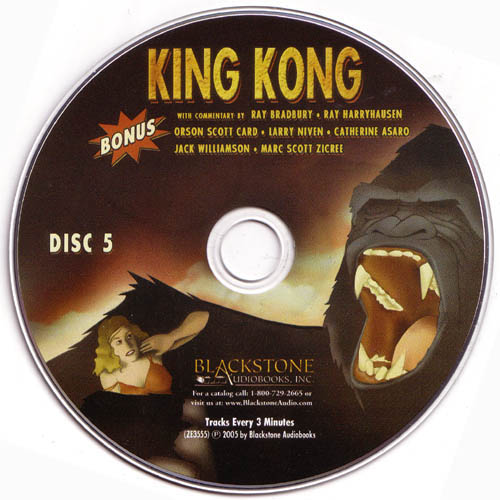
King Kong Special Features Disc 5Blackstone Audiobooks‘ release of King Kong, from way back in 2005 (read our review of it HERE) is something I’ve just now finally got my grubby mits on. I was especially excited to get a hold of it because of last disc in the 5 CD set – it contains the “special features” – and they are, quite possibly, the most special of features ever to have been added to an unabridged audiobook. The narrator/producer, Stefan Rudnicki, has tracked down some of the biggest names in Science Fiction and Fantasy Fiction and asked them to give their opinions of the original King Kong. The resultant disc is some of the most interesting and insightful film commentary I’ve ever heard. The creators of the Peter Jackson King Kong DVD were utter fools not to have hired Rudnicki to produce just this sort of material for the bonus features. Not only does “disc 5” give fond memories of an absolutely iconic fantasy film, it also dispenses deeply insightful criticism and sharp commentary from those who were influenced by the film. There are even some funny related real-life stories. Harlan Ellison, for example, talks about his overwhelming need to watch the original film whenever it airs on TV – as well as his hatred for remakes of ‘perfect movies’ in general. Stop-motion animation god Ray Harryhausen steps in to talk of how the original character of Kong became the tipping point for his amazing life’s work. And Orson Scott Card boldy dismisses the original film as irrelevant to his life and work. Indeed this is perhaps the finest collection of commentary on Kong ever collected – and that it could be recorded in the commentators’ own words, and in their own voices (except for Williamson) makes this a true treasure for the ages. Kudos to Blackstone Audiobooks, they could have just cashed in on the Kong-kraze but instead they kicked it up a notch, creating something worthy of its own page in the first printing of The Encycolpedia Galactica (publication date 2362).
Well played Blackstone, truly well played.

Jesse Willis

Review of City of Darkness by Ben Bova

SFFaudio Review

ed. – Here is a fine example of Harlan Ellison as narrator.

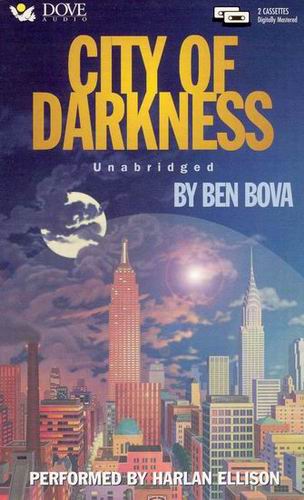
City of Darkness by Ben BovaCity of Darkness
By Ben Bova; Read by Harlan Ellison
2 Cassettes – 3 hours [UNABRIDGED]
Publisher: Dove Audio
Published: 1998
ISBN: 0787117269
Themes: / Science Fiction / City / Gangs / Environment /

This is a story about a teenager who feels New York City calling to him – “live here, live here, whatever it is, it’s here, and nowhere else”. No, this isn’t Fame. In fact, it’s much closer to John Carpenter’s Escape from New York, because Ben Bova’s Manhattan has been covered by a dome, and only opens for tourists in the summer, because of several issues, including the quality of the environment (not fit for people) and the mood of the citizens (you can’t move around in the city without being shot at).

The teenager, Ron Morgan, receives his results on tests that determine his entire future. He scores very well (extremely well), but New York beckons. His father be damned, he sneaks off to get in one last visit before giving his life to the machine. Mayhem ensues, and when the gates close for the summer, Ron finds himself locked on the wrong side. He finds the city sparsely populated by interesting characters, many of whom are young people who have split up in a way that would have made William Golding nod. Gangs rule the day, and Ron finds himself in an extremely difficult spot, with nothing to rely on other than his mechanical aptitude.

This may be my favorite Ben Bova work. He crams many of his recurring themes into this story, but social and environmental concerns rule the day here. His picture of future New York is dismal, and very much an if-this-goes-on warning. The citizens who decide to stay in the city choose to because they don’t see life in mainstream society (i.e., a lifetime in pursuit of dollars) as a better option – another thing Bova makes us consider.

Now, the story is quite good. But, what makes the audiobook great (and it is great) is the way it was read. Harlan Ellison performs the novel, and won an Audie Award for it. Ellison’s style of narration is unique in my experience. He can keep up with the best narrators in the business when it comes to accents and character creation, and then adds a story-telling touch that makes it all the more personal. His emotion isn’t limited to dialogue. He stammers when a character stammers. He’s excited when the action is intense. He is fully present while he’s narrating, and he lets himself feel and convey those feelings without waiting for dialogue to do it. It spills over, right out the earphones, and makes the story much more vivid and intense. This is a superior piece of narration – one that professionals should hear.

Posted by Scott D. Danielson

Free H.P. Lovecraft Short Story, The Nameless City, in MP3 Format

Online Audio

Yog Radio PodcastThe right proper fellows at Yog-Radio have recorded their second creepy H.P. Lovecraft tale and released it as a FREE mp3. Nice of them to prov… hey, wait a second, why would these guys be releasing such good stuff for free? Is this some lure to make me join their unspeakable cult? Well, mayhaps it is, but I’m happy to join if only they keep releasing such eldritch richness for my aural delight…

The Nameless City by H.P. LovecraftThe Nameless City
By H.P. Lovecraft; Read by Michael Scott
1 MP3 file – 27 Minutes 46 Seconds [UNABRIDGED]
Podcaster: Yog Radio
Podcast: May 7th 2006

That is not dead which can eternal lie,
And with strange æons death may die.”
-From the Necronomicon


Review of The Voice from the Edge Vol. 1: I Have No Mouth and I Must Scream by Harlan Ellison

SFFaudio Author of the Month Review

Science Fiction Audiobooks - The Voice from the Edge: I Have No Mouth and I Must ScreamThe Voice from the Edge Vol. 1: I Have No Mouth and I Must Scream
By Harlan Ellison, read by Harlan Ellison
5 CD’s – 6 hours [UNABRIDGED stories]
Publisher: Fantastic Audio
Published: 2002
ISBN: 1574535374
Themes: / Science fiction / Collection / Series / Post-Apocalypse / Artificial intelligence / Utopia / Dystopia / Magic Realism / Love / Hell /

ed. – This is one of two Harlan Ellison collections that were released by Fantastic Audio. The second is called The Voice from the Edge: Midnight at the Sunken Cathedral.

There are two basic reasons to invest in a short story collection by a single author. The first is to experience first hand the stylistic, thematic, and technical contributions the author has made to his genre and to literature in general; the second is to sample the dynamic range the author covers, to gauge the extent of his palette.

This audio book delivers the first in spades. With Harlan Ellison’s friendly, yet curmudgeonly introduction, we are thrust immediately into the gritty rawness he helped bring to science fiction. Such stories as the harrowing, lurid, complex title story, the gleefully offensive misogyny and sociopathy of “A Boy and His Dog”, the pop-cultural, pejorative ranting of “Laugh Track”, and the sophomoric sexual preoccupation of “The Very Last Day of a Good Woman” clearly delineate the dark, adult-oriented themes he introduced, as well as his predilection for unlikable anti-heroes who often leave us feeling a bit less comfortable about ourselves. And on such material, his distinctive narrative style shines. He curses with conviction, and his voice handles guilt, revenge, and damnation with seeming familiarity.

In the overall story choice, we also have a remarkable demonstration of the range of Ellison’s writing. Compare the patient, redemptive power of “Paladin of the Lost Hour” to any of the stories mentioned above, and you’ll see what I mean. Throw in the sly, haunted twist of “The Time of the Eye”, the overwrought post-modernism and tedious beatnik vamping in “’Repent Harlequin!’ said the Tick-Tock Man”, the sublime, hellish search for love in “Grail”, and the puzzling juxtaposition of the truly horrific and the trivial in “The Lingering Scent of Woodsmoke”, and you cover quite a swath of not only the science-fiction spectrum, but the fiction spectrum in general.

Unfortunately, the use of a single narrator for all these stories blurs their uniqueness, especially since that narrator is Harlan Ellison. His delivery style can be enjoyable, but it is so raw, so exaggerated, and so pervasive that it tends to flatten the relief of the work itself. I can’t say that I question the wisdom of having Ellison narrate, for on any single story his voice adds the confident insight that only an author can bring to his own work. But this is a collection, and the diverse stories deserve a wider range of vocal performance to truly showcase their differences. My advice is to make the best of this paradox by taking the collection slowly. The quality of the material, the exceptionally crisp sound and the fine, user-friendly packaging make this an audio book you should not miss. Just make sure to pace yourself.

Review of Eye For Eye by Orson Scott Card

SFFaudio Audiobook Review

Science Fiction Audiobook - Eye For Eye by Orson Scott CardEye For Eye
By Orson Scott Card; Read by Stefan Rudnicki with Margy Stein
3 CDs – 147 Minutes [UNABRIDGED]
Publisher: ReQuest Audiobooks
Published: 2005
ISBN: 1933299517
Themes: / Science Fiction / Society / Morality / Youth / Power /

“If you’re a half way decent person you don’t go looking to kill people. Even if you can do it without touching them. Even if you can do it as nobody even guesses they were murdered you still got to try not to do it.”

Mick Winger is only seventeen – and already he’s killed over a dozen people. Not on purpose of course; he never meant to hurt anyone. But when Mick gets angry, people die, even the people he loves the most. Set in the contemporary world, Mick is a godfearing young man with a mysterious power – the ability to kill people just by getting mad at them. He doesn’t want to kill people, but sometimes he gets mad and then they die of hideous cancerous tumors – sometimes fast, sometimes slow – depending on how mad he gets. The phenomena is explained by some “bio electrical field” handwaving on Card’s part but that isn’t the heart of the story. Mick’s been an orphan since the day he was born – even as a baby his uncontrollable power killed his caregivers. When he grew old enough to realize the danger he posed to others, he left the orphanage to get a job doing manual labour for a decent father figure. One day Mick finds himself unconciously withdrawing his meager savings and travelling to his birthplace – like a salmon going to spawn – but on the way he meets an older woman who knows his terrible secret. She tells him he doesn’t have to go and tries to persuade him to come with her instead. But Mick has other plans. He’ll go work for the CIA, make some good of his ability to kill. Of course Mick has forgotten even he has to sleep sometime…

I plain loved this book. Not only is the story told crisply and cleanly, but it also gets one doing some deep thinking. Mick’s gift/curse is almost the perfect allegory for gun control. Not even the most rabid NRA members would suggest it’s a good idea to give pistols to toddlers, and that’s basically Mick’s situation. He’s been given a weapon that is so a part of him that he can no more stop it than he can stop breathing. His emotions are tied into a hair trigger of killing. Pity even the most loved friend who is standing near when his emotions run hot. Orson Scott Card has tied this all in with what looks like a cross between an Old Testament inbreeding program and a fundamentalist militia.

This whole situation reminded me of a phrase Robert A. Heinlein once coined: “An armed society is a polite society.”* This concept has been much trumpted by the firearms lobby and Eye For Eye shows just what it would mean if it were practiced. If everyone was like Mick Winger, a community of the armed would also be a community of fear, where even constructive criticism is to be avoided at all costs lest someone take offense. Love thy neighbor doesn’t extend very well when thy neighbor demands the freedom to own nuclear weapons.

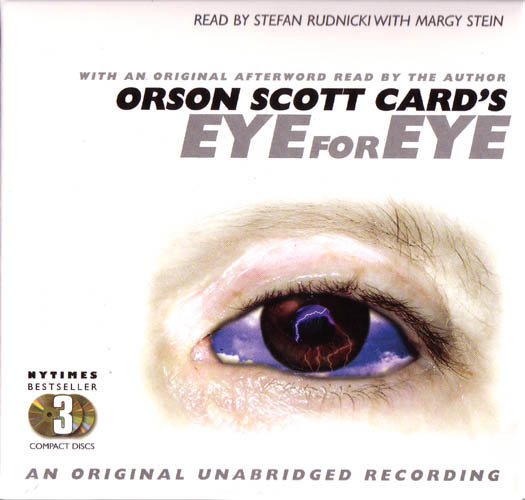
In this age of seemingly endless series, thousand page fantasy epics, and general fiction sprawl, it is wonderfully refreshing to listen to a short novel or novella. Request Audiobooks, a brand new player in the audiobook market, has dipped into Science Fiction and Fantasy’s glorious past for some wonderous tales that don’t require a forklift to enjoy. Eye For Eye was first published in Isaac Asimov’s Science Fiction Magazine, Mar 1987 issue, and in 1988 it won the Hugo Award for best novella. Then in November 1990 it was paired as half of the Tor Double Novel #27 with another novella by Lloyd Biggle Jr. (The Tor Doubles are for my money the very best modern treeware series published). For more than ten years this terrific tale sat out of print. Then ReQuest Audiobooks stepped up. And boy did they ever! ReQuest presents the novella in all its glory, and then some. They tapped master narrator Stefan Rudnicki to read it. Rudnicki who’s sonorant basso has performed more Orson Scott Card audiobooks than any other voice on Earth is perfect for the job. Then, they went to Orson Scott Card himself and had him write an original afterword just for the audiobook. To finish it all off, they commisioned some truly eye-catching art. This is my very favorite kind of audiobook. A short novel with an intriguing premise, bristling with driven characters, read by a talented narrator, and sporting a bonus feature. With a USA price point of just $14.95 for three CDs this is like a slice of audio heaven.

*-The quotation comes from the novel Beyond This Horizon by Robert A. Heinlein

Posted by Jesse Willis

Review of Caedmon’s Science Fiction Soundbook

SFFaudio Review

Science Fiction Audiobook - Caedmon Science Fiction SoundbookScience Fiction Soundbook
By Ray Bradbury, Isaac Asimov, and Robert A. Heinlein
Read By Leonard Nimoy and William Shatner
4 hours – 4 Cassettes [UNABRIDGED]
Publisher: Caedmon
Published: 1977
Themes: / Science Fiction / Mars / Edgar Allan Poe / Computers / Mathematics / Sociology / Space Travel /

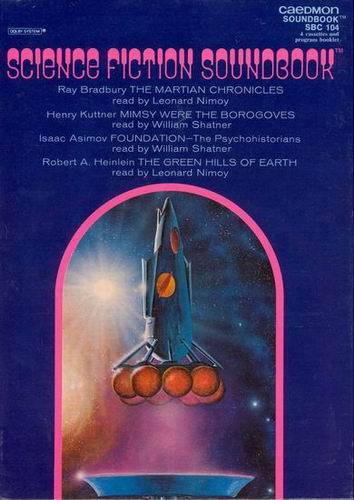
This out-of-print Caedmon set was a wonderful find (thanks, Esther!) because it contains two cassettes (four stories) that are amongst the earliest science fiction audio I ever heard. The stories are “The Green Hills of Earth” and “Gentlemen, Be Seated” by Robert A. Heinlein, and “There Come Soft Rains” and “Usher II” by Ray Bradbury, all read by Leonard Nimoy. Also included here is “The Psychohistorians” by Isaac Asimov and “Mimsy Are the Borogroves” by Henry Kuttner, both read by William Shatner. The audio was originally published in 1977.

I found Leonard Nimoy’s readings to be excellent. In Bradbury’s “Usher II”, he delivers a passionate speech about the evils of book burning with perfection. In “Gentlemen, Be Seated” and “The Green Hills of Earth” he portrays working class spacemen with complete success.

William Shatner, though, was disappointing. I’ve heard him read some Star Trek titles, and felt his delivery was pretty good, but here, on both cassettes, he reads as if he needs to be across town in fifteen minutes. He zips through the text, sometimes fast enough to affect my comprehension.

The stories are all bona-fide 5-star classics:

“There Will Come Soft Rains” by Ray Bradbury, read by Leonard Nimoy
This famous story is about a house. That’s it, just a house. An automatic, programmed house that keeps running and running… but where are its inhabitants? Bradbury manages to tell a very human tale without any actual people.

“Usher II” by Ray Bradbury, read by Leonard Nimoy
A fantastic story, passionately read, about a man who builds Poe’s House of Usher on Mars. Because of the social climate on Earth, it would be illegal to build such a fantastic structure, because stories of fantasy are simply no longer allowed. If you agree with that policy, this fellow would be happy to show you around, and he does get that opportunity. As I mentioned earlier, a highlight is a speech on censorship that was an obvious precursor to Bradbury’s Fahrenheit 451.

“The Psychohistorians” by Isaac Asimov, read by William Shatner
This is the first novelette in the first book of Asimov’s Foundation trilogy. In it, you meet Hari Seldon and Gaal Dornick in an introduction to some of the key elements of the Foundation story, including the Empire in decline and the mathematics of psychohistory. However, I did have difficulty get into Shatner’s narration.

“The Green Hills of Earth” by Robert A. Heinlein, read by Leonard Nimoy
Rhysling is a Spacer who lost his eyesight in a reactor pile accident. Now, he’s a famous bard, and this is his story. The story is an excellent portrayal of what spaceflight might be like from the working stiff’s point of view, once flight becomes common. At least from the perspective of a science fiction writer in 1948. No NASA engineers here.

“Gentlemen, Be Seated” by Robert A. Heinlein, read by Leonard Nimoy
This story is similar to “Green Hills” in that the characters are working class spacemen. One agrees to take a reporter through some new buildings on the moon (yes, he does get overtime pay for it), but an accident occurs during the tour. Another story from the late 1940’s, which is the part of Heinlein’s long career that I enjoy most.

“Mimsy Were the Borogroves” by Henry Kuttner, read by William Shatner
This story fared better under Shatner’s cadence than did “The Psychohistorians”. I was captured by it within 5 minutes or so of concentrated listening, and Kuttner’s story held my attention even when Shatner didn’t. The story involves some toys that were sent back in time by a far-future scientist with too much time on his hands. The toys are found by some kids, who play with them, and are changed by them. The story plays with the ideas of how people think – how kids think, how adults think, and how it could possibly be different. I found it a well-written and entertaining exploration of these ideas. Great science fiction.

Posted by Scott D. Danielson