
The SFFaudio Podcast #357 – READALONG: Captain James Hook And The Curse Of Peter Pan by Jeremiah Kleckner and Jeremy Marshall

Podcast

The SFFaudio PodcastThe SFFaudio Podcast #357 – Jesse and David Stifel talk about Captain James Hook And The Curse Of Peter Pan by Jeremiah Kleckner and Jeremy Marshall.

Talked about on today’s show:
that Burroughs guy (or Captain Hook), Jeremy Marshall, Jeremiah Kleckner, a modern book?, a little under six hours, a take off on a well known property, not a kid’s book, the Peter Pan play, the starting point for this book, childish irresponsibility, a Twilight Zone episode, J.M. Barrie’s Peter Pan, written for adults, vocabularies, they got a dog, in-jokes, Alice In Wonderland, he workshopped it, Hook wasn’t in the play originally, kids love pirates, this kid kidnaps other kids, a sequel, the timeline, Harry Potter of a hundred years ago, Hook, Pan, the Disney film, the black and white Broadway broadcast, kinescope, what a great role, the prototypical adult, the Etonian accent, Cyril Ritchard’s voice, The Roar of the Greasepaint – The Smell of the Crowd, the writing is so good, subtly twisted scenes, why it is short, Jeremiah Kleckner is an English teacher, how to enjoy reading, pre-production, the competition, an ACX book, Jeremiah Kleckner’s blog, auditions, the new publishing model, the cover art, Jesse is very cynical, so is David, self-published, word-wooze, wound and wooze, guberreality?, Chinese food, David Baldacci, what writing is about, a lot of gushing, an alternate take, a prequel to Peter Pan, fairies, a crocodile, Neverland, the Lost Boys, a jigsaw puzzle, who is Captain Hook?, Hook is right, Peter Pan is a self-indulgent little brat, flying, too bad!, Peter Pan treats the Lost Boys like toys, set on a course for evil, with Billy Mumy, It’s a Good Life, “happy fun”, the alliterative punctuation, the god Pan, the god of lonely shepherd boys and the god of panic, panopticon, pan was able to multiply himself infinitely, not the horny goat god, the god of wildness, children and childhood became a thing, children’s literature, child focused culture, child labour, Barrie was the peak of child culture, anti-science, “who believes in fairies?”, why we need Mr Jim Moon, the push pull of science, science killing all the fantasy of being a child, Sir Arthur Conan Doyle, he just wants to believe, The Best Of Sick Jokes,

Willie, with a thirst for gore,
Nailed his sister to the door.
Mother said, with humor quaint,
“Willie, dear, don’t scratch the paint.”

the symbol of how good the writing is, James Hoodkins, breaking the bottle, the night before his thirteenth birthday, “have fun forever”, a lucky escape, Michael Darling, the Darling family, a failed adult, a funding problem, Smee, Captain Hook’s boatswain (bo’sun), an interesting backstory for Smee, “it’s me”, Blackbeard, Long John Silver, Treasure Island, Black Sails mixes historical and fictional pirates, Robert Louis Stevenson, the second reality, Jesse Labette, Smee by A.M. Burrage, clean fun, hide-and-seek, The Demolished Man by Alfred Bester, sardine, a retelling, why does Hoodkins have a sidekick in William, responsibility, double-sided reality, watch out for William, a first step towards manhood, be his mommy, what if…, a stunning achievement, “I’m taking them to heaven.”, a child’s heaven, death, never land, just step out the window, jumping off the roof, almost a real place, The Etymologicon: A Circular Stroll Through The Hidden Connections Of The English Language by Mark Forsyth, the impact of Peter Pan, Wendy, Jonathan Swift, Vanessa, Hermione, a romp, a great performance in a meaty role, natives will tell, by today’s standards, losing regionalisms, mid-Atlantic accent, the Edgar Rice Burroughs audiobooks, a swashbuckling adventure, a completely flawless performance, a sleeper that deserves to be heard, a really fine audiobook that deserves more exposure, the Amazon.com reviews are excellent, “masterful narration”, little Billy at 5, an undersold masterpiece, with the marketing budget…, David’s tastes, science fiction as a modernization of fantasy, thinking critically about a classic, Hook was right!, Hook’s the hero!, it’s not just what you know about Peter Pan, a lot of pirate research, more real than The Pirates Of The Caribbean, not an arrrgh until the appearance of Long John Silver
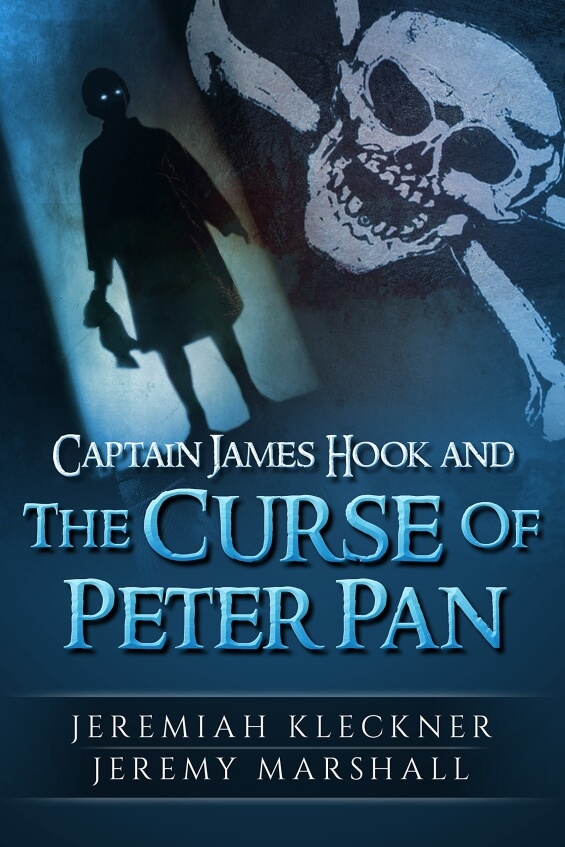
Captain James Hook And The Curse Of Peter Pan by Jeremiah Kleckner and Jeremy Marshall

Posted by Jesse Willis

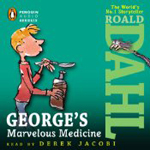
Review of George’s Marvelous Medicine by Roald Dahl

SFFaudio Review

George's Marvelous Medicine by Roald DahlGeorge’s Marvelous Medicine
By Roald Dahl, Read by Derek Jacobi
Penguin Audio
[UNABRIDGED] – 1.5 hours

Themes: / magic medicine / oversized farm animals / crusty granny / avaricious father / children / short stories /

Publisher summary:

A taste of her own medicine. George is alone in the house with Grandma. The most horrid, grizzly old grunion of a grandma ever. She needs something stronger than her usual medicine to cure her grouchiness. A special grandma medicine, a remedy for everything. And George knows just what to put into it. Grandma’s in for the surprise of her life – and so is George, when he sees the results of his mixture!

This is a short humorous story that doesn’t ever seem to fully get off the ground. But still, it’s fun and lighthearted. And while there aren’t any deep secretive insights to the human condition, it made me smile through pretty much the whole thing, and that has to be worth something, right? I loved Dahl’s warning to potential medicine makers. Equally so, I appreciated the ending. It was touching in its uncomplicated way. The image of a child knowing his fingers had brushed the magic edge of another world leaves the reader/listener in a wistful rumination.

Derek Jacobi is narrator, and he really nails the reading. I might go so far as to say that Jacobi’s delivery shines slightly brighter than Dahl’s words. Regarding the production end of things, I didn’t care at all for the numerous musical scores that seemed jammed in at odd places within the story. They were distracting and unnecessary. I felt they detracted from the overall presentation.

I recommend this to any and all Dahl enthusiasts. For those peripheral fans, you can skip it, and not feel as if you’re getting left out in the cold darkness.

Posted by Casey Hampton.

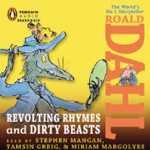
Review of Revolting Rhymes & Dirty Beasts by Roald Dahl

SFFaudio Review

Revolting Rhymes and Dirty BeastsRevolting Rhymes and Dirty Beasts
By Roald Dahl; Read by Stephen Mangan, Tamsin Greig, and Miriam Margolyes
Publisher: Penguin Audio
[UNABRIDGED] –  1 hour

Themes: / poetry / children / fairy tales / mischievous animals /

Publisher summary:

Revolting Rhymes

Did you think Cinderella married the prince and lived happily ever after, or that the three little pigs outsmarted the wolf? Think again! Master storyteller Roald Dahl adds his own darkly comic twists to six favorite tales, complete with rambunctious rhymes and hilarious surprise endings.

Dirty Beasts

Roald Dahl’s inimitable style and humor shine in this collection of poems about mischievous and mysterious animals. From Stingaling the scorpion to Crocky-Wock the crocodile, Dahl’s animals are nothing short of ridiculous. A clever pig with an unmentionable plan to save his own bacon and an anteater with an unusually large appetite are among the characters created by Dahl in these timeless rhymes. This new, larger edition is perfect for listening.

This brief and unabridged audio production begins with Revolting Rhymes then progresses into Dirty Beasts. There is music arranged as dividers between the various rhymes. I usually do not like music in audio productions but this is the exception. I appreciated how the music provided a moment for laughter or reflection, and I never felt as if the musical interludes were distracting. Stephen Mangan, Tamsin Greig, and Miriam Margolyes take turns reading the selections. All of them do a fantastic job, and not once did a narrator overacting the material pull me away from the text. I think Penguin Audio got this right.

While this is aimed at a youthful audience, it’s accessible for all ages. Those who are younger will enjoy the enthusiastic readings and rhyming schemes on display. For the older reader/listener, the cleverness of Dahl is truly something to appreciate.

Incidentally, my favorite was “The Toad and the Snail.”

Posted by Casey Hampton.

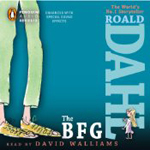
Review of the BFG by Roald Dahl

SFFaudio Review

The BFG by Roald DahlThe BFG
By Roald Dahl; Read by David Walliams
Publisher: Penguin Audio
Publication Date: 24 June 2013
[UNABRIDGED] – 4 hours, 25 minutes

Themes: / fantasy / giants / children /

Publisher summary:

The BFG is no ordinary bone-crunching giant. He is far too nice and jumbly. It’s lucky for Sophie that he is. Had she been carried off in the middle of the night by the Bloodbottler, or any of the other giants – rather than the BFG – she would have soon become breakfast. When Sophie hears that the giants are flush-bunking off to England to swollomp a few nice little chiddlers, she decides she must stop them once and for all. And the BFG is going to help her!

The BFG is classic Roald Dahl: a blend of lighthearted playfulness and bone-crunching, child-munching wickedness.

The story is about a gentle 20-foot-tall giant who lives in Giant Country with a bunch of other giants. The BFG taught himself English by reading Charles Dickens, and he mangles language in beautiful ways: “What I mean and what I say is two different things.”

The other giants, who have adorable names like Bloodbottler, Meatdripper, Childchewer, and Bonecruncher, are all much bigger than the BFG (“at least two times my wideness and double my royal highness!”) and bully him for being vegetarian. While they eat humans of various nationalities (like people from Turkey, who apparently taste like turkey, or people from Jersey, who taste of cardigans), the BFG eats only a disgusting vegetable called a snozzcumber. As he says, “I squoggle it! I mispise it! I dispunge it! But because I is refusing to gobble up human beans like the other giants, I must spend my life guzzling up icky-poo snozzcumbers instead! If I don’t, I will be nothing but skin and groans.”

The story starts when the BFG befriends a little human girl named Sophie, who he takes home with him to Giant Country, where he must hide her from the meaner giants who would eat her on sight. Together, the BFG and Sophie decide to try putting a stop to the terrible child-guzzling that’s been going on.

The narrator David Walliams did such an awesome job with the voices, from Sophie’s soft feminine inflections to the BFG’s indignant horror and naive befuddlement with humankind’s weird ways. It must have been difficult to perform the BFG’s dialogue with all the backwards idioms and inside-out clichés and weird pronunciations, but somehow Williams makes it all flow seamlessly and naturally.

The audio production is also something special, with all kinds of sound effects in the background: bubbling and burping and scraping and gurgling. These special effects didn’t seem intrusive to me at all (despite preferring straight readings usually), and seem to fit perfectly with Roald Dahl’s storytelling style.

Everything else aside, the BFG character alone makes this story worth listening to. How can you not love a creature whose ears are so sensitive he can hear the faraway music of the stars, and who desperately wants to learn how to “make an elephant” so he can ride it around, picking peachy fruits off the trees all day long!

Posted by Marissa van Uden

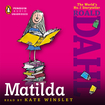
Review of Matilda by Roald Dahl

SFFaudio Review

Matilda by Roald DahlMatilda
By Roald Dahl; Read by Kate Winslet
Publisher: Penguin Audio
Publication Date: 3 July 2013
ISBN: 9781611761849
[UNABRIDGED] – 5 hours

Themes: / fantasy / telekinesis / children / school / libraries / bullies /

Publisher summary:

Matilda is a sweet, exceptional young girl, but her parents think she’s just a nuisance. She expects school to be different but there she has to face Miss Trunchbull, a kid-hating terror of a headmistress. When Matilda is attacked by the Trunchbull she suddenly discovers she has a remarkable power with which to fight back. It’ll take a superhuman genius to give Miss Trunchbull what she deserves and Matilda may be just the one to do it!

This book made me so nostalgic for childhood, mostly because Roald Dahl is a wizard who can see through a child’s eyes but also because he was such a huge influence on me when I was a kid. Matilda was one of my favorite Roald Dahl stories, and hearing it narrated by Kate Winslet was amazing—probably the best narration I’ve heard. She colors every single character a fully realized personality, from syrupy sweet to hilariously grotesque. I think Kate Winslet is doing in narration what Quentin Blake did for Roald Dahl in illustration.

The story is Roald Dahl at his best: it is sarcastic and dark (featuring a bingo-obsessed mother, a dishonest father, and a headmistress who throws children out windows for eating in class) but it’s also hilarious, magical, and hopeful.

Matilda Wormwood is a very small, sensitive, and brilliant girl who has the misfortune of being born to gormless idiots. Mr. Wormwood is a rat-faced used-car salesman who’s really only interested in people who boost his ego. He seems allergic to his daughter, mainly because she is much cleverer than him. Mrs. Wormwood, when she’s not off playing bingo, sits around watching American soaps and thinks “Looks is more important than books!”

Matilda’s good morals and quick wits unsettle her parents, which makes them even more dismissive and neglectful of her. Her only escape is to visit the local library where she devours the whole children’s section in no time. The amazed librarian than helps guide the little girls through all the classics, from Charles Dickens and Jane Austen to George Orwell and HG Wells.

 “The books transported her into new worlds and introduced her to amazing people who lived exciting lives. She went on olden-day sailing ships with Joseph Conrad. She went to Africa with Ernest Hemingway and to India with Rudyard Kipling. She travelled all over the world while sitting in her little room in an English village.”

Reading all this literature awakens something in Matilda.  She realizes that she now has a view on life that her parents have not experienced and never will, and that there’s far more to life than cheating people and watching television.

But she’s only four, so she’s stuck with them, “no matter how asinine.”  To stop herself from going crazy, she beings to play mischievous pranks on them to punish them for every wrong they do. And when she starts school and meets even nastier bullies, she must use her brain power to develop new techniques for helping good people and punishing rotten ones.

I love the honesty Roald Dahl puts into his children’s stories. Children are often taught they must respect and obey their parents and teachers no matter what, as if we live in some utopia where all adults are intelligent, caring protectors. But Roald Dahl is not afraid to tell children the truth: sometimes monsters are real, and sometimes they look just like the people who have the most power over you or are supposed to care about you. People should earn trust and respect through their actions, not get it automatically because of their authority, age, or status.

Roald Dahl also teaches the other great wisdom: the world is full of idiots and oversized egos, and the best way to survive them is to keep your wits sharp and find the humor in every situation.

Posted by Marissa van Uden


Review of Vampires in the Lemon Grove by Karen Russell

SFFaudio Review

Vampires in the Lemon Grove

Vampires in the Lemon Grove
By Karen Russell; Read by Multiple (see list below)
Publisher: Random House Audio
Published: 12 February 2013
ISBN: 9780449013717
[UNABRIDGED] 9 hours, 15 minutes

Themes: / short stories / vampires / veterans / farmers / children / reincarnation / silkworms /

Sample of title story: | MP3 |

Publisher summary:

In the collection’s marvelous title story, two aging vampires in a sun-drenched Italian lemon grove find their hundred-year marriage tested when one of them develops a fear of flying. In “The Seagull Army Descends on Strong Beach, 1979,” a dejected teenager discovers that the universe is communicating with him through talismanic objects left in a seagull’s nest. “Proving Up” and “The Graveless Doll of Eric Mutis”–stories of children left to fend for themselves in dire predicaments–find Russell veering into more sinister territory, and ultimately crossing the line into full-scale horror. In “The New Veterans,” a massage therapist working with a tattooed war veteran discovers she has the power to heal by manipulating the images on his body. In all, these wondrous new pieces display a young writer of superlative originality and invention coming into the full range and scale of her powers.

I had been looking forward to this book coming out, because I loved Karen Russell’s first book of short stories, St. Lucy’s Home for Girls Raised by Wolves. She is also the author of the much-acclaimed Swamplandia! which was a finalist for the Pulitzer Prize. These stories did not disappoint! I was curious to see if there would be more set in Florida, but these span from Italy to New Jersey, from the plains to Antarctica. And just as I would have expected, the stories are at times startling, amusing, and sad. I will just say a few words about each, but this is a must-read.

Vampires in the Lemon Grove – two ancient vampires try to satiate their desires by eating lemons

Reeling for the Empire – human silkworms, vivid and terrifying.

The Seagull Army Descends on Strong Beach, 1979 – maybe the seagulls are the only ones really paying attention

Proving Up – starts as a struggling farm family story, ends in a … i can’t even…. *shiver*

The Barn at the End of Our Term – dead presidents alive in horses’ bodies
(actual presidents, not the band)… this one made me laugh more than any of the others.

Dougbert Shackleton’s Rules of Antarctic Tailgating – Sometimes you’re the whale, but you’re probably usually the krill.

The New Veterans – PTSD, massage, tattoos, and what is healing, exactly?

The Graveless Doll of Eric Mutis – I couldn’t decide what I thought of this one.  It is either about bullying or children who can turn into other things. Maybe both. Maybe neither.

The audio version is great, because each story has its own reader, really allowing for the differences in voice and feeling.

List of readers:

Vampires in the Lemon Grove read by Arthur Morey
Reeling for the Empire read by Joy Osmanski
The Seagull Army Descends on Strong Beach, 1979 read by Kaleo Griffith
Proving Up read by Jesse Bernstein (his accent is perfect for this story!)
The Barn at the End of Our Term read by Mark Bramhall
Dougbert Shackleton’s Rules of Antarctic Tailgating read by Michael Bybee
The New Veterans read by Romy Rosemont
The Graveless Doll of Eric Mutis read by Robbie Daymond

Posted by Jenny Colvin