Review of Parable of the Sower by Octavia E. Butler

Science Fiction Audiobook Review

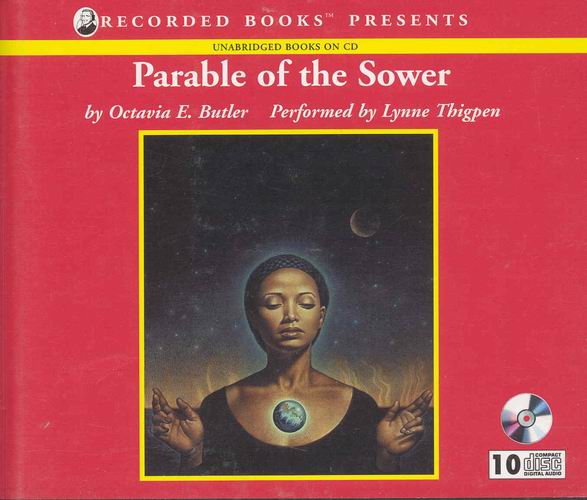
Science Fiction Audiobook – Parable of the Sower by Octavia E. ButlerParable of the Sower
By Octavia E. Butler; Read by Lynne Thigpen
10 CDs – 12 hours – [UNABRIDGED]
Publisher: Recorded Books
Published: 2000
ISBN: 0788747606
Themes: / Science Fiction / Dystopia / Survival / Religion /

Occasionally in science fiction there comes a novel that should be considered important not only inside the genre, but in all of literature. Like 1984 by George Orwell. Or Fahrenheit 451 by Ray Bradbury. Or like nearly everything Octavia Butler ever wrote, including this novel.

Parable of the Sower is a novel consisting of the diary entries of the main character, a teen named Lauren. She lives and writes in 2020’s United States of America, in the Los Angeles area. Butler imagines a lawless future America where everyone is on their own. Lauren lives in a cul-de-sac with a wall around it – her family and several others haved pooled together. Murders are commonplace, as is theft, and people struggle to survive while the world moves on. Lauren comments on the death of an astronaut on Mars, the election of a new president, as well as her ever-changing day-to-day life.

Complicating things is the fact that Lauren is a hyper-empath. If she sees someone get hurt, she feels that pain as if it was happening to her. An extremely uncomfortable thing to be, when pain exists all around her.

Out of all of this, she creates a new religion, called Earthseed, which springs forth from the beliefs formed by her life’s circumstances. She isn’t inventing it, as she says more than once – no, she’s discovering it. In a world in which the only surety is change, she discovers God. And God, she figures, is change itself.

Lynne Thigpen is flawless in her narration of this book. She did a wonderful job speaking as if the world in which Lauren moved was normal. Her emphasis and emotion perfectly fit the character. The result was an audiobook that I’m better off for having heard.

Posted by Scott D. Danielson

Review of V For Vendetta by Steve Moore

SFFaudio Review

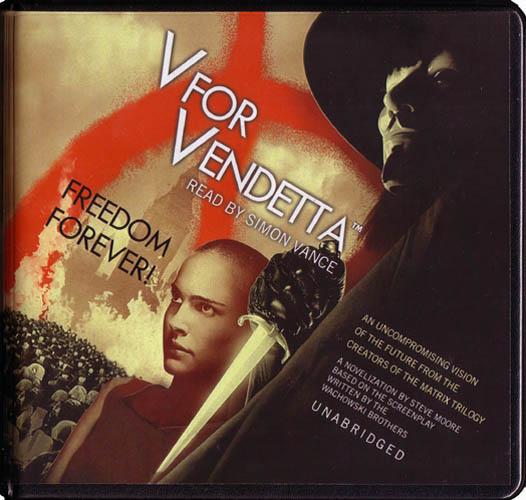
V For Vendetta by Steve MooreV For Vendetta
Novelization by Steve Moore; Read by Simon Vance
11 Cassettes, 8 CDs or 1 MP3-CD – 9.5 Hours [UNABRIDGED]
Publisher: Blackstone Audio
Published: 2006
ISBN: 0786144637 (Cassette), 0786170777 (CDs), 078617711X (MP3-CD)
Themes: / Science Fiction / Dystopia / Terrorism / Anarchy / England /

Click here for an audio sample —

“Remember, remember the fifth of November, The Gunpowder Treason and plot. I know of no reason why The Gunpowder Treason should ever be forgot…”

This audiobook had a long and treacherous road to release. Perhaps even worse, it has a questionable provenance. V For Vendetta, the unabridged audiobook, is several steps removed from the original source material. Worse still, the adapted property has been completely disowned by its original creator, celebrated graphic comics writer Alan Moore. He quite literally had his name removed from the movie credits, the novelization, and consequently this audiobook – in short he wants nothing to do with it.

Alan Moore is a famous figure in comics, and his opinion carries much weight among comic book readers. Because of all this, V For Vendetta, the novelization of the movie of the same name, is in serious jeopardy of being dismissed. But given the original material’s quality and the near classic vintage – the character and setting for “V” was originally birthed in early 1980s – you might be inclined to give this audiobook a try anyway. And for that you will be rewarded.

The road to release began with The Wachowski Brothers, the creators of the film The Matrix, optioned the story. They purchased the rights and scripturally adapted the graphic novel of V For Vendetta for the screen. After the film began production their script was then again adapted, this time as a movie novelization (or as the industry calls it a movie tie-in novel). The novel was written by Steve Moore, who, while no familial relation to Alan Moore, is very much his friend. Then Blackstone Audiobooks stepped in, hiring Simon Vance to voice an unabridged audiobook version of the Steve Moore’s novelization of The Wachowski Brother’s script of their movie which was originally based on Alan Moore’s original comic book series (that was collected into a graphic novel). See what I mean about a treacherous road? At any point along this journey the story could have been ruined. But what happened instead is that it has been IMPROVED! Indeed I think story-wise this is the best version of V For Vendetta

Soon after the opening of the novel a mysterious figure named “V,” who dresses in a Guy Fawkes costume, promises to destroy the British Parliament buildings on November 5th, one year hence. It is a bit unlear at first, is the fascist governing party the target of this threat, or perhaps it is the people of England in general? Only one woman has even a clue. Her name is Evey. With war raging round the world, an English supremacist party called “Norsefire” has fully secured governmental authority in England. Some time ago, Norsefire successfully seized the initiative, and now England’s remaining citizenry are in a stranglehold of their own making. At the start of the novel the government controls media and a petrifying secret police force seemingly made up of little more than street thugs prowls the streets after dark. In the recent past the last of the last of the concentration camps has closed – their grisly work completed. The populace has been lulled into their docility by a combination of mindless television drama, propaganda posing as opinion, and horrifying news stories about how much worse everywhere else is. So when an anarchic revolutionary destroys London’s Saint Paul’s Catherdral in pyrotechnic display, the compliant populace is only slightly stirred. The government explains that it was just a “scheduled demolition” and many Britons even believe it. But when “V,” a seeming superhero/supervillan goes on BTN the sole governmental television network, and announces a violent campaign to be capped in by the destruction of parliament buildings in one year’s time the populace begins to question if “England shall prevail” or whether it even should.

Like George Orwell‘s classic dystopia 1984 the totalitarian regime in V For Vendetta rose to power by exploiting people’s worst fears and firing-up their prejudices. Interestingly the viewpoint character is not V himself. V’s personal history, past a certain point, remains mysterious right to the end. Despite a completely third person perspective we basically follow a young woman named Evey through this tale. V saves Evey early on in the novel from a rape by government agents known as “Fingermen.” Evey’s journey is not unlike that of the population, for which she can serve as an emotional example. One other character, a police Inspector named Finch, as dutiful and honest a detective as one’d want, offers another view of that same populace coming to grips with the type of society in which it lives. Finch is assigned to pursue the mystery of V, and in so doing unravels the history of the party’s origins and V’s vendetta. About two-thirds of the way through Evey’s journey with V and his vendetta Evey is captured and tortured. Her only solace during her ordeal is a scrap of toliet paper with a moving biography of her neighboring victim. The payoff from this is extremely surprising, utterly transendant and I think probably even true. There isn’t enough praise to go round for this one, Alan Moore for originally writing it of course, the Wachowski Brothers for recognizing it and popularizing it and Steve Moore for preserving and enhancing it. They all deserve major public honours here.

On the audiobook end, Simon Vance is my new favorite British narrator. The Shakespearean inspired “V-speech” that he delivers near the beginning of this audiobook is without parallel in my experience. It’s deliciously composed, elegantly constructed and with Vance’s performance, wonderfully delivered. The film version of this same speech is very good too, but I actually found myself better able to follow it via Vance’s excellent enunciated delivery. Steve Moore, the adaptor of the film’s script, has done something special. He’s taken many inspired liberties with the script by filling in as much detail as he could to flesh out the story – nearly every effective new addition to the story was taken from the original source material the comic book version of V For Vendetta. Finally, I can thankfully say that the plot detail involving the destruction of the British parliament buildings (including London’s Big Ben) is preserved from the film version. This is extremely important. To be sure there is a scene of the destruction of the British parliament buildings in the original graphic novel but the timing of it there is far less effective in terms of a story’s arc. Though it might be controversial to say, I think it is true: The Wachowski Brothers, in their adaptation of Alan Moore’s story, clearly understood the power of terrorism better than Alan Moore himself did at the time of the comic’s writing. The goal of terrorists is to show that an authority cannot control the terrorists. When a terrorist threat, like the destruction of a weighty architechtural symbol, is made and then carried out that effect is achieved. Some fear comes from a lurking dread of some muzzy non-specific threat but true political power stems from being able to call every shot, make the predictions on destruction and have them all come true every single time. In rejigging the story to make the destruction of the British parliament buildings happen near the end instead of the start, the already powerful story of V For Vendetta is vastly improved. An SFFaudio Essential.

Posted by Jesse Willis

Review of Archibald MacLeish’s The Fall Of The City

SFFaudio Radio Drama Review

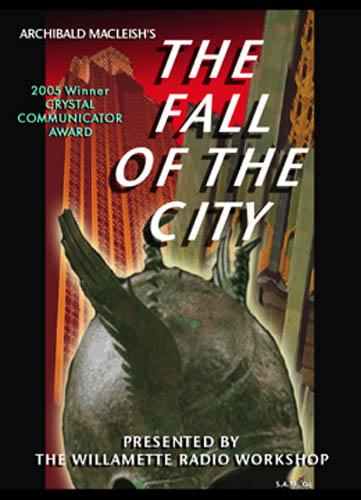
Science Fiction Radio Drama - The Fall Of The City by Archibald MacLeishThe Fall Of The City
Based on the script by Archibald MacLeish; Perfomed by a full cast
1 CD – 32 Minutes 11 Seconds [RADIO DRAMA]
Producer / Publisher: Willamette Radio Workshop / LodestoneCatalog.com
Produced / Published: 2004 / 2006
Themes: / Fantasy / Allegory / Prophecy / Utopia / Dystopia / Totalitarianism /

“- In a time like ours seemings and portents signify -“

What few of the pre-WWII fantasy radio dramas produced tended to be allegorical, The Fall Of The City is no different in that respect. This one however has a unique feature – it was written as an extended dramatized poem “verse for radio” as they called it. The original production starred the then ubiquitous Orson Welles and a number of other Hollywood stars. This is the modern re-recording of the original 1937 radio drama. The folks at Willamette Radio Workshop have put the results to CD, but it was actually broadcast on WMNF 88.5 FM in Tampa, Florida in the fall of 2004. The production asks several questions appopriate for totalitarian times: ‘What freedom is worth?’ ‘What is freedom?’ And most importantly, “freedom from what?”

As Fall Of The City begins, a ghostly almost prophetic figure has appeared in city’s cemetary for three days running. When she finally speaks to the gathered mob she fortells the arrival of a conqueror, warning “The city of masterless men will take a master, there will be shouting then, blood after.” The citizenry, shocked that their advanced state may be under dire threat are agitated into a debate about the possible actions they might take to ensure their continued freedom. I found it an experience not unlike that of a staged Greek tragedy, thus it is all three high-browed, reflective and wise. To say more might be to reveal to much. What I can say without fear of spoiling the experience for you is that this is an artful production, sound design and music are beautifully rendered with voice acting in absolute top form. I’d be interested to hear if the team at Willamette will be taking on MacLeish’s 1938 follow up Air Raid another of his poetry dramas.

Posted by Jesse Willis

Review of The Voice from the Edge Vol. 1: I Have No Mouth and I Must Scream by Harlan Ellison

SFFaudio Author of the Month Review

Science Fiction Audiobooks - The Voice from the Edge: I Have No Mouth and I Must ScreamThe Voice from the Edge Vol. 1: I Have No Mouth and I Must Scream
By Harlan Ellison, read by Harlan Ellison
5 CD’s – 6 hours [UNABRIDGED stories]
Publisher: Fantastic Audio
Published: 2002
ISBN: 1574535374
Themes: / Science fiction / Collection / Series / Post-Apocalypse / Artificial intelligence / Utopia / Dystopia / Magic Realism / Love / Hell /

ed. – This is one of two Harlan Ellison collections that were released by Fantastic Audio. The second is called The Voice from the Edge: Midnight at the Sunken Cathedral.

There are two basic reasons to invest in a short story collection by a single author. The first is to experience first hand the stylistic, thematic, and technical contributions the author has made to his genre and to literature in general; the second is to sample the dynamic range the author covers, to gauge the extent of his palette.

This audio book delivers the first in spades. With Harlan Ellison’s friendly, yet curmudgeonly introduction, we are thrust immediately into the gritty rawness he helped bring to science fiction. Such stories as the harrowing, lurid, complex title story, the gleefully offensive misogyny and sociopathy of “A Boy and His Dog”, the pop-cultural, pejorative ranting of “Laugh Track”, and the sophomoric sexual preoccupation of “The Very Last Day of a Good Woman” clearly delineate the dark, adult-oriented themes he introduced, as well as his predilection for unlikable anti-heroes who often leave us feeling a bit less comfortable about ourselves. And on such material, his distinctive narrative style shines. He curses with conviction, and his voice handles guilt, revenge, and damnation with seeming familiarity.

In the overall story choice, we also have a remarkable demonstration of the range of Ellison’s writing. Compare the patient, redemptive power of “Paladin of the Lost Hour” to any of the stories mentioned above, and you’ll see what I mean. Throw in the sly, haunted twist of “The Time of the Eye”, the overwrought post-modernism and tedious beatnik vamping in “’Repent Harlequin!’ said the Tick-Tock Man”, the sublime, hellish search for love in “Grail”, and the puzzling juxtaposition of the truly horrific and the trivial in “The Lingering Scent of Woodsmoke”, and you cover quite a swath of not only the science-fiction spectrum, but the fiction spectrum in general.

Unfortunately, the use of a single narrator for all these stories blurs their uniqueness, especially since that narrator is Harlan Ellison. His delivery style can be enjoyable, but it is so raw, so exaggerated, and so pervasive that it tends to flatten the relief of the work itself. I can’t say that I question the wisdom of having Ellison narrate, for on any single story his voice adds the confident insight that only an author can bring to his own work. But this is a collection, and the diverse stories deserve a wider range of vocal performance to truly showcase their differences. My advice is to make the best of this paradox by taking the collection slowly. The quality of the material, the exceptionally crisp sound and the fine, user-friendly packaging make this an audio book you should not miss. Just make sure to pace yourself.

Review of Market Forces by Richard K. Morgan

SFFaudio Review

Science Fiction Audiobook - Market Forces by Richard K. MorganMarket Forces
By Richard K. Morgan; Read by Simon Vance
13 CDs – 16 Hours [UNABRIDGED]
Publisher: Tantor Media
Published: 2005
ISBN: 1400101395 (Retail CD), 1400131395 (Library CD), 1400151392 (MP3-CD)
Themes: / Science Fiction / Dystopia / Economics / Satire /

“Human beings have been fighting wars as long as history recalls. It is in our nature, … last century the peacemakers, the governments of this world, did not end war. They simply managed it, and they managed it badly. They poured money without thought of return into conflicts and guerrilla armies abroad, and then into tortuous peace processes that more often than not left the situation no better. They were partisan, dogmatic, and inefficient. Billions wasted in poorly assessed wars that no sane investor would have looked at twice. Huge, unwieldy national armies and clumsy international alliances in short a huge public sector drain on our economic systems. Hundreds of thousands of young people killed in parts of the world they could not even pronounce properly. Decisions based on political dogma and doctrine alone. Well, this model is no more.”

In an interview with Rick Kleffel of The Agony Column Richard K. Morgan describes the motivaton behind Market Forces – ‘there’s a scene’ he said, ‘in the movie Lethal Weapon‘ a scene in which the suicidal cop Martin Riggs (played by Mel Gibson) is atop a roof, ironically, trying to talk down an suicidal citizen who claims he’s going to jump. Frustrated at the indecision that grips them both Riggs snaps – he handcuffs the citizen to his own wrist and then asks him “Do you really wan’t to jump? Do you wanna?” – then dragging the citizen with him Riggs jumps off the roof. It’s a scene designed to show the inner demons that haunt Riggs, who is, after all, the “Lethal Weapon” of the film’s title. So what does that have to do with Market Forces? This novel is Richard Morgan’s response to the right-wing think tanks which have for years been constantly murmuring in the media soundbites of “let the market decide,” “government is in the way of business,” “the invisible hand can regulate better.” Morgan’s frustration with these ideologues is answered by dystopian satire, a kind of Wall Street meets Mad Max. This is an England in which the gap between the rich and poor has widened. At the top are an elite, an upper-class of executives, driving armoured cars and carrying firearms in their briefcases. At the bottom are the unemployed, disenfranchized and living in deserted slums without access to public transportation, their only escape is to join the police or Special Air Service, both privatized and in mercenary service of the executive class. The commodited investment houses have morphed into “Conflict Investment” houses. It’s a powerful setting, a critical look at where we are now, as 1984 and Farenheit 451 were critical looks at where we used to be – a place we must still fight from going. In essence Morgan says ‘This is what happens when you look at what we’re doing now and then project ahead. This is what happens if you listen to the right-wing think tanks. This is what happens when you jump.’

As a primer let me explain how “conflict investment” works. You find a country, one torn by civil war or revolution. You decide who, amongst the many factions within that country could win, given the right resources and then you back them. In return for providing the arms, equipment and intelligence to win a “small war” the faction must commit to give you a cut of their country’s gross domesitc product for a quarter century or so. Our viewpoint character, Chris Faulkner, has recently been hired on as a junior associate by one of the top conflict investment firms, Shorn Associates – this happened in large part because of Chris’ reputation for savage road duelling. Meanwhile, Chris’ wife, a mechanic from Sweden, (a country with one of the last socialist governments around) is encouraging him to seek more peaceful pastures by defecting to a struggling international peace movement. With rebels in Guatemala to support and a growing record of auto-duel kills Chris is a hot number, but it increasingly seems like someone is setting him up for a fall. It’s up to Chris to decide whether he’s going to be the person his wife wants him to be or if he’s going to continue on his road to corporate partnership.

I ended up really liking Market Forces. There was a time there when I wasn’t sure, the first third of the novel is quite depressing, Morgan’s world has gone to shit and the people in it smell, and smell bad. Part of my problem was with how the world got to be this way. A corporate world full of scum? I can understand that, but a corprate world full of armed scum? It seemed a bit proposterous. Then it came to me, between discs 4 and 5 I realized, “this is a satire”. Like American Pyshco or that corporate raiders sequence in Monty Python’s The Meaning Of Life. Eventually Morgan does give an explanation of how we got from where we are now to the fifty or so years from now setting of Market Forces and that explanation works in a ‘give me an inch and I’ll give you a novel’ sort of way. The real explanation however is that to be the story it needed to be actual market forces really had to play into every human transaction. The brutal reality of competitive of an unregulated capitalism working at full force would likely still be insulated by an old boys network, an oligarchy that said it wanted unrestricted competition, but really just wanted power. In arming and glorifying the auto duels Morgan has made Chris Faulkner confront the reality of the world he is making. Ultimately the decision he faces is as terrible as those made by Winston Smith in Nineteen Eighty-Four and Guy Montag in Fahrenheit 451. It remains to be seen whether Market Forces will be as enduring as those dystopian novels, but it stands among them, bare face in the portrayal of a brutal tommorow based on the unchecked trends of today.

This is a gloomy book marked by several scenes of jagged action and carnal sex, it is a good thing Tantor Media chose a versatile reader. Narrator Simon Vance used his precise English accents to portray the undertones of resentment many of the characters didn’t even realize they had – it carried me through the gloomy bits to the dramatic conclusion. Tantor issued us another of the library retail bound CD editions, though it had identical packaging to Altered Carbon (recently reviewed) two of the indivudal pages came loose in this one while I was pawing through. UPDATE: The good folks at Tantor have informed me that they actually sent the retail edition to us. The library edition is higher priced and comes in a white box with a metal ring binder (as well as a free lifetime CD replacement guarantee).

In researching for the review I found out that Market Forces is based on an unpublished seedling of a short story, entitled Some Serious Driving. Apparently it was originally submitted to Interzone magazine, they rejected it as full of ‘unlikable characters’ – something the novel has too. In an ideal world I’d have liked to see Some Serious Driving bundled in as an extra, perhaps Tantor Media can gather together all of the Richard K. Morgan unpublished shorts to tide us over until the 5th RKM novel comes out?

One last thing, given my description of the plot you might think Market Forces a standalone novel and indeed it does stand nicely on its own- the thing is I found strong evidence that Market Forces is set in the same universe as that of the Takeshi Kovach novels, the books Richard Morgan is best known for. There’s a number of references to conflict investment in general and the Shorn corporation in particular in Broken Angels, the second Takeshi Kovach novel. Cool huh?

Posted by Jesse Willis

Review of ENGLISH 3020 Studies In Narrative: Science Fiction & Fantasy

SFFaudio Review

Science FictionIndependent and Distance Learning – ENGLISH 3020 Studies In Narrative: Science Fiction & Fantasy
Lectures by P.C. Hodgell and Michael Levy
20 MP3 Lectures
LINK: http://lrc.lib.umn.edu/Engl3020.htm
Approx 19 Hours [UNABRIDGED]
Publisher: University Of Minnesota
Published: 2002 (But recorded over several years)
Themes: / Non-Fiction / Science Fiction / Fantasy / Horror / Time Travel / Gothic Horror / Utopias / Dystopias / Religion / Vampires / Urban Fantasy / High Fantasy / Sword and Sorcery / Cyberpunk / Messiah / Apocalypse / Future War / Supermen / Robots / Feminism / Computers / Robots / Androids / Cyborgs / Dungeons & Dragons / Aliens /

Pat Hodgell and Mike Levy discuss the details of SF&F’s history in under 20 hours – no mean feat. Though in amongst the broad academic strokes there are many nice discussions listeners should note. These are academic university lectures, and not an entertainment talk show so the evidentiary schema is the primary focus.

The lectures are vaguely sequential to the history of science fiction and fantasy. The first lectures by Levy discusses the origins of Science Fiction, tackling the progenitive triumverate of Mary Wollstonecraft Shelley, H.G.Wells, and Jules Verne. The second lecture explores the early and mid twentieth century figures in the field: Edgar Rice Burroughs, Hugo Gernsback, John W. Campbell, Robert A. Heinlein. For the third and fourth lectures Fantasy author Pat Hodgell and the course’s instructor presents the origins of modern Fantasy from its roots in gothic novels and romanticism and then the various 19th century fantastic writings.

Levy’s turn on the fifth lecture covers the early Utopian and Dystopian stories with particular attention to the novels We, 1984 and Brave New World. His insightful commentary continues into the sixth lecture and covers post World War II SF with Astounding Vs. Galaxy Science Fiction Magazines, and the novels Frederik Pohl and C.M. Kornbluth’s The Space Merchants, Kurt Vonnegut’s Player Piano and John Brunner’s Shockwave Rider. For lectures seven and eight Hodgell investigates English Fantasy authors Charles Williams, C.S. Lewis and J.R.R. Tolkien. Handing off to Levy again for lectures nine and ten covering the general theme of Religion and the specific themes of Messiah and Apocalypse with the novel examples of James Blish’s A Case Of Conscience, Walter M. Miller Jr.’s A Canticle For Leibowitz, Arthur C. Clarke’s Childhood’s End and Robert A. Heinlein’s Stranger In A Strange Land.

Lecture eleven covers the theme of evolutionary Supermen – homo superior in his early fictional incarnations and where the strange motivation to write about them comes from. Lecture twelve is similar to eleven except its focus is on the manufactured heirs to humanity in the form of Computers, Robots, Androids and Cyborgs. This is also the first lecture to include a guest, SF author William F. Wu! Lectures thirteen and fourteen cover the ever popular Time Travel theme, including Connie Willis’ Firewatch, Mark Twain’s A Connecticut Yankee In King Arthur’s Court, Michael Moorcock’s Behold The Man and two of Heinlein’s excellent SF short stories All You Zombies and By His Bootstraps.

Lectures fifteen and sixteen investigate fantasy fiction after Tolkien’s influence covering the various themes of Horror, Vampires, Urban Fantasy, High Fantasy, Sword and Sorcery and the influence of the role playing game Dungeons & Dragons. Among the stories specifically discussed are Fritz Leiber’s Smoke Ghost, Richard Matheson’s I Am Legend, Ursula K. Le Guin’s “Earthsea” novels, Terry Pratchett’s “Discworld” novels and Robert E. Howard’s “Conan” stories. Lectures seventeen and eighteen examine women’s role in science fiction, with the themes of Utopias and Feminism, discussion of the novels Venus Plus X by Theodore Sturgeon and The Left Hand Of Darkness by Ursula K. Le Guin, as well as discussion of it’s authors, the likes of Joanna Russ, Ursula K. Le Guin, James Triptree Jr. and Octavia Butler.

Lecture nineteen breaks from the lecturing professor mold with Pat Hodgell doing an interview in the home of Minnesota SF author Gordon R. Dickson. He talks about how he writes, where he gets his ideas (from history dontcha know) and about the writing process – and this is a very valuable interview as Dickson is now deceased. Dickson novels discussed include among others Dorsai! and Soldier Ask Not. Pat Hodgell concludes the lecture series with a roundtable discussion with herself, Levy and SF author Elanor Arnason. Together they talk about Cyberpunk, William Gibson’s Neuromancer and the film Blade Runner, the use of Aliens in SF and some final thoughts about where they thing SF and F is going.

The sound quality of these lectures isn’t great. There are many background noises, people whispering, lecturers too close and too far from the mic, Gordon R. Dickson coughs a bit and various other aural annoyances are legion. But, it was recorded at a good level and I don’t think I missed one word that was above a whisper – these are lectures and they are free so don’t complain! The funny thing is after hearing these lectures I feel a very strange urge… to learn more about Minnesota. I’ve never had that urge before but Pat Hodgell and Mike Levy manage to include so many Minnesota references and connections into their lectures they sold me on the whole ‘10,000 Lakes to Explore’ deal! Hmmm, maybe these lectures are being given away for free because their underwritten by the Minnesota Tourism Bureau? In any case I heartily recommend you give one or some of these lectures a try they are good listening and good edjamacation.

Here’s a breakdown of the lectures::

Lecture 1 – 29 Minutes 6 Seconds – SF FOUNDATIONS
(LINK: http://lrc.lib.umn.edu/dai/P131_1A.MP3)

Lecture 2 – 27 Minutes 8 Seconds – SF FOUNDATIONS
(LINK: http://lrc.lib.umn.edu/dai/P131_1B.MP3)

Lecture 3 – 26 Minutes 46 Seconds – FANTASY
FOUNDATIONS
(LINK: http://lrc.lib.umn.edu/dai/P131_2A.MP3)

Lecture 4 – 27 Minutes 10 Seconds – FANTASY
FOUNDATIONS
(LINK: http://lrc.lib.umn.edu/dai/P131_2B.MP3)

Lecture 5 – 26 Minutes 7 Seconds – THE FUTURE
(LINK: http://lrc.lib.umn.edu/dai/P131_3A.MP3)

Lecture 6 – 26 Minutes 3 Seconds- THE FUTURE
(LINK: http://lrc.lib.umn.edu/dai/P131_3B.MP3)

Lecture 7 – 28 Minutes 2 Seconds- HOBBITS AND INKLINGS
(LINK: http://lrc.lib.umn.edu/dai/P131_4A.MP3)

Lecture 8 – 27 Minutes 9 Seconds- HOBBITS AND INKLINGS
(LINK: http://lrc.lib.umn.edu/dai/P131_4B.MP3)

Lecture 9 – 27 Minutes 18 Seconds- SCIENCE FICTION AND
RELIGION
(LINK: http://lrc.lib.umn.edu/dai/P131_5A.MP3)

Lecture 10 – 26 Minutes 57Seconds – SCIENCE FICTION
AND RELIGION
(LINK: http://lrc.lib.umn.edu/dai/P131_5B.MP3)

Lecture 11 – 27 Minutes 18 Seconds – SUPERMEN
(LINK: http://lrc.lib.umn.edu/dai/P131_6A.MP3)

Lecture 12 – 28 Minutes 11Seconds – ROBOTS, ANDROIDS
AND CYBORGS
(LINK: http://lrc.lib.umn.edu/dai/P131_6B.MP3)

Lecture 13 – 26 Minutes 7 Seconds- TIME TRAVEL
(LINK: http://lrc.lib.umn.edu/dai/P131_7A.MP3)

Lecture 14 – 27 Minutes 11 Seconds – TIME TRAVEL
(LINK: http://lrc.lib.umn.edu/dai/P131_7B.MP3)

Lecture 15 – 28 Minutes 2 Seconds – MODERN FANTASY AND
HORROR
(LINK: http://lrc.lib.umn.edu/dai/P131_8A.MP3)

Lecture 16 – 43 Minutes 47 Seconds – MODERN FANTASY
AFTER TOLKIEN
(LINK: http://lrc.lib.umn.edu/dai/P131_8B.MP3)

Lecture 17 – 27 Minutes 30 Seconds -WOMEN IN SCIENCE
FICTION
(LINK: http://lrc.lib.umn.edu/dai/P131_9A.MP3)

Lecture 18 – 27 Minutes 57 Seconds -WOMEN IN SCIENCE
FICTION
(LINK: http://lrc.lib.umn.edu/dai/P131_9B.MP3)

Lecture 19 – 44 Minutes 16 Seconds – AN INTERVIEW WITH
GORDON R. DICKSON
(LINK: http://lrc.lib.umn.edu/dai/P131_10A.MP3)

Lecture 20 – 43 Minutes 46 Seconds – CYBERPUNK AND
ALIENS
(LINK: http://lrc.lib.umn.edu/dai/P131_10B.MP3)

Posted by Jesse Willis