The SFFaudio Podcast #236 – AUDIOBOOK/READALONG: The Hills Of The Dead by Robert E. Howard

Podcast

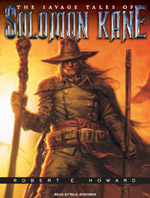
The SFFaudio PodcastThe SFFaudio Podcast #236 – The Hills Of The Dead by Robert E. Howard, read by Paul Boehmer (courtesy of Tantor Media’s The Savage Tales Of Solomon Kane). This is a complete and unabridged reading of the story (60 minutes) followed by a discussion of it. Participants in the discussion include Jesse, Mr Jim Moon, Matthew Sanborn Smith, and Bryan Alexander

Talked about on today’s show:
Second-to-last Solomon Kane story chronologically, “Red Shadows” and “Wings of the Night” close contenders for Solomon Kane stories, the latter featuring harpies from Jason and the Argonauts, history of Solomon’s staff explained in other stories, fetishes (not THAT kind!), juju stick, magical weapons, Wandering Star edition illustrated by Gary Gianni, comic book adaptations, vampire-slaying, story uncharacteristically well-plotted including foreshadowing, “plains and hills full of lions” oh my!, lion sleeping habits, “Africa is full of never-explained mysteries” excuses plot holes, prefigures Richard Matheson’s I Am Legend, Kate Beckinsale’s Underworld movies, one of few stories to depict ‘nation of vampires’, Kiss of the Vampire (film), Transylvania, homeopathic symbolism, sex sells, ‘Howardian damsel in distress’, voodoo, feminization of the jungle, homoerotic undertones, Howard biography Blood and Thunder by Mark Finn, post-Colonial critique, vampires in fiction oscillate between sexualized and homicidal, Stephen King slams Stephanie Meyer’s Twilight vampires, Nosferatu (relatively unknown at the time of this story’s writing) introduced the idea that sunlight kills vampires, the Devil as source of Kane’s lustful urges, “Howard doesn’t do metaphors very well”, vampire-zombie continuum, Howard as great visual writer, animal characteristics ascribed to Kull and Conan but not Kane, snake imagery (related to serpent in Garden of Eden?), Slave Coast, vultures, nature of the soul, “Rogues in the House” (written in one sitting while Howard had a headache), the dangers of over-interpreting Howard, Howard’s subconscious, early 20th-century magazines preoccupied with race, Cosmpolitan (it was once a literary magazine), race hierarchy, Solomon Kane less racist than Howard himself, racial hierarchy, Berbers, Solomon Kane’s conflicted personality, the New Model Army, Howard’s characters are solitary, Puritans, Kane has a death wish, Kane’s celibacy, significance of Solomon Kane’s name, Ben Jonson satirizes Puritan names (in Bartholomew Fayre), so does Terry Pratchett (in Lords and Ladies, Mormonism, concept of congregation of all believers, English Civil War and its sects, Grendel in Beowulf as descendant of Cain, Sandman comics, Kane is “always on the road”, Matthew Hopkins witchfinder general, wood imagery, we learn what a palaver is, The Dark Tower series, temptation, inquisition, H. P. Lovecraft, cohesion of Howard’s works, history of the English language, George Harrison’s coyright infringement, parallel evolution in fiction, Clark Ashton Smith, Charles Baudelaire, genocide, the importance of a shared reader-author premise, shared cultural values, Hitler, The King in Yellow, Woodrow Wilson was a racist, zombies vs. animals.

The Hills Of The Dead - Illustration by Greg Staples

The Hills Of The Dead by Robert E. Howard

The Hills Of The Dead

Solomon Kane's Fetish Staff

Solomon Kane in Africa

The Hills Of The Dead by Robert E. Howard

The Hills Of The Dead by Robert E. Howard - illustration by Hugh Rankin from Weird Tales, August 1930

ad for The Hills Of The Dead by Robert E. Howard from WEIRD TALES, July 1930

ad for The Hills Of The Dead by Robert E. Howard from WEIRD TALES, July 1930

The Hills Of The Dead - illustrated by Gary Gianni

Guillem H. Pongiluppi illustration of The Hills Of The Dead

Marcus Boas art - Robert E. Howard's Hills Of The Dead

Posted by Seth Wilson

Review of Matilda by Roald Dahl

SFFaudio Review

Matilda by Roald DahlMatilda
By Roald Dahl; Read by Kate Winslet
Publisher: Penguin Audio
Publication Date: 3 July 2013
ISBN: 9781611761849
[UNABRIDGED] – 5 hours

Themes: / fantasy / telekinesis / children / school / libraries / bullies /

Publisher summary:

Matilda is a sweet, exceptional young girl, but her parents think she’s just a nuisance. She expects school to be different but there she has to face Miss Trunchbull, a kid-hating terror of a headmistress. When Matilda is attacked by the Trunchbull she suddenly discovers she has a remarkable power with which to fight back. It’ll take a superhuman genius to give Miss Trunchbull what she deserves and Matilda may be just the one to do it!

This book made me so nostalgic for childhood, mostly because Roald Dahl is a wizard who can see through a child’s eyes but also because he was such a huge influence on me when I was a kid. Matilda was one of my favorite Roald Dahl stories, and hearing it narrated by Kate Winslet was amazing—probably the best narration I’ve heard. She colors every single character a fully realized personality, from syrupy sweet to hilariously grotesque. I think Kate Winslet is doing in narration what Quentin Blake did for Roald Dahl in illustration.

The story is Roald Dahl at his best: it is sarcastic and dark (featuring a bingo-obsessed mother, a dishonest father, and a headmistress who throws children out windows for eating in class) but it’s also hilarious, magical, and hopeful.

Matilda Wormwood is a very small, sensitive, and brilliant girl who has the misfortune of being born to gormless idiots. Mr. Wormwood is a rat-faced used-car salesman who’s really only interested in people who boost his ego. He seems allergic to his daughter, mainly because she is much cleverer than him. Mrs. Wormwood, when she’s not off playing bingo, sits around watching American soaps and thinks “Looks is more important than books!”

Matilda’s good morals and quick wits unsettle her parents, which makes them even more dismissive and neglectful of her. Her only escape is to visit the local library where she devours the whole children’s section in no time. The amazed librarian than helps guide the little girls through all the classics, from Charles Dickens and Jane Austen to George Orwell and HG Wells.

 “The books transported her into new worlds and introduced her to amazing people who lived exciting lives. She went on olden-day sailing ships with Joseph Conrad. She went to Africa with Ernest Hemingway and to India with Rudyard Kipling. She travelled all over the world while sitting in her little room in an English village.”

Reading all this literature awakens something in Matilda.  She realizes that she now has a view on life that her parents have not experienced and never will, and that there’s far more to life than cheating people and watching television.

But she’s only four, so she’s stuck with them, “no matter how asinine.”  To stop herself from going crazy, she beings to play mischievous pranks on them to punish them for every wrong they do. And when she starts school and meets even nastier bullies, she must use her brain power to develop new techniques for helping good people and punishing rotten ones.

I love the honesty Roald Dahl puts into his children’s stories. Children are often taught they must respect and obey their parents and teachers no matter what, as if we live in some utopia where all adults are intelligent, caring protectors. But Roald Dahl is not afraid to tell children the truth: sometimes monsters are real, and sometimes they look just like the people who have the most power over you or are supposed to care about you. People should earn trust and respect through their actions, not get it automatically because of their authority, age, or status.

Roald Dahl also teaches the other great wisdom: the world is full of idiots and oversized egos, and the best way to survive them is to keep your wits sharp and find the humor in every situation.

Posted by Marissa van Uden


Review of The Crown Tower by Michael J. Sullivan

SFFaudio Review

Crown TowerThe Crown Tower (The Riyria Chronicles #1)
By Michael J. Sullivan; Narrated by Tim Gerald Reynolds
Publisher: Recorded Books
Publication Date: 6 August 2013
[UNABRIDGED] = 12 hours, 49 minutes

Themes: / fantasy / warrior / thief / prostitutes /

Publisher summary:

Two men who hate each other. One impossible mission. A legend in the making.
Hadrian Blackwater, a warrior with nothing to fight for is paired with Royce Melborn, a thieving assassin with nothing to lose. Together they must steal a treasure that no one can reach. The Crown Tower is the impregnable remains of the grandest fortress ever built and home to the realm’s most prized possessions. But it isn’t gold or jewels that the old wizard is after, and if he can just keep them from killing each other, just might do it.

The Crown Tower is the first book of the Riyria Chronicles series by Michael J. Sullivan in the same world as his Riyria Revelations series. Even though published later than Revelations, the Chronicles books are chronologically earlier and explore the adventures of the same characters before the events of Revelations. Sullivan gives a great forward to the book explaining all of this and explains that he went to great lengths to ensure that a new Riyria reader (like me) could start from either point. The Crown Tower serves as a great introduction to the world and the characters and I’m looking forward to more Riyria!

The plot of the novel mainly follows two threads: Hadrian is a highly skilled warrior who has quit fighting in armies and killing men for no good reason. He gets roped into a high risk heist with a thief (Royce) he doesn’t like or trust by an old wizard friend of the family. They need to steal something from an impregnable tower but there seems to be more going on here than it seems. Gwen is a prostitute stuck in the city of Medford waiting for a man of prophecy she isn’t sure will actually come. She works for a terrible man who cares nothing for his girls and is quickly reaching the breaking point. Oh and she can tell a man’s past, present, and future by reading his palm. Gwen’s story was the less compelling of the two threads for me, but I’m sure parts of her story have greater significance in later portions of Riyria.

I really like the dynamics between Hadrian and Royce just because of how different they are. Hadrian has hope in the world, faith in the goodness of people, and a desire to help others. Royce trusts nothing, no one, and is prone to killing innocents to remove the possibility of witnesses whenever needed. One is outgoing and the other is a complete mystery. Naturally, they hate each other.

I also really like the setting of the world and the way the book is written. So many fantasy book are going the direction of “grimdark fantasy” where everything is gritty and terrible, fights are graphic, and sex scenes are pornographic. Sullivan does a great job of being realistic portraying people in dire circumstances (like the prostitutes) while still keeping the novel clean overall. He manages to have a brothel in this story without being pornographic! Amazing! Sullivan also doesn’t dwell on gore and violence while still having compelling action scenes. He builds up some serious anticipation to see Hadrian fight and does not disappoint when it comes.

As for the audiobook performance, Tim Gerard Reynolds does a great job with the different characters’ voices in this book. Hadrian and Royce’s voices match their characters really well and I had no trouble following anything going on. He did well building up the suspense during the climax of the book. I am definitely looking forward to more novels read by Reynolds.

Posted by Tom Schreck

The SFFaudio Podcast #234 – AUDIOBOOK/READALONG: Who Knows? by Guy de Maupassant

Podcast

The SFFaudio PodcastThe SFFaudio Podcast #234 – Who Knows? by Guy de Maupassant; read by Mark Turetsky. This is a complete and unabridged reading of the story (39 minutes) followed by a discussion of it. Participants in the discussion include Jesse, Mark Turetsky, and Professor Chris Coski of Ohio University.

Talked about on today’s show:
One of the last Guy de Maupassant stories, fantasy podcasts, what genre is this story?, the mysterious, the macabre, the morbid, do we buy the narrator’s story?, Am I Insane? by Guy de Maupassant, the events that happen are insane, a horror story?, a satire of Gothic horror, it is a ridiculous premise, a mental institution, is he lying?, is he deluded?, the servants, very thorough thieves, the title, Maupassant is intentionally ambiguous, there’s always a grain of the opposite, a syphilitic brain crafts a masterful short story, is it a true-ish story?, Maupassant was kind of a loner, boating among other things, Maupassant liked his solitude, touring all the European cities, THE SIGN OF DEATH PRECEDES STRANGE EVENTS, “several hours”, if the furniture is taking the place of other people…, affection for objects, The Golden Braid (aka The Tress Of Hair), falling in love with an object, the writing desk and its contents, where did the writing desk go?, his letters his papers, his personal history is now gone, deracinate , visiting new places, the history of his heart, the photographs, his emotional life, the furniture is the mental faculties, the house is him,

“Then I suddenly discerned, on the threshold of my door, an armchair, my large reading easy-chair, which set off waddling [LIKE A DUCK]. It went away through my garden. Others followed it, those of my drawing-room, then my sofas, dragging themselves along like [CROCODILES] on their short paws; then all my chairs, bounding like [GOATS], and the little foot-stools, hopping like [RABBITS].”

his desk is like a wife who’s trying to run away, the repeated refrains, “imagine my feelings”, you stop being the reader and become a participant, the revolver, marauders, the doors are alive too, Rouen, his arms were there, gun nuts, the presentiments, the river Robec, the black nauseous waters, the second hotel scene mirrors the first, is the hotel an asylum, you found your mental faculties, he checks himself in (to the hotel and the asylum), are you a private gentleman?, is the asylum is a prison?, the fat bald little yellow bearded man from Rouen with a head like a moon, grammatically it doesn’t make sense, ambiguity, THE MOON, the witch’s sabbath crescent, the play “beautiful music and fairy life drama”, he’s had a spell cast on him, “a serious accident would certainly take place”, a paralytic stroke, the sound from outside his body, a humming, trains passing, clocks, marching multitudes, “the big one”, the crescendo, “Signad” in Swedish means “designed”, Sigurd, the ring cycle, dwarves, fantasy and reality mixing, were the cops playing along?, “this house communicates with it’s neighbors”, very weird, Jesse’s tweeted dream explanation: “Dreamt an explanation for WHO KNOWS? By Guy de Maupassant – the furniture was deleted, & their dissolution was confabulated.”, not a psychological interpretation, an ontological interpretation, accidentally deleting something, SimCity, ctrl-z, not a useful miracle, an incompetent higher power, “My god, my god”, “Merciful heaven”, no grudge against, Who knows?, God knows!, a murderous schoolteacher, Revenge by Guy de Maupassant, a higher power that deletes, the short story is the only form that can be perfect, there’s something perfect, any lacuna, “a missing section of text”, the oxymoron, rude gentleness, an unbalanced situation, the insane sanity or the sane insanity, the widow Bidoin,

“He ordinarily passes his evenings at the house of a female neighbor, who is also a furniture broker, a queer sort of sorceress, the widow Bidoin”

is she married to the bald man, that Disney movie, maybe it isn’t a perfect short story, etymological searches, the tour of Africa, Sicily, Normandy, “where there hover no vague hauntings”, the missing night, a different sort of desert, Fear by Guy de Maupassant, “I had a presentiment in Africa”, “the sun dissipates it like a fog”, fear vs. panic, the spiritual gnawing of northern cultures, The Inn by Guy de Maupassant, H.P. Lovecraft, “God is dead but he never really was alive. The universe is real but we’re alone in it. Looking up at the starry night we are pointless, alone, with nothingness behind us, nothingness ahead of us, and its horrible.” he goes crazy because he’s alone, in the tumult of the crowd (with it’s light pollution), “there’s a shop for that down the street”, very very very small and unimportant, Lovecraft made it a monster, Eric S. Rabkin, light as the symbol for knowledge, inside the interesting chest cavity, a cosmic vastness and emptiness in which we are lost, solitude, Rouen, Rotomagus (round market or round plain) – but the word magus, J.R.R. Tolkien’s dwarves, great craftsmen, is the man from Roen really God?, yesterday I was in a private asylum, three months, a descent into madness, is there no lacuna in the inflexible sequence of his observations, a lacuna in which the end took place.

Qui Sait?

Who Knows by Guy de Maupassant

Stories Strange And Sinister

Pall Mall Magazine, June 1894 - Who Knows? by Guy de Maupassant - illustrated by Arthur Jule Goodman

Posted by Jesse Willis

Kubla Khan or a Vision of Dream by Samuel Taylor Coleridge (read by Wayne June)

SFFaudio Online Audio

Kubla Khan is a wondrous dream inspired poem by Samuel Taylor Coleridge. Written in 1797, but published in 1816, it is said to have been composed one night after Coleridge had been taking opium and reading a work describing Xanadu (the summer palace of the Mongol ruler and Emperor of China, Kublai Khan).

The way the great narrator Wayne June reads it you can almost feel the narcotic vapours enveloping you in their ethereal somnifacience.

After you’ve astral projected into the audio, feel free to grab hold of this ever so slighty more tangible |PDF|.

Kubla Khan by Samuel Taylor Coleridge

In Xanadu did Kubla Khan
A stately pleasure-dome decree:
Where Alph, the sacred river, ran
Through caverns measureless to man
Down to a sunless sea.
So twice five miles of fertile ground
With walls and towers were girdled round:
And here were gardens bright with sinuous rills
Where blossomed many an incense-bearing tree;
And here were forests ancient as the hills,
Enfolding sunny spots of greenery.
But oh! that deep romantic chasm which slanted
Down the green hill athwart a cedarn cover!
A savage place! as holy and enchanted
As e’er beneath a waning moon was haunted
By woman wailing for her demon-lover!

And from this chasm, with ceaseless turmoil seething,
As if this earth in fast thick pants were breathing,
A mighty fountain momently was forced;
Amid whose swift half-intermitted burst
Huge fragments vaulted like rebounding hail,
Or chaffy grain beneath the thresher’s flail:
And ‘mid these dancing rocks at once and ever
It flung up momently the sacred river.
Five miles meandering with a mazy motion
Through wood and dale the sacred river ran,
Then reached the caverns measureless to man,
And sank in tumult to a lifeless ocean:
And ‘mid this tumult Kubla heard from far
Ancestral voices prophesying war!

The shadow of the dome of pleasure
Floated midway on the waves:
Where was heard the mingled measure
From the fountain and the caves.
It was a miracle of rare device,
A sunny pleasure-dome with caves of ice!
A damsel with a dulcimer
In a vision once I saw:
It was an Abyssinian maid,
And on her dulcimer she played,
Singing of Mount Abora.
Could I revive within me
Her symphony and song,
To such a deep delight ‘t would win me
That with music loud and long,
I would build that dome in air,
That sunny dome! those caves of ice!
And all who heard should see them there,
And all should cry, Beware! Beware!
His flashing eyes, his floating hair!
Weave a circle round him thrice,
And close your eyes with holy dread,
For he on honey-dew hath fed,
And drunk the milk of Paradise.

Kubla Khan illustrated by Dugald Walker

Posted by Jesse Willis

The SFFaudio Podcast #233 – READALONG: Oryx And Crake by Margaret Atwood

Podcast

The SFFaudio PodcastThe SFFaudio Podcast #233 – Scott, Luke Burrage, and Jenny talk about Oryx And Crake by Margaret Atwood.

Talked about on today’s show:
Where’s Jesse?, Eric S. Rabkin, SPOILER TERRITORY, Jenny loves post-apocalyptic dystopian novels, it ends with more questions than answers, a man wandering on the shore, a back and forth structure, Earth Abides by George R. Stewart, big disease, a week, Jimmy’s story, the story of the apocalypse, pigoons and rakunks, The Year Of The Flood, corporate compounds, New New York, dystopia, a future world and then an apocalypse, Octavia Butler, religion, Parable Of The Sower, a parallel story with backstory and humor, a sermon and a hymn by God’s gardeners, the audiobook, a planned trilogy?, the Culture series by Iain M. Banks, extinctathon, Madadam, expert splicers, a hacker genius, the world’s best ever minds, the floor model crakers, war is misplaced sexual aggression, they could eat their own poop, it seems like Jimmy survived through the plague because he wasn’t entirely human, he doesn’t have the right smarts, creating a creation myth, the blood and roses game, nothing was a mystery anymore, yup and tick, Quicktime Osama, Civilization V, is Oryx really Oryx?, SPOILER, “I’m counting on you.”, “If only he’d paid attention to his fridge magnets.”, the way that Jimmy comes to conclusions is kinda different, “he knew why he picked Oryx”, the First Law series, Joe Abercrombie, the music at the end of the audiobook started way too early, narrator Campbell Scott, Jenny hates the convenience of canned and frozen food, wolvogs, any other complaints?, Luke really didn’t like reading about people getting off on child pornography, Jimmy is obsessed with having people tell them stuff while he’s having sex with them, Atwood’s larger point, nighty-night.com, satire, in other parts of their brains and gonads, a big turn off, do I really have to listen to this now?, why is Crake destroying humanity?, neuronormative, there will be no child abuse, random levels of technology, a good novel, good Science Fiction?, technology, DVDs, most SF writers know, Colossus: The Forbin Project,

“Although ‘MaddAddam’ is a work of fiction, it does not include any technologies that do not already exist, or bio-beings that do not already exist, are not under construction, or are not possible in theory.”

it didn’t feel intentional, it felt clunky and badly thought out, Margret Atwood doesn’t want to call it Science Fiction, she’s just not interested, a lot different in tone and feel than most SF, the Booker prize list, this is a book about humans, super-reductive, what does it tell us about humanity?, social Science Fiction, this is pretty bad Science Fiction (but a good novel), the Science Fiction falls out of Crake’s brain, J.G. Ballard, Jenny’s book club experience, boycotted, people refusing to read Oryx And Crake because it is SF, SF lumpers try to deny, Star Wars isn’t SF, a literature of ideas, “the fear of this battlestation”, a perfect description of SF, literary fiction that’s SF, Gravity’s Rainbow, Infinite Jest, Luke doesn’t like sub-genres, gmail has tags, assigning, where do you shelf it?, in the modern world a book can be shelved in many shelves, Goodreads, own-poetry-unread, STAR RATINGS!, the Force is a fantasy element, “oh, here’s another Death Star.”

Jimmy's Father Worked For Organ Farms Inc. by Mat Roff

Jimmy Went In To See The Pigoons by Jason Courtney

Oryx And Crake illustration by Jeremy Wheeler

Posted by Jesse Willis