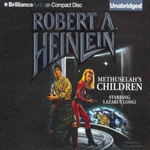
Review of Methuselah’s Children by Robert A. Heinlein

SFFaudio Review

Methuselah's ChildrenMethuselah’s Children
By Robert Heinlein; Read by MacLeod Andrews
6 CDs – 7 Hours [UNABRIDGED]
Publisher: Brilliance Audio
Published: July 2012
ISBN: 9781455878987
Themes: / space / genetic engineering / genetic modification / aging / death / interstellar travel / aliens /

Publisher Summary:

After the fall of the American Ayatollahs as foretold in Stranger in a Strange Land and chronicled in Revolt in 2100, the United States of America at last fulfills the promise inherent in its first Revolution: for the first time in human history there is a nation with Liberty and Justice for All.

No one may seize or harm the person or property of another, or invade his privacy, or force him to do his bidding. Americans are fiercely proud of their re-won liberties and the blood it cost them; nothing could make them forswear those truths they hold self-evident. Nothing except the promise of immortality….

This 1941 novel by Robert Heinlein is a short but epic space adventure about the Howard Families, a population of people who can live very long lives thanks to a history of selective breeding. Over the centuries, they took on different identities to hide their long-life nature from “short-lifers,” but eventually some of them decided to share their scientific achievement with the public.

However, instead of celebrating the Howard Families’ scientific achievement, the short-lifers suspect them of concealing the true secret to long life. This is where the story starts: when the government and the public begin to persecute the Howard Families, Lazarus Long (the kilt-wearing leader of the group who is more than 200 years old and who always has a knife strapped to his thigh) hijacks a city-sized starship so the families can flee Earth and go in search of a new home.

Despite its short size, this book covers a long length of time, is packed with ideas, and manages to explore deep themes such as aging, death, human genetic modification, and individualism, among others. There’s bound to be something in here for everyone, although personally I struggled with the first half because of the lengthy democratic meetings and the seemingly endless strategizing about what to do, how to do it, and when to do it. I also thought the discussions about the technicalities of interstellar travel or alien biology were a little tedious, but I’m sure hard-SF fans will love every moment.

I really got into the story later, when the families started arriving on other planets and things got weird. The alien cultures, worlds and philosophies were brilliant and often eerie. How can you not love aliens who say things like, “My people will like to see you and smell your skin.”

The human characters, on the other hand, were less lovable for me. They lacked depth and tended to speak literally and directly, without subtext. The narration on the audiobook didn’t help warm the dialog up either, because in the reading the characters sometimes sounded like they were barking lines at each other, and at other times odd words in the dialog were emphasized that I don’t think should have been.

The narrator McLeod Andrews did give a very clear reading though, and once I got used to his style the odd emphases were less noticeable. He did an awesome job of embodying the voice of grumpy but optimistic Lazarus Long, who was the most developed and interesting character.

Ultimately, even though not everything might be to your taste, there are just so many great ideas and themes squished into this book that you’re bound to find a ton to enjoy, despite its short length.

Review by Marissa VU

BBC Radio 4: In Our Time – a new podcast for every subject with shows from the past 14 years

SFFaudio Online Audio

Our friend Anne has added a wonderful new post to his Anne Is A Man blog about podcasts. Says Anne:

“I used to write that one should always download the In Our Time podcasts and keep for ever. The BBC used to keep only the last episode in the feed. In case one had not kept the episode, the only option to listen was to go to the on-line archive and listen while streaming. While that has become less and less of a bother with WiFi all around and capable smartphones, it still was a pity you had no option. All of this now belongs to the past; the archive is also available for download and one can lay ones hands on any chapter ever.”

The archive has been categorized into five separate feeds, sorted by subject:

BBC Radio 4 - In Our Time - CultureIn Our Time Archive – Culture
Melvyn Bragg and his guests discuss the history of ideas. Topics in the Culture feed include: architecture, the Renaissance, writing forms (like the novel, the sonnett and biography), as well as a multitude of specific persons.

Podcast feed: http://downloads.bbc.co.uk/podcasts/radio4/iotc/rss.xml


BBC Radio 4 - In Our Time - HistoryIn Our Time Archive – History

Melvyn Bragg and his guests discuss the history of ideas. Topics in the History feed include: The Wars of the Roses, specific battles, a multitude of historical personages, as well as the history of tea.

Podcast feed: http://downloads.bbc.co.uk/podcasts/radio4/ioth/rss.xml


BBC Radio 4 - In Our Time - PhilosophyIn Our Time Archive – Philosophy

Melvyn Bragg and his guests discuss the history of ideas. Topics in the Philosophy feed include: just war, rhetoric, great thinkers (Confucius, Popper, Socrates) as well as specific works of philosophy.

Podcast feed: http://downloads.bbc.co.uk/podcasts/radio4/iotp/rss.xml


BBC Radio 4 - In Our Time - ReligionIn Our Time Archive – Religion

Melvyn Bragg and his guests discuss the history of ideas. Topics in the Religion feed include: fundamentalism, prayer, the Devil, paganism, the Holy Grail, and the Spanish Inquisition.

Podcast feed: http://downloads.bbc.co.uk/podcasts/radio4/iotr/rss.xml


BBC Radio 4 - In Our Time - ScienceIn Our Time Archive – Science

Melvyn Bragg and his guests discuss the history of ideas. Topics in the Religion feed include: genetic engineering, artificial intelligence (and regular intelligence), quantum gravity, oceanography, aliens and cryptography.

Podcast feed: http://downloads.bbc.co.uk/podcasts/radio4/iots/rss.xml

Posted by Jesse Willis

The SFFaudio Podcast #124 – READALONG: Beyond This Horizon by Robert A. Heinlein

The SFFaudio PodcastThe SFFaudio Podcast #124 – a discussion of the Audible Frontiers audiobook Beyond This Horizon by Robert A. Heinlein with Scott, Jesse, and Tamahome.

Talked about on today’s show:
“We believe that an armed society is a polite society”, under the pen name Anson MacDonald, his 2nd novel, For Us The Living was first, “no nudity or free love”, The Amazing, The Astounding, And The Unknown by Paul Malmont, “a string of ideas broken up by action”, like two novellas put together, a novel about genetics and dueling, list of characters and terms, reversed names like Korea, “he’s a special guy”, moderators, germplasm, “sperm wars”, engineering away violence, Gattaca, Brave New World, “great egg!”, naturals, experimentals, written in the time of Hitler, kids are like Dune, Felix wonders what’s the point, reincarnation?, “says crazy ideas like they’re common sense”, synthesist, Scott has some quotes ready, Felix doesn’t want kids, “Felix just needs a good woman”, rambunctious scene with Felix and Phyllis, “I’m gonna kiss ya!”, Galactic Suburbia would not like this book, Heinlein’s characters, frozen football player, “everyone’s going to be a telepath”, John W. Campbell, “they don’t talk about telepathy anymore”, Podkayne Of Mars, Heinlein and fertility, Heinlein FAQ, the economic system — Social Credit, Beyond This Horizon on Wikipedia, spread the wealth, “What is money?”, it all goes to 0’s and 1’s, waterbed conception, The John W. Campbell Letters, bringing up super-writers, we never change, Campbell hated Dune Messiah, Felix is a “starline”, no Heinlein sequels??, “needs more telepathy”, best Heinlein novel?, Moon Is A Harsh Mistress, Double Star is like Moon Over Parador with Richard Dreyfuss, Starship Troopers has an action-packed start, Heinlein’s short stories like By His Bootstraps with Dreyfuss dramatized on 2000X, Red Planet with pet ball that’s an alien (now I get the Willis joke), Have Spacesuit Will Travel starts well, Heinlein as a dad, Fullcast Audio did a lot of these, Tunnel In The Sky just arrived and is like The Hunger Games, it’s a sci-fi Lord Of The Flies, Full Cast Audio is trying to be family friendly, nudity, worst Heinlein plot?, will the future remember football?, the sport “bligablong”, let’s read the opening, “the halt?”, serialized like The Space Merchants, “it’s all of those things and much more!”, it’s quotable, is the U.S. more polite?, England, duels are stressful, old reviews, 1900-1950 era, 1984, Brave New World, Heinlein starts the SF novel and hardback trend, Hugo Gernsback, Scott loved Foundation, Nazis on the moon, Rocket Ship Galileo, generation ship in Universe (nice old cover), “sucker for space.”

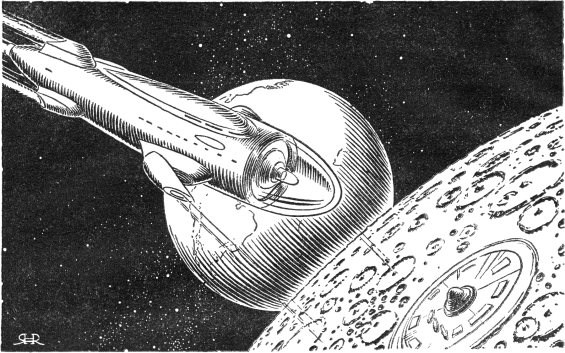
Beyond This Horizon - cover illustration by Hubert Rogers

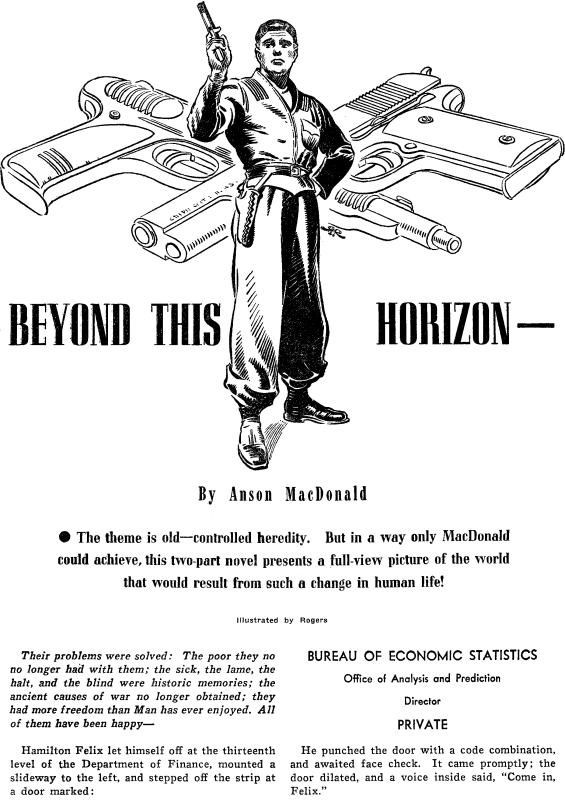
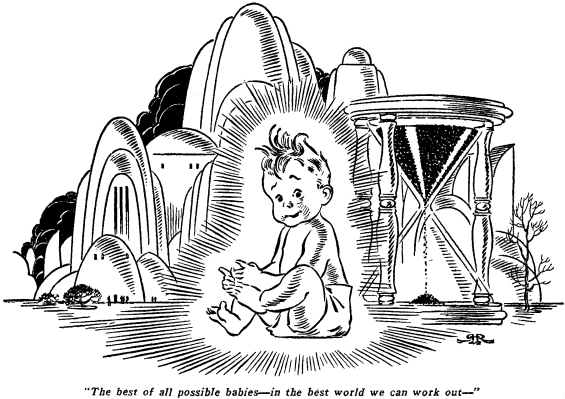
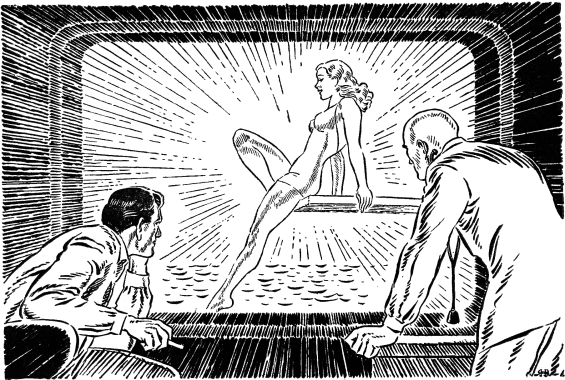
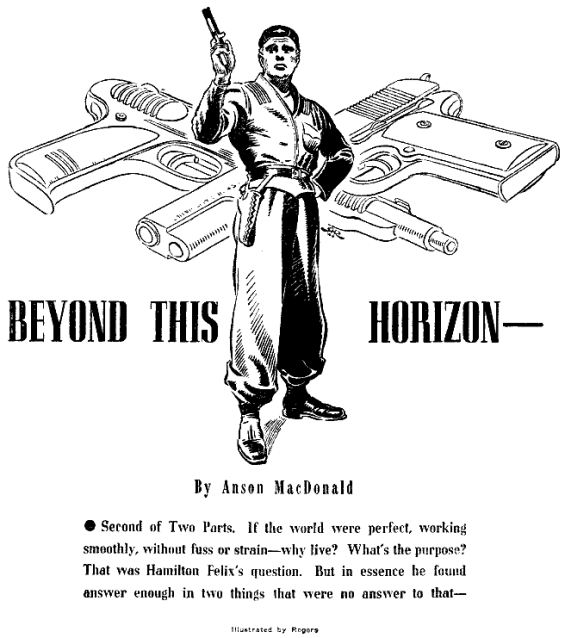
Beyond This Horizon - Astounding Science Fiction April 1942 - illustration by Hubert Rogers

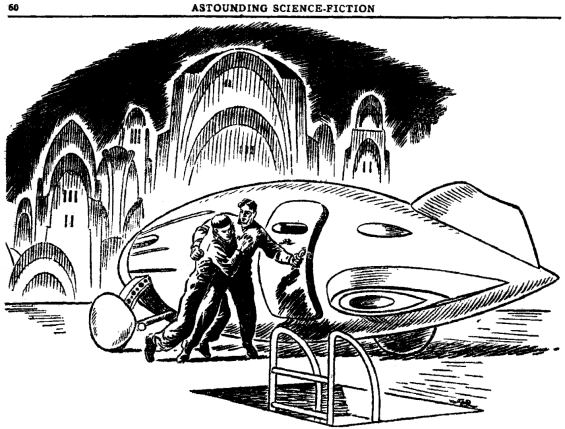
Beyond This Horizon - Astounding Science Fiction April 1942 - illustration by Hubert Rogers

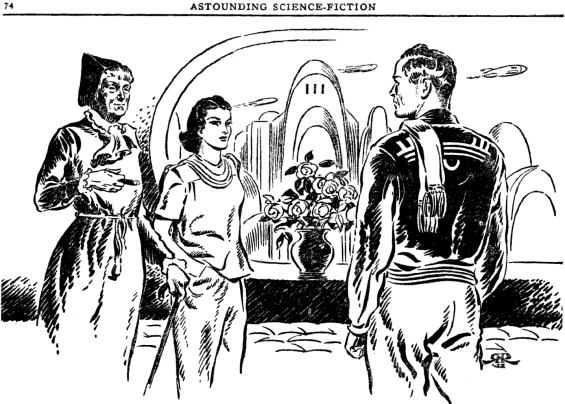
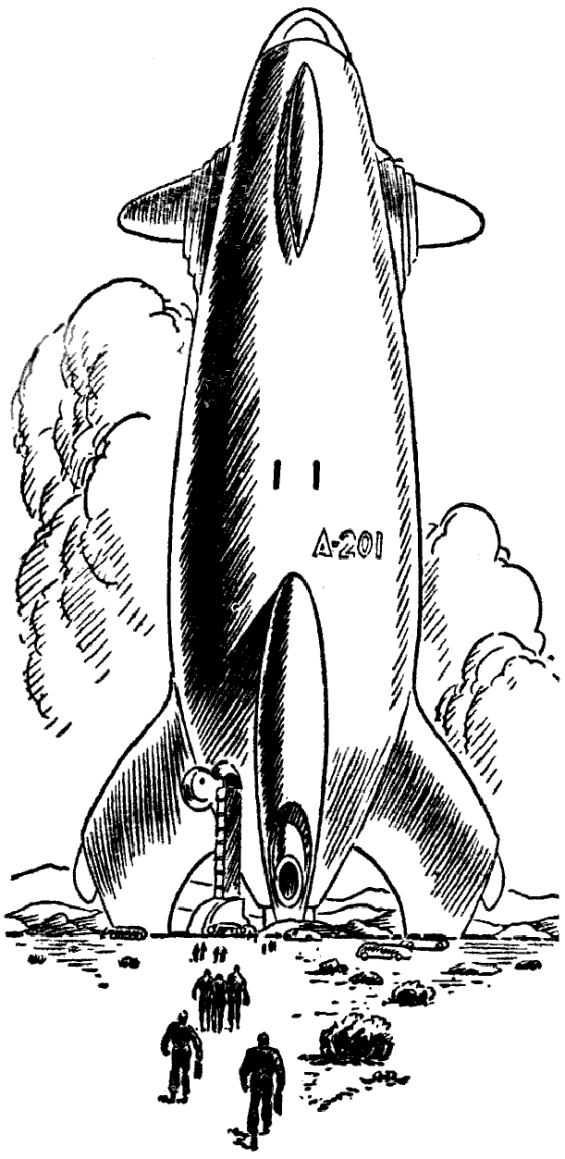
Beyond This Horizon - Astounding Science Fiction April 1942 - illustration by Hubert Rogers

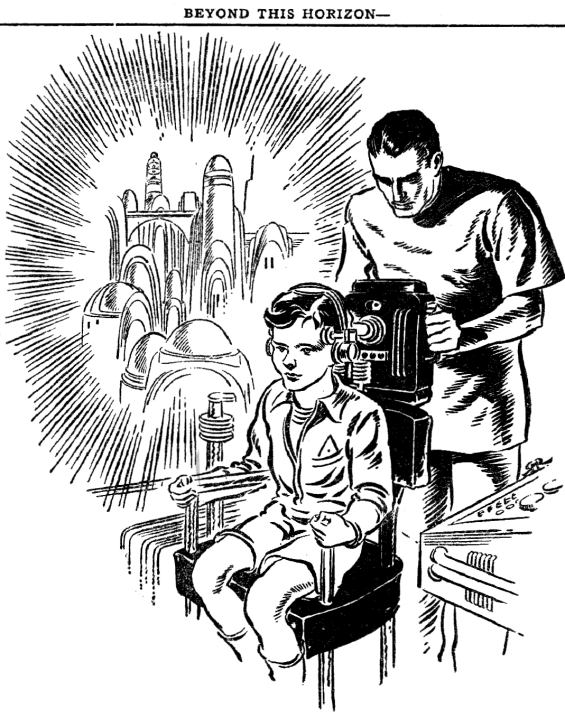
Beyond This Horizon - Astounding Science Fiction April 1942 - illustration by Hubert Rogers

Beyond This Horizon - Astounding Science Fiction April 1942 - illustration by Hubert Rogers

Beyond This Horizon - Astounding Science Fiction May 1942 - illustration by Hubert Rogers

Beyond This Horizon - Astounding Science Fiction May 1942 - illustration by Hubert Rogers

Beyond This Horizon - Astounding Science Fiction May 1942 - illustration by Hubert Rogers

Beyond This Horizon - Astounding Science Fiction May 1942 - illustration by Hubert Rogers

Beyond This Horizon - Astounding Science Fiction May 1942 - illustration by Hubert Rogers

Beyond This Horizon - Astounding Science Fiction May 1942 - illustration by Hubert Rogers

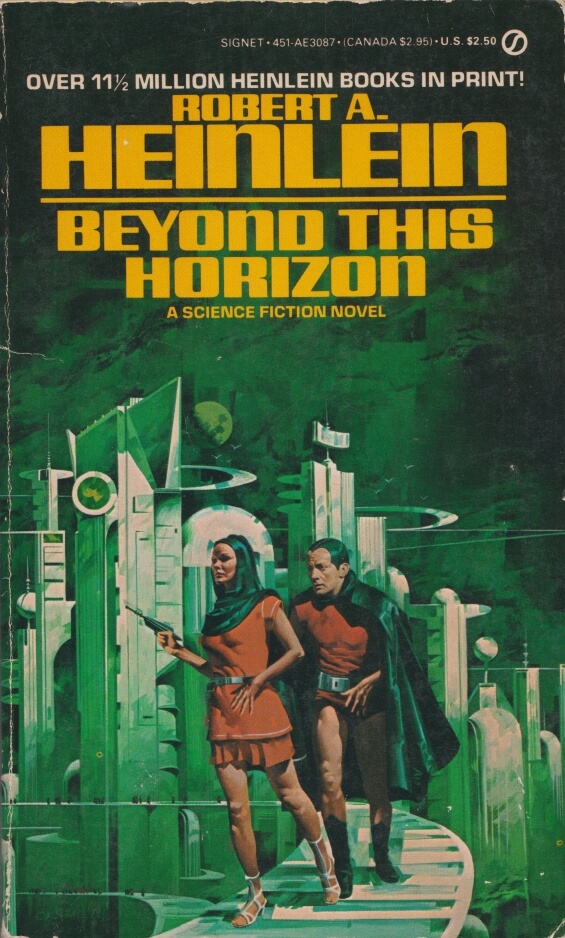
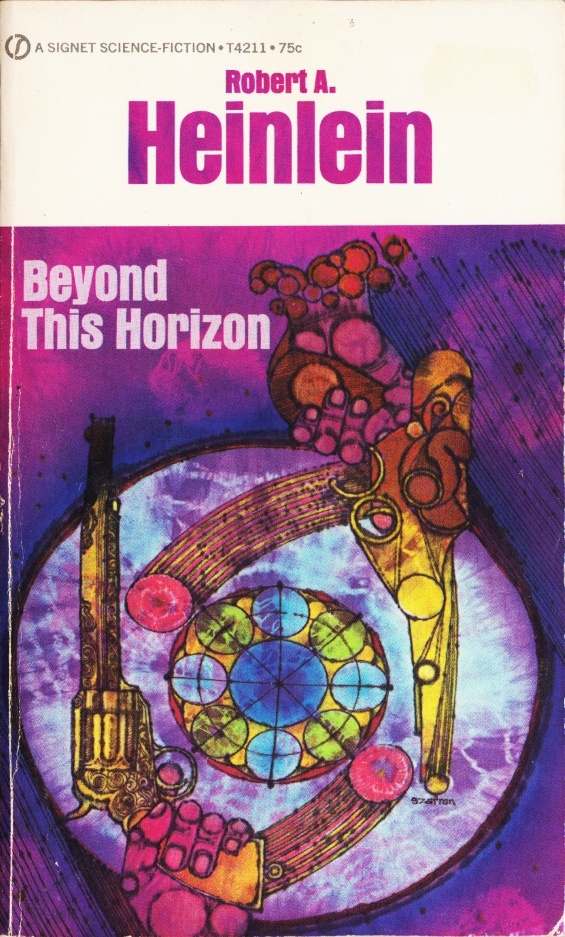
SIGNET - Beyond This Horizon by Robert A. Heinlein

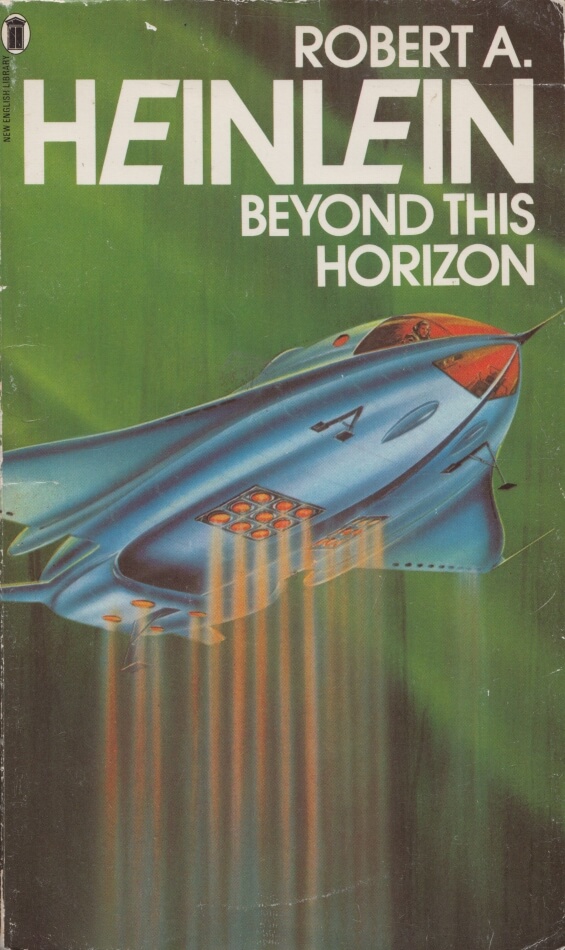
New English Library - Beyond This Horizon by Robert A. Heinlein

Signet Science Fiction - T4211 - Beyond This Horizon by Robert A. Heinlein

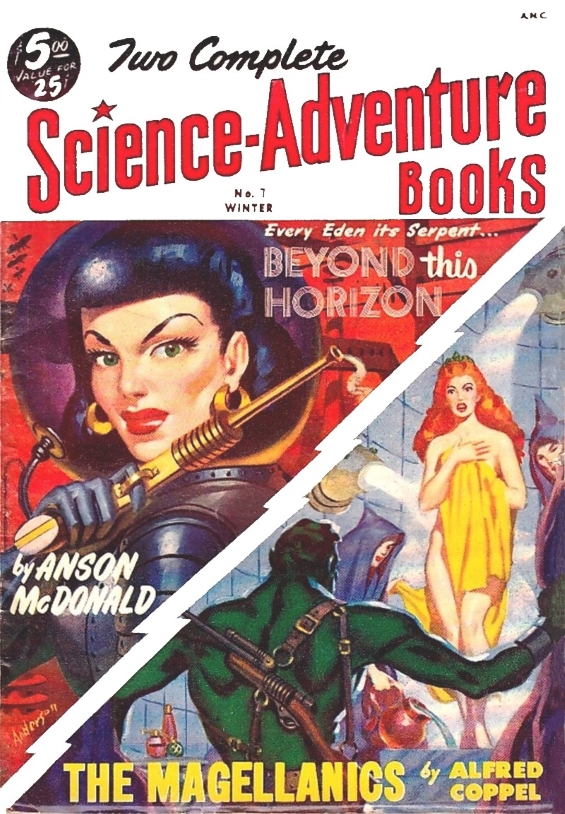
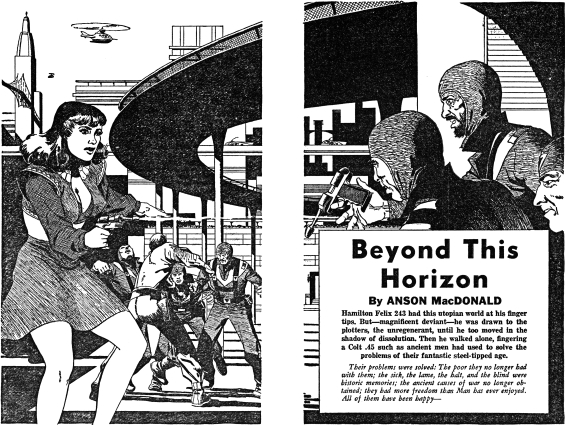
Science Adventure Books, No. 1, Winter 1952 - Beyond This Horizon by Robert A. Heinlein

Science Adventure Books, No. 1, Winter 1952 - Beyond This Horizon by Robert A. Heinlein

Science Adventure Books, No. 1, Winter 1952 - Beyond This Horizon by Robert A. Heinlein

Otre L'Orizzonte by Robert A. Heinlein

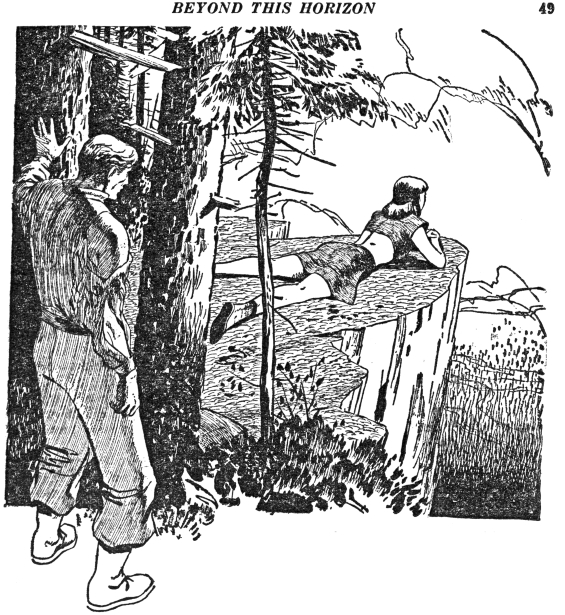
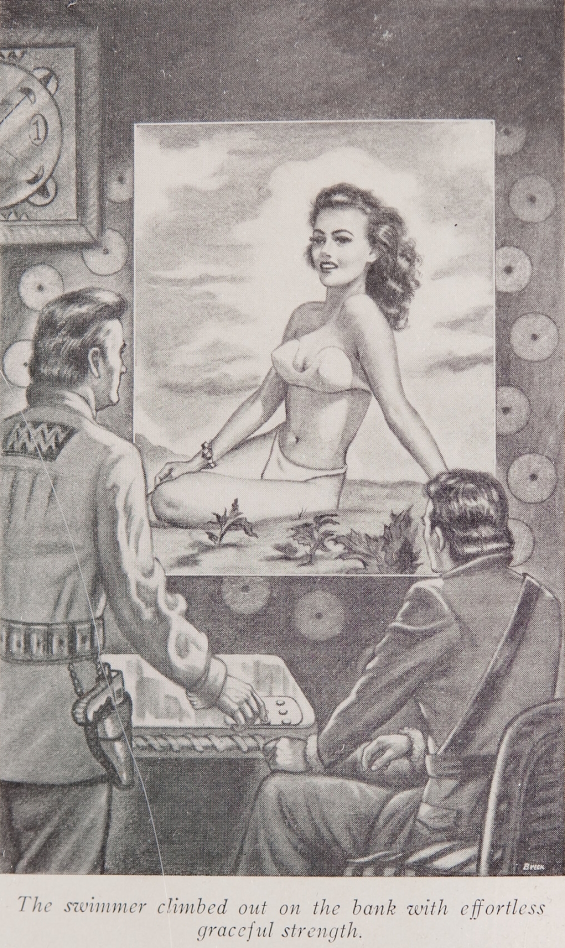
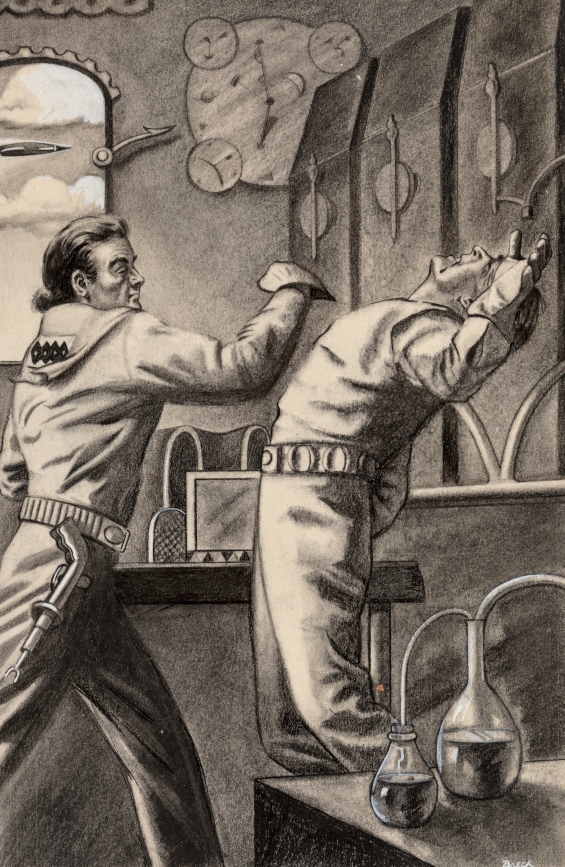
Robert Breck illustration for Beyond This Horizon, 1948

Robert Breck illustration for Beyond This Horizon, 1948

Posted by Tamahome

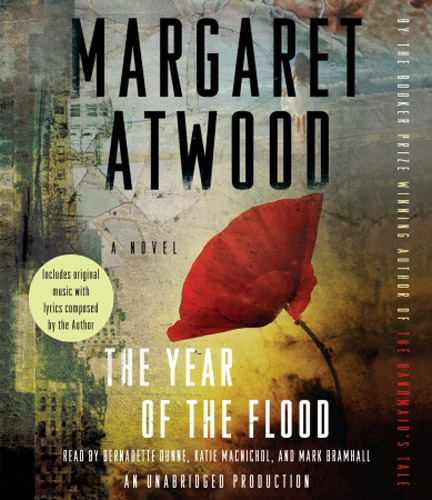
Review of The Year Of The Flood by Margaret Atwood

SFFaudio Review

RANDOM HOUSE AUDIO - The Year Of The Flood by Margaret AtwoodThe Year Of The Flood
By Margaret Atwood; Read by Bernadette Dunne, Katie MacNichol and Mark Bramhall
11 CDs – Approx. 14 Hours [UNABRIDGED]
Publisher: Random House Audio
Published: September 22, 2009
ISBN: 9780739383971
Themes: / Science Fiction / Dystopia / Disaster / Environmentalism / Environmental Disaster / Ecology / Planetary Ecology / Religion / Genetic Engineering / Sex / Activism / Genetics /

The long-awaited new novel from Margaret Atwood. The Year of the Flood is a dystopic masterpiece and a testament to her visionary power. The times and species have been changing at a rapid rate, and the social compact is wearing as thin as environmental stability. Adam One, the kindly leader of the God’s Gardeners—a religion devoted to the melding of science and religion, as well as the preservation of all plant and animal life—has long predicted a natural disaster that will alter Earth as we know it. Now it has occurred, obliterating most human life. Two women have survived: Ren, a young trapeze dancer locked inside the high-end sex club Scales and Tails, and Toby, a God’s Gardener barricaded inside a luxurious spa where many of the treatments are edible. Have others survived? Ren’s bioartist friend Amanda? Zeb, her eco-fighter stepfather? Her onetime lover, Jimmy? Or the murderous Painballers, survivors of the mutual-elimination Painball prison? Not to mention the shadowy, corrupt policing force of the ruling powers . . .Meanwhile, gene-spliced life forms are proliferating: the lion/lamb blends, the Mo’hair sheep with human hair, the pigs with human brain tissue. As Adam One and his intrepid hemp-clad band make their way through this strange new world, Ren and Toby will have to decide on their next move. They can’t stay locked away . . .By turns dark, tender, violent, thoughtful, and uneasily hilarious, The Year Of The Flood is Atwood at her most brilliant and inventive.

Margaret Atwood’s book The Year Of The Flood spans several years, before, after and during the waterless flood which is a plague that affects only humans. There are three readers, Bernadette Dunne, Katie MacNichol and Mark Bramhall. Throughout the eleven discs (14 hours), I enjoyed listening to the women, and began to dread the onset of the male reader. He was certainly professional. Was it his character, Adam One, a religious cult leader of God’s Gardeners? Was it the inevitable sermon he would read in a church-appropriate voice? Or was it the hymns, written by Atwood and set to “original” music that would have me engaging in positive procrastination in order to avoid finishing this audiobook.

The loveliest parts of the book take place from the point of view of Ren, a child in God’s Garden. The religion is a logical outcome for a near future on Earth following environmental disasters not too difficult to imagine. Technologies we toy with today lead to some A Clockwork Orange style vocabulary. Words such as “garboil” (a kind of petroleum made from trash) lend a frighteningly vital immersion into this eco-nightmare. Other wonderful vocabulary delights come through the genetic alterations of food and creature such as soydines and bugs with little smiley faces engineered thereon so thoughts of squishing them would be repugnant. The Gardeners have a host of saints to celebrate, showing Atwood’s ability to relate some important environmentalists and peaceniks to her tale including Saint Rachel Carson, Saint David Suzuki and Saint Mahatma Gandhi.

The main female characters, Ren and Toby, both fully developed, are compelling. Throughout the story, one is interested in them as human beings, in their suffering, in their losses, in their desires. Despite the time shifts, the readers manage to keep the characters believable; one is lost in the story (as one should be!) until the final disc. Maybe Atwood can’t write optimistic endings. With all the violence, sadistic sex and death in the world of the Gardeners who are staunch vegetarians who don’t even kill the insects that invade their gardens; with spray guns, layabout body parts and a world of human-pig hybrids conducting funerals, the last disc felt wrong. Ren’s character becomes childish. Toby becomes a murderous cold-blooded killer and then suddenly has another personality shift. The only character to remain true is the one-dimensional ADAM ONE. I was strung along on the brilliant imagination, left flat on story line, and confused in the end by the characters I thought I liked.

Am I waiting for that third expected book in a TRILOGY featuring some of these characters? My interest in Atwood’s “exfernal” world is now lukewarm.

Posted by Elaine Willis

Review of Winterfair Gifts by Lois McMaster Bujold

SFFaudio Review

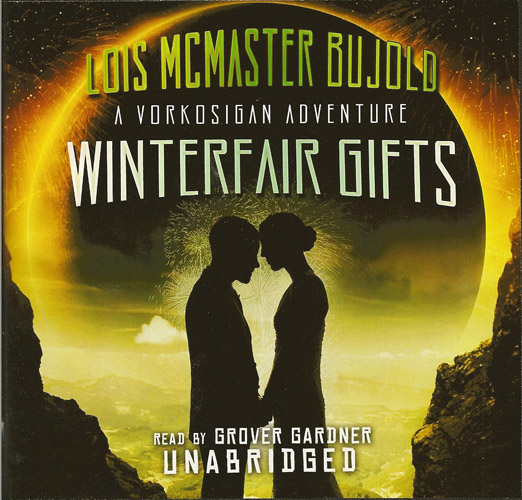
Science Fiction Audiobook - Winterfair Gifts by Lis McMaster BujoldWinterfair Gifts
By Lois McMaster Bujold; Read by Grover Gardner
2 CDs – 2.5 Hours [UNABRIDGED]
Publisher: Blackstone Audio
Published: 2008
ISBN: 9781433250170
Themes: / Science Fiction / Romance / Genetic Engineering / Crime /

This Hugo-nominated novella adds a delightful extra chapter to Bujold’s Vorkosigan series, describing the wedding of Miles and Ekaterin and events leading up to it. In the festive season of Winterfair on the planet Barrayar, Lord Miles Vorkosigan is making elaborate preparations for his wedding. The long-awaited event stirs up romance and intrigue among his eccentric family and friends, particularly for bioengineered space mercenary Sergeant Taura and shy, diffident Armsman Roic. But Miles also has an enemy who is plotting to turn the romantic ceremony into a festival of death.

I generally like most of the things I read. This is probably because I pick what I’m going to read fairly carefully. It’s rare when I sit down with an a book and it isn’t something I’ve already read something about. One of the things that tends to keep me away from a book is an excessive length. I find far too much of today’s fiction overly wordy. I want the ideas in the book, the experiences, I don’t need to see it hit a certain pagecount. The style of the moment is to go long. Often this leads to entirely pointless writing within a story. It’s like I’m Paul Newman in Fat Man And Little Boy. My mantra is: “Just give it to me.” Give me the story – don’t flower it up or string it out. Just give me the bloody story!

Lois McMaster Bujold doesn’t bloat out her stories. This audiobook, a novella, is a good example of that economy. Sure it’s part of a series, but it can and does stand alone. The story is slowly paced, but not slow to read. Readers, like me, who haven’t been oh-so-carefully following the Miles Vorkosigan adventures can still follow the story of any particular novel (or novella) and enjoy it for what it is – a good read. Those who have been following along carefully, and who pick up on some of the timeline and character clues, will probably get an extra bit of enjoyment out of it.

Bujold is one of the few female SF authors I have no problem reading. This is despite her coming at SF from what I see as a very female point of view. Emotion, humor and romance are key for Bujold. Character, something I usually don’t care that much about, is also one of Bujold’s major strengths. In this novella, we get two minor Vorkosigan players meeting and working together for the first time. Its mostly a character piece – with the mechanics of the crime and the science fictional elements taking a serious back seat to a budding romance. It’s the same sort of work/romance thing you get in Bones and Moonlighting. Nobody enjoys those stories for the groundbreaking writing. Now that may sound like I’m damning Winterfair Gifts with faint praise. I’m really not. Winterfair Gifts is fun, skillful storytelling set in an SF universe. This is a gentle romance with a bittersweet twist. A romance story dudes can enjoy. Bujold is a fine writer and Winterfair Gifts is a damn fine audiobook. Consider this fresh series as an alternative to the increasingly devalued Dune series.

Sergeant Taura and Armsman Roic, two trusted members of the extended Vorkosigan security services (and everyone else in this book) are voiced by veteran narrator Grover Gardner. Gardner is one of the old school narrators who long time audiobook fans just love to listen to. His voice is rather odd, almost sounding artificial – but not at all in a bad way. Audiofile Magazine has a quote describing his voice as “sandpaper and velvet” – which really doesn’t tell you much – unless you’ve heard his voice. He’s a skilled narrator and is well chosen for the Vorkosigan saga.

Posted by Jesse Willis

The SFFaudio Podcast #008

Podcast

The SFFaudio PodcastThe SFFaudio Podcast #008 – here there be podcasts – we’ve adorned ourselves in too much gold, now we can’t move! So join us on our 8th show, where we’re always etymologically correct.

Scott: Oh ya right. I just forgot something man. Uh, before we dock, I think we ought to discuss the bonus situation.

Jesse: Right.

Scott: We think… we think we deserve full shares.

Jesse: Right.

Scott: Pass the cornbread.

Topics discussed include:
42Blips.com, METAtropolis, Jay Lake, John Scalzi, Elizabeth Bear, Tobias Buckell, Karl Schroeder, Mr. Spaceship, Philip K. Dick, Stefan Rudnicki, Wonder Audio, Anne McCaffrey, The Ship Who Sang, Michael Hogan, Battlestar Galactica, 18th Century Spain, Cascadia (Oregon, Washington, British Columbia, and sometimes Idaho), Detroit, “Turking”, The Turk (the chess playing automaton), alternative economy, Kandyse McClure, infodump, shared world, Brandon Sanderson, hard fantasy, Elantris, Larry Niven, The Magic Goes Away, manna, unicorns, dragons, Dungeons & Dragons, Mistborn, Robert Jordan, The Wheel Of Time, Writing Excuses Podcast, Howard Tayler, SchlockMercenary.com, Dan Wells, The Dark Knight, Aural Noir, The New Adventures Of Mike Hammer, Stacy Keach, Mike Hammer, Full Cast Audio, Red Planet, Robert A. Heinlein, Bruce Coville, Mars, Heinlein’s Future History sequence, the Red Planet TV miniseries, Princess Academy, Shannon Hale, Blackstone Audio, The Collected Stories Of Philip K. Dick Volume 1, and Volume 2, Inferno by Larry Niven and Jerry Pournelle, David Farland, Runelords, Collected Public Domain Works Of H.P. Lovecraft, LibriVox.org, October, Ray Bradbury, “Autumn ennui”, AUTHOR PAGES, LEIGH BRACKETT, FREDERIC BROWN, JAMES PATRICK KELLY, BBC7, RadioArchive.cc, Beam Me Up Podcast, MACK REYNOLDS, Robert Sheckley, Religulous, Constantine’s Sword, The Ultimate Encyclopedia Of Science Fiction: The Definitive illustrated Guide edited by David Pringle, space opera, planetary romance, Julie D., Forgotten Classics podcast, The Wonder Stick, time travel, alien intrusions, metal powers, Slan, The Demolished Man, comedic SF, aliens, artificial intelligence, “cosmic collisions”, Deep Impact, cyborgs, dinosaurs, the dying Earth, Gene Wolfe, elixir of life, immortality, Roger Zelazny, Robert Silverberg, genetic engineering, nuclear war, overpopulation, parallel worlds, robots, androids, Joanna Russ, Ben Bova, space travel, suspended animation, teleportation, transcendence = the Singularity ?, Childhood’s End, Arthur C. Clarke, religion, 2001: A Space Odyssey, Monica Hughes, Crisis On Conshelf Ten, Hard SF, cyberpunk, psychology, New Wave, lost races, military SF, science fantasy, shared worlds, steampunk.

Posted by Jesse Willis