Review of Thirteen by Richard K. Morgan

SFFaudio Review

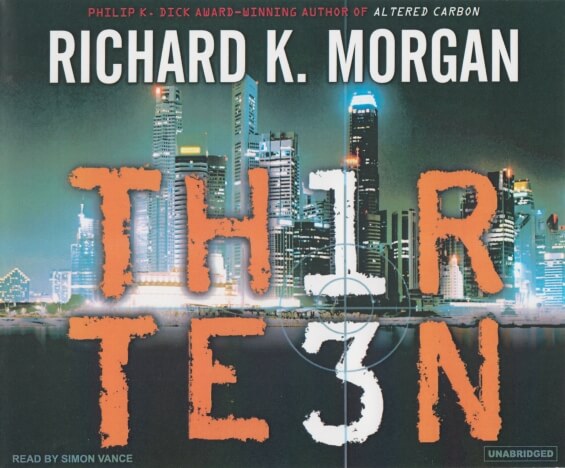
Tantor Audio - Thirteen by Richard K. Morgan

Thirteen
By Richard K. Morgan; Read by Simon Vance
18 CDs or 3 MP3-CDs – Approx. 23 Hours [UNABRIDGED]
Publisher: Tantor Audio
Published: July 2007
ISBN: 1400104319 (CDs), 1400154316 (MP3-CDs)
Themes: / Science Fiction / Noir / Mystery / Hard Boiled / Genetic Engineering /

Carl Marsalis is a traitor, a bringer of death, a genetic freak and an unwelcome reminder of all that is dark in the human psyche – he in every sense of the word a Black Man. And right at the moment he’s beyond the UN’s jurisdiction, banged up in a Florida jail for financing an illegal abortion. So when the US police call, Carl cuts a deal. The 13s are genetically engineered alpha males, designed to fight the century’s last conflicts. But men bred and designed to fight are dangerous to have around in peacetime. Many of them have left for Mars, but one has returned. Somehow he survived the journey to Earth, and now a series of brutal slayings has erupted across America. Only Carl can stop him. And so begins a frenetic man hunt and a battle for survival. And a search for the truth about what was really done with the world’s last soldiers.

I find Richard K. Morgan, in his rare interviews, offers deep insights into his work. In regards to Thirteen (called Black Man in the U.K.), he describes it as: “An accidentally lengthy meditation on elements of the human condition that the Kovacs books [Altered Carbon etc.] always had the capacity to sidestep – namely, the prison of our own flesh, and the inevitable doom of our own mortality.” And its true, Morgan delivers action and cogitation on action. The setting, a grimly-futuristic Earth and the characters play out the consequences of a well thought out backstory. In Thirteen it seems that various experiments in genetic engineering have lead to at least thirteen strains of humanity. Like all good hard-boiled mysteries it has a fully realized backstory that predominates the main-stage machinations. Carl Marsalis is our anti-hero. He’s one of a small group of genetically engineered super-soldiers who were created by the British government for military use. In Thirteen, Morgan has created a grim future – one that is different from his detailed Altered Carbon and Market Forces worlds – but no less vivid. Years ago, in our future, a new arms race ran rampant, every nation with super-power ambitions started making genetic super-soldiers, others side stepped into crossbreeding bonobos sexual appetites and attitudes into humans. Add in a new racism bound to genetics, the old racism based on skin tone, the potential return of Jesus Christ, a dissolved United States of America, and international intrigue plays out from South America to Asia Minor and Mars – and you get a very rich premise. Carl Marsalis is a dour, taciturn anti-hero, but he’s pretty compassionate for a sociopath. His genes and something called “mesh” (another Richard K. Morgan edge-giver like “neuro chem” from Altered Carbon) and martial arts from Mars make him one bad-ass Brit. If there’s a weakness with the story, it’s the intricacy, there’s almost too much backstory – this leads to too many scenes where little bits of information get doled out. The addition of well more than a dozen characters for Marsalis to tangle with make the whole novel feel long. Thankfully, there’s a perfect ending capping this thoughtfully Noir Science Fiction novel.

Tantor Audio tapped Simon Vance to voice Thirteen, he also narrated Morgan’s Market Forces. Vance brings his a growing body of experience to work with him, and manages to nail a lot of accents in this continent bounding tale. The only point I was shaken from the narrative came when Vance used what sounded like a Charlie Chan impression for a female Chinese character. So far Tantor’s had a lock on the Richard K. Morgan audiobook market so I’m hoping they’re planning on recording The Steel Remains, his forthcoming novel too.

Posted by Jesse Willis
Review of Diplomatic Immunity by Lois McMaster Bujold

SFFaudio Review

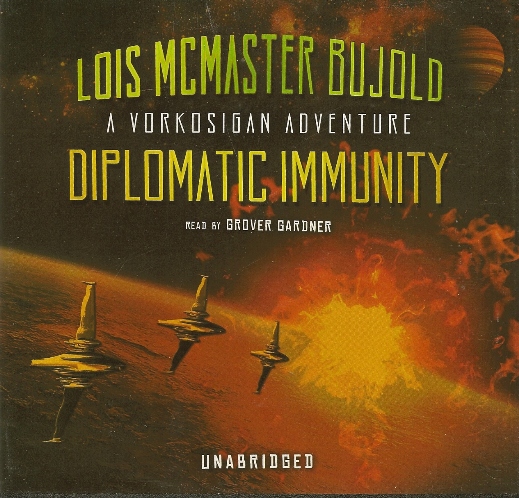
Diplomatic Immunity by Lois McMaster BujoldDiplomatic Immunity
By Lois McMaster Bujold; Read by Grover Gardner
9 CDs – 11 hours – [UNABRIDGED]
Publisher: Blackstone Audio
Published: 2008
ISBN: 9781433213144
Themes: / Science fiction / Space Opera / Military / Diplomacy / Romance / Genetic Engineering / Intrigue /

Blackstone Audio has been publishing the entire Vorkosigan series read by Grover Gardner. There are several volumes out, and we’ve reviewed a couple of them (The Vor Game and Mirror Dance) before this one. I have little to add to the positive assessment of Gardner’s talent that the other reviews of this series have pointed out; I’ll just say that I enjoy his narration of these books very much. He’s got a dry tone that fits Miles Vorkosigan perfectly. A very pleasant listen.

In this particular volume, Miles is called into diplomatic action against the Quaddies, a genetically engineered race that we were introduced to in the novel Falling Free. In that novel, we learn that quaddies are genetically altered humans that have four arms and no legs which is an advantage if you live and work in zero gravity. The only problem? They were treated as slaves by the company that made them, and the novel is largely about their rebellion.

Diplomatic Immunity takes place 300 years after that one, and much has changed, though distrust for “downsiders” remains. Vorkosigan is called in when some citizens are captured and held by the Quaddies at their Graf Station. He meets with the representatives of the Quaddie government, hears their side of the story, then proceeds to uncover the truth while preventing a war.

Miles Vorkosigan is a fine character. He’s got flaws (and plenty of them) yet always manages to succeed despite them. His personality is entertaining, and the plot of this novel, in which Miles is called upon as both diplomat and detective, is just plain fun. Whenever I listen to one of these, I imagine how good a television series this would make. These novels are not meant to be masterpieces of hard science fiction – they are meant to be enjoyed, and enjoy them I do. I can’t wait to hear the next one, though I feel that listening to them in the original print publication order would add even more to the experience, the main reason being that the Miles I hear in this novel is not the same Miles I heard in The Vor Game, I expect due to events in the novels in-between.

Lois McMaster’s Vorkosigan novels have an interesting history on audio. A company named The Reader’s Chair originally came out with enjoyable unabridged versions read in tag team fashion by Michael Hanson and Carol Cowan. Unfortunately, the company didn’t survive. One of the first reviews I wrote when I got into reviewing audio was the Reader’s Chair audio version Falling Free, the Nebula Award winning novel that I spoke of earlier in the review. Click here to see it.

Posted by Scott D. Danielson

BBC Radio 7 reruns Brave New World

Online Audio

BBC 7's The 7th DimensionThough BBC7 doesn’t offer a single podcast [GRRR!], the do have one endearment that we can appreciate… re-runs! BBC Radio 7’s the 7th Dimension is re-broadcasting the ten part abridgment of Brave New World. Aldous Huxley’s dystopian classic, first published in 1932, depicts an ominous,l but not wholly repulsive vision of future society. This abridged version has been previously broadcast on both BBC7 and BBC4.

Brave New World by Aldous HuxleyBrave New World
By Aldous Huxley; Read by Anton Lesser
10 X 15 Minute Episodes – Approx. 2.5 Hours [ABRIDGED]
BROADCASTER: BBC7’s The 7th Dimension
BROADCAST: Monday to Friday at 6:45pm (repeats 12:45am) UK Time*
A nightmare vision of the future, where humans are battery farmed and cloning and consumerism is rife.

All ten parts will be made available via the Listen Again service shortly after they air.

Jesse Willis

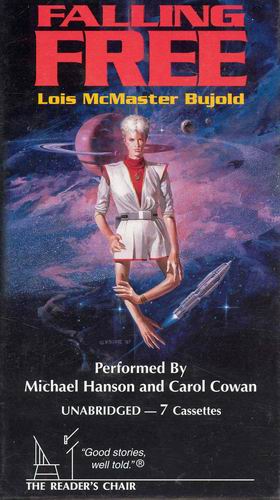
Review of Falling Free by Lois McMaster Bujold

Science Fiction Audiobooks - Falling Free by Lois McMaster BujoldFalling Free
By Lois McMaster Bujold; Read by Michael Hanson and Carol Cowan
7 Cassettes – 9 hours [UNABRIDGED]
Publisher: The Reader’s Chair
Published: 1996
ISBN: 0962401099
Themes: / Science Fiction / Genetic Engineering / Space Travel / Space Stations / Slavery / Corporations /

When I heard about The Reader’s Chair going out of business, I couldn’t help but to revisit this book. I first started writing about audiobooks back in 2001, and one of the first columns I wrote for SFSite was about The Reader’s Chair. In that column, I said:

The audio versions are first-rate. Hanson and Cowan read the books with enthusiasm, providing different characters with different inflections. Great care was taken to make these novels a listening pleasure.

Upon listening to this Nebula-winning novel, and after hearing I have no clue how many audiobooks since, I can still say that the Reader’s Chair titles are amongst the finest out there. Michael Hanson has a deep sonorous voice that demands attention, and Carol Cowan is a warm yet feisty counterbalance.

Falling Free is a novel that fits into Lois McMaster Bujold’s Vorkosigan series, but the events occur 200 years before the birth of the famous Miles Vorkosigan. The story involves a corporation that genetically engineers a new race of humans (called Quaddies) that are uniquely adapted for work in zero-gravity. Enter Leo Graf, an engineer hired to teach zero-g welding techniques to this new race of slave labor. When he sees how the Quaddies are treated, he becomes very uneasy. Think you know where this is heading? Bujold pulls it off brilliantly.

This one is now officially out of print, but well worth finding. The Reader’s Chair productions are top notch, from the high quality production value to the sturdy and fine-looking packaging. I’m very sorry to see them go.

Posted by Scott D. Danielson

Review of Vitals By Greg Bear

Science Fiction Audiobooks - Vitals by Greg BearVitals
By Greg Bear; Read by Jeff Woodman
3 Cassettes – 5 hours 16 minutes [ABRIDGED]
Publisher: Random House Audio
Published: January 2002
ISBN: 0553714953
THEMES: / Science Fiction / Genetic Engineering / Immortality /

The edge of immortality is the deadliest place of all…Hal Cousins is one of a handful of scientists nearing the most sought after discovery in human history: the key to short-circuiting the aging process. Fueled by a wealth of research, an overdose of self-confidence, and the money of influential patrons to whom he makes outrageous promises, Hal experiments with organisms living in the hot thermal plumes in the ocean depths. But as he journeys beneath the sea, his other world is falling apart.

I like Greg Bear’s work, I really do. Or at least I did before listening to Vitals. I truly savored previous Greg Bear audiobooks, the novels Blood Music and Queen Of Angels and the collection of his short work entitled The Wind From A Burning Woman are all really great listens even though somewhat difficult to follow. Unfortunately Vitals sounds more intriguing in theory than it is in execution. I really cannot think of a single good thing to say about the novel’s construction. It takes the interesting ideas from Blood Music and then ineffectually recycles them into an aimless plodding story. The central conceit, that bacteria are taking over the world in an unpredictable way, is blatantly stolen from Blood Music, Bear’s best work. But Bear doesn’t refine his ideas, instead he adds in a completely bizarre character viewpoint switch in the middle of the story, and later another non-sequitor changes the time period for even more exposition, backing and filling to detrimental effect.

What’s worse, Bear decides to eliminate what few interesting characters there are and finally puts us out of our misery with an unresolved ending. Vitals is like a bad action movie jumping from one scene to another without rhyme or reason. It’s one big train wreck of a novel. Bear has truly fallen and he can’t get up!

This is an abridgement and surely we could argue that a bad abridgement can really hurt an audiobook, but somehow I doubt adding more words to this mess could have helped. Jeff Woodman did his best with what he was given; his narration was very good and clear, with distinct characterization of voices. The cover art falls into the category of “bland non-specific” which so pervades novels these days.

Posted by Jesse Willis