SFBRP #151: Time Travel Special, part 1 – Mark Twain – A Connecticut Yankee in King Arthur’s Court

SFFaudio Online Audio

The Science Fiction Book Review Podcast Episode #151 of The Science Fiction Book Review Podcast is a special episode on Mark Twain’s A Connecticut Yankee in King Arthur’s Court and similar time travel tales. It is both special and strange. First it’s strange because it’s the first part of a two part discussion of time travel and not a regular book review. Secondarily it is special because I participated in it!

Or as Luke puts it:

Time Travel Special part 1: Luke and Jesse discuss A Connecticut Yankee in King Arthur’s Court by Mark Twain as a jumping off point for the topic of “A being out of time.”

|MP3|

Podcast feed: http://www.sfbrp.com/?feed=podcast

Discussed on the show:
The Invisible Man by H.G. Wells, Smoke by Donald E. Westlake, romance and time travel, science fiction’s hold on time travel, the process of time travel vs. the man out of time, Army Of Darkness, A Connecticut Yankee in King Arthur’s Court is totally political, retellings and abridgements of A Connecticut Yankee in King Arthur’s Court, Jonathan Swift’s Gulliver’s Travels, framing stories, “a dispute with crowbars”, the LibriVox audiobook edition, 1889 illustrations on Gutenberg.org, the Blackstone Audio audiobook, Stuart Langton, Yankee vs. English accents, the Arthurian characters, Idiocracy, taking the piss out of the British, a very thin satire, The Marching Morons by C.M. Kornbluth, The Ugly Little Boy by Isaac Asimov, The Door Into Summer by Robert A. Heinlein, The Accidental Time Machine by Joe Haldeman, the effect on electricity on progress, Thomas Edison, dynamite, SFBRP #100, Then End Of Eternity by Isaac Asimov, comparing the 19th century man with the 21st century man, smartness man and the most moral man, democracy, “what we really need are newspapers”, the tyrannies of monarchy and religion, pick your own oppression, the man from the past comes to the present, adventures, “the Vulcan project”, great insults, Sandy’s reproach, “Mark Twain is fucking hilarious”, the characters bamboozle each other (and the reader too), attributed to Mark Twain, Oscar Wilde, Will Rogers, Groucho Marx, “he is his own target”, occupy Wall Street, Ray Nelson’s Eight O’Clock In The Morning, John Carpenter’s They Live, the 1%, the Robber Barons, Carnegie and Nobel, A Connecticut Yankee in King Arthur’s Court is an essential adult read!, “you think you might know this book, but really you don’t know this book”, Luke gives it 4 out of 5 stars, sfbrp.com/episode-lists, feedback from #150 (ebooks, audiobooks and paperbooks)

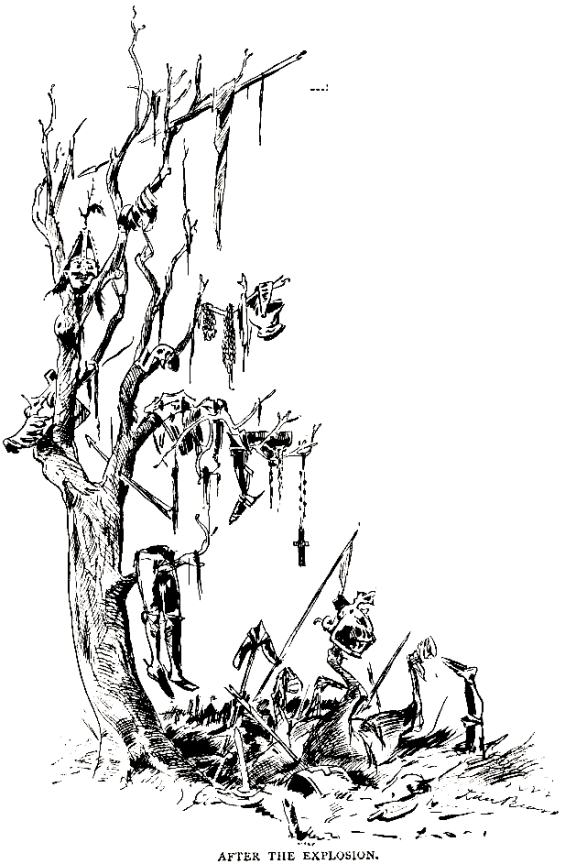
After The Explosion

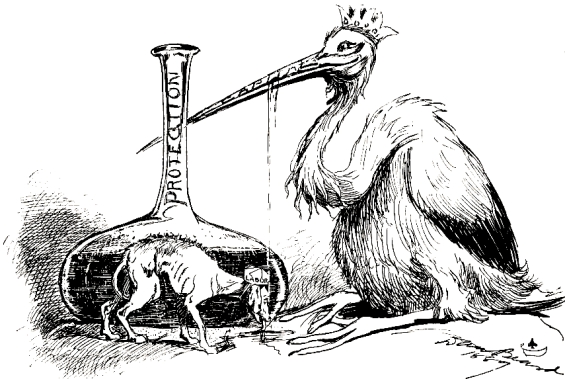
Protection / Capitalism

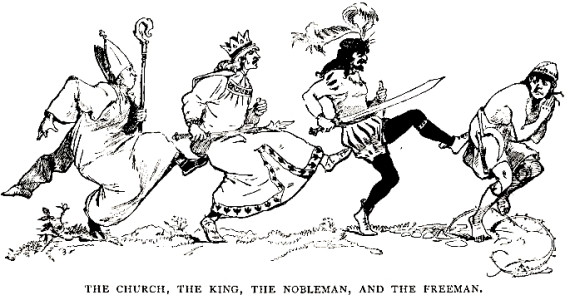
The Chruch, The King, The Nobleman, The Freeman

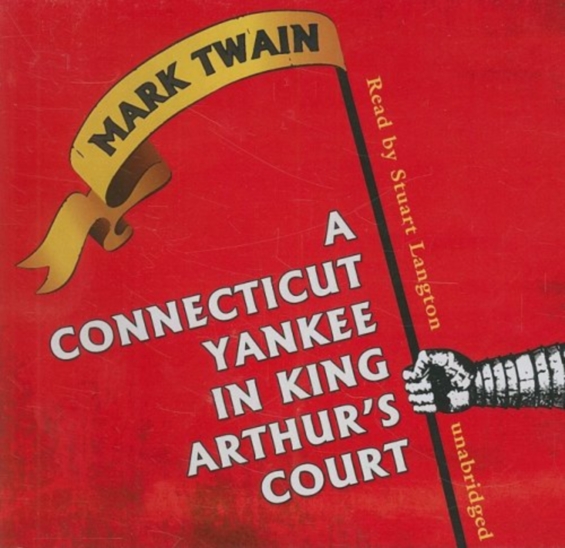
Blackstone Audio - A Connecticut Yankee in King Arthur’s Court by Mark Twain

Posted by Jesse Willis

The SFFaudio Podcast #145 – READALONG: Little Brother by Cory Doctorow

Podcast

The SFFaudio PodcastThe SFFaudio Podcast #145 – Little Brother by Cory Doctorow. Jesse, Tamahome, Professor Eric S. Rabkin and Jenny discuss Little Brother by Cory Doctorow. |ETEXT|

Talked about on today’s show:
Tam can’t trust anyone over 25, Jesse’s review in 2008, re-reading Little Brother in 2012, South Carolina, did Jenny vote Herman Cain (Stephen Colbert)?, SOPA/PIPA, non-fiction essay combined with YA, cliche, didacticism vs. propaganda vs. agitprop, we loved the infodumping, the underlying Oedipal structure, Robert A. Heinlein, libertarian bent, The Moon Is A Harsh Mistress, Starship Troopers, Ray Bradbury, Something Wicked This Way Comes, ‘this book has well devolved mythic structure’, levers vs. buttons, relevance, Homer, Electronic Frontier Foundation, the future of money, Luke Burrage’s review of Down And Out In The Magic Kingdom, money is hard to understand, Little Brother is a call to arms, National Defense Authorization Act (suspending habeous corpus as outlined in Article One of the United States Constitution), Nineteen Eighty-Four, George Orwell, Ms. Galvez’s Social Studies class, history, Heinleinian straw men vs. Doctorowan straw men, DHS, TSA, pebbles in your shoes, gait recognition, Oedipus = lame-foot, Charles Walker, the yippies, “this is a masterwork”, Jesse hates sequels, will the sequel to Little Brother deliver anything like what we might expect?, idea based writing vs. character based writing, w1n5t0n, trust, Marcus’ moral problem (RFID cloning without consent for the “greater good”), what act of violence is allowable?, moral relativism, the ends vs. the means, adolescence, “when is it time to overthrow the government?”, treason, Jenny makes “a gorgeous point”, Cory Doctorow’s choice to set Little Brother in, Law & Order (Lenny Briscoe), British North American Act, Canada didn’t have a bill of rights until 1981, The Charter Of Rights And Freedoms, Canada’s founding fathers are not demi-gods, Byron Sonne, G-20, is Little Brother a libertarian book?, “freedom is something you have to take for yourself”, Friedrich Hayek, Prometheus Award, the government of California is the hero (or the CHP), authority tries to perpetuate itself, UC Berkley, sex, juvenile vs. YA, “we live on Mars but we keep our houses extremely hot”, Snow Crash by Neal Stephenson, The Dervish House, Ready Player One, The Diamond Age, Eric makes a minor discovery, Big Brother -> Little Brother, Star-Begotten by H.G. Wells has the origin of “Big Brother”, Olaf Stapledon, “man is the boy who won’t grow up”, Spanish Civil War, The Midwich Cuckoos by John Wyndham (aka The Children Of The Damned), The Iron Heel by Jack London, comparing Doctorow with London, what is propaganda?, pamphleteering, Joseph Goebbels, Eric thinks etymologically, propagation and ideology, the Wikipedia entry on propaganda, is The Moon Is A Harsh Mistress propaganda?, “Oceania is now”, more strawful men, Sinclair Lewis, agitprop fiction, Science Fiction, “it’s a call to arms”, being a hacker, “go forth and hack my children”, “pay attention”, Gitmo by the bay, Iraq, Hacking The X-Box, Mac vs. PC ads, the hacker ethic is the science ethic, LARPing, “just to be smarter about the world around me”, alternative schooling, BART (Bay Area Rapid Transit), SkyTrain, The People Mover (The DPM), jitney, first person perspective, how to care, the terrorism detector and super-AIDS, Jane Jacobs, Jenny’s favourite character was Andrew, crystallizing the Oedipal issues, the Scoville scale, “the word is mister”, Ange vs. mom, The Tempest, severe haircut lady’s sadism, The Dark Knight Returns, is there a hero-normative angle?, The Puppet Masters, Friday, Have Spaceship-Will Travel, the ideal audience, Good Night Moon, Kirby Heybourne’s narration, transitional objects, Cory’s analogies are wonderful, taking a hiatus from Science Fiction, a pleased (but silent) smile, Jesse still has all his LEGO, a balding grey haired kid, Paranoid Linux, Jenny is ambivalent about whether she is of two minds, that couldn’t really happen here … could it?, Erich Fromm’s Escape from Freedom, the closer you get to power the more obvious it becomes, idelogical blindness, Drew wants to be able to believe, “He loved big brother.”

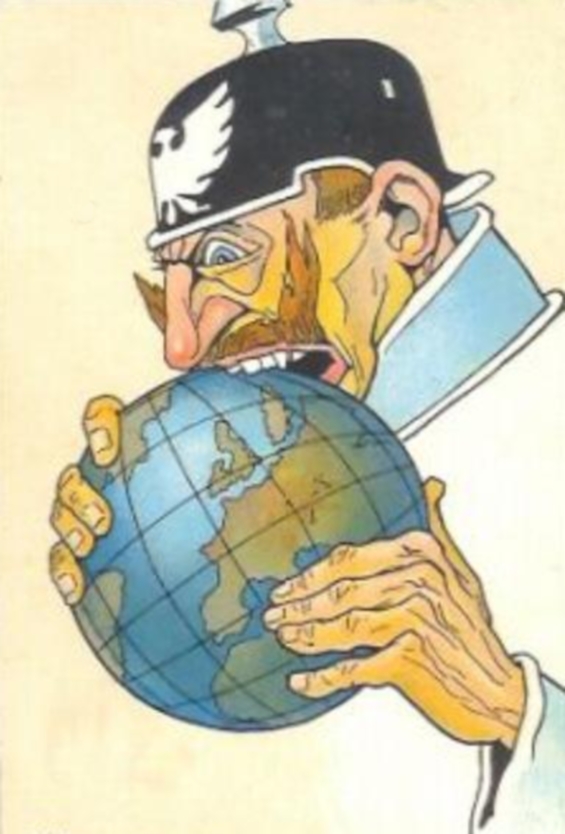
Kaiser Wilhelm II biting the world
Govenment Tech Support

Posted by Jesse Willis

Commentary: How (and why) I make ebooks out of paperbooks

SFFaudio Commentary

When you’ve got an old paperback book that’s coming apart at the spine, with pages falling out all over the place it’s time to consider making it immortal. In order to do that, in a reasonable period of time, you must kill the book. That’s the hardest part of the process. The actual transformation is pretty easy.

To do it I use a Fujitsu ScanSnap S1500 which came with Adobe Acrobat Standard 9. Here are three videos I put together that show the process of turning a paperback into an ebook:

And here’s a PDF |SAMPLE| of the result.

Update:
John writes in to say:

I read your recent post about digitizing print books with interest. I wondered if you might be able to expand on your process a bit, as it seemed to me like a few steps were missing from your video.

Indeed, here are my answers to some specific questions:

How do you actually sever all the pages from the book?

Most of the time this can be done just with your hands, at least with paperbacks and old magazines. The only tools I’ve ever needed to use are flathead screwdriver, to pry up staples found in some mags from the 1960s and 1970s, and scissors which I’ve used to trim out glued edges. If you’re doing a hardcover with sewn binding you’d probably be able to do it with just an X-Acto knife.

When you run the pages through the scanner, does it scan both sides of the page simultaneously? Or do you have to scan them all twice?

The Fujitsu ScanSnap is not only superfast, it’s also supersmart, it scans both sides at the same time (technically the term is “duplex”).

If so, how do you collate them so the pages are all in the right order?

The bundled software, called ScanSnap Manager, allows you to customize the named output files. I usually have them just come out as 001, 002, 003, etc..

How long does it take you to digitize a single book?

Lets see I’ve just scanned the February 1976 issue of Fantasy & Science Fiction which has 128 pages (64 leaves). In the scanning itself I set a stopwatch. It took 1 minute 30 seconds to scan the entire mag. The software took another 45 seconds of processing. And I spent about 30 seconds correcting orientation on a few pages. So under three minutes for 128 pages

Have you tried this on hardcovers as well, or just paperbacks?

I don’t think I’ve done more than a couple of hardcovers, they were really easy though as they were essentially unbound already.

Posted by Jesse Willis

The SFFaudio Podcast #141 – READALONG: The Island Of Doctor Moreau by H.G. Wells

Podcast

The SFFaudio PodcastThe SFFaudio Podcast #141 – Last week’s podcast was an unabridged reading of The Island Of Doctor Moreau by H.G. Wells. This week Scott, Jesse, Tamahome and Professor Eric S. Rabkin form an ad hoc community discuss it!

Talked about on today’s show:
Are we men or animals?, Charles Laughton, The Island Of Lost Souls, Burt Lancaster, Marlon Brando, Val Kilmer, let the movie atrophy and evaporate, changing the name Prendick to Prentice to Parker, Margaret Atwood, Moor, death, water, Moreau, Gustav Moreau, etchings of Dante’s Inferno, ebony, anthracite, Moreau is a funeral shroud, prig + dick (thick), prender, Prendick appropriates Moreau’s island, the manuscript, Prendick is a user, “a false church”, Edward (the happy guardian), Charles (the common man), “a private gentleman”, the single biggest theme in the book (modern European culture deforms the natural state of things), beastilizing humans or humanizing beasts, the white man’s burden (and his name is black), pro-science vs. anti-progress, Darwin brings the questioning of the moral narrative of humans, Montgomery and Moreau lack moral direction, Prendick too is directionless (all at sea), vivisection, “life is the house of pain”, Wells (and Mary Shelley) are deeply concerned with the relationship of scientists with the larger community, Eric thinks science unaware of moral obligation is the target, Prendick is a disingenuous narrator, Moreau is a colonial overload, “The Lady Vain”, Lady Day (Billie Holiday) vs. Lady Day (the Catholicism meaning), “Lady Day” is an ironic reversal of “Saint Mary”, Ipecacuanha = ipecac, Gulliver’s Travels, what are the chances of a collision with a derelict ship in the middle of Pacific?, M’Ling, mankind’s way of finding destruction, “ship of fools”, the ships are microcosms, a foreshadowing of destruction (of an unsustainable ), “Wells is just so God-damned smart”, Addaneye Island vs. Adonai (God), M’Ling is Manling, is M’ling a dog or an ape?, Thomas HobbesLeviathan, “solitary, poor, nasty, brutish and short”, “the great chain of being”, “In the afternoon, Moreau, Montgomery, myself, and M’ling went across the island to the huts in the ravine.” Montgomery = defender of the mountain, Prendick’s narration belies the events of the story, poetic justice, “he attacks Helmar with his hands”, men don’t sink like stones, cannibalism, “when every animal is a person then you better have a law against cannibalism”,

A sudden convulsion of rage shook me. I was almost moved to batter his foolish head in, as he lay there helpless at my feet. Then suddenly his hand moved, so feebly, so pitifully, that my wrath vanished. He groaned, and opened his eyes for a minute. I knelt down beside him and raised his head. He opened his eyes again, staring silently at the dawn, and then they met mine. The lids fell.

“Sorry,” he said presently, with an effort. He seemed trying to think. “The last,” he murmured, “the last of this silly universe. What a mess — ”

I listened. His head fell helplessly to one side. I thought some drink might revive him; but there was neither drink nor vessel in which to bring drink at hand. He seemed suddenly heavier. My heart went cold. I bent down to his face, put my hand through the rent in his blouse. He was dead…

Eric thinks Prendick is trying to exonerates himself, abolutionism a theme of abstinence and alcohol, “you’re Mr. Shut Up”, Lem Johnson, Governor George Gawler‘s 1838 speech to the local Aborigines in the Adelaide area:

“Black men – We wish to make you happy. But you cannot be happy unless you imitate good white men. Build huts, wear clothes, work and be useful. Above all things you cannot be happy unless you love GOD who made heaven and earth and men and all things. Love white men. Love other tribes of black men. Do not quarrel together. Tell other tribes to love white men, and to build good huts and wear clothes. Learn to speak English. If any man injure you tell the protector and he will do you justice.”

language as an instrument of repression, “this is an impossible story”, vivisection cannot create men, “this is a fable”, Thomas Henry Huxley, Wells was an apprentice to Huxley, natural selection and animal nature, if you can evolve can you devolve?, Montgomery is Moreau’s vicar (or Pope), an experiment with a snake, the Garden of Eden, Prendick is a liar, there is no great chain of being, Brits don’t have the right to change Indians, neither the force of arms, nor the claim of church, nor the claim of law can justifiably impose on one’s fellow man, The Time Machine, cannibalism is a transformation of murder, The Island Of Doctor Moreau as a fable, Sigmund Freud’s essay on “the uncanny” (make the metaphorical literal), The Eyes Have It by Philip K. Dick, it looks like a beast fable, “animal swiftness”, The Rime Of The Ancient Mariner by Samuel Taylor Coleridge, rabbits and Easter and eggs, Prendick destroys the symbol of christian resurrection, “a boat of community”, The War Of The Worlds as a kind of coda to The Island Of Doctor Moreau, Frankenstein, human beings are social animals, Boer Wars, South Africa, The Invisible Man, The Kingdom Of The Blind by H.G. Wells, one man is no match to a community, all of Wells’ protagonists seem to be horrible human beings, “a private gentleman”, if you have means you have an obligation to participate in the world, the doubting Thomas Marvel, the ocelot man, the pig men, the monkey man, “he’s a five man”, “big thinks” vs. “little thinks”, “it takes a real man to tell a lie”, sex and marriage and community in Frankenstein, Doctor Moreau Explains, man-making vs. woman-making, the puma-woman, Brian Aldiss, The Other Island Of Doctor Moreau, Frankenstein Unbound, “when suffering finds a voice”, vivisection, social class, PETA, the British Museum, the National Anti-Vivisection Society, The Invention Of Morrel by Adolfo Bioy Casares, Jorge Luis Borges, “an atrocious miracle”, “youthful blasphemy”, are there any contemporary reviews for The Island Of Doctor Moreau?, Henry James vs. H.G. Wells, little picture vs. big picture, psychology vs. sociology, characters vs. ideas, our Rainbow’s End discussion, Wells is undervalued because he is so easy to read, the consumption of food and drink, Wells learned it all, The Outline Of History by H.G. Wells, Samuel Johnson’s dictionary, ramify, The Lord Of The Flies by William Golding, The Inheritors is an elegiac recognition of the importance of community, neanderthals.
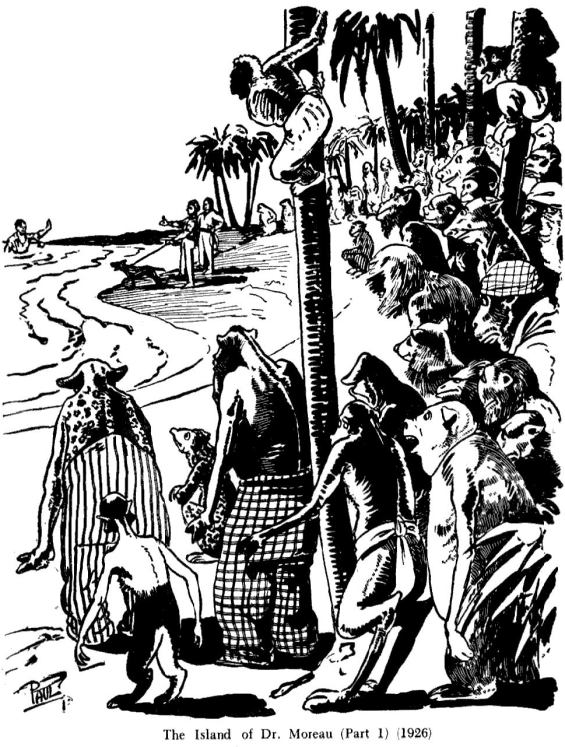
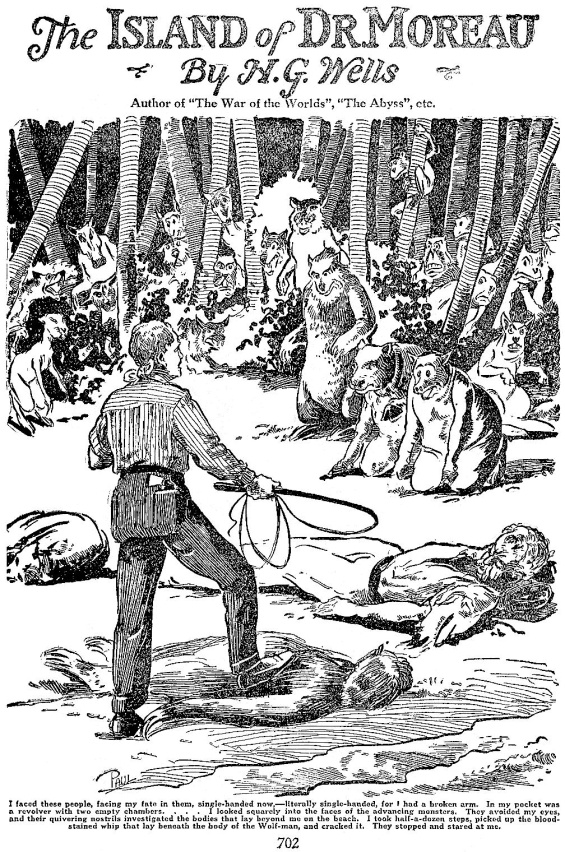
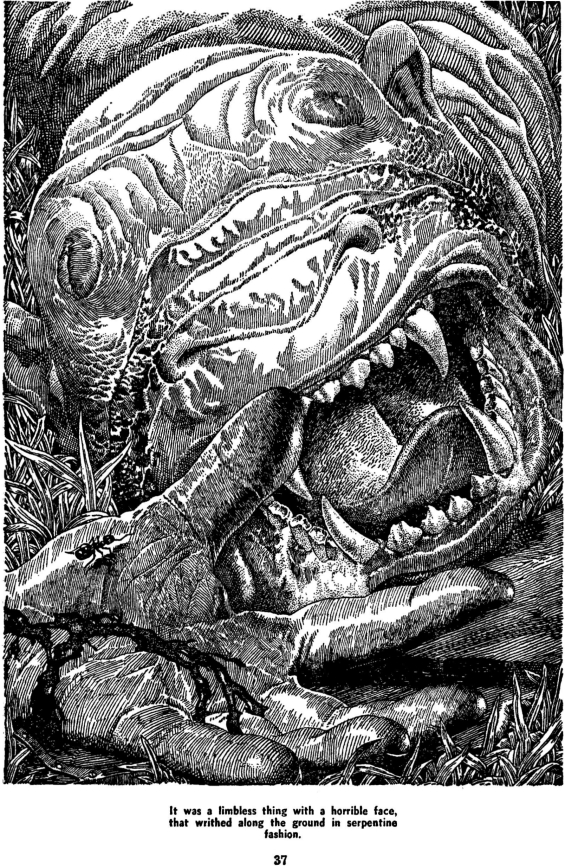
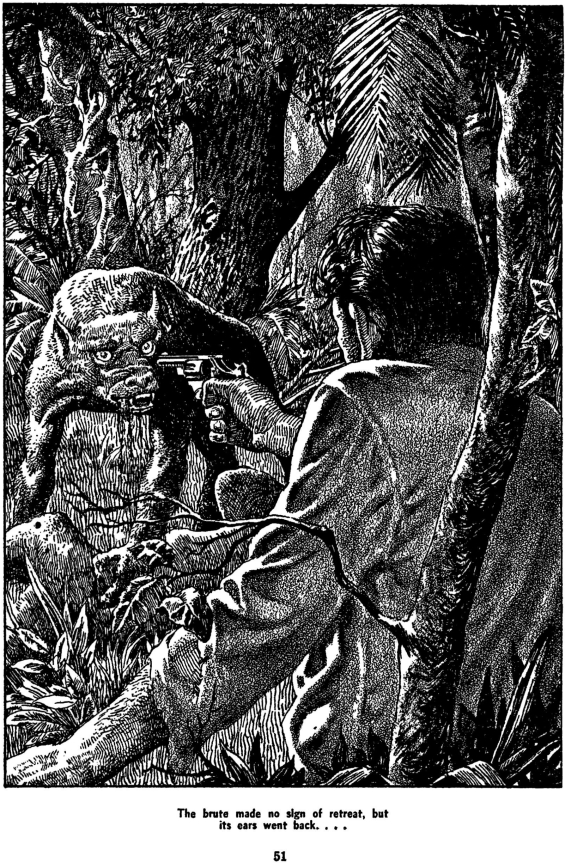
The Island Of Doctor Moreau by H.G. Wells - Illustration by Frank R. Paul for Amazing Stories

The Island Of Doctor Moreau by H.G. Wells - Illustration by Frank R. Paul for Amazing Stories

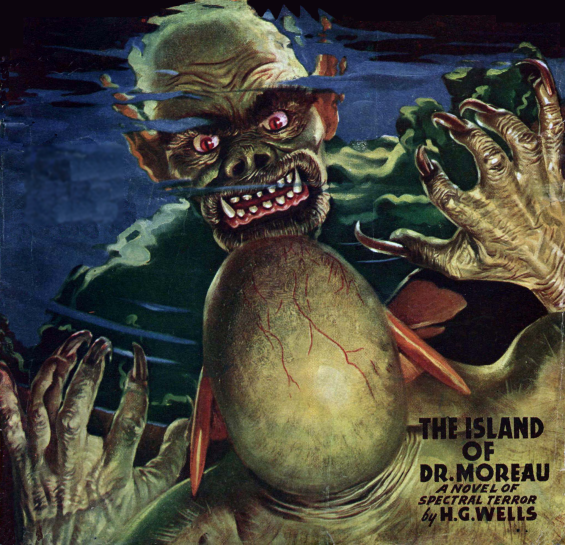
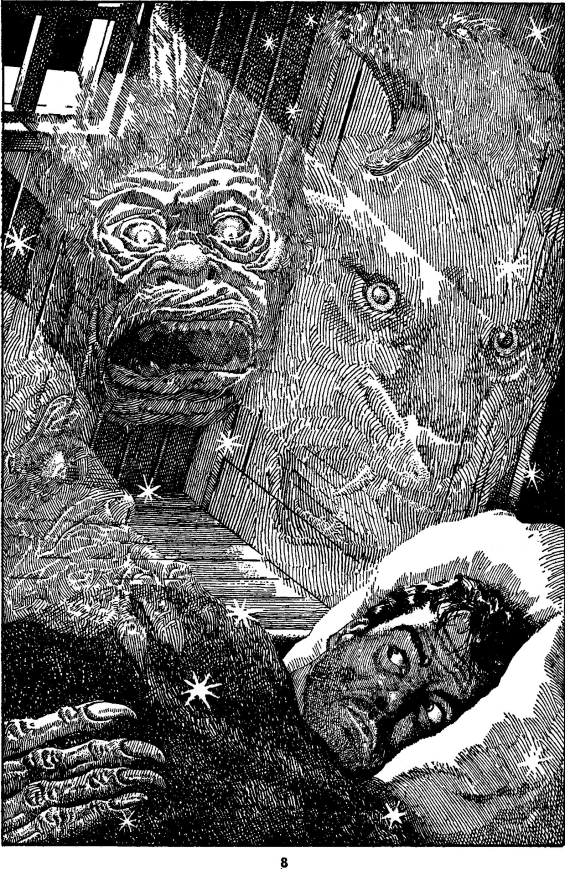
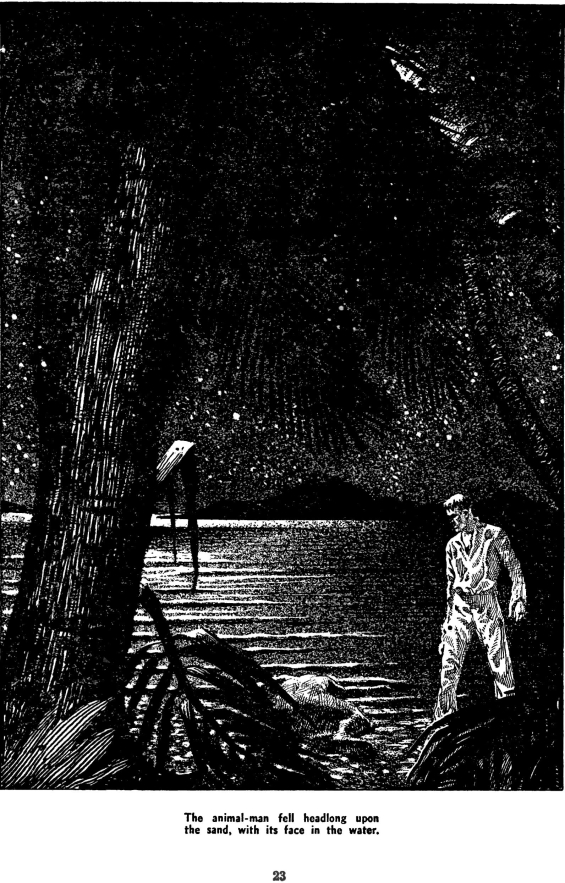
Famous Fantastic Mysteries - THE ISLAND OF DOCTOR MOREAU

Famous Fantastic Mysteries - THE ISLAND OF DOCTOR MOREAU

Famous Fantastic Mysteries - THE ISLAND OF DOCTOR MOREAU

Famous Fantastic Mysteries - THE ISLAND OF DOCTOR MOREAU

Famous Fantastic Mysteries - THE ISLAND OF DOCTOR MOREAU

Famous Fantastic Mysteries - THE ISLAND OF DOCTOR MOREAU

The Island Of Dr. Moreau - Cover illustration by Paul Lehr

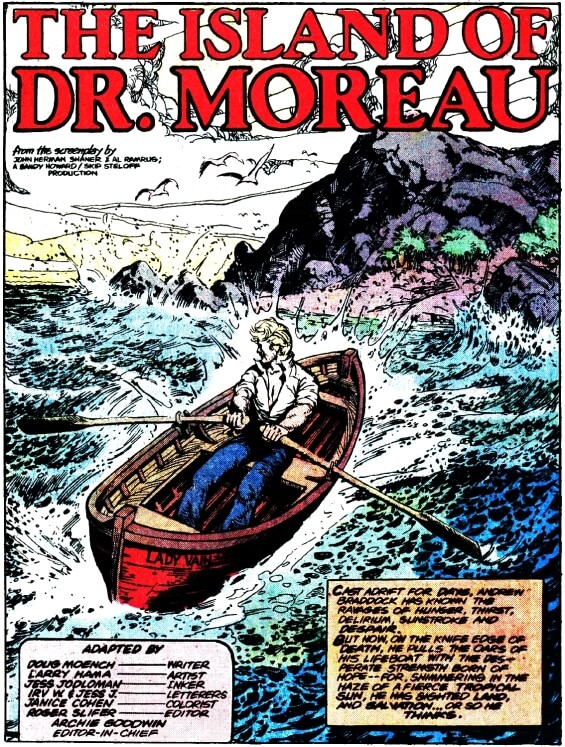
H.G.WELLS' The Island Of Dr Moreau - MARVEL

Posted by Jesse Willis

The Country Of The Blind by H.G. Wells

SFFaudio Online Audio

TITLE - The Country O fThe Blind by H.G. Wells

Here’s the editorial introduction to The Country Of The Blind from Amazing Stories, December 1927:

We take many things for granted in this world. We accept many preconceived notions about an amazing large number of things, which, like as not prove to be amazingly wrong. If any story ever proved this point, The Country Of The Blind certainly is that one. The author exploits the well-known saying , “In the country of the blind the one-eyed man is king.” Indeed that statement is most easy to believe and all logic should point that way. In reading this interesting story, you will soon find out how far wrong even seemingly good logic can be.

The above, presumably written by Hugo Gernsback himself, ably covers most of what I thought to say about this story. But that didn’t quite stop me.

This audiobook was my first time reading this story. I’m starting to think that H.G. Wells always wrote allegory and fable. The main character in this piece, and all Wellsian fiction, is completely unlikeable. The society he creates is unlikeable too. What does it say about me that I appreciated the story, even if I didn’t like it? What does it say about modern SF that stories with unlikeable protagonists in unlikeable societies are so few?

I guess I appreciated The Country Of The Blind because there’s a very deep skepticism to it, about human nature, about society but most importantly about the claim of wisdom. Man is a foolish, foolish beast. His only guide to the future is what has come before. But we’re always tempted to take some distilled bit of wisdom and use it that to do our thinking for us. What does it say for us when for every proverb we use to rationalize a decsion there is another proverb that could have supported an alternate?

Better, perhaps, to reject proverb entirely.

LibriVoxThe Country Of The Blind
By H.G. Wells; Read by llite (aka George Cooney)
1 |MP3| – Approx. 61 Minutes [UNABRIDGED]
Publisher: LibriVox.org
Published: January 17, 2010
While attempting to summit the unconquered crest of Parascotopetl, a mountaineer named Nunez slips and falls down the far side of the mountain. At the end of his descent, down a snow-slope in the mountain’s shadow, he finds a valley, cut off from the rest of the world on all sides by steep precipices. Nunez has discovered the fabled Country of the Blind. The valley had been a haven for settlers fleeing the tyranny of Spanish rulers until an earthquake reshaped the surrounding mountains and cut it off forever from future explorers. The isolated community prospered over the years despite a disease that struck them all blind. As the blindness slowly spread over the generations and the last sighted villager had died, the community had fully adapted to life without vision. First published in the April 1904 issue of the Strand Magazine.

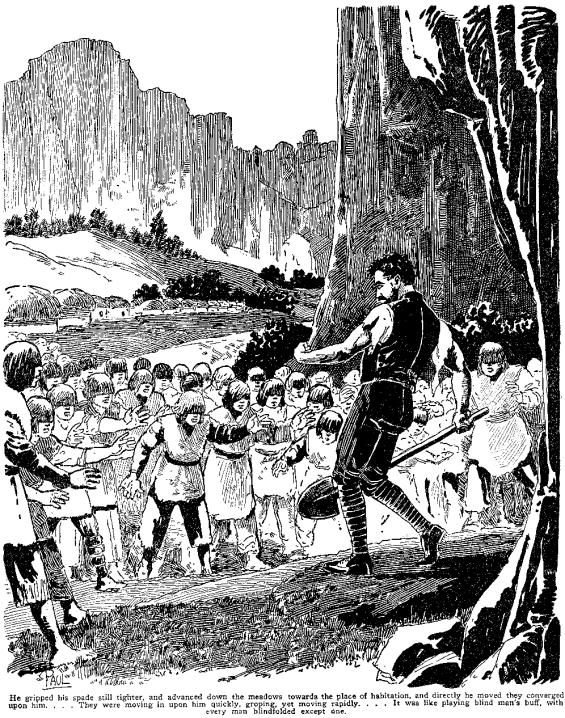
The Country Of The Blind - illustrated by Frank R. Paul

Included below are all the audio drama adaptations I could find. I recommend the episode of Escape with Paul Frees.

EscapeEscape – The Country Of The Blind
Based on the story by H.G. Wells; Adapted by John Dunkel; Performed by a full cast
1 |MP3| – Approx. 29 Minutes [RADIO DRAMA]
Broadcaster: CBS Radio
Broadcast: November 26, 1947
produced/directed by William N. Robson
Cast:
William Conrad … Ibarra
Paul Frees … Nunez
Produced/directed by William N. Robson

EscapeEscape – The Country Of The Blind
Based on the story by H.G. Wells; Adapted by John Dunkel; Performed by a full cast
1 |MP3| – Approx. 30 Minutes [RADIO DRAMA]
Broadcaster: CBS Radio
Broadcast: June 20, 1948
Cast:
Berry Kroeger … Ibarra
Paul Frees … Nunez

EscapeEscape – The Country Of The Blind
Based on the story by H.G. Wells; Adapted by John Dunkel; Performed by a full cast
1 |MP3| – Approx. 30 Minutes [RADIO DRAMA]
Broadcaster: CBS Radio
Broadcast: March 20, 1949.
Cast:
Berry Kroeger … Ibarra
Edmund O’Brien … Nunez
Produced/directed by Norman MacDonnell

SuspenseSuspense – The Country Of The Blind
Based on the story by H.G. Wells; Adapted by John Dunkel and William N. Robson; Performed by a full cast
1 |MP3| – Approx. 19 Minutes [RADIO DRAMA]
Broadcaster: CBS Radio
Broadcast: October 27, 1957
Cast:
Raymond Burr

SuspenseSuspense – The Country Of The Blind
Based on the story by H.G. Wells; Adapted by John Dunkel and William N. Robson; Performed by a full cast
1 |MP3| – Approx. 24 Minutes [RADIO DRAMA]
Broadcaster: CBS Radio
Broadcast: December 13, 1959
Cast:
Bernard Grant
Produced/directed by Paul Roberts

Favorite Story Favorite Story – Strange Valley
Based on The Country Of The Blind by H.G. Wells; Adapted by ???; Performed by a full cast
1 |MP3| – Approx. 27 Minutes [RADIO DRAMA]
Broadcaster: KFI
Broadcast: April 23, 1949
Cast:
Ronald Coleman … Nunez

[via Escape-Suspense.com]

Posted by Jesse Willis

The SFFaudio Podcast #140 – AUDIOBOOK: The Island Of Doctor Moreau by H.G. Wells

Podcast
H.G. WELLS' The Island Of Dr Moreau
The SFFaudio PodcastThe SFFaudio Podcast #140 – The Island Of Doctor Moreau by H.G. Wells, read by Jonathan Kent.

This UNABRIDGED AUDIOBOOK (4 Hours 8 Minutes) comes to us courtesy of Tantor Media and their collection of “Unabridged Classics”. Thanks Tantor!

Come back for our next episode (SFFaudio Podcast #141) to hear our discussion.

Here’s the ETEXT.

TANTOR MEDIA - The Island Of Doctor Moreau by H.G. Wells

Incidentally, I believe this is the first time an entire novel has been podcast as one big file.

Posted by Jesse Willis