TEDxUCDavis – Michael Saler – History and Imaginary Worlds

SFFaudio News

Professor Michael Saler, of UC Davis, suggested I check out his talk about “History and Imaginary Worlds” which he gave at a TEDx at UC Davis.

Saler’s talk reminded me of something Dave Barry said.

He said he wanted to get an Amtrak jersey made, like one of those football or hockey style oversized jerseys. He wanted to get an Amtrak logo emblazoned on the front of it, and have two little ones put onto the shoulders. He wanted to have “GUNN” stitched on to the back of it (David Gunn was the president of Amtrak at the time). He wanted to walk around in public wearing it, and quote statistics about how many miles of track Amtrak had laid down, and to tell everyone how many passengers it delivered in it’s 2003 “season.”

I guess he thought that a lot folks might think it strange if a grown man walked around wearing a costume of one of his heroes. He didn’t want any of those normal sports fans to think he was strange.

Posted by Jesse Willis

The SFFaudio Podcast #170 – READALONG: The Fountains Of Paradise by Arthur C. Clarke

Podcast

The SFFaudio PodcastThe SFFaudio Podcast #170 – Jesse, Tamahome, and Jenny discuss the Brilliance Audio audiobook of The Fountains Of Paradise by Arthur C. Clarke.

Talked about on today’s show:
Skyhooks and space elevators, Sri Lanka, “my first space elevator book”, Robert A. Heinlein, Friday, “it feels like a novel”, “the fictional accounting of a real construction project”, history, Colombo, afterwords, sources and acknowledgements, “what a rip-off”, Sigiriya’s Lion Paws Gate, King Kashyapa I, “past, present, and future”, engineering fiction vs. science fiction, Taprobane, Paradise Regained by John Milton, Jo Walton’s review of The Fountains Of Paradise, religion, “Heinlein in a dress”, an idea book, to think interesting Science Fictional thoughts, hard SF, Clarke’s Laws, space probe, a game changer, Gregg Margarite, Shri Jawaharlal Nehru, The Nine Billion Names Of God, Sigmund Freud, growing out of religion?, Thomas Aquinas, symbolic logic, Bertrand Russell, satellites and their uses, unseen benefits to giant engineering projects and science, Sydney Opera House, the Eiffel Tower, Burj Khalifa, Mission: Impossible – Ghost Protocol, “this is what we’re meant to do”, the space age, the 1970s, Jenny gets depressed, Terpkristin‘s visit to French Guiana (PICS!), will we have a Chinese moonbase by 2022?, innovation vs. exploration, Jerry O’Neil, good reasons to go to space, we ought to do things that we can do, Leviathan Wakes by James S.A. Corey, the daily life challenges of a space born population, The Island Worlds by Eric Kotani and John Maddox Roberts, the probe is a person, The Geek’s Guide To The Galaxy #64: John Scalzi, (Star Trek holds us back), “the God Particle”, “you’re going to die soon”, can we empathize with a character that isn’t a human being?, a complimentary cosmonaut, 2001: A Space Odyssey, one day in Jerusalem, the transhuman future in the end of The Fountains Of Paradise, Starglider/Starholme, a well developed solar society, the Wikipedia entry for The Fountains Of Paradise, The Last Theorem, The City And The Stars, a non-off putting post-human story, Childhood’s End by Arthur C. Clarke, Fahrenheit 451 by Ray Bradbury, Ted Chiang, Charles Stross, sequels and science, Star Trek: The Next Generation, Alastair Reynolds, Kim Stanley Robinson, in SF ideas build can on one another whereas others books are more parasitizing upon those ideas, why does it have to be a new book?, ‘these were the stepping stones to today’, a balance of both a good story and good ideas, William Gibson, Embassytown by China Miéville, The City And The City, “garbage, garbage, garbage”, 2312, Playboy’s serialization of The Fountains Of Paradise, Buckminster Fuller, why did Sir Arthur C. Clarke live in Sri Lanka?, Milton is literature, Dante’s Inferno, Lucifer’s fall from heaven, Brilliance Audio, A Fall Of Moondust by Arthur C. Clarke, BBC Radio dramatization of A Fall Of Moondust, Crisis On Conshelf Ten by Monica Hughes, “best book ever”, The Abyss, Tom Swift, Aquaman vs. The Sub-Mariner, Blue Remembered Earth by Alastair Reynolds, The Prefect, Ray Of Light by Brad Torgeson, “Alien sun mirror block deepwater living daughter Glimmer Club surface discovery.”, the Mars tangent, Phobos and Deimos, John Scalzi, “I liked that he didn’t explain it.”, “we don’t build em that way”, “I want it to be hard”, Phobos interference would be a feature not a bug, “wiggle the thread”, atmospheric density and windspeed, carbon nano-tubes vs. buckminsterfullerene, Roald Dahl, Charlie And The Great Glass Elevator, horror, The BFG, Jack McDevitt, a waking dream, in the shadow of Vesuvius, the Prime Directive, Doctor Who, Fantasy vs. Science Fiction, Inferno (Doctor Who episode), Sliders, Doorways by George R.R. Martin, Tom Baker.

BRILLIANCE AUDIO - The Fountains Of Paradise by Arthur C. Clarke

Caedmon - Arthur C. Clarke reads Fountains Of Paradise

Del Rey paperback - The Fountains Of Paradise by Arthur C. Clarke

Playboy, January 1979 - The Fountains Of Paradise by Arthur C. Clarke - illustration by Ignacio Gomez

Playboy, February 1979 - The Fountains Of Paradise by Arthur C. Clarke - illustration by Ignacio Gomez

Posted by Jesse Willis

New Releases: AudioGo: The History Of The World In 100 Objects

New Releases

AudioGo has collected the popular BBC Radio 4 programme The History Of The World In 100 Objects as I guess what we’d call a 25 hour radiobook.

In 2010, the BBC and the British Museum embarked on an ambitious project: to tell the story of two million years of human history using one hundred objects selected from the Museum’s vast and renowned collection.

Presented by the British Museum’s Director Neil MacGregor, each episode focuses on a single object – from a Stone Age tool to a solar-powered lamp – and explains its significance in human history.

Music, interviews with specialists and quotations from written texts enrich the listener’s experience. On each CD, objects from a similar period of history are grouped together to explore a common theme and make connections across the world. Seen in this way, history is a kaleidoscope: shifting, interlinked, constantly surprising and shaping our world in ways that most of us have never imagined.

This box set also includes an illustrated booklet with additional background information and photographs, and each CD includes PDF images of the featured objects.

The landmark series on BBC Radio 4 that tells the story of humanity through 100 man-made objects from the British Museum’s unique collection.

Posted by Jesse Willis

Review of The Summer Isles by Ian R. MacLeod

SFFaudio Review

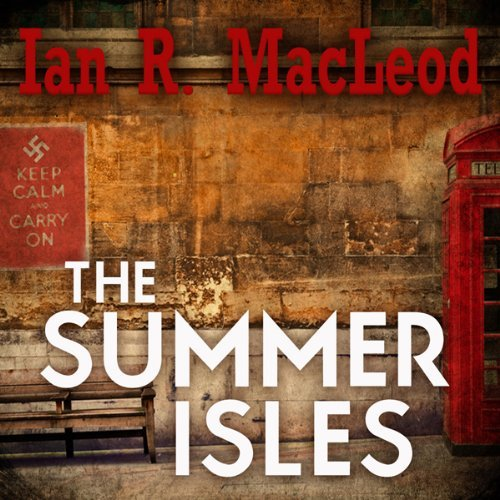
AUDIBLE FRONTIERS - The Summer Isles by Ian R. MacLeodThe Summer Isles
By Ian R. MacLeod; Read by Steve Hodson
Audible Download – Approx. 13 Hours [UNABRIDGED]
Publisher: Audible Frontiers
Published: 2012
Themes: / Alternative History / Dystopia / History / Fascism / Homosexuality /

I have always been intrigued by alternative histories. Unfortunately my knowledge of history sometimes limits my enjoyment, being more of an overview of the subject. I often can’t tell if an event has been changed, and if so, whether it is significant or not. In some of the better alternate histories you can get away with not knowing too much about the period and still enjoy the story. Thankfully, in this case, I had recently been reading a history of Europe covering the same period from the early 1910’s to 1940.

MacLeod’s The Summer Isles is set primarily in a 1940 where Great Britain lost The Great War in 1918. America doesn’t enter the war and France makes an appeasement with Kaiser Wilhelm II’s Germany. The result is that Britain, not Germany, is left in a state of shock, feeling betrayed by their supposed allies. A young soldier, John Arthur, rises to power in the bleak years that follow, suggesting a parallel to Hitler, who gets only a single reference, never having the opportunities to gain power that losing the war afforded. The great Empire that was Britain is stripped away in the reparations following the war. That sense of betrayal is used to fuel Arthur’s rise to power as he brings in his political movement “Modernism”. John Arthur’s portrait hangs everywhere, even in the men’s public toilets.

Modernism is a very British take on fascism and drove several of the same horrors that Naziism did in our own history. Jews, homosexuals, intellectuals, the Irish and any and all other ‘deviants’ are persecuted and ultimately removed from the new Modernist society. The Jews in particular are sent to be “resettled” on the eponymous Summer Isles.

The story is told by Geoffrey Brook, a secretly homosexual Oxford history Don, who had some prestige for having been a favourite teacher of John Arthur as a child. Brook is in his 60’s in 1940 when he receives the news that he has at terminal lung cancer.

Brook, in trying to reconcile himself with his past, recounts in flashbacks the one true love of his life that he lost in the Great War. More flashbacks fill in the years before and after that war; several of the scenes flowing together with the present day as Brook’s mind drifts in and out of his reminiscences. Particularly when he visits some of the same locations.

MacLeod’s writing is excellent, at times didactic, as the historian narrator recounts past political and social events, yet by turns touching, confused, detailed and frightened as more personal or recent events are recounted. Slow at times, this fits will with the drifting recollections of the narrator as the hidden story is gradually revealed. The final act of the novel moves at a much faster pace, while still holding convincingly onto the character of the narrator. The Summer Isles was nominated for the John C Campbell Memorial Award, the Sidewise Award for Alternate History and the World Fantasy Award.

The audio narration by Steve Hodson fits the character perfectly. The weariness with life, the broken rapture at prized but lost moments of love and of lust are all perfectly portrayed. He even nails virtually all of the Scottish pronunciations; a pet peeve sf mind, being Scottish myself, with several other narrators.

Posted by Paul [W] Campbell

Recent Arrivals: Justinian’s Flea: Plague, Empire, And The Birth Of Europe by William Rosen

SFFaudio Recent Arrivals

William Rosen’s appearance on The Daily Show with John Stewart, a couple of years ago, prompted me to pick up his audiobook The Most Powerful Idea In The World. It’s a terrific book, and a very solid audiobook (with Michael Prichard narrating). It delivered a concise, impressively researched and argued, history of the industrial revolution’s engine and it’s causes. I highly recommend that book (also available from Tantor). But what I hadn’t realized was that Rosen had already penned a book on another fascinating historical period.

Sample |MP3|

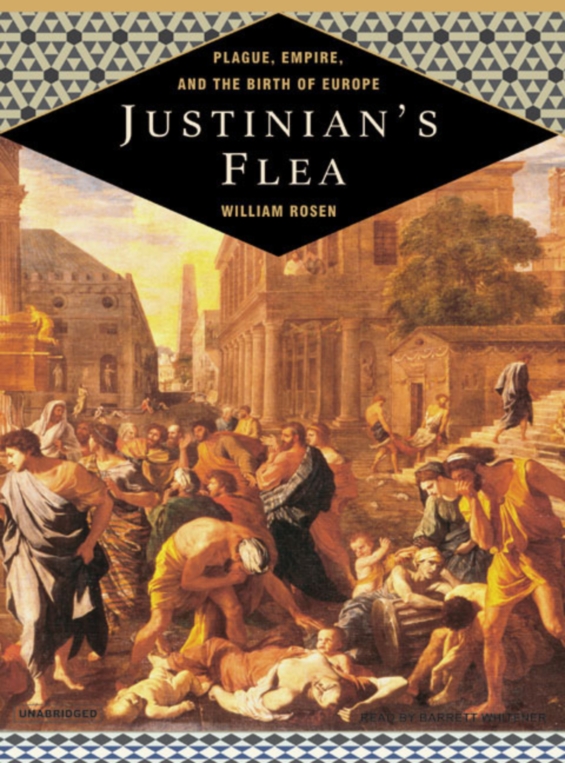
Tantor Media - Justinian's Flea: The First Great Plague And The Fall Of The Roman Empire by William Rosen

Justinian’s Flea: Plague, Empire, And The Birth Of Europe
By William Rosen; Read by Barrett Whitener
MP3 Download – Approx. 11 Hours 51 Minutes [UNABRIDGED]
Publisher: Tantor Media
Published: May 22, 2007
The Emperor Justinian reunified Rome’s fractured empire by defeating the Goths and Vandals who had separated Italy, Spain, and North Africa from imperial rule. At his capital in Constantinople, he built the world’s most beautiful building, married its most powerful empress, and wrote its most enduring legal code, seemingly restoring Rome’s fortunes for the next 500 years. Then, in the summer of 542, he encountered a flea. The ensuing outbreak of bubonic plague killed 5,000 people a day in Constantinople and nearly killed Justinian himself.Weaving together evolutionary microbiology, economics, military strategy, ecology, and ancient and modern medicine, William Rosen offers a sweeping narrative of one of the great hinge moments in history, one that will appeal to readers of John Kelly’s The Great Mortality, John Barry’s The Great Influenza, and Jared Diamond’s Collapse.

Posted by Jesse Willis

CBC: Ideas: The Swerve: How the World Became Modern by Stephen Greenblatt

SFFaudio Online Audio

CBC Radio One - IdeasThe Swerve: How the World Became Modern, and its author Stephen Greenblatt, are the subject of the latest CBC Ideas podcast. The Swerve is the story of the recovery of a lost epic Roman poem, by Titus Lucretius Carus, titled On The Nature Of Things – Greenblat makes the case for it being a work that changed the world, made it modern, by bringing ancient philosophy into an age ready for enlightenment. It’s an absolutely fascinating discussion. Host Paul Kennedy, as usual, shows that Canadian tax dollars can be used incredibly well when put in the right hands.

The poem in question is available as a LibriVox audiobook HERE.

And The Swerve: How the World Became Modern is available from Recorded Books (narrated by Edoardo Ballerini).

Here’s the book’s description:

Renowned historian Stephen Greenblatt’s works shoot to the top of the New York Times best-seller list. With The Swerve, Greenblatt transports listeners to the dawn of the Renaissance and chronicles the life of an intrepid book lover who rescued the Roman philosophical text On the Nature Of Things from certain oblivion.

Nearly six hundred years ago, a short, genial, cannily alert man in his late 30s took a very old manuscript off a library shelf, saw with excitement what he had discovered, and ordered that it be copied. That book was the last surviving manuscript of an ancient Roman philosophical epic by Lucretius – a beautiful poem containing the most dangerous ideas: that the universe functioned without the aid of gods, that religious fear was damaging to human life, and that matter was made up of very small particles in eternal motion, colliding and swerving in new directions.

The copying and translation of this ancient book – the greatest discovery of the greatest book-hunter of his age – fueled the Renaissance, inspiring artists such as Botticelli and thinkers such as Giordano Bruno; shaped the thought of Galileo and Freud, Darwin and Einstein; and had a revolutionary influence on writers such as Montaigne and Shakespeare, and even Thomas Jefferson.

Here’s the |MP3|

Podcast feed: http://www.cbc.ca/podcasting/includes/ideas.xml

Posted by Jesse Willis