Campfire Radio Theater

SFFaudio Online Audio

Campfire Radio TheaterI get a lot of email from amateur audio dramatists looking for publicity. They come about once every week or two. They’ve all got shows they want me to review or post about. I dutifully link to them most of the time. But you may notice that they often go up without any kind of comment. Either this is because I’m not particularly impressed – or perhaps it’s just because I have nothing in particular to say about them (maybe it’s in a genre I don’t care for). Here’s a typical example of the email I get (I received it just yesterday):

Hi Jessie. I produce a full cast audio drama called Campfire Radio Theater. Our primary focus is horror related tales in the classic tradition of anthology shows such as Lights Out and Nightfall. I would be honored if you guys were to review our podcast and feature us on SFF Audio. Please give any of our episodes a listen and let me know if you have any interest.

http://campfireradiotheater.podbean.com/

Kindest regards,
John Ballentine

Looking just at the email I see good things and bad things. First there’s the good: “Lights Out and Nightfall” are two series I like. That’s good. Like them Campfire Radio Theater is an anthology series, that too is good. But, there’s also a lot of bad. First, my name is spelled wrong. I’m human, I make mistakes too, but it’s not a good sign to spell my name wrong. Second it’s a podbean podcast. I haven’t had much luck with podbean based podcasts. I don’t know why that is.

Lastly, there’s the name. Theater is spelled wrong.

I know that many disagree. And it can be argued that American English is special, and should be allowed it’s quirks. I hear that. But for me it is a bad sign. Some U.S.A. based radio dramatists know this and made their names accordingly. There’s the Seeing Ear Theatre, the Firesign Theatre, and of course the “National Audio Theatre” festival. My prejudice is that for every good “re” there’s a dozen or so bad “er”s. There are plenty of counterexamples (there are plenty of “er”s that are terrific) but I do have the bias.

I could rationalize it more. Saying that the choice to go “re” invokes the traditional distinction between the venue where the production is performed and the production itself. As in: “I went to the theater (the playhouse) to see some real theatre (a dramatized play) performed on stage.” But I digress.

So, anyway, like always, I clicked on over to the provided link and had a look at the website. Once there I wasn’t very impressed. Campfire Radio Theater doesn’t have a proper logo – that’s terrible. So, I guess you could say I went into the first episode with low expectations.

Usually amateurs sound like amateurs, with acting more like reading, and a rookie sort of sound design that leaves me completely flat.

Demon Eyes was the name of the first episode in the podcast feed. I listened to it and suddenly had all my cynical expectations thrown out the window.

Not only does Demon Eyes have some very good acting – including the writer/producer himself in a role – but it also has some very solid sound design!

If John Ballentine could do this with his first ever show what could he do once he has some serious experience?

I’m very, very impressed!

There’s also something different going on with the plot and dialogue. It’s got a kind of odd vibe that I can’t quite get my finger one. Somehow it feels like a kind of anti-Spirit Blade sort of show. I don’t know if that’ll continue into subsequent episodes of this anthology. And I don’t know if the quality will get worse, or better, based on just the one episode, but I’m eager to have a listen to the second show and find out.

How’s that for publicity John?

Demon Eyes |MP3|

Podcast feed: http://campfireradiotheater.podbean.com/feed/

iTunes 1-Click |SUBSCRIBE|

Posted by Jesse Willis

The SFFaudio Podcast #153 – AUDIOBOOK/READALONG: Small Town by Philip K. Dick

Podcast

The SFFaudio PodcastThe SFFaudio Podcast #153 – Small Town by Philip K. Dick, read by Gregg Margarite. This is a complete and unabridged reading of the short story followed by a discussion of it with Jesse, Tamahome, and Gregg Margarite!

Of Small Town Philip K. Dick wrote:

“Here the frustrations of a defeated small person — small in terms of power, in particular power over others — gradually become transformed into something sinister: the force of death. In rereading this story (which is of course a fantasy, not science fiction) I am impressed by the subtle change which takes place in the protagonist from Trod Upon to Treader. Verne Haskel initially appears as the prototype of the impotent human being, but this conceals a drive at his core self which is anything but weak. It is as if I am saying, The put-upon person may be very dangerous. Be careful as to how you misuse him; he may be a mask for thanatos: the antagonist of life; he may not secretly wish to rule; he may wish to destroy.”

Talked about on today’s show:
Gregg is getting better at girls, girls are always questioning you, horror, urban fantasy, The Twilight Zone, Science Fiction, Fantasy, Rod Serling, paranoid Verne Haskell, a lead quarter, the redistribution of wealth, playing god, “…and he rested and he made a sandwich”, god games, SimCity 2000, churches can’t be stopped, Microcosmic God, “shoved into the next dimension”, is it slipstream?, Stopover In A Quiet Town, transformers are the science, diorama, the train doesn’t run them over, “moral”, “extremely moral”, train guys, Lego, erector sets, Lincoln Logs, Meccano, matchbox cars, small towns can be hell, comic book stores, “urbane-al-ity”, is Verne the god of Woodland?, pet shops and mortuaries, little man, SFSignal’s Sword And Sorcery Panel suggest characters should be the focus, “Finished!”, world warping, John Carter, handwavium, “make out”, Beyond The Door, Dick’s faithless women, Clans Of The Alphane Moon, how risque were SF mags in the 1950s?, San Fransisco, Silvia is one of Dick’s most common female character names, a life sized diorama, The Tell Tale Heart, The Days Of Perky Pat, The Three Stigmata Of Palmer Eldritch, the game of Life, Barbie, chew-z, the documentary Marwencol (2010), “he wants love”, Mark Hogancamp’s world is open, living in a real dream world, Deja Thoris has a time machine, Jeff Malmberg, A Clockwork Orange, adding layers, “well done Jeff”, R. Crumb, Blade Runner‘s androids take photographs to take memories, “reality and consciousness are fluid constructs”, crazy vs. differently enabled, Esopus magazine, a world without irony, authenticity, people are complicated, Greenwich Village, cross-dressing, WWII.

Small Town by Philip K. Dick second publication in the April 1967 issue of Amazing Stories

Marwencol

Posted by Jesse Willis

To Virgil Finlay… by H.P. Lovecraft (narrated by Wayne June)

SFFaudio Online Audio

To Virgil Finlay by H.P. Lovecraft

I mentioned to Wayne June that I’d found the above poem in the July 1937 issue of Weird Tales. He hadn’t heard of it before. Then he went and narrated it for us!

|MP3|

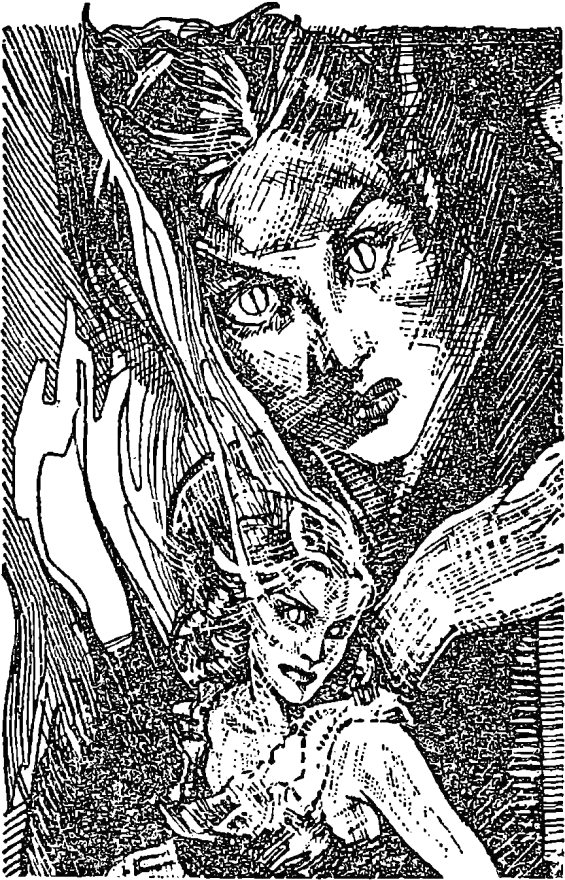
Written in a letter, dated November 30, 1937, it was sent from H.P. Lovecraft to Virgil Finlay. It was inspired by art drawn for a Robert Bloch story, published in the May 1936 issue of Weird Tales, and entitled The Faceless God. Here’s the illustration that inspired it:

The Faceless God - illustration by Virgil Finlay

Here’s at least part of the letter:

“I could easily scrawl a sonnet to one of your masterpieces if you weren’t too particular about quality. For example –

To Virgil Finlay Upon his Drawing Of Robert Bloch’s Tale “The Faceless God”
By H.P. LOVECRAFT

In dim abysses pulse the shapes of night,
Hungry and hideous, with strange miters crowned;
Black pinions beating in fantastic flight
From orb to orb through soulless voids profound.
None dares to name the cosmos whence they course,
Or guess the look on each amorphous face,
Or speak the words that with resistless force
Would draw them from the halls of outer space.

Yet here upon a page our frightened glance
Finds monstrous forms no human eye should see;
Hints of those blasphemies whose countenance
Spreads death and madness through infinity.
What limnner he who braves black gulfs alone
And lives to wake their alien horrors known?

Well well – quite in the Yuggoth tradition! I’ll have to keep a copy of this to try on one or another of the fan magazines!”

[Thanks Wayne!]

Posted by Jesse Willis

The Influence of RADIO DRAMA on comics and vice versa

SFFaudio News

EC ComicsThere’s a fascinating article by Kurt Kuersteiner HERE titled “OTR: The Evil Influence Behind EC.” In it Kuersteiner maps some of the many stories swiped from radio drama series and turned into EC Comics.

It came to me at the perfect time too. I’ve just been getting into EC comics over the last few months. Having grown up under the censorship of the Comics Code Authority I didn’t really know what I was missing. Now though, reading these pre-code comics, I can now see that my intellectual growth had been greatly stunted.

I’d have been a far smarter person if I’d been able to buy and read comics like these as a kid.

My favourite such tale so far was published in the July/August 1953 issue of Weird Fantasy (issue number 20). It’s called The Automaton. At first it seemed to me like a mashup of a Philip K. Dick’s The Electric Ant, Alfred Bester’s Fondly Fahrenheit and George Orwell’s 1984. But looking at the chronology that can’t be what it is. First off Philip K. Dick was just getting started around then. And while he was a comics reader The Electric Ant wasn’t published until 1969.

And while by 1953 Bester had already been working in comics – he hadn’t yet written Fondly Fahrenheit. So the story is definitely Orwellian and very cool, and certainly like a couple of Dick and Bester tales that were yet to be written. But then again, maybe it was inspired by a radio drama that I’ve not heard yet. Anybody know of one like this?

As it stands The Automaton is set in the futuristic dystopian world of Los Angeles in 2009. Our protagonist is XT-751, a man recounting his story of being sent to a northern labour camp after a suicide attempt. Suicide is illegal in this world because the state owns every person from the cradle to the grave.

I actually have been thinking about The Automaton for months now. And after reading Kuersteiner’s article it somehow gelled into a post. It’s just been something I could’t quite shake. The story is not only extremely thought provoking, and still timely, but also extremely frightening. And maybe a lot of the rest of it is that it is about as far away from superhero comics as you can possibly get. Best of all it’s told in just seven pages – that’s a highly distilled story.

The only credit for The Automaton is for the artist, Joe Orlando, but maybe he wrote it too?

From EC Comics - Weird Fantasy #020 - The Automaton Page 1

From EC Comics - Weird Fantasy #020 - The Automaton Page 2

From EC Comics - Weird Fantasy #020 - The Automaton Page 3

From EC Comics - Weird Fantasy #020 - The Automaton Page 4

From EC Comics - Weird Fantasy #020 - The Automaton Page 5

From EC Comics - Weird Fantasy #020 - The Automaton Page 6

From EC Comics - Weird Fantasy #020 - The Automaton Page 7

Posted by Jesse Willis

The Flayed Hand by Guy de Maupassant

SFFaudio Online Audio

Guy de Maupassant’s short story, La Main Écorchée (which translates to The Flayed Hand), is a creepy supernatural tale of horror. The title delivers exactly what you might suspect – a gruesome story that doesn’t end at all well for one of the characters. More surprising to me, as compared to W.W. Jacobs’ The Monkey’s Paw, are the characters.

They were not what I expected at all. The story played itself out like a black comedy. Then, in researching the story I learned that in his teens Maupassant was shown, by the poet Algernon Swinburne, a mummified hand!

The Flayed Hand by Guy de MaupassantThe Flayed Hand
By Guy de Maupassant; Read by Alan Winterrowd
1 |MP3| – Approx. [UNABRIDGED]
Published: Boomcoach’s Audiobooks
Published: 2009
|ETEXT|
Published under the pseudonym Joseph Prunier, this was Guy de Maupassant’s first short story. It appeared in L’Almanach Lorrai in 1875.

The Weird CircleWeird Circle – The Hand
Based on The Flayed Hand by Guy de Maupassant; Perfomed by a full cast
1 |MP3| – Approx. 30 Minutes [UNABRIDGED]
Broadcaster: MBS, NBC, ABC
Broadcast: October 14, 1943 or December 19, 1943
A severed hand in a trophy room gets its revenge on the one who cut it off.

CBS Radio Mystery TheaterCBS Radio Mystery Theater – #0080 – The Hand
Based on the short story The Flayed Hand by Guy de Maupassant; Adapted by Ian Martin; Performed by a full cast
1 |MP3|- Approx. [RADIO DRAMA]
Broadcaster: CBS
Broadcast: April 24, 1974
Source: CBSRMT.com
A postal surprise in the form of a human hand leaves a man convinced of its apocalyptic portents.
Cast:
Mildred Clinton
Ian Martin
Alexander Scourby
Guy Sorel

Here is the splash page from the Classics Illustrated comics adaptation:

Classics Illustrated - The Flayed Hand by Guy de Maupassant

Incidentally, one of my favourite Michael Caine movies, the schlocky 1981 film, The Hand, was probably indirectly inspired by The Flayed Hand:

Posted by Jesse Willis

The SFFaudio Podcast #139 – AUDIOBOOK/READALONG: The Pyramid Of Amirah by James Patrick Kelly

Podcast

The SFFaudio PodcastThe SFFaudio Podcast #139 – The Pyramid Of Amirah by James Patrick Kelly, read by James Patrick Kelly. This is a complete and unabridged reading of the short story (16 Minutes) followed by a discussion of it (by Jesse, Tamahome, and James Patrick Kelly himself). Here’s the ETEXT.

Talked about on today’s show:
Call him Jim!, James Patrick Kelly’s FREE READS podcast, “a gift story”, PBS, Mayan temples, ancient Mayan empire, Copán (Honduras), “time passes”, “2,000 words of nothing happening and 200 words of everything changes”, is it Science Fiction or Fantasy?, David G. Hartwell, Katherine Cramer Year’s Best Fantasy 3, 3D TV, the Earstone is the iPod Nano’s successor, Catholicism, religion, it’s a Horror story, sacrificial victims who volunteer, is Amirah hallucinating?, David Hume on miracles, take a miracle and make it a recipe, Memphis (Egypt), is religion a fantasy?, what is slipstream?, proto-slipstream, “Kelly Link is a goddess”, Feeling Very Strange: The Slipstream Anthology edited by James Patrick Kelly and John Kessel, cognitive dissonance, slipstream encourages cognitive dissonance, “for every religion there is an equal and opposite religion”, “making the familiar strange and the strange familiar”, horror, comedy, Fantasy, The Lord Of The Rings, Science Fiction, Nine Billion Names Of God by Arthur C. Clarke, The Crawling Chaos, James Patrick Kelly doesn’t fully understand The Pyramid Of Amirah, is the Dalai Lama happy?, stay in your god tombs, The Girl Detective, Karen Joy Fowler, Carol Emshwiller, Franz Kafka, readers are happier when they’re really really surprised, most readers don’t re-reread stories, slipstream is a balcony on the house of fiction, behind the push of science is the turbulence of religion and the fantastic, Bruce Sterling, Ted Chiang is slipstream?, J.R.R. Tolkien, some short stories are Rorschach tests, Bruce Coville’s Full Cast Audio, Robert A. Heinlein’s juvenile novels, the love hate relationship with Heinlein, Heinlein’s villains are all straw men, Starship Troopers, The Moon Is A Harsh Mistress, Heinlein’s sexy mother, Heinlein’s late career needed editing, Stranger In A Strange Land, stories in dialogue with other stories, Think Like A Dinosaur is in dialogue with The Cold Equations by Tom Godwin (and the controversy about it), The New York Review Of Science Fiction, not all problems are institutional problems (you are going to die), institutional facts vs. brute facts, John W. Campbell, was Campbell a terrible editor?, “all stories must have telepathy”, the story that must not be named (in Galaxy SF April 1975), Jim Baen, religious Science Fiction, Death Therapy by James Patrick Kelly, Terry Carr, The Best Science Fiction of the Year #8, collaborations, John Kessel, Jonathan Lethem, Robert Frazier, ISFDB, The Omega Egg, Mike Resnick, Kafkaesque: Stories Inspired by Franz Kafka, Tachyon Publications, The Secret History Of Science Fiction, The Drowned Giant by J.G. Ballard, The Lottery Of Babylon by Jorge Luis Borges, Max Brod, Joe Hill, Heart Shaped Box, You Will Hear The Locust Sing by Joe Hill, T.C. Boyle, Michael Chabon, Carter Scholz, Don DeLillo, Lucius Shepard, The Nine Billion Names Of God by Carter Scholz, A Recursion In Metastories by Arthur C. Clarke, post-cyberpunk stories, what is post-cyberpunk?, Mirrorshades: The Cyberpunk Anthology, Cheap Truth, the way technology changes the way we are, Cory Doctorow, Charles Stross, a new cyberpunk anthology is in the works, is there pre-cyberpunk?, Blade Runner, Philip K. Dick isn’t really cyberpunky, steampunk has a vision, what is the ethos of a steampunk story?, alternate history, goggles and zeppelins vs. computer hacking and mirror-shades, Pavane by Keith Roberts, William Gibson, Boneshaker by Cherie Priest, Bernardo’s House is an iconically Jim Kelly short story, Isaac Asimov, robots, a post-cyberpunk character, a prim and proper sex doll, There Will Come Soft Rains by Ray Bradbury, Mary Robinette Kowal, puppets, a stage adaptation of There Will Come Soft Rains.

A Recursion In Metastories by Arthur C. Clarke (Galaxy SF, October 1966 - Page 78)

The Pyramid Of Amirah by James Patrick Kelly - from Fantasy & Science Fiction, March 2002

Posted by Jesse Willis