News, Reviews, and Commentary on all forms of science fiction, fantasy, and horror audio. Audiobooks, audio drama, podcasts; we discuss all of it here. Mystery, crime, and noir audio are also fair game.
Here are three new short stories set to air on BBC Radio 4 Extra on Monday, Tuesday, and Wednesday.
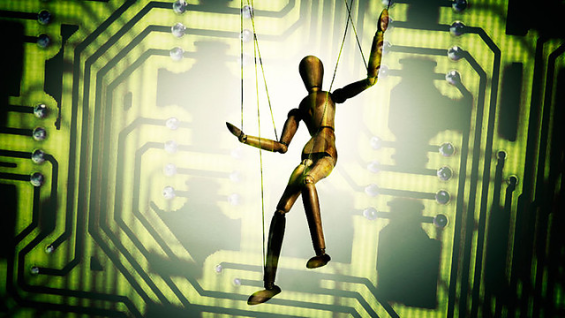
Marionettes, Inc.
By Ray Bradbury; Read by ???
1 Broadcast – Approx. 15 Minutes [ABRIDGED?]
Broadcaster: BBC Radio 4 Extra
Broadcast: October 8, 2012
Fragments Of A Hologram Rose
By William Gibson; Read by Jon Strickland
1 Broadcast – Approx. 15 Minutes [ABRIDGED?]
Broadcaster: BBC Radio 4 Extra
Broadcast: October 9, 2012
Tomorrow’s News Yesterday
By Terry Pratchett and Neil Gaiman; Read by Jon Strickland
1 Broadcast – Approx. 15 Minutes [ABRIDGED?]
Broadcaster: BBC Radio 4 Extra
Broadcast: October 10, 2012
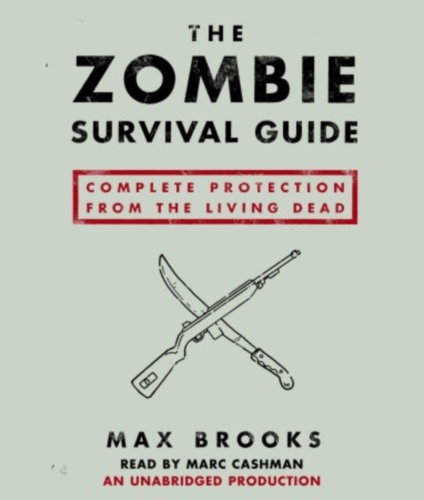
The Zombie Survival Guide: Complete Protection From The Living Dead
By Max Brooks; Read by Marc Cashman
Approx. 8 Hours 38 Minutes [UNABRIDGED]
Publisher: Random House Audio
Published: September 12, 2006
ISBN: 9780739342725
Themes: / Zombies / Humor / Horror / Apocalypse /
The next time a Class 2 zombie outbreak occurs in my neighborhood, I’ll be well-prepared to deal with the shambling corpses of hungry undead now that I’ve read Max Brooks’ The Zombie Survival Guide: Complete Protection From The Living Dead.
The Zombie Survival Guide dispels exaggerated myths and legends of the undead and instead presents the reader with unvarnished “truths” about zombies. You’ll find information on zombies’ physical strength, sight, hearing, and rate of decay, and the pros and cons of various weaponry for battling the undead (everything from medieval maces and claymores, to M-16s and flamethrowers). It describes various scenarios for identifying early signs of localized (Class 1) outbreaks, to full-blown widespread undead infestation (Class 3). You’ll find best practices for battling zombies in urban settings, in harsh desert and swamp environments, even under the sea. The Zombie Survival Guide tells you how to defend your home by stocking up with key food and supplies and moving to your second floor and destroying all staircases (recommend for Class 2), or how to survive on the run as you move to the most remote and therefore safest parts of the planet in a world-wide zombie apocalypse in which mankind is overrun (Class 4). The best vehicle should an outbreak occur? You might not guess it, but it’s a bicycle. On a bike you can easily outrun the slow, slouching pace of zombies, it will never run out of gas, you can carry a bicycle over rough terrain, and you can maneuver a bike through the inevitable traffic jams that accompany a full-on panic. Motorcycles are very good too, though their noise attracts the undead. Boats are also a secure means of travel, says Brooks, but watch your anchor line—zombies walking on the ocean floor can use it to climb up to your boat. “Hundreds” of hapless victims have died this way, Brooks tells us.
The Zombie Survival Guide serves as a perfect gateway to Brooks’ highly recommended World War Z |READ OUR REVIEW|. If for nothing else, and you find Brooks’ post-apocalyptic strategems and survival tactics tedious, I’d recommend this book simply for the highly entertaining “Recorded Outbreaks” section. Here Brooks describes various zombie outbreaks throughout history, from ancient tales recorded in chilling primitive artwork, all the way up through living eyewitness accounts from the early 21st century. These are written in the economical journalism style that Brooks’ employs so effectively in World War Z, lending these “outbreaks” a documentary-style feel, which makes them seem more realistic and terrifying. According to Brooks there have been many zombie outbreaks throughout history—perhaps even in my neighborhood, hence my need to be ready—but these have been largely laughed off by skeptical media, ascribed to outbreaks of disease, localized madness, or industrial pollution, or covered up by governments or the CDC, fearful that public knowledge would result in full-scale panic.
For all its earnestness you have to take The Zombie Survival Guide with a heavy dose of salt. While it’s written in a deadpan style and never descends into farce, and purports to be a “real” guide for complete protection against the walking dead, when you read passages like “If you want to know the true danger of an airborne (parachute) attack against zombies, try dropping a square centimeter of meat on a swarming anthill. Chances are, that meat will never touch the ground. In short, air support is just that—support. People who believe it to be a war-winner have no business planning, orchestrating, or participating in any conflict with the living dead,” you can’t help but laugh (I did laugh out loud, several times). While not as well-written or as compelling as World War Z, for zombie aficionados The Zombie Survival Guide is nevertheless a must-read.
Marc Cashman narrates with a dry, clipped voice that perfectly suits the how-to nature of The Zombie Survival Guide. There’s a touch of William Shatner in his delivery, with dramatic pauses in odd places, but that only adds to the fun.
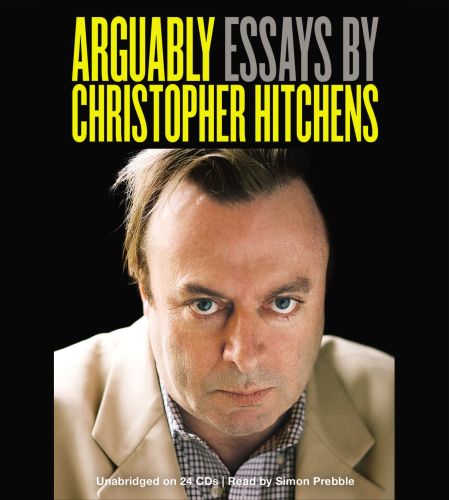
Arguably: Essays
By Christopher Hitchens; Read by Simon Prebble
24 CDs – Approx. 28.5 Hours [UNABRIDGED]
Publisher: Hachette Audio
Published: September 1, 2011
ISBN: 9781611139068
Themes: / Non-fiction / History / War / Biography / Science Fiction / Fantasy / Iran / Afghanistan / Germany / North Korea / France / Dystopia / Utopia / Religion / Tunisia / Piracy / Terrorism / Feminism / Pakistan /
The first new collection of essays by Christopher Hitchens since 2004, Arguably offers an indispensable key to understanding the passionate and skeptical spirit of one of our most dazzling writers, widely admired for the clarity of his style, a result of his disciplined and candid thinking. Topics range from ruminations on why Charles Dickens was among the best of writers and the worst of men to the haunting science fiction of J.G. Ballard; from the enduring legacies of Thomas Jefferson and George Orwell to the persistent agonies of anti-Semitism and jihad. Hitchens even looks at the recent financial crisis and argues for arthe enduring relevance of Karl Marx. The audio book forms a bridge between the two parallel enterprises of culture and politics. It reveals how politics justifies itself by culture, and how the latter prompts the former. In this fashion, Arguably burnishes Christopher Hitchens’ credentials as-to quote Christopher Buckley-our “greatest living essayist in the English language.”
Here’s a question I was thinking about while listening to Arguably.
What is fiction for?
One answer, the bad one, is that it’s for entertainment. That’s certainly where many readers are willing go, and the fiction writers who write it too. Maybe that’s precisely why so much fiction is just so very shitty.
To me, if you aren’t exploring ideas in your fiction, then you really aren’t serving a greater purpose. Idea fiction, fiction with ideas rather than just action and plot, is to my mind a kind of supplement to the wisdom found in writings on history, biography and science.
Of the many lessons learned I in listening to the 107 essays in Arguably I was particularly struck by the wisdom Christopher Hitchens gleaned from his reading of fiction. Hitchens reviews many books in this collection, nearly half of the essays are book reviews. Books like 1984, Animal Farm, Flashman, The Complete Stories Of J.G. Ballard, Our Man In Havana, and even, surprisingly, Harry Potter And The Deathly Hallows all get fascinating, critical, and reverent reviews.
Yet Hitchens also takes the lessons with him into his writing about his travels. Hitchens writes about visits to such places as North Korea, Cyprus, Afghanistan, and Kurdish Iraq. When talking about his visit to Beirut we see what comes when Hitchens, a man of ideas, acts upon them. The essay, The Swastika and the Cedar sees the convictions of the commited anti-fascist Hitchens beaten and nearly kidnapped for an act of vandalism on a prominently displayed swastika. Writes Hitchens:
“Well, call me old-fashioned if you will, but I have always taken the view that swastika symbols exist for one purpose only—to be defaced.”
In a review of two books, Lolita and The Annotated Lolita, Hitchens applies the controversial subject in a real life look at the modern, and very non-fictional oppression and objectification of women. Indeed, the ideas he appreciated in fiction helped Hitchens to come to grips with the real world.
I think the worst essay in this collection is the one on the serving of wine and restaurants, Wine Drinkers Of The World, Unite. It was simply a waste of the talent, too light, too easy a target. And yet, even that essay, the worst essay in all 107 has a memorable anecdote: “Why,” asks Hitchens’ five year old son, “are they called waiters? It’s we who are doing all the waiting.”
As to the narration of the audiobook. I’m ashamed to admit that I was initially dismayed when I saw that Christopher Hitchens had not narrated this audiobook himself. I was wrong to worry. Incredibly, Simon Prebble seems to have have become Hitchens for this narration. Prebble perfectly captures the erudite words, so eloquently performs them, and with an accent so like that of Hitchens’ own so as to make me think that it was Hitchens who had actually read it.
I think the worst essay in this collection is the one on the serving of wine and restaurants, Wine Drinkers Of The World, Unite. It was simply a waste of the talent, too light, too easy a target. And yet, even that essay, the worst essay in all 107 has a memorable anecdote: “Why,” asks Hitchens’ five year old son, “are they called waiters? It’s we who are doing all the waiting.”
Here’s a list of the book’s contents, with links to the original etexts when available, along with my own notes on each:
The Private Jefferson – a review of Jefferson’s Secrets: Death And Desire At Monticello by Andrew Burstein
Jefferson Vs. The Muslim Pirates – a review of Power, Faith, And Fantasy: America In The Middle East: 1776 To The Present by Michael B. Oren
Benjamin Franklin: Free And Easy – a review of Benjamin Franklin Unmasked: On the Unity of His Moral, Religious, And Political Thought by Jerry Weinberger
John Brown: The Man Who Ended Slavery – a review of John Brown, Abolitionist: The Man Who Killed Slavery, Sparked The Civil War, And Seeded Civil Rights by David S. Reynolds
Abraham Lincoln: Misery’s Child (aka Lincoln’s Emancipation) – a review of Abraham Lincoln: A Life by Michael Burlingame
JFK: In Sickness And By Stealth – a review of An Unfinished Life: John F. Kennedy, 1917–1963 by Robert Dallek
Saul Bellow: The Great Assimilator – review of six novels by Saul Bellow (The Dangling Man, The Victim, The Adventures Of Augie March, Seize The Day, Henderson The Rain King, and Herzog)
Vladimir Nabokov: Hurricane Lolita – reviews of Lolita by Vladimir Nabokov and The Annotated Lolita edited and annotated by Alfred Appel, Jr.
John Updike: No Way – a review of The Terrorist by John Updike (with reference to The Coup too) John Updike: Mr. Geniality – a critical review of the affable Due Considerations: Essays And Considerations by John Updike
Vidal Loco – Gore Vidal went crazier, more elitist and perhaps more racist as he got older (with attention and quips for Quentin Crisp and Oscar Wilde and Joyce Carol Oates)
America The Banana Republic – Hitchens on the “socialistic” bank bailout of 2008 (“socialism for the rich and free enterprise for the rest”)
An Anglosphere Future – a review of The History Of The English Speaking Peoples by Andrew Roberts (with reference to both Sherlock Holmes and The White Company by Sir Arthur Conan Doyle as well as to Cecil Rhodes and Rudyard Kipling)
Political Animals – a review of Dominion: The Power Of Man, The Suffering Of Animals, And The Call To Mercy by Matthew Scully
Old Enough To Die – on capital punishment as applied to children In Defense Of Foxhole Atheists – a visit to the United States Air Force Academy and the tax funded proselytizing
ECLECTIC AFFINITIES Isaac Newton: Flaws Of Gravity – a stroll through the medieval streets of Cambridge with the scientists, mathematicians, and philosophers who worked there
Gustave Flaubert: I’m With Stupide – a review of Bouvard et Pécuchet by Gustave Flaubert translated by Mark Polizzotti The Dark Side Of Dickens – a review of Charles Dickens by Michael Slater a biography (Hitchens was a not uncritical admirer of the subject)
Marx’s Journalism: The Grub Street Years – a glowing review of Dispatches for the New York Tribune: Selected Journalism Of Karl Marx edited by James Ledbetter, foreword by Francis Wheen (Marx admired the United States, and other fascinating facts about the father of communism)
Rebecca West: Things Worth Fighting For – an introduction to Black Lamb and Grey Falcon: A Journey Through Yugoslavia by Rebecca West
Ezra Pound: A Revolutionary Simpleton – a review of Ezra Pound, Poet: A Portrait Of The Man And His Work: Volume I: The Young Genius, 1885-1920 by A. David Moody (a biography of the fascist poet)
John Buchan: Spy Thriller’s Father – a review of John Buchan The Presbyterian Cavalier by David R. Godine (with discussion of The 39 Steps and a fantasy novelette The Grove Of Ashtaroth)
Fraser’s Flashman: Scoundrel Time – a look at the George MacDonald Fraser series of Flashman books and the connection with The Adventure Of The Empty House
AMUSEMENTS, ANNOYANCES, AND DISAPPOINTMENTS Why Women Aren’t Funny – a controversial essay on why more comedians are male and why women laugh at them the way they do
As American As Apple Pie – a literary and chronological history of the blowjob, with reference to Valdamir Nobokov’s Lolita
So Many Men’s Rooms, So Little Time – a fascinatingly insightful argument on what’s was going on with the Larry Craig bathroom airport scandal and related phenomena
A War Worth Fighting – a persuasively systematic review of Churchill, Hitler And The Unnecessary War: How Britain Lost Its Empire And The West Lost The World by Pat Buchanan
Just Give Peace A Chance? – a critical review of Human Smoke by Nicholson Baker
Don’t Mince Words – the disenfranchisement of south Asians in Britain isn’t the cause of bombings, hatred of women is.
History And Mystery – al-Qaeda in Iraq, jihadists, or “insurgents”? Do words matter? Of course they bloody well do.
Words Matter – political slogans make of “every adult in the country” an “illiterate jerk who would rather feel than think”
This Was Not Looting – how can a government “loot” it’s own weapons manufacturing facility? The government of Iraq managed it according to The New York Times.
The “Other” L-Word – a lighthearted piece on the prominence of the word “like” and it’s use
The You Decade – what’s wrong with you (marketing to the selfish)
Suck It Up – the Virginia Tech shootings prompted the wrong response from the world (namely that it prompted one)
A Very, Very Dirty Word – the English empire, in centuries to come, may only be remembered for soccer and the phrase “fuck off”
“One must not put a loaded rifle on the stage if no one is thinking of firing it.” -Anton Chekhov, November 1,1889.
Mindwebs – The Gun Without A Bang
By Robert Sheckley; Read by Michael Hanson
1 |MP3| – Approx. 19 Minutes [UNABRIDGED with a musical bed]
Broadcaster: WHA Radio (Madison, WI)
Broadcast: August 4, 1982
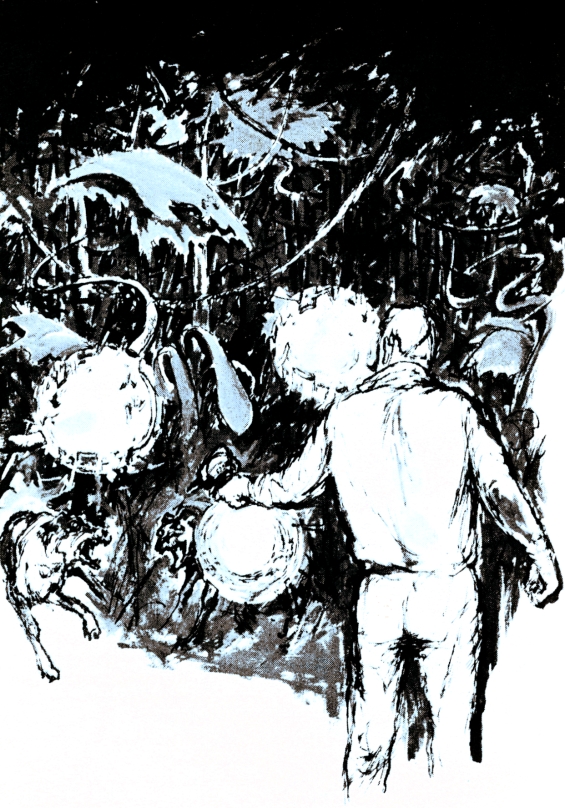
Provider: Archive.org Alfred Dixon is a weapons expert assigned to test, in hostile alien jungle conditions, a new deadly disintegration pistol. The thing kills alright, but there’s one thing it doesn’t do. It won’t report. First published in Galaxy Science Fiction, June 1958.
It took me two attempts to get into this Fritz Leiber audiobook. Part of the issue was that the first person protagonist is female and the audiobook’s narrator is male. Phil Chenevert, the narrator, is a talented voice actor but he still sounded male. This bothered me all the way up to chapter four when I had my growning indignity balloon deflated by this choice paragraph:
I swung back to the play just at the moment Lady Mack soliloquizes, “Come to my woman’s breasts. And take my milk for gall, you murdering ministers.” Although I knew it was just folded towel Martin was touching with his fingertips as he lifted them to the top half of his green bodice, I got carried away, he made it so real. I decided boys can play girls better than people think. Maybe they should do it a little more often, and girls play boys too.
Despite my loss of that criticism, I am still not fully satisfied with the story. Like The Big Time |READ OUR REVIEW| before it, No Great Magic is well written fluff – with not even the shape of a plot beginning until the very end.
It may just be that No Great Magic, and perhaps a good deal of other time travel related SF, are of a kind of “cozy” Science Fiction story that I just don’t fully embrace.
Still, the first person narration by the amnesiac heroine and Chenevert’s narrative skill make No Great Magic worth checking out – and perhaps your tastes and my tastes will differ.
“I hope you have been involved in the theater somewhere in your past or present because this story smells heavily of greasepaint.”
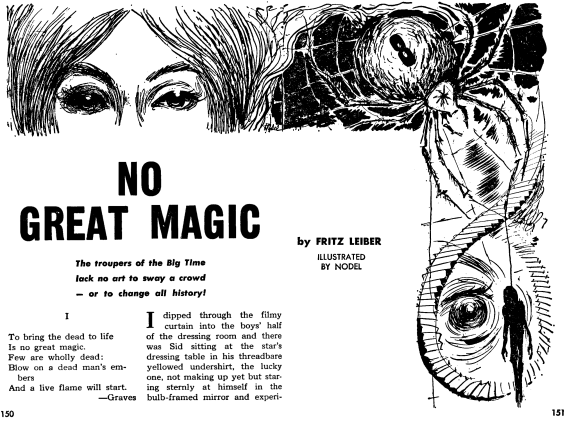
No Great Magic
By Fritz Leiber; Read by Phil Chenevert 8 Zipped MP3 Files or Podcast – Approx. 1 Hour 53 Minutes [UNABRIDGED]
Publisher: LibriVox.org
Published: May 27, 2012
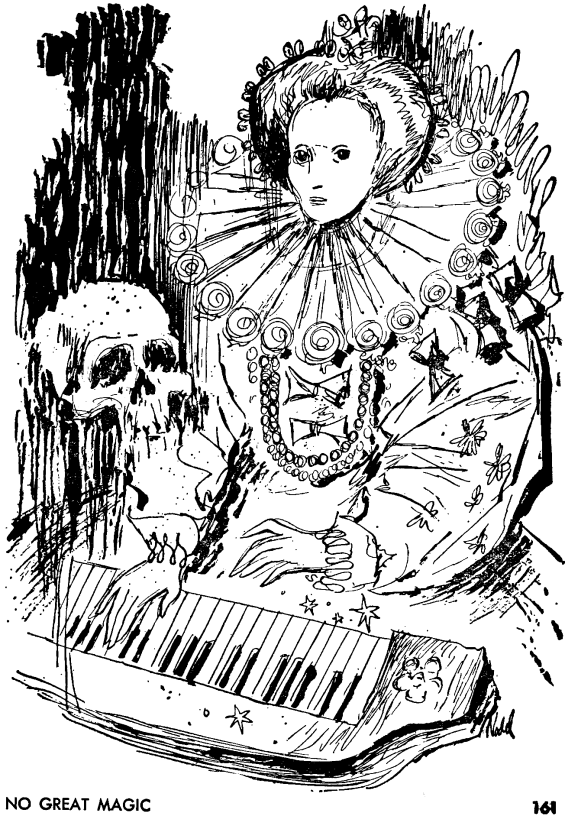
|ETEXT| They were a traveling group of Shakespearean players; perfectly harmless, right? wrong. For one thing, why did they have spacemen costumes in their wardrobes,right next to caveman ones? Why was the girl in charge of backstage suffering from amnesia and agoraphobia? No Great Magic is needed to perform the plays they put on, but sometimes great science. No matter where, or when. First published in Galaxy Science Fiction, December 1963.
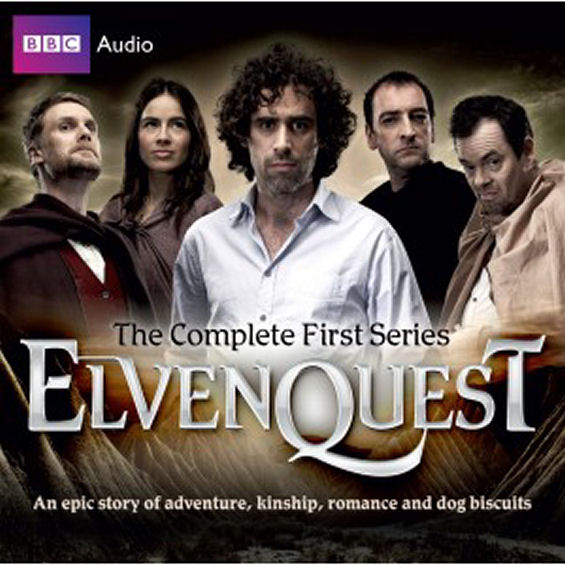
Elvenquest
Written by: Anil Gupta and Richard Pinto
Cast: Stephen Mangan, Alistair McGowan, Sophie Winkleman, Darren Boyd, Kevin Eldon, Dave Lamb. Also featuring Chris Pavlo, Carrie Quinlan, Lizzy Watts, and Clare Willie.
Broadcaster: BBC Radio 4
Released: 3 August 2009
Publisher: AudioGO
Synopsis: Sam is a fantasy novelist who is whisked off to a Tolkien-style parallel universe by a noble elf, a sexy warrior princess, and a feisty dwarf called Dean. Why? Because Sam’s dog is the Chosen One who is destined to save “Lower Earth” from the evil Lord Darkness.
Three words: Fun. Fun. Fun.
A smartly written script and a great cast make for a wonderfully hilarious send-up of the fantasy quest story and of fantasy novels in general.
Writers Anil Gupta and Richard Pinto hit all the right notes: the Chosen One, a prophecy, elves, dwarves, warrior maidens, demons, goblins, trolls, unicorns, deadly traps and puzzles, and colonic irrigations, to name a few. Imagine Lord of the Rings as written by Douglas Adams, Mel Brooks, and the Monty Python troupe and you get the picture.
Most importantly–the cast. The cast, I think, really nails the script with excellent performances and crackerjack comic timing.
Stephen Mangan as Sam Porter seems to be, at times, channeling Simon Jones as Arthur Dent and it works. Sam, like Arthur, is out of his depth in Lower Earth and is simply trying to fit in.
Alistair McGowan plays Lord Darkness like a mixture of Alan Rickman’s Sheriff from Robin Hood, Prince of Thieves and Rowan Atkinson’s Edmund Blackadder. He’s even got a Blackadder-like delivery and intonation.
Vidar the Elf Lord isn’t the brightest crayon in the box but makes up for it by being gung-ho and bombastic and Darren Boyd captures that beautifully. He sounds like he’s having too much fun declaiming and waxing rhapsodic.
Dave Lamb, as Amis the Dog/the Chosen One, is canine exuberance personified. Sophie Winkleman is superb as Penthiselea the Warrior Princess, lending the right touch of kick-ass chick with a sword, as well as being the voice of grounded reason for the others and, in many cases, the straight man–er, woman.
As Dean the Dwarf and Kreech the evil sidekick, Kevin Eldon manages to portray seemingly polar opposite characters who happen to share a “love” for violence. Dean wants to dash into battle at every opportunity while Kreech wants to unleash the goblin hordes on the questers.
The one thing that irked me while listening was the laugh track. I didn’t think it needed to be there and, at first, was distracting. But I got used to it enough that it “faded” into the background.
According to this site, the show was recorded in front of a live audience. Explains the track.
But I still think it’s unnecessary.
Other than that, this is a top-of-the-line production and I highly recommend it. Especially if you love comedy and fantasy. And comedic fantasy.




 Arguably: Essays
 Mindwebs – The Gun Without A Bang
 No Great Magic