FREE LISTENS Top 10 Free Stories

Review

Free Listens Blog

A few weeks ago Jesse posted my list of Best Free Audiobooks. I got a great response for this post, so I thought I’d do another one with my favorite free short stories that I’ve reviewed at Free Listens. Of course such lists are inherently silly, as they depend upon the listmaker’s tastes, current mood, memory, and a host of other little factors that have nothing to do with the quality of the story. So, if you’d rather, here’s a list of 10 really darn good stories (but maybe not the best):

  1. “The Lottery” – Shirley Jackson
  2. “A Rose for Emily” – William Faulkner
  3. “The Gospel According to Mark” – Jorge Luis Borges
  4. “The Gift of the Magi” – O. Henry
  5. “Nightfall” by Isaac Asimov
  6. “Bullet in the Brain” – Tobias Wolff
  7. “A Sound of Thunder” – Ray Bradbury
  8. “The Monkey’s Paw” – W.W. Jacobs
  9. “The Open Window” – Saki
  10. “The Yellow Wallpaper” – Charlotte Perkins Gilman

Hope you enjoy these!

Posted by Seth

The SFFaudio Podcast #066 – TALK TO: Harlan Ellison

Podcast

The SFFaudio PodcastThe SFFaudio Podcast #066 – Scott talks to Harlan Ellison, in the vintage 2006 interview, about audiobooks and audio drama.

Talked about on today’s show:
SFWA, Harlan Ellison’s Grand Master of Science Fiction award, Ray Bradbury, Isaac Asimov, Alfred Bester, Repent Harlequin Said The Tick-Tock Man, A Boy And His Dog, Shatterday, Alternate World Recordings, Shelly Levinson, Roy Torgeson, The Prowler In The City A The Edge of the World, Yours Truly Jack The Ripper by Robert Bloch, Dangerous Visions, The Bloody Times Of Jack The Ripper, radio drama, Orson Welles, reading your own work aloud, Joseph Patrich, in the tradition of Geoffrey Chaucer, Ovid, Plato, auctorial performance, teaching English at universities, autodidact-ism, the Harlan Ellison Recording Collection, Caedmon, Harper Audio, The Ellison Audio Archipelago, Stefan Rudnicki, Dove Audio, A Sinner In The Hands Of An Angry God by Jonathan Edwards, Guglielmo Marconi, Voices From The Edge: I Have No Mouth But I Must Scream by Harlan Ellison |READ OUR REVIEW|, Audio Literature, Blackstone Audio, Deep Shag Recordings, On The Road With Harlan Ellison series, Jack Williamson, Robert A. Heinlein, performing an audiobook, reading for the blind, Scott Brick, the wonderful voice of Stefan Rudnicki, City Of Darkness by Ben Bova, A Wizard Of Earthsea by Ursula K. Le Guin |READ OUR REVIEW|, Ben Bova’s writing style, Mars by Ben Bova (read by Harlan Ellison), cryonics vs. cryogenics, fixing mistakes in other people’s books, the popularity of Science Fiction in radio’s heyday, Mysterious Traveler, Suspense, Lights Out, X-Minus One, Dimension X, I Love A Mystery, War Of The Worlds, 1950s “giant ant movies”, Galaxy Magazine, Radio Yesterday, Sea Legs by Frank Quattrocchi, the radio serials: Space Cadet, Superman, Flash Gordon, Buck Rogers, 2000X, the man Harlan Ellison won’t mention the name of (Yuri Rasovsky), Robin Williams, By His Bootstraps by Robert A. Heinlein, Richard Dreyfuss, NPR, the sense of belonging, The Green Hornet, The Hitchhiker’s Guide To The Galaxy (Tertiary Phase), Douglas Adams.

Posted by Jesse Willis

BBC Audio and RadioArchive.cc: The Taming Of The Shrew and Science Fiction

SFFaudio Online Audio

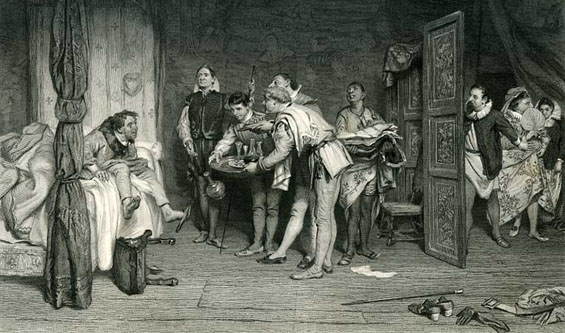
The "Induction" scene in The Taming of the Shrew

If I asked you to think about “Shakespeare and Science Fiction” you’d probably go with Forbidden Planet (a spacey version of The Tempest). If you’re more TV inclined you’d probably go with Star Trek, maybe even name the episode entitled “The Conscience of the King” outright. That’s the one that features a near perfect inversion of the traveling actors sequence in Hamlet (as well as part of the production of the play itself).

And yeah, Shakespeare himself may appear as a character in Science Fiction stories. Isaac Asimov’s The Immortal Bard is perhaps my favourite example of that. But no actual Science Fiction can be found in any play by William Shakespeare. Right?

Shakespeare’s plays have many fantastic elements (ghosts, magic, witches, prophecy), but those are all Fantasy tropes, not SF. Not one the the plays of William Shakespeare could possibly qualify as Science Fiction outright. Right?

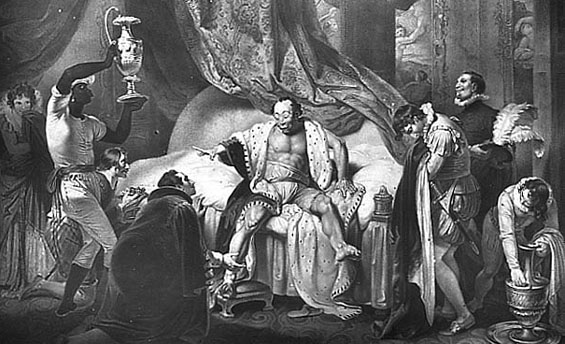
But then, I was thinking about the very Philip K. Dickness of the opening sequence of Shakespeare’s farcical romp called The Taming Of The Shrew. It’s called “The Induction” and features a character named Christopher Sly, a drunkard, who while unconscious, is abducted from the street where he lays and is taken into a mischievous Lord’s home. There, he’s put to bed, and when awakened, is told by the household’s servants that he’s been “asleep” for fifteen years, that he is the lord of the manor, and that he has a beautiful young wife! All the household’s servants are in on the jape and obey his every command. The Lord who arranged this practical joke says,

Persuade him that he hath been lunatic;
And when he says he is, say that he dreams,
For he is nothing but a mighty lord.
This do and do it kindly, gentle sirs:
It will be pastime passing excellent,
If it be husbanded with modesty.

Only then, once the ridiculous question of identity is hatched does The Taming of the Shrew begin (performed by a troupe of traveling actors who visit Christopher Sly’s manor). We’ve talked about Fictional Fictional Characters, on the SFFaudio Podcast before, this is a case of a fictional fictional play. The actors in the play are playing actors in a play.

“Christopher Sly’s presence as a spectator in Shakespeare’s The Taming Of The Shrew makes the entire drama of wife-taming into a mere science fiction spectacle of household order.” -From the introduction to Poor Women in Shakespeare by Fiona McNeill

I’m betting that’s as close as The Taming Of The Shrew gets to Science Fiction.

This is all apropos of some recent reading of the play proper and a visit to RadioArchive.cc where you’ll be able to find a terrific sounding 1988, BBC Radio 3 dramatization that faithfully adapts the play to audio.

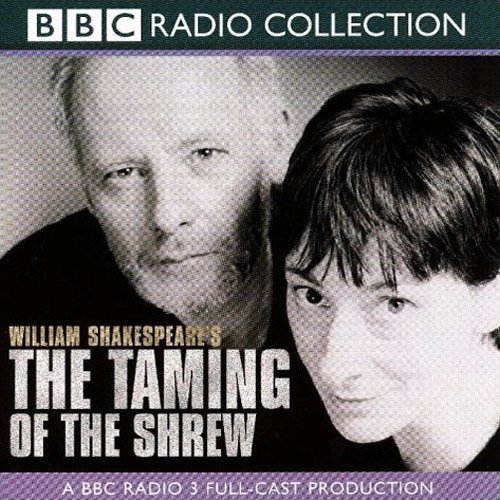
BBC Radio - The Taming Of The Shrew by William ShakespeareThe Taming of the Shrew
By William Shakespeare; Adapted by Jeremy Mortimer; Performed by a full cast
CD or MP3 (via TORRENT) – Approx. 2 Hours [RADIO PLAY]
Broadcaster: BBC Radio 3 / BBC Radio 7
Broadcast: 1988 / 2005
Publisher: BBC Audio
Published: 1999
ISBN: 056355391X
This hearty comedy has always been a favourite with audiences. Three suitors pursue Bianca Minola, but her father won’t let her marry until her older sister, Katherine, is married. Kate is wilful, loud, volatile and above all, shrewish. Her suitor Petruchio is stern, jolly, and somewhat odd. A match made in heaven?
Cast:
Bob Peck, Cheryl Campbell, Moira Leslie, Robert Glenister, Stephen Tompkinson, Douglas Hodge, Christopher Fairbank, Michael Deacon, Anthony Jackson, Willam Simons, John Badley, and Paul Copley
Crew:
Directed by Jeremy Mortimer
Music composed by Mia Soteriou

The Induction scene in The Taming of the Shrew

Posted by Jesse Willis

Review of Saturn’s Children by Charles Stross

SFFaudio Review

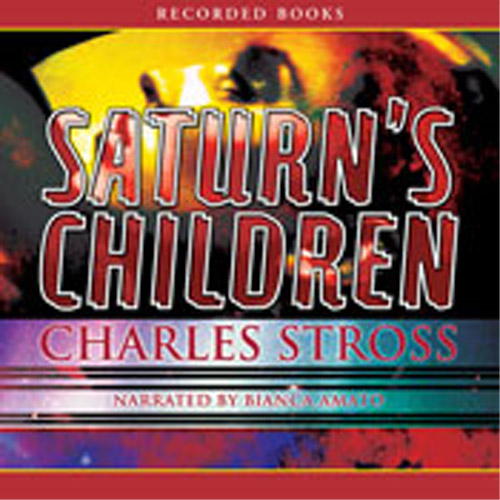
RECORDED BOOKS - Saturn's Children by Charles StrossSaturn’s Children
By Charles Stross; Read by Bianca Amato
11 CDs – Approx. 13 Hours 45 Minutes [UNABRIDGED]
Publisher: Recorded Books
Published: 2009
ISBN: 9781440750113, 9781440750106
Themes: / Science Fiction / Androids / Robots / Sex / Slavery / Identity / Venus / Mars / Mercury / Eris /

The Hugo Award-winning author of numerous best-sellers, Charles Stross crafts tales that push the limits of the genre. In Saturn’s Children, Freya is an obsolete android concubine in a society where humans haven’t existed for hundreds of years. A rigid caste system keeps the Aristos, a vindictive group of humanoids, well in control of the lower, slave-chipped classes. So when Freya offends one particularly nasty Aristo, she’s forced to take a dangerous courier job off-planet.

This novel’s title comes from the myth that Saturn (the Roman god of agriculture and harvest), ate his children at birth for fear of them usurping him. Its an apt starting point for a tale about robots More interesting is that Saturn’s Children opens with a reading of Asimov’s three laws of robotics

1. A robot may not injure a human being or, through inaction, allow a human being to come to harm.
2. A robot must obey any orders given to it by human beings, except where such orders would conflict with the First Law.
3. A robot must protect its own existence as long as such protection does not conflict with the First or Second Law.

…and then informs us that there are no humans left alive. There is, however, a whole solar system full of robots, all willing and able to obey all three laws. So what happened to all those humans? The novel is the answer to that question.

Saturn’s Children is told from the point of view of Freya Nakamichi-47 a gynoid (that’s a female android). She was activated (born) long after the last human had died. Freya, despite never having met one, still longs for her lost love (any human). Indeed, even the mere thought a human being makes her sexually excited. This is because, as a self described grande horizontale, Freya’s destiny was to be a sexual companion to any human that owned her. Now, without a master, she finds work where and when she can. But after a nasty run-in with an Aristo, a wealthy robot that owns other robots (called Arbiters), Freya will take any work that gets her off planet. Soon she’s employed by Jeeves, a masculine android who is more like her in shape and purpose than most robots. Freya’s first assignment is to transport a bio-engineered package across the solar system. But the pink police (a kind of anti biological proliferation organization), and another, more shadowy, organization are determined to stop her. Along the way Freya visits Cinnabar (a city on rails) that’s perpetually in Mercury’s shadow, drawing power from the temperature difference between Mercury’s light and dark sides), has sex with a rocket ship and grows some new hair.

Freya does a whole lot more than that too. She has a lot more sex for one. But beyond the sex there is some more fully cerebral stimulation going on in Saturn’s Children. The idea of a post-human solar system is an interesting one, and Stross plays with it quite effectively. This is a theme that I think hasn’t been done often enough in SF. The closest novel, in scope, if not in tone, is perhaps Clifford D. Simak’s City (in which intelligent dogs and robots have inherited a humanless Earth). This humanless solar system is, as I mentioned, quite vividly explored, with floating cities (like Bespin’s Cloud City) on Venus, waste heated bio-labs on the frozen dwarf planet of Eris, and a truly frightening description of what’s happened to poor old Earth. Stross has quite a lot of fun playing with the world he’s created here, naming a city Heinleingrad, naming a robot butler character after P.G. Wodehouse’s famous “gentleman’s personal gentleman.” It all mostly works with Saturn’s Children seeming to take most of its inspiration though from Heinlein’s novel Friday. Both novels feature artificial female persons as secret couriers, both tell their own stories, both secrete their smuggled cargos in their abdomens. Later on in Saturn’s Children there is some playing with the ideas promulgated in Heinlein’s 1970 novel I Will Fear No Evil. And, identity, in a world where brain data, and brain states, are easily and quickly copyable, isn’t as simple as it is with us meatbags. On the whole I enjoyed Saturn’s Children and found it full of interestingness. It was as most novels are these days, too long, and in need of a critical editor. The worst sin here is that the ending is rather weak, and features an afterword that leaves open the possibility of a sequel or seven.

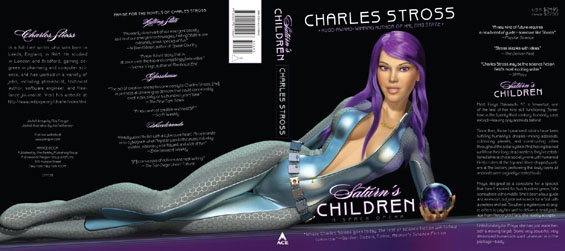
Narrator Bianca Amato, a South African accented “ALIEN OF EXTRAORDINARY ABILITY” (according to her resume), mispronounces a couple of the more obscure words but the general gist of her reading is highly competent. It helps a whole lot that Freya’s story is told in first person. I’m not sure what the present tense adds to the narrative other than being a little noticeable and not particularly harmful. Also, as I mentioned in a recent podcast, the Recorded Books cover art is boring, whereas the Ace Books paperbook edition is fabulous!

Check out the dust jacket from the paperbook edition:

Saturn's Children by Charles Stross - The PAPERBOOK's Dustjacket

Posted by Jesse Willis

The SFFaudio Podcast #052 – TALK TO: William F. Wu

Podcast

The SFFaudio PodcastThe SFFaudio Podcast #052 – Jesse and Scott are joined by Science Fiction author and YELLOW PERIL scholar William F. Wu.

Talked about on today’s show:
Isaac Asimov, the “Robots In Time” series, the “Robot City” series, The Twilight Zone (1985), Wong’s Lost And Found Emporium by William F. Wu, Allan Brennert, Prisoners Of Gravity, Clarion Writers’ Workshop, Amazing Stories, Harlan Ellison, the best adaptation of Tom Godwin’s The Cold Equations, The Yellow Peril: Chinese Americans In American Fiction 1850-1940 by William F. Wu, University Of Michigan, Eric S. Rabkin, invasion stories, San Fransisco, The Battle Of Wabash by Lorelle, Dr. Fu Manchu, 19th century, Chinese immigration to the USA, immigration, Blazing Saddles (1974), The Insidious Dr. Fu-Manchu, Charlie Chan, Sax Rohmer, comics, Marvel, DC Comics, Charlton Comics, Asians characters in comics, anglicizing Chinese names, David Lo Pan, Sui Sin Far (aka Edith Eaton), the co-evolution of Sax Rohmer and Dr. Fu Manchu, Sir Arthur Conan Doyle, Sherlock Holmes, the best episode of Doctor Who episode ever: The Talons Of Weng Chiang, John Carpenter’s Big Trouble In Little China, James Hong, Hong On The Range by William F. Wu, San Diego, ComiCon, Mister Ron, Peter Sellers, The Fiendish Plot Of Dr. Fu Manchu (1980), Christopher Lee, The Face Of Fu Manchu (1965), Master Of Kung-Fu, Green Lantern/Green Arrow, Captain America, Bruce Lee, Enter The Dragon, Doug Moench, Starlog, the Marvel “no prize”, Julius Schwartz

Wong’s Lost And Found Emporium as adapted for an episode of The Twilight Zone (1985) Parts 1, 2 and 3:

Prisoners Of Gravity – Workshops/Clarion Parts 1, 2 and 3:

Posted by Jesse Willis

Ellery Queen Mystery Magazine podcast

Aural Noir: Online Audio

Ellery Queen's Mystery Magazine PodcastHere is a terrific find for fans of mystery and crime tales! Hosted by Ellery Queen Mystery Magazine‘s editor, Janet Hutchings, comes a new podcast the Ellery Queen Mystery Magazine podcast! It features:

“Monthly readings and dramatizations of stories by the world’s leading writers of suspense chosen from the magazine’s archives. The full range of the genre is represented in these riveting audio renditions, from the drawing-room mystery to urban noir—including police procedurals, private-eye tales, psychological suspense, and locked-room and impossible-crime stories.”

I’ve been listening to these for hours today. The audio dramatizations are actually pretty good. The short stories tend to be very solid too (and are mostly read by their authors). Sound quality varies though and sometimes the recording level volume is set far too low. Additionally, the proof-listening is occasionally very shoddy (with repeated lines remaining unedited). The latest episode (#7) has three stories all based on the same newspaper article. The results are mixed, but I really like the idea of stories based around a story seed like that. In fact, it reminds me of something John Joseph Adams and David Barr Kirtley were talking about in a recent Geek’s Guide to the Galaxy podcast. They mentioned the John W. Cambpell story seed that lead to the writing of Isaac Asimov’s Nightfall and Robert A. Heinlein’s Orphans Of The Sky. Two SF stories that are both very different and very terrific.

My favourite Ellery Queen Mystery Magazine podcast episode so far is #5, Dear Doctor Watson, a Steve Hockensmith short story. Its a kind of Sherlockian pastiche set in the Victorian West. It’s protagonist a kind of amateur Sherlock Watson team that’s only half-hampered by being illiterate and in Montana. Dear Doctor Watson is both fun and well read by two narrators.

I truly hope to see the “Ganelon” stories by James Powell and the “Black Widowers” tales by Isaac Asimov showing up in future episodes. They’re the absolute tops!

Ellery Queen's Mystery Magazine - September 1956Episode 1: Cut! Cut! Cut!
Based on a story by Ellery Queen; Adapted by Ed Bogas; Performed by a full cast
1 |MP3| – Approx. 12 Minutes [AUDIO DRAMA]
Podcast: Ellery Queen Mystery Magazine podcast
Podcast: August 2009
Ellery Queen receives a phone call from a murder victim in this clever play involving a witness of another species. First published in Ellery Queen’s Mystery Magazine September 1956 issue.

Ellery Queen’s Mystery Magazine - November 2001Episode 2: Groundwork
Based on the story by Neil Schofield; Performed by a full cast
1 |MP3| – Approx. 25 Minutes [UNABRIDGED]
Podcast: Ellery Queen Mystery Magazine podcast
Podcast: September 2009
A nosy neighbor alerts police to suspicious digging in the garden next-door—and she isn’t the only one to get an unexpected comeuppance. First published in EQMM in November 2001.

Ellery Queen’s Mystery Magazine - June 2003Episode 3: The Talking Dead
By Melodie Johnson Howe; Read by Melodie Johnson Howe
1 |MP3| – Approx. 27 Minutes [UNABRIDGED]
Podcast: Ellery Queen Mystery Magazine podcast
Podcast: October 2009
A TV writer goes missing, leaving her show’s star without a script and opening up a perfect scenario for murder. In this fourth installment in her series of Diana Poole mysteries, former Hollywood actress Melodie Johnson Howe takes a penetrating look at the off-stage life of a TV idol. First published in EQMM June 2003.

Ellery Queen’s Mystery Magazine - February 1953Episode 4: A Lump Of Sugar
Adapted from a story by Ellery Queen; Adapted by Ed Bogas; Performed by a full cast
1 |MP3| – Approx. 9 Minutes [AUDIO DRAMA]
Podcast: Ellery Queen Mystery Magazine podcast
Podcast: December 2009
Ellery Queen returns in a case involving a cryptic dying message. First published in EQMM in February, 1953. The story later appeared under the titles Murder In The Park and The Mystery Of The 3 Dawn Riders.

Ellery Queen’s Mystery Magazine - February 2007Episode 5: Dear Doctor Watson
By Steve Hockensmith; Read by Steve Hockensmith and Mike Willtrout
1 |MP3| – Approx. 36 Minutes [UNABRIDGED]
Podcast: Ellery Queen Mystery Magazine podcast
Podcast: December 2009
A pair of Old West cowboys try to prove they’re worthy of joining a detective agency by retrieving an incriminating letter. But things are not all they appear to be in Missoula, Montana, circa 1890… First published in the February 2007 issue of EQMM.

Ellery Queen's Mystery Magazine - May 1976Episode 6: The Problem Of The Locked Caboose
Based on the story by by Edward D. Hoch; Performed by a full cast
1 |MP3| – Approx. 27 Minutes [AUDIO DRAMA]
Podcast: Ellery Queen Mystery Magazine podcast
Podcast: January 2010
The solving of so-called “impossible crimes” is the hallmark of Edward D. Hoch’s series character Dr. Sam Hawthorne. In this episode, the New England country doctor is on board a night train when a body is discovered in its locked caboose. First published in EQMM in May, 1976.

Ellery Queen Mystery Magazine - March/April 2007Episode 7: Say That Again, The Old Story and Wheeze
By Peter Lovesey, Liza Cody, Michael Z. Lewin; Read by Peter Lovesey, Liza Cody, Michael Z. Lewin
1 |MP3| – Approx. 73 Minutes [UNABRIDGED]
Podcast: Ellery Queen Mystery Magazine podcast
Podcast: February 2010
Three stories (Say That Again by Peter Lovesey, The Old Story by Liza Cody, and Wheeze by Michael Z. Lewin) that take their lead from a single newspaper article provide an entertaining look at how a common creative impetus can take the imaginations of different writers in wonderfully different directions. Includes a short interview with the authors, all leading writers of suspense, recorded at the 2009 Bouchercon World Mystery Convention.

Podcast feed:

http://eqmm.podomatic.com/rss2.xml

iTunes 1-Click |SUBSCRIBE|

Posted by Jesse Willis