LibriVox: Red Nails by Robert E. Howard

SFFaudio Online Audio

LibriVoxThis may be the best treat in the month of June! Check out this wonderful reading of the original 1936 CONAN novella, Red Nails, by my friend Gregg Margarite! Read what Robert E. Howard wrote about it, as he was writing it:
“‘You see, girl [Howard was writing to Novalyne Price], when a civilization begins to decay and die, the only thing men or women think about is the gratification of their body’s desires. They become preoccupied with sex. It colors their laws, their religion — every aspect of their lives.[…]’Girl, I’m working on a yarn like that now –a Conan yarn. Listen to me. When you have a dying civilization, the normal, accepted life style ain’t strong enough to satisfy the damned insatiable appetites of the courtesans and, finally, of all the people. They turn to Lesbianism and things like that to satisfy their desires…I am going to call it The Red Flame of Passion.'”

We call it Red Nails!

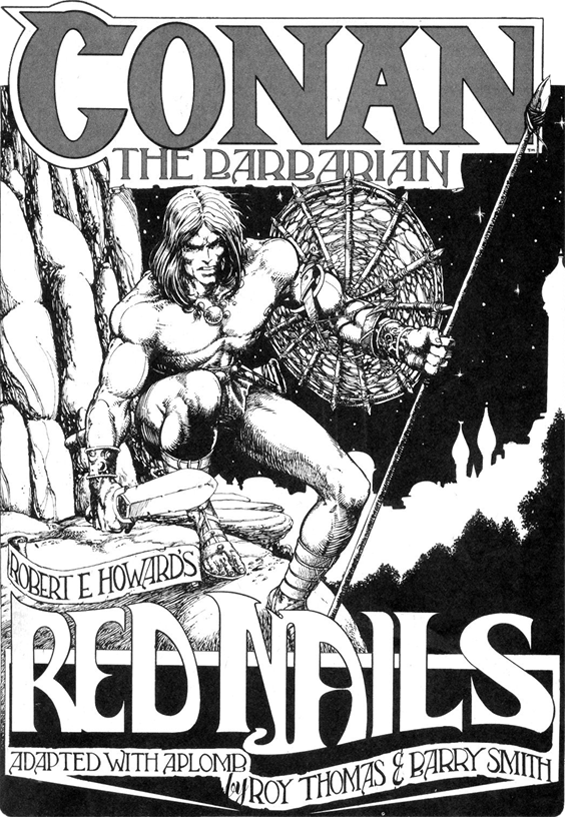
I broke out my copies of Savage Tales #2 and Conan Saga #9 in order to illustrate some of the terrific art that Robert E. Howard’s last Conan story has generated. Here are some of additional materials from the original publication too. First up, it’s desribed as:”One of the strangest stories ever written—the tale of a barbarian adventurer, a woman pirate, and a weird roofed city inhabited by the most peculiar race of men ever spawned”Then the editorial staff of Weird Tales had this to say:

“Nearly four years ago, WEIRD TALES published a story called The Phoenix On The Sword, built around a barbarian adventurer named Conan, who had become king of a country by sheer force of valor and brute strength. The author of that story was Robert E. Howard, who was already a favorite with the readers of this magazine for his stories of Solomon Kane, the dour English Puritan and redresser of wrongs. The stories about Conan were speedily acclaimed by our readers, and the barbarian’s weird adventures became immensely popular. The story presented herewith is one of the most powerful and eery weird tales yet written about Conan. We commend this story to you, for we know you will enjoy it through and through.”

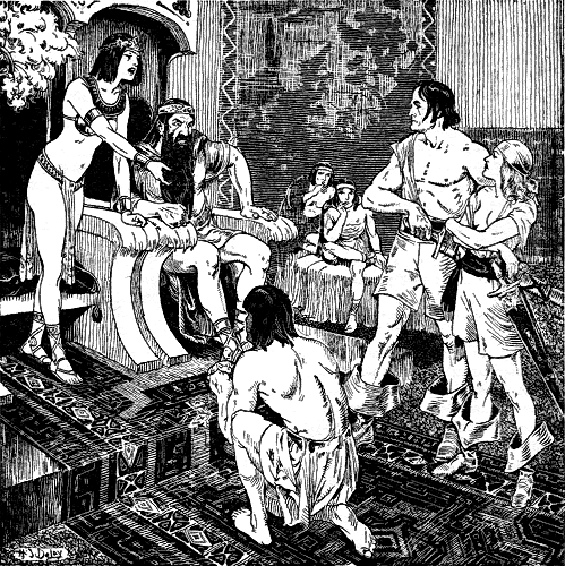
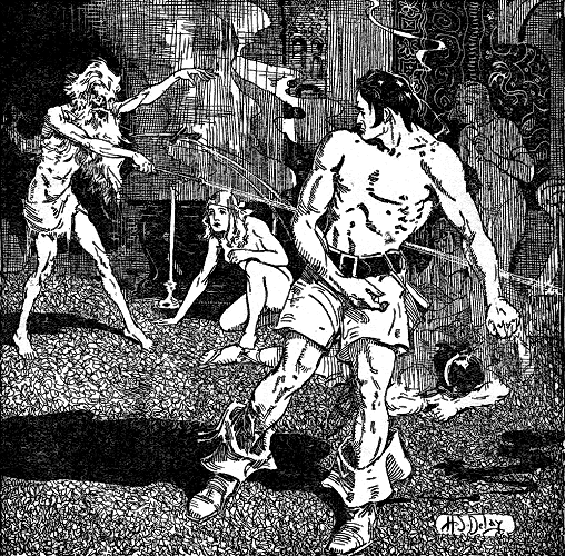
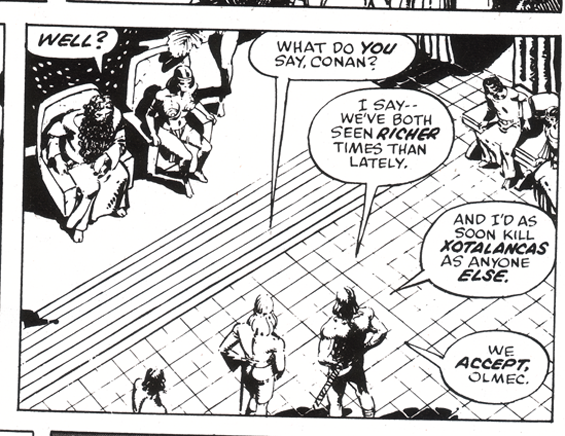
And, after you begin listening, be sure to compare the three scenes from the story I’ve matched up.

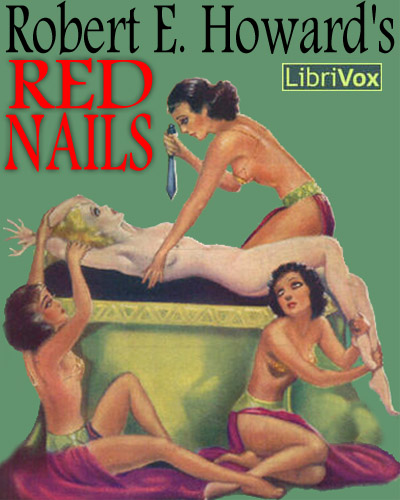
LIBRIVOX - Red Nails by Robert E. HowardRed Nails
By Robert E.Howard; Read by Gregg Margarite
5 Zipped MP3 Files or Podcast – Approx. 3 Hours 24 Minutes [UNABRIDGED]
Publisher: LibriVox.org
Published: June 19, 2010
Text Source: Gutenberg.org |HTML|
Conan the Cimmerian pursues the beautiful and deadly pirate Valeria after she kills a Stygian only to find himself cornered by a dragon. Apparently this dragon doesn’t know who he’s messing with. The pair then encounters the city of Xuchotl with its warring factions and ancient secrets. Swordplay and sorcery ensue. – Red Nails is Howard’s final Conan story. First published in the July, August, September and October 1936 issues of Weird Tales magazine.

Chapter 1 |MP3| Chapter 2 |MP3| Chapters 3 & 4 |MP3| Chapters 5 & 6 |MP3| Chapter 7 |MP3|

Podcast feed: http://librivox.org/rss/4404

iTunes 1-Click |SUBSCRIBE|

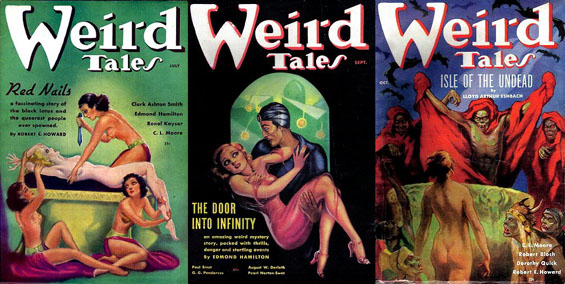
Art from the original 1936 Weird Tales publication:

Weird Tales July, August-September and October 1936 issues

WEIRD TALES - Red Nails by Robert E. Howard

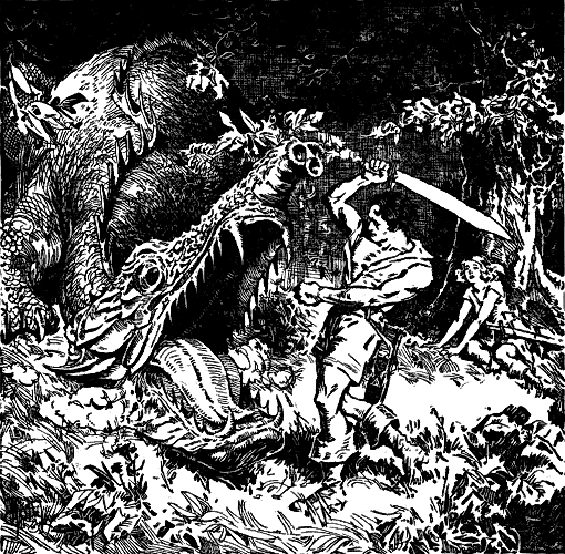
Art from the Roy Thomas and Barry Windsor-Smith comics adaptation from 1973 & 1974 :

Roy Thomas And Barry Windsor Smith adapt Red Nails

Thomas/Smith - Red Nails Dragon Scene
Thomas/Smith - Red Nails Throne Room Scene
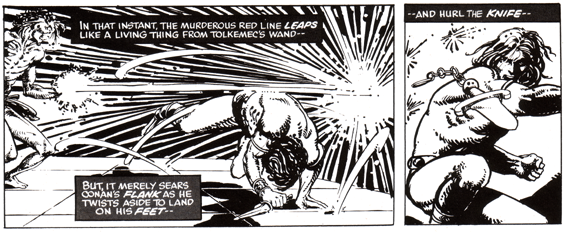
Thomas/Smith - Red Nails - Tolkemec Laser and Knife Scene

[Thanks also to Betty M. and David Lawrence]

Posted by Jesse Willis

Review of The Magicians by Lev Grossman

SFFaudio Review

Fantasy Audiobook - The Magicians by Lev GrossmanThe Magicians
By Lev Grossman; Read by Mark Bramhall
17 Hours – [UNABRIDGED]
Publisher: Penguin Audio
Published: 2009
Themes: / Fantasy / Magic / Wizard School / Meta Fiction / Alternate Worlds / Fictional fictional characters /

It would be too easy to simply compare this book to the Harry Potter series. There are obvious elements that are present in both, specifically the magic school. But Lev tells a story that only uses that as a means to bring the characters together and move onto the main story, which really kicks off once they graduate.

The main character, Quentin Coldwater, is a very bright high school kid who is busy applying to Universities. Despite his academic excellence, Quentin struggles to connect with the real world. He has a fascination with a series of fantasy books about a land called Fillory. In those books he can see a purpose to existence that he can’t find in his own life.

One university, Brakebills Academy, takes an interest in him and gives him an exam. It is during this exam that Quentin discovers that he is one of those few who have a talent for magic. He is enrolled in the school and goes from the smartest kid in his school to about average in his year. He pushes himself to excel and eventually finds that he is being skipped ahead a year. He makes friends and finds love. But his time there is not without upset. Eventually he and his friends graduate and we are not even half-way through the book.

Struggling to decide what to do with their lives, Quentin and his college friends drift through life for a short time. The world of the wizards isn’t challenging to them. This secret culture looks after their own, keeping a low profile and pretty much doing whatever interests them. Lacking direction and guidance Quentin and his friends have too much money and no responsibilities. They party. Drink, drugs and sex. But then they discover something that even their tutors didn’t know about. Fillory, the land from Quentin’s books, is real and they have a way to get there. They gear up and mount a small expedition to find adventure and fill the hole in their lives. They go into this with a tactics and planning of a group of fantasy role-players. They see everything in terms of the stories of Fillory. They expect quests will turn up to tell them what they need to do, and indeed one does.

The parallels between Fillory and Narnia are much stronger than those with the Harry Potter series, and pervades through much more of the novel. In the Fillory novels, a family of children, the Chatwins, from rural England in the early 1900’s keep finding secret paths into Fillory where they have adventures, defeat enemies to the land and return home as if no time has passed. While there isn’t a Lion god, there is Ember and Umber the twin Ram gods, who clean up any remaining mess and sends the Chatwin children back home. The events and characters in these books are real and have a serious impact on Quentin and his friends as they try to figure out what really happened in Fillory. There are hints and clues throughout that a second reading would put into a clearer context after knowing the ending.

The narrator, Mark Bramhall, gives an excellent performance, keeping most of the voices distinct.

Although this is described as a coming of age novel, I would hesitate to recommend it to younger teen readers. There are several strong uses of offensive language, all fitting with the characters and their situation. Definitely not aimed at the same primary market Harry Potter was.

Posted by Paul [W] Campbell

Review of The Eyes of the Dragon by Stephen King

SFFaudio Review

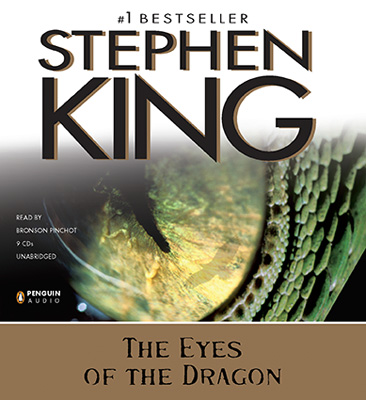
Fantasy Audiobook - The Eyes of the Dragon by Stephen KingThe Eyes of the Dragon
By Stephen King; Read by Bronson Pinchot
11 Hours – [UNABRIDGED]
Publisher: Penguin Audio
Published: 2010
Themes: / Fantasy / Good and evil / Magic / Monarchy / Wizards /

After writing his magnum opus IT, Stephen King briefly stepped away from the genre that defined his career. The result was The Eyes of the Dragon (1987), a fantasy novel. King said that he wrote The Eyes of the Dragon for his daughter Naomi (for whom the book is dedicated, along with King’s friend Ben Straub) who reportedly never liked her father’s terrifying tales.

While that may be true, I also think that King may have thought he had said all that he had to say about horror and was looking to explore other genres. He may also have simply exhausted himself with the tome-like IT and needed to try his hand at something short and simple. Compared with most King novels, The Eyes of the Dragon is a chapbook (it’s nine compact discs in the Penguin Audio version, 380 pages in paperback including illustrations).

In brief, The Eyes of the Dragon is a story about the inheritance of the kingship of the fictional realm of Delain. Roland, the old king, fathers two sons late in life, Peter and Thomas. Peter, the eldest, is slated to inherit the throne. Peter possesses all the qualities you would want in a monarch—he’s smart, just, honest, and brave. Thomas on the other hand is a near clone of his father—an average thinker, prone to vacillations, reluctant to make important decisions. Roland’s adviser is Flagg, a shadowy wizard who has served the kings of Delain for centuries, perhaps longer. Flagg is actually a demonic figure who wants to see Delain in ruins and the world thrown into a dark age of bloody anarchy. He devises a plot to poison Roland, framing the murder so that the blame falls on Peter. When the dust settles, Thomas, only 12 years old, unfit to rule and terrified with his new responsibility, is put on the throne. Flagg knows that Thomas will be a puppet in his hands and the instrument through which he can finally see his centuries-long evil plans come to fruition. Peter is sentenced to life in a prison in the tower of the Needle, a small cell high above the city.

King has professed a love for the writings of J.R.R. Tolkien (The Stand is a semi-homage to The Lord of the Rings, and The Dark Tower series draws its inspiration from that book as well). The Eyes of the Dragon shares a lot in common with The Hobbit. Roland’s ancient heirloom is the arrow Foe-Hammer, one of the names given to Gandalf’s sword Glamdring. It’s also an allusion to the black arrow Bard uses to bring down the dragon Smaug. King tells the tale using an omniscient narrator who speaks with a pleasant, conversational voice, and seems to be relaying the tale years later and from some other time and place. This authorial voice is another hallmark of The Hobbit, written initially for Tolkien’s children and meant to be read aloud.

In general I liked The Eyes of the Dragon very much. As with all of King’s stories it’s wonderfully told with a compelling narrative. It feels like a fairy tale with an edge, in which the events will likely work out for the good in the end but with blood spilled and hearts broken along the way.

Peter is a great character and is easy to root for. Despite his unjust sentence and the fact that he knows he will likely never leave the Needle alive, he refuses to succumb to despair. Peter is a born leader with a carriage of command. Guards who initially spit in his soup or try to bully him, believing that as a convicted murderer he will be humbled and easy prey, are cowed by his regal bearing. His captors begin to question whether he indeed murdered his father. Peter has truth on his side and maintains his innocence with a quiet certitude that inspires awe. After his first week in the Needle he makes up his mind to live, and to not relinquish his kingship. Though he’s been convicted and stripped of his regalia and title he is in all respects still the uncrowned King of Delain.

If you’re a fan of King’s world and works you’ll recognize the name of Flagg, who is also the main villain of The Stand and The Dark Tower. While menacing in The Eyes of the Dragon, I found Flagg not as terrifying as he is portrayed in The Stand. Perhaps it’s because he’s less mysterious here and more of a prototypical evil dark wizard. He only reaches the truly insane level of depravity and malice I came to associate with Flagg of The Stand at the very end of the novel.

The Eyes of the Dragon is a moral tale and uses the fantasy trope of pitting opposing sides of good and evil against each other (Peter is almost stainlessly pure, while Flagg is an unredeemable monster who wants to see Delain thrown into a 1,000-year reign of anarchy and blood-soaked chaos). In between are characters with shades of gray, and just like The Lord of the Rings the outcome is decided by a few average folk who have to make difficult choices that run at odds with their own best interests.

But The Eyes of the Dragon is not without a few flaws. In my opinion King is far more comfortable and convincing when he’s writing about our world and in particular his Maine birthplace. Fictional small towns like Derry and Castle Rock feel real because King knows their environs and peoples. In contrast, the kingdom of Delain is unremarkable and without character (it’s a typical monarchy with kings and a servant class, whose technology is roughly high medieval). Any truly fantastic elements are at a minimum: Flagg is the only person who has access to magic and his spells are more alchemy than spellcraft. The only monster we see is a single smallish dragon in a flashback sequence whose head is mounted on the wall of Roland’s sitting room (from this trophy we get the title of the novel).

There are some holes in the plot, too. For someone who is incredibly ancient, powerful, and brilliantly evil, how does Flagg let Peter live for more than five years, letting him patiently spin his escape plot from the top of the Needle? Flagg recognizes Peter almost from birth as a formidable threat: Why wouldn’t he poison him, or pay the guards to murder him, or simply do it himself? When Flagg finally does catch on to Peter’s escape plan and comes racing up the stairs of the Needle swinging his monstrous double-bladed axe like a medieval version of Jack Torrance, I wondered why he had chosen to wait so long.

The second plot hole is Peter’s method of escape. I won’t spoil it here, but it seemed unrealistic that one of the omnipresent guards (who frequently pop their heads into the window on Peter’s cell door) wouldn’t have caught him in the act at some point during his five-plus years of imprisonment.

Still, a few problems aside, The Eyes of the Dragon is, like most of King’s material, a great read and highly recommended. Bronson Pinchot does a wonderful job as narrator and in particular delivers a wonderfully-voiced Flagg, delivering his lines with a whispering malice.

Posted by Brian Murphy

LibriVox: The Sky Is Falling by Lester del Rey

SFFaudio Online Audio

LibriVoxNarrator Karen Savage comes from the plainspoken school of audiobook narration. Her reading is crisp and clean, and, barring accidents will be listened to for at least several centuries. The Sky Is Falling is a weird and fascinating tale that blends a hard Science Fiction attitude with a grotesque Fantasy world. The brushing and melding of two incommensurable fiction paradigms, like this, was also done in Larry Niven and Jerry Pournelle’s Inferno |READ OUR REVIEW|.

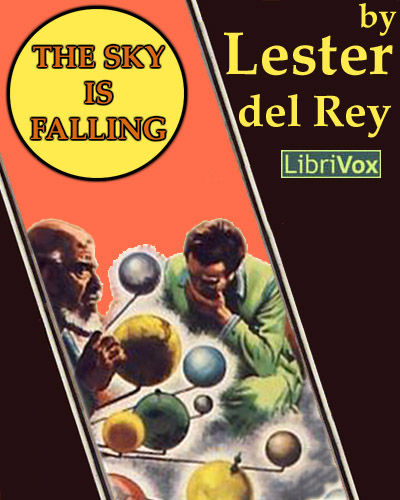
LIBRIVOX - The Sky Is Falling by Lester del ReyThe Sky Is Falling
By Lester del Rey; Read by Karen Savage
10 Zipped MP3 Files or Podcast – Approx. 3 Hours 16 Minutes [UNABRIDGED]
Publisher: LibriVox.org
Published: March 28, 2010
After dying in a terrible accident at a building site, Dave Hanson finds himself being brought back to life in a world where magic is real, and where the sky is breaking apart and falling. And he is expected to put it back together again. Will he be able to save this strange world, and his own new life?

Podcast feed:

http://librivox.org/rss/3780

iTunes 1-Click |SUBSCRIBE|

Also of note, this production completes the entire audiobooking of ACE DOUBLE #76960 (the other half being Lester del Rey’s Badge Of Infamy:

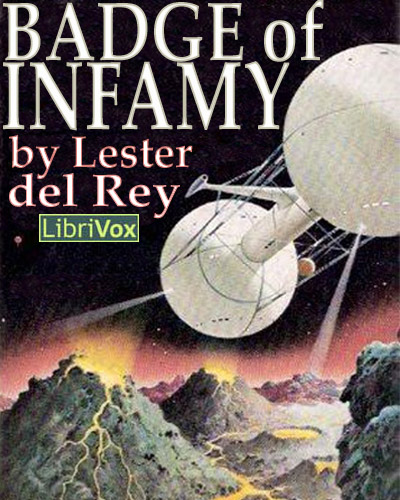
LIBRIVOX - Badge Of Infamy by Lester del ReyBadge Of Infamy
By Lester del Rey; Read by Steven H. Wilson
15 Zipped MP3 Files or Podcast – Approx. 3 Hours 19 Minutes [UNABRIDGED]
Published: LibriVox.org
Published: January 17, 2007
Daniel Feldman was a doctor once. He made the mistake of saving a friend’s life in violation of Medical Lobby rules. Now, he’s a pariah, shunned by all, forbidden to touch another patient. But things are more loose on Mars. There, Doc Feldman is welcomed by the colonists, even as he’s hunted by the authorities. But, when he discovers a Martian plague may soon wipe out humanity on two planets, Feldman finds himself a pivotal figure. War erupts. Earth is poised to wipe out the Mars colony utterly. A cure to the plague is the price of peace, and only Feldman can find it

Podcast feed:

http://librivox.org/bookfeeds/badge-of-infamy-by-lester-del-rey.xml

iTunes 1-Click |SUBSCRIBE|

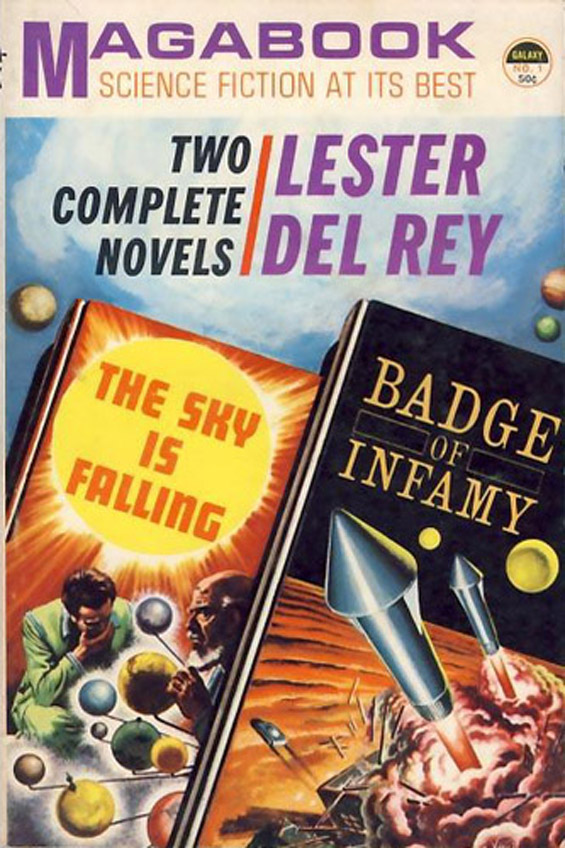
Here’s the first appearance of these two novels together:

Galaxy Magabook - The Sky Is Falling / Badge Of Infamy by Lester del Rey

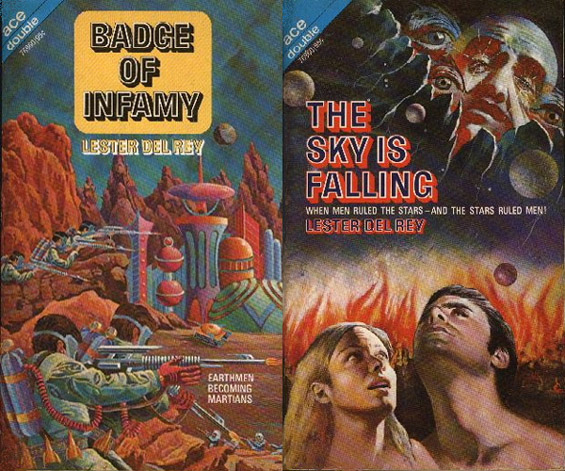
And here’s the 1973 ACE Double appearance of these two novels together:

Ace Double- Badge Of Infamy / The Sky Is Falling by Lester del Rey

[thanks also to mim@can]

Posted by Jesse Willis

Review of The Gathering Storm by Robert Jordan and Brandon Sanderson

SFFaudio Review

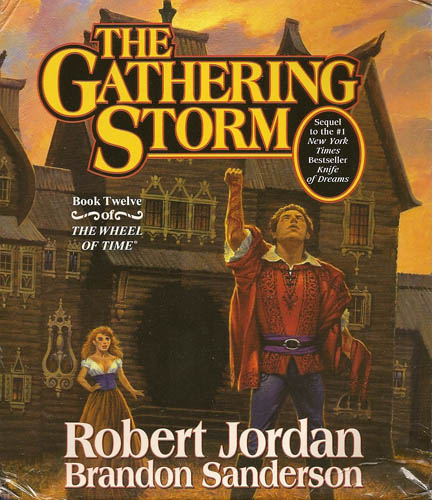
Fantasy Audiobook - The Gathering Storm by Robert Jordan and Brandon SandersonThe Gathering Storm – Book Twelve of The Wheel of Time
By Robert Jordan and Brandon Sanderson
Read by Kate Reading and Michael Kramer
26 CDs – 34.5 Hours – [UNABRIDGED]
Publisher: Macmillan Audio
Published: 2009
ISBN: 9781593977672
Themes: / Fantasy / Epic fantasy / Good and Evil / Power / Politics / Religion / Magic /

The Gathering Storm is the first of the final trilogy of The Wheel of Time series. It was a long time coming, and I am pleased to report that Brandon Sanderson did an outstanding job. I actually spent part of my listening time looking for stylistic differences from the other books, but hats off to Sanderson for pulling this off. He nailed the tone of the other books, and tells a good story.

There are so many characters in these books, with different styles of speaking, that Michael Kramer and Kate Reading would be forgiven for inconsistencies in their narration, as they’ve done all 11 volumes that come before this one. That’s over 230 hours of audio! But they were right on, too. Their professional, enjoyable narration gave the book an additional source of continuity. These two are the voices of the Wheel of Time series.

So much has happened in this series that to say much about the plot here will spoil previous volumes. It should suffice for me to say that I enjoyed this book enough that I’ve started the series over from the beginning, in anticipation of the upcoming pair of concluding novels.

Posted by Tricia

LibriVox: The Spell Of The Yukon by Robert W. Service

SFFaudio Online Audio

I’m not much for either poetry or magic. But some poems are magic. Here’s one…

LIBRIVOX - The Spell Of The Yukon by Robert W. ServiceThe Spell Of The Yukon
By Robert W. Service; Read by Mark F. Smith
1 |MP3| – Approx. 4 Minutes [POEM]
Publisher: LibriVox.org
Published: January 10, 2010

There are another dozen recordings of The Spell Of The Yukon by Robert W. Service available at LibriVox.org. I chose to point you towards Mark F. Smith’s version, but maybe you think another reader captures the poem better.

Here’s my annotated text version (can you spot the Star Trek connection?)…

The Spell Of The Yukon
by Robert W. Service

I wanted the gold, and I sought it,
I scrabbled and mucked like a slave.
Was it famine or scurvy — I fought it;
I hurled my youth into a grave.
I wanted the gold, and I got it —
Came out with a fortune last fall, —
Yet somehow life’s not what I thought it,
And somehow the gold isn’t all.

No! There’s the land. (Have you seen it?)
It’s the cussedest land that I know,
From the big, dizzy mountains that screen it
To the deep, deathlike valleys below.
Some say God was tired when He made it;
Some say it’s a fine land to shun;
Maybe; but there’s some as would trade it
For no land on earth — and I’m one.

You come to get rich (damned good reason);
You feel like an exile at first;
You hate it like hell for a season,
And then you are worse than the worst.
It grips you like some kinds of sinning;
It twists you from foe to a friend;
It seems it’s been since the beginning;
It seems it will be to the end.

I’ve stood in some mighty-mouthed hollow
That’s plumb-full of hush to the brim;
I’ve watched the big, husky sun wallow
In crimson and gold, and grow dim,
Till the moon set the pearly peaks gleaming,
And the stars tumbled out, neck and crop;
And I’ve thought that I surely was dreaming,
With the peace o’ the world piled on top.

The summer — no sweeter was ever;
The sunshiny woods all athrill;
The grayling aleap in the river,
The bighorn asleep on the hill.
The strong life that never knows harness;
The wilds where the caribou call;
The freshness, the freedom, the farness —
O God! how I’m stuck on it all.

The winter! the brightness that blinds you,
The white land locked tight as a drum,
The cold fear that follows and finds you,
The silence that bludgeons you dumb.
The snows that are older than history,
The woods where the weird shadows slant;
The stillness, the moonlight, the mystery,
I’ve bade ’em good-by — but I can’t.

There’s a land where the mountains are nameless,
And the rivers all run God knows where;
There are lives that are erring and aimless,
And deaths that just hang by a hair;
There are hardships that nobody reckons;
There are valleys unpeopled and still;
There’s a land — oh, it beckons and beckons,
And I want to go back — and I will.

They’re making my money diminish;
I’m sick of the taste of champagne.
Thank God! when I’m skinned to a finish
I’ll pike to the Yukon again.
I’ll fight — and you bet it’s no sham-fight;
It’s hell! — but I’ve been there before;
And it’s better than this by a damsite —
So me for the Yukon once more.

There’s gold, and it’s haunting and haunting;
It’s luring me on as of old;
Yet it isn’t the gold that I’m wanting
So much as just finding the gold.
It’s the great, big, broad land ‘way up yonder,
It’s the forests where silence has lease;
It’s the beauty that thrills me with wonder,
It’s the stillness that fills me with peace.

Posted by Jesse Willis