The SFFaudio Podcast #042 – READALONG: The Coming Of Conan The Cimmerian by Robert E. Howard

Podcast

The SFFaudio PodcastThe SFFaudio Podcast #042 – Jesse is joined by Brian Murphy and Gregg Margarite to talk about the Tantor Media audiobook: The Coming Of Conan The Cimmerian by Robert E. Howard |READ OUR REVIEW|.

Talked about on today’s show:
The Hyena by Robert E. Howard, racism, racism in Robert E. Howard’s fiction, Jack London, H.P. Lovecraft, Solomon Kane, Crom, By This Axe I Rule, Howard/Lovecraft correspondence, plot vs. mood, pessimism, writers who kill themselves, Philip K. Dick, defining chaos, Dark Valley Destiny by L. Sprague de Camp, Blood And Thunder by Mark Finn, Howard’s life and death, The Whole Wide World, Howards’ westerns and historical stories, “with gigantic melancholies and gigantic mirth”: was Howard or Conan bipolar?, Texas in the early 20th century, Conan’s intellect, The Tower Of The Elephant, Barbarian vs. Cimmerian, Conan’s philosophy (Epicureanism?), fantasy, Howard’s use of magic, The Frost Giant’s Daughter (aka Gods Of The North), magic doesn’t trump steel, existentialism, nihilism, Ymir, The Prisoner, Howard’s animal similes, The God in the Bowl is a murder mystery and a locked room mystery and a detective story!, Yag-Kosha isn’t a great alien design, The Hyborian Age, Marvel’s Conan The Barbarian, The Savage Sword Of Conan, Dark Horse’s Conan, Curtis Magazines, The Scarlet Citadel, big battles and giant snakes, Marvel’s King Conan (Conan The King), The Hour Of The Dragon, Queen Of The Black Coast, barbarian love, Oliver Stone, John Milius, The Howard Conan:

“Let me live deep while I live; let me know the rich juices of red meat and stinging wine on my palate, the hot embrace of white arms, the mad exultation of battle when the blue blades flame and crimson, and I am content. Let teachers and priests and philosophers brood over questions of reality and illusion. I know this: if life is illusion, then I am no less an illusion, and being thus, the illusion is real to me. I live, I burn with life, I love, I slay, and am content.”

The Stone/Milius Conan:

“Crush your enemies, see them driven before you, and hear the lamentation of their women.”

How do you pronounce names like Cimmeria and Bêlit?, Clark Ashton Smith, Bêlit’s character, Conan the Daoist, Conan’s character, Conan’s morality, Black Colossus, who the hell is Mitra?, The Cimmerian blog, Rogues In The House, Iron Shadows In The Moon, the Vilayet Sea, A Probable Outline Of Conan’s Career, Red Nails, The Pool of the Black One, Rogues In The House, people are animals, Charles Darwin and Robert E. Howard, Clifford D. Simak, man’s successor (intelligent dogs) take over, Thak is a great character name, writing (or just saying that you are), Fantasy seems to be a novel length genre, The Bloody Crown Of Conan, The Conquering Sword Of Conan, narrator Todd McLaren, character voices, bite the wax tadpole, Roy Thomas.

A 1938 newstand full of pulp magazines

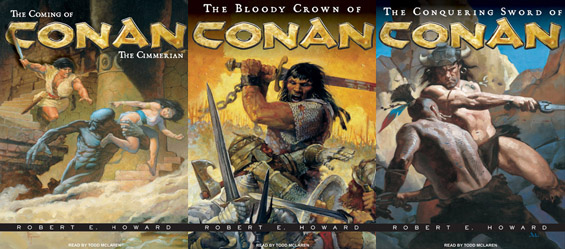
Tantor Media - The Coming Of Conan The Cimmerian, The Bloody Crown Of Conan, The Conquering Sword Of Conan

Posted by Jesse Willis

Review of The Lies Of Locke Lamora by Scott Lynch

SFFaudio Review

Science Fiction Audiobook - The Lies of Locke Lamora by Scott LynchThe Lies of Locke Lamora
By Scott Lynch; Read by Michael Page
18 CDs – Approx. 23 Hours [UNABRIDGED]
Publisher: Tantor Audiobooks
Published: 2009
ISBN: 1400110513
Themes: / Fantasy / Crime / Magic /

An orphan’s life is harsh—and often short—in the island city of Camorr, built on the ruins of a mysterious alien race. But born with a quick wit and a gift for thieving, Locke Lamora has dodged both death and slavery, only to fall into the hands of an eyeless priest known as Chains—a man who is neither blind nor a priest. A con artist of extraordinary talent, Chains passes his skills on to his carefully selected “family” of orphans—a group known as the Gentlemen Bastards.

Here’s the one sentence summary I’ve been using to describe The Lies Of Loche Lamora:

Like Oliver Twist in Lankhmar.

In a way this is the anti-Harry Potter book. It’s about a school for thieves and not magicians. It doesn’t have heroes and villains as much as it has profligate crooks and despicable liars. Our protagonist is the titular Locke Lamora, a young wastrel in the city of Camorr. He’d starve or be sold into worse slavery had he not been born with a certain larceny in his heart. Camorr, the city itself, too is a terrific character in this book, being a vividly described assemblage of various fantasy cities Lankhmar, Arenjun, and real life historical ports like late medieval Venice. Under careful tutelage, Locke and his companions grow into formidable talents, practicing their art in a series of ever more elaborate con-games.

When I was a kid playing Dungeons and Dragons I almost always played the “thief” class. Magic users always seemed lame to me, clerics were like magic users but with religion (which seemed to me like a third wheel for actual role playing) and fighters were boring. Sure you’re tough – and that’s good for fighting, but that’s it. I always thought there was a little too much fighting in D&D. My favourite part of role playing was the part in the tavern, before the quest proper really got started. I was inspired by Baggins burglar clan – but thought they had it too damn easy with the magic ring of theirs. Later in life I’d see movies like: The Sting, The Grifters, and Harry In Your Pocket. I’d read books like: The Green Eagle Score and The Girl With The Long Green Heart. Those stories all had setups I really dug. I liked characters who lived by their wits. Characters who, without being either the best shot, or the fastest draw, without having the biggest muscles or fastest legs could make the getaway with at least half a sack of gold in hand. And that’s why I like The Lies Of Loch Lamora so much.

The Lies Of Locke Lamora is rich with detail. I have a hard time conceiving just how much time Scott Lynch put into the world building. The magic system is based, smartly, around the “language” or “name” model of magic. Words have power. Knowing the “true name” of something or someone gives you power over it. Indeed, even in real life language is almost like magic. I can say to you something like: “The blue horse with the rainbow flavoured fedora is clambering slowly up the valley’s cool red roof” and some sort of weird imagery is suddenly **poofed** into your mind. I can buy into this kind of magic. It’s the same kind of magic that J.K. Rowling puts into her villain names: Just think about it, Voldemort and Malfoy, (“underground death dweller” and “bad foil”). It’s too bad Rowling didn’t have the teachers at Hogwarts teaching this magic language magic system instead of the hodge-podge it has – I might have cared more. So back to the book at hand, magic plays a fairly central role in the plot of The Lies Of Locke Lamora, it’s rare, and doesn’t enter into the novel until quite late. Other furnishings in Lynch’s Fantasy landscape include substitution. Instead of glasses we get “optiks” and instead of chemical we get “alchemical.”

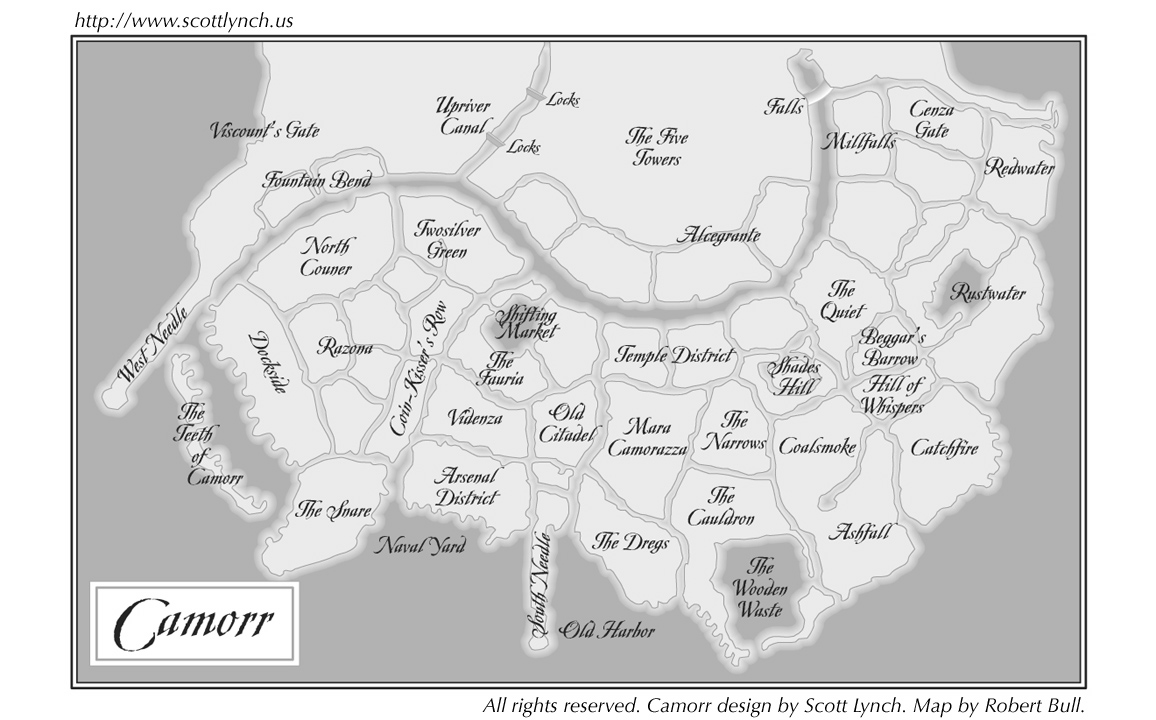
Thinking back, narrator Michael Page did employ a fairly wide range of voices. And there are quite a few characters for him to bring to life. Several of these age over time. Some narrators take over the text, Page is not one of them – he delivers the lines as appropriate, so that for the most part I didn’t notice his performance. If there are any laments I have about this excellent audiobook they are very few. One would be it’s length, it is a tad long. This is a sin that virtually every Fantasy novel is guilty of these days. It held my attention, but there were certainly a few scenes that could have been easily summarized without losing one whit of the novel’s otherwise careful pacing. Another lament, the Bantam Spectra paperbook edition of this book includes an excellent map of the city of Camorr. Modern audiobooks never include maps as a supplement. So neither does this Tantor edition. This is a mistake. Any novel assumes a certain familiarity with geography but Fantasy novels, especially of this kind, are burdened with creating a new world from scratch. An audience that is unfamiliar with its geography is less likely to be able to follow the action spatially. Several times during my was listening I wished I had a map of the city of Camorr at hand.

If you do get this audiobook I suggest that you print out a copy of THIS MAP over on ScottLynch.us.

Posted by Jesse Willis

Review of The Steel Remains by Richard K. Morgan

SFFaudio Review

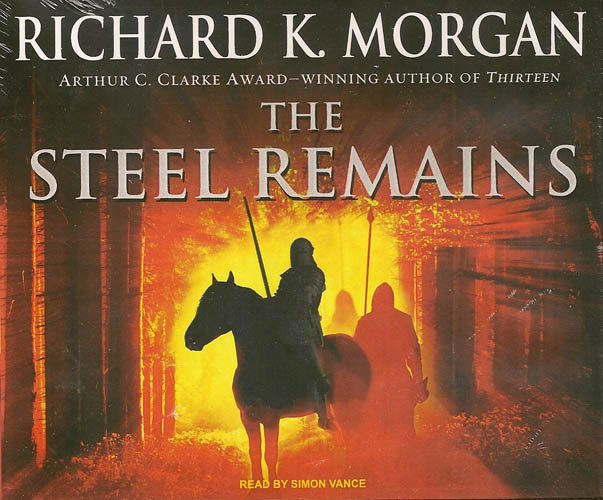
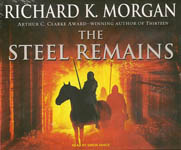
Science Fiction Audiobook - The Steel Remains by Richard K. MorganThe Steel Remains
By Richard K. Morgan; Read by Simon Vance
[UNABRIDGED]
Publisher: Tantor Media
Published: 2009
ISBN: 9781400139637
Themes: / Fantasy / Noir / Hard Boiled / Magic / War / Homosexuality /

“Men were like blades, they would all break sooner or later, you included. But you looked around at the men you led, and in their eyes you saw what kind of steel you had to hand, how it had been forged and tempered, what blows, if any, it would take.”

—Richard Morgan, The Steel Remains

With his new book The Steel Remains, Richard Morgan sets out to (as main character Ringil Eskiath might say) “prick the bloated arse” of J.R.R. Tolkien and post-Tolkien fantasy. Elsewhere on the web Morgan has expressed his deep dissatisfaction with traditional high fantasy, which often pits stainless forces of good against hordes of irredeemable evil in bloodless, antiseptic sword play. He’s accused Tolkien of the same shortcomings (a flawed analysis with which I vehemently disagree). Against this backdrop, Morgan set out to write The Steel Remains as a deliberately gray, grimy, alternative viewpoint. His book succeeds in sliding cold steel into the lie of childlike fantasy, with which my favorite genre of fiction is admittedly littered.

But when the screaming of gutted men and the skirling of steel dies down, and the full extent of the destruction is laid bare for us to see, The Steel Remains does not have much to offer. The old cliché that it’s easier to tear down and destroy than to build anew applies here. In its falling over itself desire to slice and dice fantasy’s traditional conservatism, The Steel Remains indulges in plenty of its own predictable clichés: Every priest is a religious fanatic and a sex fiend, every leader a morally and ethically corrupt, egotistic blowhard, for example. The book lacks a moral compass; Morgan the author’s world view must be a bleak one, indeed.

The action of The Steel Remains focuses on the converging storylines of three uneven characters—one very well done (Ringil, a sarcastic, war-weary, homosexual master swordsman), one middling (Egar, a brawling, boisterous, randy barbarian from the steppes), and one rather forgettable (Archeth, a black, female half-breed of human and Kiriath, deadly with throwing knives and hooked on drugs). All three are veterans of a recent war against an invading race of “scaly folk,” in which humanity staved off utter destruction at a very high price. Ringil, a war hero but now combat- and world-weary, has retreated from his mercenary lifestyle and is living a slothful, under-the-radar existence, until he’s summoned by an urgent message from his mother: Ringil’s cousin, Sherin, has been sold into slavery to repay a debt, and Ringil’s mother wants her back. Ringil reluctantly agrees.

Soon Ringil finds out that the slavery web in which Sherin has been caught is very dark, wide, and sinister. At its centre are a race of alien beings called the dwenda—tall, attractive, human-like, magic-using creatures that are a combination of Michael Moorcock’s Melniboneans with their cruel and alien immorality, and Poul Anderson’s Nordic-inspired, haughty, and warlike elves (Morgan lists Anderson and Moorcock as two of his sources of inspiration; the third is, unsurprisingly, Karl Edward Wagner). The dwenda are planning to incite a second war on earth and then destroy the victor, taking back their ancestral lands (the dwenda dwelled on earth many years ago). The dwenda require the sacrifice of barren human females to fuel the dark powers that are the source of their sorcery.

There’s much to like in The Steel Remains. Morgan’s prose is sharp and highly readable, and he shows a fine eye for detail and realism in his culture and city-building. Trelayne—a nasty, sprawling, brawling city in which whoring, slavery, and public executions are practiced openly—feels real. Egar’s Majak culture is based on pre-colonized North American Indians, and is well-done with its shamans and superstitions, trade in vast herds of buffalo, and armor and weapons suited to a nomadic lifestyle on the plains.

In addition, if you like your battles bloody and realistic, Morgan is your man. His fight scenes are well-done and you get a great sense of Ringil’s skill with his deadly broadsword of Kiriath steel, and Egar’s brutal butcher’s work with his two-bladed Majak lance. Disembowelings, beheadings, and other ghastly wounds are rife.

Much of the book passed under my eyes as well-oiled but heartless machinery producing graphic combat carnage and highly explicit sex (I’ll pause here to state that the blood and semen-soaked pages of The Steel Remains would make George R.R. Martin blanch, and Eric Van Lustbader—author of The Ninja—green with envy). I found the characters rather unlikeable and unengaging, and the plot fair at best. Very little actually clicked with me until the concluding act, in which Ringil, Egar, and Archeth reunite to fight a desperate last stand against the duenda. This was one of the few moving scenes in the book in which I actually felt some measure of concern and identification with our heroes. Ringil’s rousing speech is of the stuff with which great heroic fantasy is made. I wish there was more like this.

In summary, we know that life is can be dirty and horrible. War is hell, yes, and men are weak and piggish. But Morgan drives the same points home, again and again, over 400 dark, cynical, iconoclastic pages of The Steel Remains, which by the end is too one-note and sacrifices story at the expense of the author’s agenda.

Narrator Simon Vance does a terrific job as narrator, changing his voice to suit the temperaments and personalities of the various characters in Morgan’s novel. Clarity and precision are among Vance’s strengths as a reader and he does not disappoint here. When I began listening to The Steel Remains, and before I had seen the narration credits, I recognized Vance’s distinctive voice from his wonderful depiction of Count Dracula and the rest of the characters from Bram Stoker’s Dracula (Blackstone Audiobooks). For unknown reasons Vance performed Dracula under the pseudonym, Robert Whitfield.

[For more of Brian’s thoughts on The Steel Remains check out The SFFaudio Podcast #034]

Posted by Brian Murphy

The SFFaudio Podcast #034 – READALONG: The Steel Remains by Richard K. Morgan

Podcast

The SFFaudio PodcastThe SFFaudio Podcast #034 – Jesse and Scott have invited a roster of internet celebrities on for this podcast to talk about Richard K. Morgan‘s novel The Steel Remains. Listen in as…

Brian Murphy (of The Silver Key blog and The Cimmerian),

Gregg Margarite (LibriVox.org narrator and book coordinator),

and Luke Burrage (professional juggler and host of the Science Fiction Book Review Podcast) discuss…

The Steel Remains by Richard K. Morgan [AN UNABRIDGED AUDIOBOOK from TANTOR MEDIA]!

Talked about on today’s show:
The Cimmerian blog, Deathworld by Harry Harrison @ LibriVox.org, The Real Fantastic Stuff an essay by Richard K. Morgan, J.R.R. Tolkien, The Lord Of The Rings, noir, Sci-Fi Dimensions interview with Richard K. Morgan (not Dark Horizons), homosexuality, nihilism, anti-hero, the Takeshi Kovacs novels (Altered Carbon, Broken Angels, Woken Furies), Morgan’s Thirteen (aka Black Man), Tolkien’s The Silmarillion, Adam Robert’s letter to Hugo fans (about the Hugo nominees), Cory Doctorow’s Little Brother, Neil Gaiman’s The Graveyard Book, the Hugo Awards, Morgan’s Market Forces, Lord Valentine’s Castle by Robert Silverberg, George R.R. Martin’s A Song Of Ice And Fire, David Eddings, Warbreaker by Brandon Sanderson, Terry Brooks, the Dragonlance series, magic, Tolkien’s use of magic, Morgan’s use of magic in The Steel Remains, characterization in The Steel Remains, recurring themes in Morgan’s novels, Robert E. Howard‘s Conan, what is Ringil Eskiath’s motivation?, what does everyone think of The Steel Remains?, what is the nature maps in Fantasy novels?, The Darkness That Comes Before by Scott Bakker. Next week we’ll talk about more audiobooks with these guys too.

Posted by Jesse Willis

Lecture – Necronomicons: The Scariest Book in the World

SFFaudio Online Audio

Yog RadioNecronomicons: The Scariest Book in the World
By Dan Harms
1 |MP3| – Approx. 79 Minutes [LECTURE]
Provider: Yog-Sothoth.com
Recorded: May 28th, 2009
The Necronomicon was once the most famous book that never existed – until a few decades ago, when the first copies appeared on the market. From Lovecraft to Grant to… well, you name it! This is the story of their non-existence, their existence, and their secret stories. Dan Harms reveals the history of these books, their relevance in the broader current of the grimoire tradition, and their impact upon magical practice. Recorded at Treadwell’s bookshop, London.

Posted by Jesse Willis

Review of Elantris, Part 1 by Brandon Sanderson

SFFaudio Review

We are so pleased to post this review by Susan Dunman, aka AudiobookDJ. You can find her at her wonderful AudiobookDJ blog, or over at SF Site talking audio. Thanks Susan!

Fantasy Audiobook - Elantris Part 1 by Brandon SandersonElantris, Part 1
By Brandon Sanderson; Performed by a Full Cast
Adaptation by Johann Dettweiler
6 CDs – 7 hours – [AUDIO DRAMA]
Publisher: Graphic Audio
Published: 2009
ISBN: 9781599505558
Themes: / Fantasy / Audio Drama / Religion / Romance / Leadership / Magic /

Elantris was once the city where all men dreamed of living. Full of magic and marvels, its citizens were godlike in their appearance and had superhuman abilities. But now, Elantris is a place for the damned, offering only misery and despair for those unfortunate enough to be locked inside the walled city.

For something is terribly wrong with the Dor, a mysterious force that randomly and instantaneously changes individuals from mortals to immortals. Now that change, called the shaod, transforms people, not into gods, but into grey-skinned, hairless creatures whose bodies cannot heal from wounds or illness. However, those same pain-racked bodies cannot die and are banished to the crumbling city of Elantris, away from the “normal” population of Arelon.

The Crown Prince of Arelon awakens one morning to find his skin covered in the black splotches that are the first signs of the shaod’s transforming power. That same day his father orders the priests to perform a funeral service and send Prince Raoden to Elantris – a fate that befalls all who are considered “dead” after their transformation because they cease to have a heart-beat and do not need food or water to survive.

This turn-of-events is not only disastrous for Prince Raoden, but also for his fiancee, Princess Sarene. She has just arrived from a neighboring country to meet her soon-to-be husband for the first time. Serene is only told that the prince is dead – not that he has been condemned to Elantris. But the suspicious Serene decides to remain in Arelon despite her betrothed’s death, vowing to uncover the truth about Prince Raoden’s untimely demise.

This sets the stage for listeners to experience a remarkable story – made even more enticing by this audio adaptation. With a full compliment of narrators (28 to be exact), sound effects and background music, listeners can hear a three-dimensional production of Sanderson’s work – it’s like wearing 3-D glasses for your ears. To do justice to the book, this adaptation is produced in three parts, each approximately seven hours long.

I know some audiobook fans prefer single voice narration, but if you do enjoy audio drama, or have never tried it, then you should listen to a Graphic Audio production. The sound effects can be powerful,
but only rarely do they invade the narrator’s sound space. In addition, the background music really sets the tone for the various scenes. And if you listen closely, you might find surprises. For example, in one ballroom scene, the music playing softly in the background is The Blue Danube Waltz, making me wonder if Johann Strauss, Jr. had done some kind of universe/time shift maneuver to get his music played in Arelon.

Elantris was Sanderson’s first published work, coming out in April of 2005. He explores themes of love, politics, religion, and eternity in intriguing and imaginative ways. This audio production compliments his work in a very satisfying way and I’m looking forward to hearing part two!

Note: For those who do prefer single-voice narration, Recorded Books offers an unabridged narration by Jack Garrett.

Posted by Susan Dunman