
A Piece Of String by Guy de Maupassant (as read by Stefan Rudnicki)

Aural Noir: Online Audio

Here’s a really thoughtful short crime story that I think my Catholic friends will especially enjoy (it’s good and it’s pretty hard to find a good audio edition). Though some have classified it as humorous it has plenty of depth (they must be thinking it is a black comedy). It follows in the tradition of The Boy Who Cried Wolf and may remind you of later works like Joseph Heller’s Catch-22. In the paperbook translation where I first read it, the title was A Piece Of Yarn. This is not a literal translation of the French (“La Ficelle“) but is actually about ten times better than A Piece Of String (for reasons which are clearer after reading the entire tale). And as an added bonus there’s probably not a better American accented narrator for this story than Stefan Rudnicki. Enjoy!

A Piece Of String by Guy de MaupassantA Piece Of String (aka A Piece Of Yarn)
By Guy de Maupassant; Read by Stefan Rudnicki
1 |MP3| – Approx. 17 Minutes [UNABRIDGED]
Publisher: Redwood Audiobooks (Listen To Genius)
Published: 2008
Source: ListenToGenius.com
A thrifty hand, a shrewd eye and a good story are universally loved by the prideful farmers of Normandy. But Maître Hauchecome soon finds himself in a epistemological struggle between his word, his reputation and his story.

The full text of the tale follows below:

A Piece Of String
By Guy de Maupassant

Along all the roads around Goderville the peasants and their wives were coming toward the burgh because it was market day. The men were proceeding with slow steps, the whole body bent forward at each movement of their long twisted legs; deformed by their hard work, by the weight on the plow which, at the same time, raised the left shoulder and swerved the figure, by the reaping of the wheat which made the knees spread to make a firm “purchase,” by all the slow and painful labors of the country. Their blouses, blue, “stiff-starched,” shining as if varnished, ornamented with a little design in white at the neck and wrists, puffed about their bony bodies, seemed like balloons ready to carry them off. From each of them two feet protruded.

Some led a cow or a calf by a cord, and their wives, walking behind the animal, whipped its haunches with a leafy branch to hasten its progress. They carried large baskets on their arms from which, in some cases, chickens and, in others, ducks thrust out their heads. And they walked with a quicker, livelier step than their husbands. Their spare straight figures were wrapped in a scanty little shawl pinned over their flat bosoms, and their heads were enveloped in a white cloth glued to the hair and surmounted by a cap.

Then a wagon passed at the jerky trot of a nag, shaking strangely, two men seated side by side and a woman in the bottom of the vehicle, the latter holding onto the sides to lessen the hard jolts.

In the public square of Goderville there was a crowd, a throng of human beings and animals mixed together. The horns of the cattle, the tall hats, with long nap, of the rich peasant and the headgear of the peasant women rose above the surface of the assembly. And the clamorous, shrill, screaming voices made a continuous and savage din which sometimes was dominated by the robust lungs of some countryman’s laugh or the long lowing of a cow tied to the wall of a house.

All that smacked of the stable, the dairy and the dirt heap, hay and sweat, giving forth that unpleasant odor, human and animal, peculiar to the people of the field.

Maître Hauchecome of Breaute had just arrived at Goderville, and he was directing his steps toward the public square when he perceived upon the ground a little piece of string. Maître Hauchecome, economical like a true Norman, thought that everything useful ought to be picked up, and he bent painfully, for he suffered from rheumatism. He took the bit of thin cord from the ground and began to roll it carefully when he noticed Maître Malandain, the harness maker, on the threshold of his door, looking at him. They had heretofore had business together on the subject of a halter, and they were on bad terms, both being good haters. Maître Hauchecome was seized with a sort of shame to be seen thus by his enemy, picking a bit of a head. two arms and string out of the dirt. He concealed his “find” quickly under his blouse, then in his trousers’ pocket; then he pretended to be still looking on the ground for something which he did not find, and he went toward the market, his head forward, bent double by his pains.

He was soon lost in the noisy and slowly moving crowd which was busy with interminable bargainings. The peasants milked, went and came, perplexed, always in fear of being cheated, not daring to decide, watching the vender’s eye, ever trying to find the trick in the man and the flaw in the beast.

The women, having placed their great baskets at their feet, had taken out the poultry which lay upon the ground, tied together by the feet, with terrified eyes and scarlet crests.

They heard offers, stated their prices with a dry air and impassive face, or perhaps, suddenly deciding on some proposed reduction, shouted to the customer who was slowly going away: “All right, Maître Authirne, I’ll give it to you for that.”

Then lime by lime the square was deserted, and the Angelus ringing at noon, those who had stayed too long scattered to their shops.

At Jourdain’s the great room was full of people eating, as the big court was full of vehicles of all kinds, carts, gigs, wagons, dumpcarts, yellow with dirt, mended and patched, raising their shafts to the sky like two arms or perhaps with their shafts in the ground and their backs in the air.

Just opposite the diners seated at the table the immense fireplace, filled with bright flames, cast a lively heat on the backs of the row on the right. Three spits were turning on which were chickens, pigeons and legs of mutton, and an appetizing odor of roast beef and gravy dripping over the nicely browned skin rose from the hearth, increased the jovialness and made everybody’s mouth water.

All the aristocracy of the plow ate there at Maître Jourdain’s, tavern keeper and horse dealer, a rascal who had money.

The dishes were passed and emptied, as were the jugs of yellow cider. Everyone told his affairs, his purchases and sales. They discussed the crops. The weather was favorable for the green things but not for the wheat.

Suddenly the drum beat in the court before the house. Everybody rose, except a few indifferent persons, and ran to the door or to the windows, their mouths still full and napkins in their hands.

After the public crier had ceased his drumbeating he called out in a jerky voice, speaking his phrases irregularly:

“It is hereby made known to the inhabitants of Goderville, and in general to all persons present at the market, that there was lost this morning on the road to Benzeville, between nine and ten o’clock, a black leather pocketbook containing five hundred francs and some business papers. The finder is requested to return same with all haste to the mayor’s office or to Maître Fortune Houlbreque of Manneville; there will be twenty francs reward.”

Then the man went away. The heavy roll of the drum and the crier’s voice were again heard at a distance.

Then they began to talk of this event, discussing the chances that Maître Houlbreque had of finding or not finding his pocketbook.

And the meal concluded. They were finishing their coffee when a chief of the gendarmes appeared upon the threshold.

He inquired:

“Is Maître Hauchecome of Breaute here?”

Maître Hauchecome, seated at the other end of the table, replied:

“Here I am.”

And the officer resumed:

“Maître Hauchecome, will you have the goodness to accompany me to the mayor’s office? The mayor would like to talk to you.”

The peasant, surprised and disturbed, swallowed at a draught his tiny glass of brandy, rose and, even more bent than in the morning, for the first steps after each rest were specially difficult, set out, repeating: “Here I am, here I am.”

The mayor was awaiting him, seated on an armchair. He was the notary of the vicinity, a stout, serious man with pompous phrases.

“Maître Hauchecome,” said he, “you were seen this morning to pick up, on the road to Benzeville, the pocketbook lost by Maître Houlbreque of Manneville.”

The countryman, astounded, looked at the mayor, already terrified by this suspicion resting on him without his knowing why.

“Me? Me? Me pick up the pocketbook?”

“Yes, you yourself.”

“Word of honor, I never heard of it.”

“But you were seen.”

“I was seen, me? Who says he saw me?”

“Monsieur Malandain, the harness maker.”

The old man remembered, understood and flushed with anger.

“Ah, he saw me, the clodhopper, he saw me pick up this string here, M’sieu the Mayor.” And rummaging in his pocket, he drew out the little piece of string.

But the mayor, incredulous, shook his head.

“You will not make me believe, Maître Hauchecome, that Monsieur Malandain, who is a man worthy of credence, mistook this cord for a pocketbook.”

The peasant, furious, lifted his hand, spat at one side to attest his honor, repeating:

“It is nevertheless the truth of the good God, the sacred truth, M’sieu the Mayor. I repeat it on my soul and my salvation.”

The mayor resumed:

“After picking up the object you stood like a stilt, looking a long while in the mud to see if any piece of money had fallen out.”

The good old man choked with indignation and fear.

“How anyone can tell—how anyone can tell—such lies to take away an honest man’s reputation! How can anyone—-”

There was no use in his protesting; nobody believed him. He was con.

fronted with Monsieur Malandain, who repeated and maintained his affirmation. They abused each other for an hour. At his own request Maître Hauchecome was searched; nothing was found on him.

Finally the mayor, very much perplexed, discharged him with the warning that he would consult the public prosecutor and ask for further orders.

The news had spread. As he left the mayor’s office the old man was sun rounded and questioned with a serious or bantering curiosity in which there was no indignation. He began to tell the story of the string. No one believed him. They laughed at him.

He went along, stopping his friends, beginning endlessly his statement and his protestations, showing his pockets turned inside out to prove that he had nothing.

They said:

“Old rascal, get out!”

And he grew angry, becoming exasperated, hot and distressed at not

being believed, not knowing what to do and always repeating himself.

Night came. He must depart. He started on his way with three neighbors to whom he pointed out the place where he had picked up the bit of string, and all along the road he spoke of his adventure.

In the evening he took a turn in the village of Breaute in order to tell it to everybody. He only met with incredulity.

It made him ill at night.

The next day about one o’clock in the afternoon Marius Paumelle, a hired man in the employ of Maître Breton, husbandman at Ymanville, returned the pocketbook and its contents to Maître Houlbreque of Manneville.

This man claimed to have found the object in the road, but not knowing how to read, he had carried it to the house and given it to his employer.

The news spread through the neighborhood. Maître Hauchecome was informed of it. He immediately went the circuit and began to recount his story completed by the happy climax. He was in triumph.

“What grieved me so much was not the thing itself as the lying. There is nothing so shameful as to be placed under a cloud on account of a lie.”

He talked of his adventure all day long; he told it on the highway to people who were passing by, in the wineshop to people who were drinking there and to persons coming out of church the following Sunday. He stopped strangers to tell them about it. He was calm now, and yet something disturbed him without his knowing exactly what it was. People had the air of joking while they listened. They did not seem convinced. He seemed to feel that remarks were being made behind his back.

On Tuesday of the next week he went to the market at Goderville, urged solely by the necessity he felt of discussing the case.

Malandain, standing at his door, began to laugh on seeing him pass. Why?

He approached a farmer from Crequetot who did not let him finish and, giving him a thump in the stomach, said to his face:

“You big rascal.”

Then he turned his back on him.

Maître Hauchecome was confused; why was he called a big rascal?

When he was seated at the table in Jourdain’s tavern he commenced to explain “the affair.”

A horse dealer from Monvilliers called to him:

“Come, come, old sharper, that’s an old trick; I know all about your piece of string!”

Hauchecome stammered:

“But since the pocketbook was found.”

But the other man replied:

“Shut up, papa, there is one that finds and there is one that reports. At any rate you are mixed with it.”

The peasant stood choking. He understood. They accused him of having had the pocketbook returned by a confederate, by an accomplice.

He tried to protest. All the table began to laugh.

He could not finish his dinner and went away in the midst of jeers.

He went home ashamed and indignant, choking with anger and confusion, the more dejected that he was capable, with his Norman cunning, of doing what they had accused him of and ever boasting of it as of a good turn. His innocence to him, in a confused way, was impossible to prove, as his sharpness was known. And he was stricken to the heart by the injustice of the suspicion.

Then he began to recount the adventures again, prolonging his history every day, adding each time new reasons, more energetic protestations, more solemn oaths which he imagined and prepared in his hours of solitude, his whole mind given up to the story of the string. He was believed so much the less as his defense was more complicated and his arguing more subtile.

“Those are lying excuses,” they said behind his back.

He felt it, consumed his heart over it and wore himself out with useless efforts. He wasted away before their very eyes.

The wags now made him tell about the string to amuse them, as they make a soldier who has been on a campaign tell about his battles. His mind, touched to the depth, began to weaken.

Toward the end of December he took to his bed.

He died in the first days of January, and in the delirium of his death struggles he kept claiming his innocence, reiterating:

“A piece of string, a piece of string—look—here it is, M’sieu the Mayor.”

Posted by Jesse Willis

ABC Radio National: The Philosopher’s Zone on the morality of Ebeneezer Scrooge

SFFaudio Online Audio

ABC Radio National - The Philosopher’s ZoneABC Radio National‘s The Philosopher’s Zone is one of the oldest public radio podcast, and I’ve been following it very closely since very near its inception back in 2005. Week after week it explores the history, issues and ideas of philosophy in an accessible and informative manner. I can’t get enough of it. The Philosopher’s Zone is kind of like a very focused version of BBC Radio 4’s In Our Time. One recent program, that I just finished listening to, features a fascinating examination of the morality and ethics of Ebeneezer Scrooge. As depicted in Charles Dickens’ A Christmas Carol Scrooge appears to be a very disobliging sort, but is he actually morally bankrupt? Examining his character and actions (through the lenses of utilitarianism, Kantian’ style categorical imperative and virtue ethics) host Alan Saunders, and guest Scott C. Lowe, discuss the curious problem of Scrooge’s lack of immorality.

Here’s the synopsis:

Ebenezer Scrooge is one of the few people you are allowed to hate at Christmas, or at least you’re allowed to ‘dislike’ what he stands for. Miserly and lacking in empathy, Scrooge is essentially a joyless, friendless, humourless, lonely old man. But was he morally bad as common wisdom would have it? Our guest this week says NO. Ebenezer Scrooge was as a man of ethical principle.

|MP3| Bah humbug – Why Ebenezer Scrooge is actually a man of principle

Subscribe to the podcast feed:

http://abc.net.au/rn/podcast/feeds/pze.xml

Posted by Jesse Willis

Week 1: Think Like a Dinosaur by James Patrick Kelly

SFFaudio Review

SFFaudio celebrates its 7th anniversary this month! What better way to celebrate than with more posts? I’m going to listen to one short story every weekday through the month of March, and tell you all about it here. Here’s the first!

Science Fiction Audiobook - Think Like a Dinosaur by James Patrick KellyThink Like a Dinosaur
By James Patrick Kelly; Read by James Patrick Kelly
1 Hr – [UNABRIDGED]
Publisher: James Patrick Kelly
Published: 2007
Themes: / Science Fiction / Aliens / Physical Laws / Morality / Teleportation /

Before the rest of us knew what this podcasting stuff was all about, James Patrick Kelly was busy reading his stories into a microphone and publishing them over in the “Free Reads” section of jimkelly.net. Many stories have reached his Free Reads listeners, including his Hugo-winning novella Burn. And he’s still at it; his current Nebula nominee, “Going Deep” can be found over there too, free for the downloading.

“Think Like a Dinosaur” was part of another fine audio delivery innovation. In partnership with Audible.com, Jim published 4 sets of stories, called StoryPods, as podcasts-for-purchase delivered through Audible. You can still buy the StoryPods or the individual stories at Audible.

But the story – this is one of those stories that keeps you thinking long afterwards. Like Tom Godwin’s “The Cold Equations” (JPK explains in the afterword exactly how that story influenced this one), the main character is presented with a moral dilemma of the highest order. Things are not exactly the same as in “The Cold Equations”, though, because it’s not clear if the concept of “harmony” is something invented by the aliens in the story, or is an actual, unbreakable physical law.

On thing is for certain, though. “Think Like a Dinosaur” has become as much a part of science fiction’s Great Conversation as Godwin’s story. Required reading!

Posted by Scott D. Danielson

Review of The Invisible Man by H.G. Wells

SFFaudio Review

Science Fiction Audiobook - The Invisible Man by H.G. WellsThe Invisible Man
By H.G. Wells; Read by James Adams
5 CDs – Approx. 5.5 Hours [UNABRIDGED]
Publisher: Blackstone Audio
Published: 2009
ISBN: 9781433277528
Themes: / Science Fiction / Invisibility / Chemistry / Biology / Crime / 19th Century / Sussex / Morality / Personal Responsibility /

On a freezing February day, a stranger emerges from out of the gray to request a room at a local provincial inn. Who is this out-of-season traveler? More confounding is the thick mask of bandages obscuring his face. Why does he disguise himself in this manner and keep himself hidden away in his room? Aroused by trepidation and curiosity, the local villagers bring it upon themselves to find the answers. What they discover is a man trapped in a terror of his own creation, and a chilling reflection of the unsolvable mysteries of their own souls.

While nobody could really deny H.G. Wells was an amazing and talented Science Fiction author I think we can all agree that some of his fictions are superior to others. Among those that are not superior is The Invisible Man. This is not from any serious defect in the novel’s writing. Indeed, I cannot see anything that H.G. Wells has really done badly or that he could have done better. So, if it couldn’t have been done better then why isn’t it better? I think the problem stems from two interrelated factors: One is a serious technical gripe, something in the book and unavoidable, and the other being the smallness of that idea. Taken together they make it difficult to fully engage with. What holds back The Invisible Man from an utter perfection is at the weak premise at the very core of the novel, invisibility. Invisibility is both impossible and small. I’ve expanded on its impossibility in another essay. Its smallness is a problem I will tackle here.

Invisibility is a long standing meme in human culture: Plato describes invisibility in the legend of The Ring Of Gyges, Tolkien used a similarly endowed ring in The Lord Of The Rings, and even modern scientific versions of invisibility (the invisible-like camouflage in Predator) are still with us. The problem is invisibility isn’t a story, its barely a half of an idea in terms of ideas – its a place to take a story, but it isn’t a very fruitful one. I felt the same way when I read Richard Matheson’s The Incredible Shrinking Man |READ OUR REVIEW|READ OUR REVIEW|. I though: “A man shrinking, that’s new!” It was new and completely unfruitful. See the fallout from the idea of a man shirking inexorably towards nothingness is a feeling of emptiness. The man shrinks, the world gets bigger. A man shrinks, everyday objects become like mountains and house pets like dragons. Its interesting, to be sure, but it isn’t a story. Like invisibility, no amount of hand-waving can make the explanation scientifically plausible. Unlike, the The Incredible Shrinking Man however I can still recommend The Invisible Man – Wells is the master of Science Fiction. In The Invisible Man he takes a fatally flawed concept, invisibility, and writes the shit out of it. When Griffin, the scientist and anti-hero of the title goes about explaining his methodological reasoning in a Socratic dialogue, he is fully persuasive. Check this passage out:

“Phew!” said Kemp. “That’s odd! But still I don’t see quite … I can understand that thereby you could spoil a valuable stone, but personal invisibility is a far cry.”

“Precisely,” said Griffin. “But consider, visibility depends on the action of the visible bodies on light. Either a body absorbs light, or it reflects or refracts it, or does all these things. If it neither reflects nor refracts nor absorbs light, it cannot of itself be visible. You see an opaque red box, for instance, because the colour absorbs some of the light and reflects the rest, all the red part of the light, to you. If it did not absorb any particular part of the light, but reflected it all, then it would be a shining white box. Silver! A diamond box would neither absorb much of the light nor reflect much from the general surface, but just here and there where the surfaces were favourable the light would be reflected and refracted, so that you would get a brilliant appearance of flashing reflections and translucencies—a sort of skeleton of light. A glass box would not be so brilliant, not so clearly visible, as a diamond box, because there would be less refraction and reflection. See that? From certain points of view you would see quite clearly through it. Some kinds of glass would be more visible than others, a box of flint glass would be brighter than a box of ordinary window glass. A box of very thin common glass would be hard to see in a bad light, because it would absorb hardly any light and refract and reflect very little. And if you put a sheet of common white glass in water, still more if you put it in some denser liquid than water, it would vanish almost altogether, because light passing from water to glass is only slightly refracted or reflected or indeed affected in any way. It is almost as invisible as a jet of coal gas or hydrogen is in air. And for precisely the same reason!”

“Yes,” said Kemp, “that is pretty plain sailing.”

So, I’m of two minds on The Invisible Man. It derives its heart from a weak concept – and like the phlogiston theory of combustion it is discredited, and undeserving of serious consideration. Despite all this I still find myself willing to recommend you read the novella. The psychological rigor that Wells brings to the novel makes The Invisible Man quite possibly the first and last straight Science Fiction story worthy of our attentions.

Narrator James Adams is a capable reader, he reads the third person perspective text with what sounds like an authentic English accent. The clam-shell style case, for the library CD edition that I received, features a bit of fading text on the cover, a design inspired by the invisibility of the title. Unfortunately this makes the details hard to make out in anything other than a bright light environment. Blackstone Audio has four other formats available too: Cassette, MP3-CD, digital download (via Audible.com) and playaway (a kind of disposable MP3 player that can only play one book). Given the widespread availability of The Invisible Man by other audiobook publishers I’d like to have seen some value added materials, perhaps a specially commisioned introduction by Professor Eric Rabkin and or an afterward by Professor Michael D.C. Drout.

One thing I like about paperbooks that rarely (if ever) gets included in an audiobook is a map. Maps are fun and informative. One of the funnest paperback series ever was the old Dell Mapbacks. Here’s the Map from the back of Dell’s edition of The Invisible Man:

The Invisible Man by H.G. Wells - A Dell Book (MAPBACK)

Posted by Jesse Willis

SFPRP: The Invisible Man by H.G. Wells

SFFaudio Online Audio

Luke Burrage, in the first of two shows with me as a guest on Science Fiction Book Review Podcast, is reviewing and talking about The Invisible Man by H.G. Wells. Its a fun exercise, we run down the whole book and talk about other invisibility stories too. Have a listen…

The Science Fiction Book Review Podcast SFBRP #078 – H.G. Wells – The Invisible Man
1 |MP3| – Approx. 58 Minutes [UNABRIDGED]
Podcaster: SFBRP.com
Podcast: Monday, January 18, 2010

Here’s what we talked about:
The Invisible Man by H.G. Wells, the public domain status of the writings of H.G. Wells, Luke and Jesse in conversation, The War Of The Worlds, The Island Of Dr. Moreau, The First Men In The Moon, Luke’s review of The Time Machine, Sussex, invasion literature, mad scientist, horror, thriller, the village of Iping, invisibility, scientific invisibility, What Was It?, haunted house, the 2000 film Hollow Man, Smoke by Donald E. Westlake, the development of the invisibility meme, creating tension in a scene with exposition, Luke’s review of Fahrenheit 451 by Ray Bradbury, the Steven Spielberg, George Lucas, Lawrence Kasdan Raiders Of The Lost Ark story conference |PDF|, a Nazi monkey, Griffin (the titular Invisible Man) as an anti-hero, The Ring Of Gyges (found within Plato’s The Republic), invisibility as a cipher for moral character, invisibility is good for nothing other than spying, if you’re an invisible person you’ll need a confederate, The Hobbit and The Lord Of The Rings by J.R.R. Tolkien, Miss Pim’s Camouflage by Lady Stanley, WWI, Invisible Agent, WWII, isolation, moral isolation, anonymity, Eric Rabkin’s point about, refractive index, albinism, the sleight of hand that H.G. Wells uses in The Invisible Man and The Time Machine, The Crystal Egg by H.G. Wells, Mars, long distance communication, what is the serious problem with invisibility? [the answer is a DEFEATER for any truly HARD SF story], the background for The Time Machine is Charles Darwin, evolution and the class system, the background for The War Of The Worlds is invasion literature, war and colonialism, Eddie Izzard‘s colonialism through flags, the background for The Invisible Man is personal responsibility, isolation and moral character, Thomas Marvel (the tramp with an invisible friend), the parallels between The Invisible Man and Treasure Island by Robert Louis Stevenson and Fawlty Towers, psychopathy, sociopathy, the one ring’s invisibility, invisibility for burglary is only half as useful as you’d expect, imagine the Sauron’s ring in the hands of Denethor, Boromir, or Gandalf!, the filmspotting podcast, visit Luke’s website!

http://www.sfbrp.com/?feed=podcast

iTunes 1-Click |SUBSCRIBE|

Posted by Jesse Willis

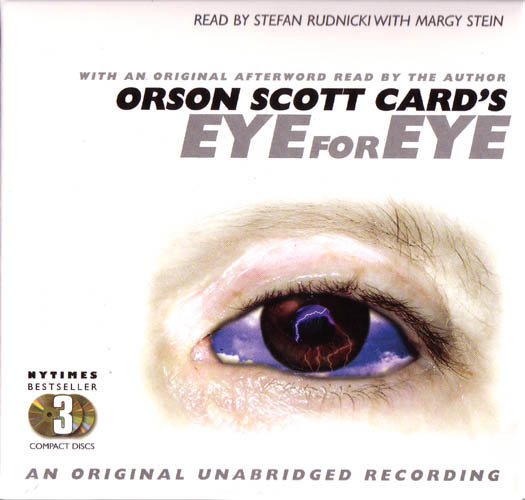
Review of Eye For Eye by Orson Scott Card

SFFaudio Audiobook Review

Science Fiction Audiobook - Eye For Eye by Orson Scott CardEye For Eye
By Orson Scott Card; Read by Stefan Rudnicki with Margy Stein
3 CDs – 147 Minutes [UNABRIDGED]
Publisher: ReQuest Audiobooks
Published: 2005
ISBN: 1933299517
Themes: / Science Fiction / Society / Morality / Youth / Power /

“If you’re a half way decent person you don’t go looking to kill people. Even if you can do it without touching them. Even if you can do it as nobody even guesses they were murdered you still got to try not to do it.”

Mick Winger is only seventeen – and already he’s killed over a dozen people. Not on purpose of course; he never meant to hurt anyone. But when Mick gets angry, people die, even the people he loves the most. Set in the contemporary world, Mick is a godfearing young man with a mysterious power – the ability to kill people just by getting mad at them. He doesn’t want to kill people, but sometimes he gets mad and then they die of hideous cancerous tumors – sometimes fast, sometimes slow – depending on how mad he gets. The phenomena is explained by some “bio electrical field” handwaving on Card’s part but that isn’t the heart of the story. Mick’s been an orphan since the day he was born – even as a baby his uncontrollable power killed his caregivers. When he grew old enough to realize the danger he posed to others, he left the orphanage to get a job doing manual labour for a decent father figure. One day Mick finds himself unconciously withdrawing his meager savings and travelling to his birthplace – like a salmon going to spawn – but on the way he meets an older woman who knows his terrible secret. She tells him he doesn’t have to go and tries to persuade him to come with her instead. But Mick has other plans. He’ll go work for the CIA, make some good of his ability to kill. Of course Mick has forgotten even he has to sleep sometime…

I plain loved this book. Not only is the story told crisply and cleanly, but it also gets one doing some deep thinking. Mick’s gift/curse is almost the perfect allegory for gun control. Not even the most rabid NRA members would suggest it’s a good idea to give pistols to toddlers, and that’s basically Mick’s situation. He’s been given a weapon that is so a part of him that he can no more stop it than he can stop breathing. His emotions are tied into a hair trigger of killing. Pity even the most loved friend who is standing near when his emotions run hot. Orson Scott Card has tied this all in with what looks like a cross between an Old Testament inbreeding program and a fundamentalist militia.

This whole situation reminded me of a phrase Robert A. Heinlein once coined: “An armed society is a polite society.”* This concept has been much trumpted by the firearms lobby and Eye For Eye shows just what it would mean if it were practiced. If everyone was like Mick Winger, a community of the armed would also be a community of fear, where even constructive criticism is to be avoided at all costs lest someone take offense. Love thy neighbor doesn’t extend very well when thy neighbor demands the freedom to own nuclear weapons.

In this age of seemingly endless series, thousand page fantasy epics, and general fiction sprawl, it is wonderfully refreshing to listen to a short novel or novella. Request Audiobooks, a brand new player in the audiobook market, has dipped into Science Fiction and Fantasy’s glorious past for some wonderous tales that don’t require a forklift to enjoy. Eye For Eye was first published in Isaac Asimov’s Science Fiction Magazine, Mar 1987 issue, and in 1988 it won the Hugo Award for best novella. Then in November 1990 it was paired as half of the Tor Double Novel #27 with another novella by Lloyd Biggle Jr. (The Tor Doubles are for my money the very best modern treeware series published). For more than ten years this terrific tale sat out of print. Then ReQuest Audiobooks stepped up. And boy did they ever! ReQuest presents the novella in all its glory, and then some. They tapped master narrator Stefan Rudnicki to read it. Rudnicki who’s sonorant basso has performed more Orson Scott Card audiobooks than any other voice on Earth is perfect for the job. Then, they went to Orson Scott Card himself and had him write an original afterword just for the audiobook. To finish it all off, they commisioned some truly eye-catching art. This is my very favorite kind of audiobook. A short novel with an intriguing premise, bristling with driven characters, read by a talented narrator, and sporting a bonus feature. With a USA price point of just $14.95 for three CDs this is like a slice of audio heaven.

*-The quotation comes from the novel Beyond This Horizon by Robert A. Heinlein

Posted by Jesse Willis