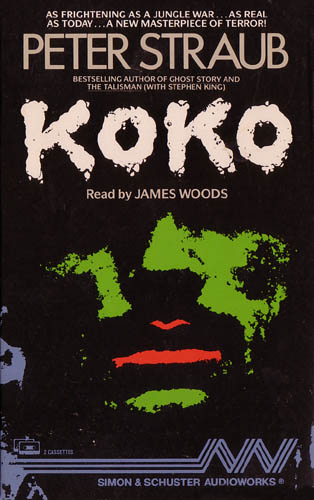
Review of Koko By Peter Straub

Fantasy Audiobooks - Koko by Peter StraubKoko
By Peter Straub; Read by James Woods
2 Cassettes – Approx. 3 hours [ABRIDGED]
Publisher: Simon & Schuster Audio
Published: November 1988 – Out Of Print
ISBN: 0671652397
Themes: Fantasy / Horror / Mystery / Vietnam / Serial Killer /

“Koko…” Only four men knew what it meant… Vietnam vets. One was a doctor. One was a lawyer. One was a working stiff. One was a writer. All were as different as men could be – yet all were bound eternally together by a single shattering secret.

A group of Vietnam vets flies back to Asia in search of a former member of their old unit, someone who they think may have become a serial killer, someone calling himself “Koko”. Koko’s motivation and identity are inextricably linked to their tour in ‘Nam, and specifically to one experience they all shared in a Vietnamese village. But in order to discover Koko’s true nature, a few of them may have to die.

Simon & Schuster Audio have used the same cool cover art from the paperback for this audiobook, which is great, but they’ve heavily abridged the novel, which isn’t. Thankfully, the story still works despite the abridgement, and the reader, James Woods, has the chops to become a full time narrator if that Hollywood thing doesn’t work out. Also added to the production is suitably accented music, which works well despite happening at seemingly random intervals. Peter Straub is really able to carve the words into your mind in such a way as to freak you right out of your skin. But it’s not just the words themselves; it’s the characters and the thoughts they have, and the motivations that drive them. It’s certainly a horror novel, but more in the tradition of Joseph Conrad’s Heart Of Darkness than Stephen King’s It. What’s really weird though is that Koko won the World Fantasy Award for best novel. Despite lacking any fantastic elements, Koko is more mystery than fantasy and more horror than fantasy. But don’t get me wrong, Koko deserved the award. It’s just that it is so far outside the boundaries of typical fantasy fiction that only a phrase like “speculative fiction” can capture it at all. Were the work not so impressive nobody would bother debating whether it was fantasy or not. It’s definitely worth the debate.

Posted by Jesse Willis
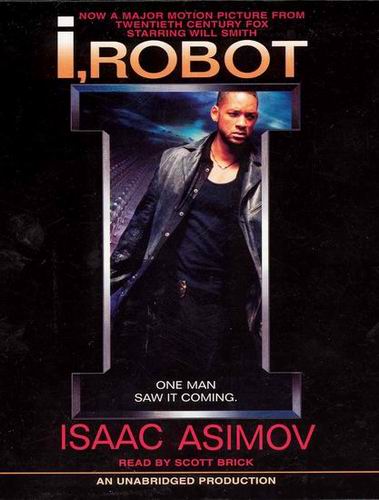
Review of I, Robot By Isaac Asimov

Science Fiction Audiobooks - I, Robot by Isaac AsimovI, Robot
By Isaac Asimov; Read by Scott Brick
7 CDs – Approx. 8 Hours [UNABRIDGED]
Publisher: Random House Audio
Published: 2004
ISBN: 0739312707
Themes: / Science Fiction / Robots / Mystery /

The debate rages on. Most don’t know how much the film I, Robot (to be released in July) resembles Isaac Asimov’s original work. A badge-toting Will Smith gracing the cover of this audiobook suggests that the resemblence will be tenuous at best… many say that it doesn’t matter. Whatever your opinion, the result for audiobook listeners is an excellent unabridged version of some classic SF.

I, Robot is a collection of 9 short stories, connected by an ongoing discussion between a reporter and 75 year-old Susan Calvin, robo-psychologist. She is talking to the reporter about the history of robots, or the history of U.S. Robot and Mechanical Men, Inc, the company which produces the world’s robots, and for which she works. The stories she relates to the reporter are:

“Robbie”
A small girl enjoys the family robot – a bit too much, according to her mother, who arranges its disappearance.

“Runaround”
On a manned expedition to Mercury, a robot named Speedy doesn’t return from an important mission. Unfortunately, Speedy’s mission is vital to the survival of the human crew.

“Reason”
A robot believes the unbelievable – is it possible?

“Catch That Rabbit”
A robot used for asteroid mining goes wrong, and U.S. Robots representative Gregory Powell is sent to make it right.

“Liar!”
Could be subtitled: The Mystery of the Mind-reading Robot.

“Little Lost Robot”
Susan Calvin is called in to solve a problem with a collection of robots – which one is lying and why?

“Escape!”
A supercomputer called “The Brain” is asked a question, and it answers.

“Evidence”
A prominent politician is accused of being a robot.

“The Evitable Conflict”
The Machines take an even greater role in the affairs of humanity.

The behavior of all of Asimov’s robots are governed by his famous Three Laws of Robotics (see them below), and the stories themselves are all about the effects of robots on humanity on both the personal and societal levels. These stories are excellent, intelligent, classic science fiction – some of the finest work by one of the finest science fiction writers ever – Isaac Asimov.

Scott Brick, a narrator I always look forward to hearing, performs. He is engaging throughout and reads as if he truly enjoyed doing it. He’s one of the best.

And here, as promised, are the Three Laws:
The Three Laws of Robotics
1) A robot may not injure a human being or, through inaction, allow a human being to come to harm.
2) A robot must obey orders given to it by human beings except where such orders would conflict with the First Law.
3) A robot must protect its own existence as long as such protection does not conflict with the First or Second Law.

NOTE: For more unabridged Asimov, check out Books on Tape, where Scott Brick has narrated more of his titles. Asimov’s robot novels, the first two of which are The Caves of Steel and The Naked Sun have not been produced as audiobooks, as far as I know. A glaring omission! The BBC has produced an audio drama of The Caves of Steel, however.

Posted by Scott D. Danielson

Review of The Icarus Hunt By Timothy Zahn

SFFaudio Review

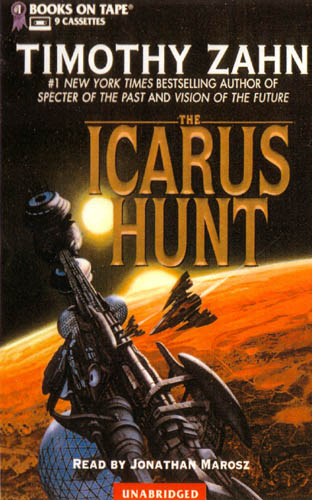
Science Fiction Audiobooks - The Icarus Hunt by Timothy ZahnThe Icarus Hunt
By Timothy Zahn; Read by Jonathan Marosz
9 Cassettes – Approx. 12 Hours [UNABRIDGED]
Publisher: Books On Tape Inc.
Published: 1999
ISBN: 0736649573
Themes: / Science Fiction / Space Opera / Mystery / Galactic Civilization / Aliens /

From Timothy Zahn, Hugo Award winner and New York Times bestselling author of two landmark Star Wars® series, comes an original new tale featuring a renegade space pilot, his unusual alien partner, and an unknown cargo that can change the course of galactic history.

Captain Jordan McKell, and his alien partner, Ixil, incautiously agree to fly The Icarus and its special cargo to Earth. The Icarus turns out to be an unusual ship containing a ragtag crew and a secret cargo that everybody in the Spiral seems to want to get their hands on. Things look tough but get worse, when they discover one of the crew’s been murdered and that there’s a saboteur aboard.

The Icarus Hunt is more science fantasy than science fiction. Set in a universe very similar to that of Star Wars, it’s also a novel firmly planted in that tradition of smugglers and space jockeys eluding powerful governments, with plenty of aliens, gunfights and seedy spaceports. If you’re in the mood for old-fashioned escapist SF, this one’s definitely for you. Myself, I enjoyed the simplicity of the tale, which is told entirely from one character’s perspective, but with enough curves to keep it interesting. Timothy Zahn wrote a few Star Wars novels, so he’s got the chops for this, but unlike with those novels, Zahn is able to build his own universe instead of just riding on the coattails of the first three movies. Zahn himself has described The Icarus Hunt as “Star Wars meets Alastair McLean”, and he’s telling the truth. The protagonist is a human that’ll remind you of the Han Solo/Lando Calrissian type, the good hearted rogue, and the plot has enough double-crossing to make you think you’re watching Where Eagles Dare or Ice Station Zebra. This isn’t deep material but it’s engaging. The worst sin it commits is in its length, its just a tad long for the plot material.

Jonathon Marosz uses more than a dozen voices and his reading is spot on. The viewpoint character is, as I stated before, a Han Solo type, and Marosz could definitely pinch hit for Harrision Ford in a minute. The cover art for this one is taken from the Bantam books paperback, and looks great. Production values are excellent, sound quality is perfect, though it has no extras at all. A solid reading of a solid space adventure.

Posted by Jesse Willis

Review of Sci-Fi Private Eye edited by Isaac Asimov and Martin H. Greenberg

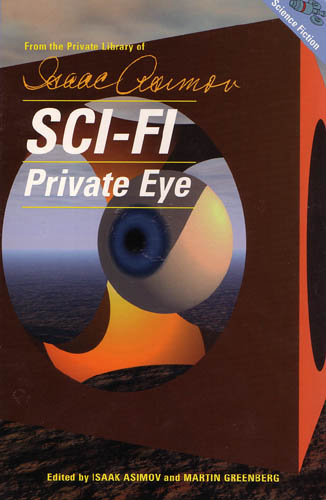
Science Fiction Audiobooks - Sci-Fi Private Eye edited by Isaac Asimov and Martin H. GreenbergSci-Fi Private Eye
Edited by Isaac Asimov and Martin Greenberg; Read by Bill Fantini and Nelson Runger
4 cassettes – 6 hours [UNABRIDGED]
Publisher: Dercum Audio
Published: August 1997
ISBN: 155656273X
Themes: / Science Fiction / Mystery / Utopia / Dystpoia / Sherlock Holmes / Mars / Berzerker / Time Travel / Artificial Intelligence / Covert Warfare /

Decades ago, SF grandmaster Isaac Asimov noted the similarity between detective “whodunit” stories and science fiction “puzzle” stories. Avoiding some of the obvious pitfalls, he began to write stories that contain elements of both of these popular genres. Later as an anthologist, Asimov teamed up with Martin H. Greenberg to collect the best of this subgenre. Sci-Fi Private Eye was the happy result. Though obviously not recorded under perfect conditions, you can literally hear the pages turning, I was flabbergasted by the love and care that went into the recording of this audiobook. It starts off with a haunting original musical score, then, instead of simply reading the first story, as is typical with nearly every audiobook, it introduces the anthology with a brief but well composed essay on the subject of mystery science fiction! The packaging is not as good, while in a sturdy enough case, the original cover art falls into a category I call “computer designed abstract boring”. Even worse, they spelled Asimov’s name wrong. The cassettes themselves also lack important details (what story starts where and ends where). The stories though are so good that I’ve got to summarize and review them individually:

Stories Included:
Introduction written and read by Isaac Asimov
“Getting Across” by Robert Silverberg
“The Martian Crown Jewels” by Poul Anderson
“Of The Metal Murderer” by Fred Saberhagen
“Mouthpiece” by Edward Wellen
“War Game” by Philip K. Dick

Robert Silverberg’s “Getting Across” is a terrific SF short story told in the first person. It was originally published in the anthology entitled Future City (1973). A future society is in danger. To house the engorged human race, the Earth is entirely covered by one large metropolis. But it isn’t one big city so much as it is a million city-states abutting one another. Each district has its own government, its own customs and industries, and it’s own way of life. Contact between districts is restricted and often dangerous to those who attempt it. All districts rely on a master computer program for the smooth operation of these automated communities. So when Ganfield’s master computer program is stolen, things start to deteriorate quickly. Garbage starts piling up uncollected, food stops being delivered, the climate control system stops working, and the deactivated robotic police force cannot prevent the cannibalism that is only weeks away. The man whose “month-wife” stole the program is sent to find her and bring it back. His task is nearly impossible because even if he can get out of his district getting across will only be the first hurdle. Typical of Silverberg’s great work in the 1970s.

Poul Anderson’s “The Martian Crown Jewels” was first published in A Treasury of Great Science Fiction, Vol. 1 (1959). The Martian Crown Jewels have been stolen! The theft threatens to destroy diplomatic relations between Mars and Earth. Inspector Gregg, of the Earth police force stationed on Mars, is stumped. Who can solve the baffling locked spaceship mystery and avert a galactic catastrophe of cataclysmic proportions? None other than Mars’ greatest consulting detective, Syaloch, a seven-foot feathered Martian who lives at 221B “Street of Those who Prepare Nourishment in Ovens.” Most entertaining.

Edward Wellen’s “Mouthpiece” first saw print in the pages of Fantasy & Science Fiction Magazine’s February 1974’s issue. Most of the stories I’ve read by Edward Wellen tend to be focused on the workings of the human mind, and this one is no exception. This one fictionalizes a fascinating historical curiosity regarding the final hours of “Dutch” Schultz and takes it just that bit farther – into artificial intelligence – leaving us pondering the nature of personality, memory and thought. It’s also a great little mystery to boot!

Fred Saberhagen’s “The Adventure Of The Metal Murderer” was first published in Omni Magazine’s January 1980 issue, and is another in Saberhagen’s long running series of Berzerker short stories. It’s a time travel story that starts in the distant future and then goes back to 19th century London, England. A clever tale that will remind you of Michael Moorcock’s “Behold The Man”.

Philip K. Dick’s “War Game” was first published in Galaxy Science Fiction Magazine’s December 1959 issue. Earth’s traditional enemy, Ganymede, is at it again. They are trying to subvert and soften up the good people of Earth by selling potentially dangerous toys and games as a prelude to invasion. One toy appears to assemble itself over time into a nuclear weapon, another convinces the user that the virtual reality he or she is in is actual reality, and a third is a harmless variation on the board game Monopoly. But the market demand for the inventive Ganymedian games is pressuring the Earth customs to clear the toys for stocking in time for Christmas. If they follow the rules only one will get through to the store shelves. Typically Dickian and thus very entertaining.

Posted by Jesse Willis

Review of Anne Manx and the Trouble on Chromius

Science Fiction Audio Drama - Anne Manx and the Trouble on ChromiusAnne Manx and the Trouble on Chromius
Starring Claudia Christian, Andy Hallet, and Paris Jefferson
Written by Larry Weiner
Duration: 1 hour, 45 minutes
Format: 2 Audio CD’s, also available at Audible.com
ISBN: 0966039289
Producer: The Radio Repertory Company of America
Themes: / Science Fiction / Mystery / Private Eye /

You know the story. Smart-ass female private eye gets embroiled in something that’s more than she bargained for. Using her brains, attitude, and savvy, she saves the day. Think V.I. Warshawski or Kinsey Milhone. The difference here is that we’re talking science fiction and the setting is somewhere like the planet Chromius instead of New York or Chicago. But still… familiar territory.

Though the plot elements aren’t uncommon, the overall production certainly is. Claudia Christian heads a very good cast in this well-produced satirical radio drama that reminds me how entertaining radio drama can be. This is real radio drama that pulls you in and doesn’t let go.

Whether Claudia Christian is trading barbs with another character or questioning an informant, she presents a believable and hilarious main character. Her sidekick, played by Andy Hallet, made me laugh out loud more than once. The original music was also quite good, as were the sound effects. Through good headphones, I was fully immersed in the action-packed story.

Anne Manx and the Trouble on Chromius won the Gold Mark Time Award for Best Science Fiction Audio of the year 2002. Story by Larry Weiner, produced by Angelo Panetta for the Radio Repertory Company of America. Find the entire credit list here, and LISTEN TO A SAMPLE here.

Review of The Moon Moth [AUDIO DRAMA] adapted from the novella by Jack Vance

SFFaudio Review

The Moon MothSFFaudio EssentialThe Moon Moth
By Jack Vance; adapted by George Zarr
Performed by a Full Cast
Duration: 73 minutes 22 seconds
Available at: http://www.scifi.com/set/playhouse/moth/
Producer: Seeing Ear Theater
Themes: Science Fiction / Mystery / Aliens / Identity / Sociology /

A tone-deaf detective pursues a singing assassin through an opera of blood in this classic satirical thriller by Jack Vance. On the planet Sirene everyone wears a mask according to his status — or strahk — in society. Communication is accomplished through singing accompanied by a plethora of instruments, each of which signifies a different emotional mood or is used to talk to a different social caste. The problem is, the assassin Angmark is a master of Sirenese customs and — like everyone else on Sirene — his face is hidden behind a mask. Our doddering ambassador-detective’s only hope: to learn to use his own mask — the lowly Moon Moth — before Angmark relieves him of a head to put it on.

“The Moon Moth” is one of the best short science fiction stories tackling ideas of alternative social systems. Most stories of this type are found in full length novels like Robert Silverberg‘s A Time Of Changes or Ursula K. Le Guin‘s The Left Hand Of Darkness, but what is so delightful about this story is how densely packed with excellence it truly is. “The Moon Moth” is whimsical story with a truly original alien culture, the tale is part social commentary, part social satire and an absolutely terrific variation on the locked room mystery all packed successfully into 73 minutes of goodness! David Garrison and the rest of the Seeing Ear Theater cast are hilarious and effective but the real kudos has to go to George Zarr who so skillfully adapted Jack Vance‘s 1961 short story to the audio drama form. And unbeleivably, this play is still available for free on the internet! Very highly recommended!