News, Reviews, and Commentary on all forms of science fiction, fantasy, and horror audio. Audiobooks, audio drama, podcasts; we discuss all of it here. Mystery, crime, and noir audio are also fair game.
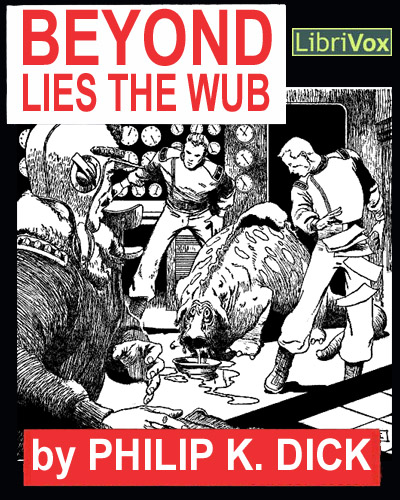
There’s probably always going to be a place in my heart for Philip K. Dick’s Beyond Lies The Wub. It was my first PKD short story. It’s very short and usually runs just over fifteen minutes read aloud – which I frequently do. And even though Dick claimed only to have been paid $15 for it*, I find it absolutely invaluable.
I’ve felt that way from the very first time I heard it, back in 2006. The narrator, Mac Kelly, delivered the story at a measured pace that really sang the story to me.
Since then I’ve become even more enamored with Gregg Margarite’s rendition, recorded for LibriVox in 2009.
And that’s the one I’d like to share with you. I share it with you now, but you can share it with your friends too because, not only is the story public domain, the audiobook itself is too!
Beyond Lies The Wub
By Philip K. Dick; Read by Gregg Margarite
1 |MP3| – Approx. 16 Minutes [UNABRIDGED]
Publisher: LibriVox.org
Published: May 4, 2009
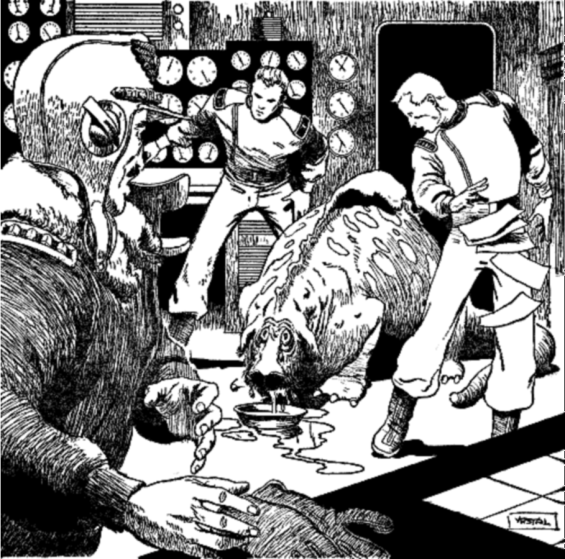
|ETEXT| The slovenly wub might well have said: Many men talk like philosophers and live like fools. First published in Planet Stories, July 1952.
And here’s a combination of the narration with the magazine scans:
I’ve done a bigger post on The Defenders by Philip K. Dick, that’s HERE, but I’ve just uploaded a YouTube version of the X Minus One adaptation that I’ve put together with the original art from its publication in Galaxy Science Fiction, January 1953 issue:
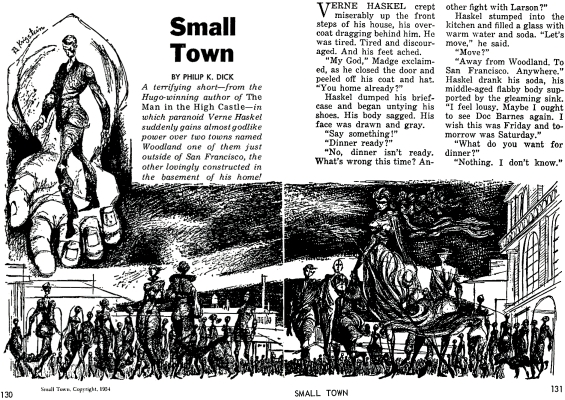
The SFFaudio Podcast #153 – Small Town by Philip K. Dick, read by Gregg Margarite. This is a complete and unabridged reading of the short story followed by a discussion of it with Jesse, Tamahome, and Gregg Margarite!
Of Small Town Philip K. Dick wrote:
“Here the frustrations of a defeated small person — small in terms of power, in particular power over others — gradually become transformed into something sinister: the force of death. In rereading this story (which is of course a fantasy, not science fiction) I am impressed by the subtle change which takes place in the protagonist from Trod Upon to Treader. Verne Haskel initially appears as the prototype of the impotent human being, but this conceals a drive at his core self which is anything but weak. It is as if I am saying, The put-upon person may be very dangerous. Be careful as to how you misuse him; he may be a mask for thanatos: the antagonist of life; he may not secretly wish to rule; he may wish to destroy.”
Talked about on today’s show:
Gregg is getting better at girls, girls are always questioning you, horror, urban fantasy, The Twilight Zone, Science Fiction, Fantasy, Rod Serling, paranoid Verne Haskell, a lead quarter, the redistribution of wealth, playing god, “…and he rested and he made a sandwich”, god games, SimCity 2000, churches can’t be stopped, Microcosmic God, “shoved into the next dimension”, is it slipstream?, Stopover In A Quiet Town, transformers are the science, diorama, the train doesn’t run them over, “moral”, “extremely moral”, train guys, Lego, erector sets, Lincoln Logs, Meccano, matchbox cars, small towns can be hell, comic book stores, “urbane-al-ity”, is Verne the god of Woodland?, pet shops and mortuaries, little man, SFSignal’s Sword And Sorcery Panel suggest characters should be the focus, “Finished!”, world warping, John Carter, handwavium, “make out”, Beyond The Door, Dick’s faithless women, Clans Of The Alphane Moon, how risque were SF mags in the 1950s?, San Fransisco, Silvia is one of Dick’s most common female character names, a life sized diorama, The Tell Tale Heart, The Days Of Perky Pat, The Three Stigmata Of Palmer Eldritch, the game of Life, Barbie, chew-z, the documentary Marwencol (2010), “he wants love”, Mark Hogancamp’s world is open, living in a real dream world, Deja Thoris has a time machine, Jeff Malmberg, A Clockwork Orange, adding layers, “well done Jeff”, R. Crumb, Blade Runner‘s androids take photographs to take memories, “reality and consciousness are fluid constructs”, crazy vs. differently enabled, Esopus magazine, a world without irony, authenticity, people are complicated, Greenwich Village, cross-dressing, WWII.
I’ve just heard that Gregg Margarite, my good friend, and a friend to humanity, has died.
Here are the facts as I’ve been told them.
Gregg died of a sudden heart attack on Friday morning (March 23, 2012).
__
I’ve never used an emoticon in a post on SFFaudio. Emoticons, I thought, were for when words couldn’t be easily employed. And I figured that was never.
I was wrong.
If there ever was a day for a frowny face that day is this day.
:(
I became a friend of Gregg’s after listening to his recordings on LibriVox. I said to him that I wanted to be his friend because he was narrating so many of the audiobooks that I wanted to listen to. I told him that meant we had to be friends. And he believed me. And so we were.
We did several podcasts with Gregg. All of them were really fun. And, we were planning more. My last communication with him was about Philip K. Dick’s The Short Happy Life Of The Brown Oxford – which he wanted to narrate. Gregg wrote:
“I have 3 holy grails when it comes to PKD short stories, Brown Oxford, Electric Ant (not gonna happen in my lifetime) and Not By Its Cover.”
I was also waiting to hear his thoughts on the first episode of Black Mirror. I know he got it, but I don’t know if he saw it. I guess I’ll never know.
I told Gregg I had started listening to his narration of the novel Couch by Benjamin Parzybok. He asked that I tell him about it after listening. I won’t get that chance now.
Gregg was also planning on narrating The Ganymede Takeover, a novel by Philip K. Dick and Ray Nelson. I don’t think he’d actually started it yet though as I hadn’t yet sent him my copy.
The last update on Gregg’s site says that he’d recorded 205 hours, 58 minutes, and 30 seconds of audiobooks. Most of that was for LibriVox. I figure that’s one hell of a legacy.
In the many times we spoke I learned many surprising things about Gregg. He said he used to build “surrogate penises for Ronald Regan”, he was a musician, he was an artist and he was a fiction writer too (but under pseudonyms). I never learned his pseudonyms.
Gregg’s website, Acoustic Pulp, offers no comments section. So I invite anybody wishing to communicate any kind thoughts with Janine, Gregg’s wife, to comment below.
Update:
Mark Nelson has started a LibriVox forum thread.
I made this infographic for myself for while researching the Philip K. Dick stories published in the years 1954 and 1955.
I find it rather stunning to look at.
The data in BLACK all comes from the form filed on November 22, 1983 and submitted to the U.S. Copyright Office under Registration Number RE0000190631 (SEE THE ACTUAL SCANS HERE).
The RED and YELLOW highlights are my own notations.
As you can see the copyright claimants “Laura Coelho, Christopher Dick & Isa Dick” claimed 37 stories were published in 1955. This is false. Only the 12 stories were published in 1955. The remainder, all 25 of them (highlighted in RED), were actually published in 1954 in other magazines, books, or issues. The 12 stories that were genuinely eligible for renewal are correctly noted, the 25 submitted that were not eligible are false.
What do you make of that?
To me it looks like 25 cases of deliberate fraud. To me it looks like the public has been denied its rights to these stories for nearly three decades.
Maybe there’s a math whiz out there could tell us what the chances of making 25 honest clerical errors only in the 25 cases where the clerk’s client benefits, without, at the same time, making any similar mistakes in the 12 cases where a typo doesn’t accrue a benefit to the clerk’s client (namely in those cases where a story was actually eligible for a legal renewal).


 Beyond Lies The Wub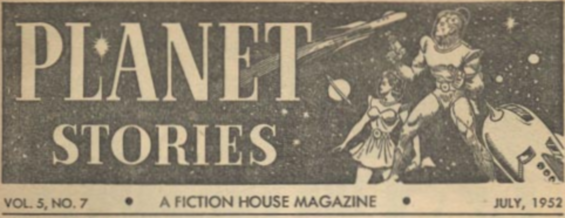





 I’ve just heard that Gregg Margarite, my good friend, and a friend to humanity, has died.