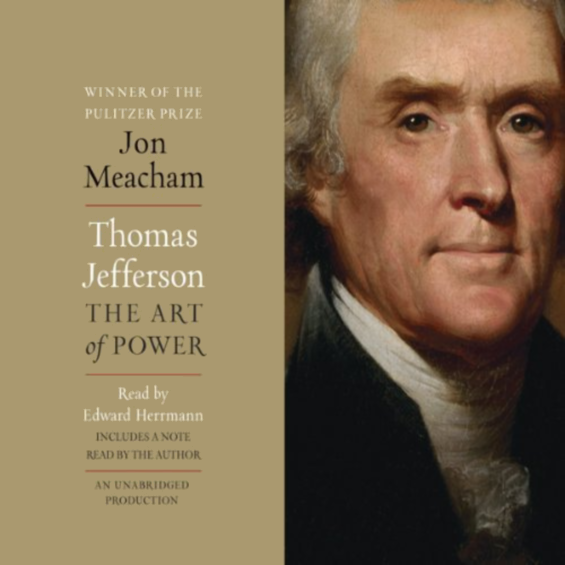
Recent Arrivals: Random House Audio – Thomas Jefferson: The Art Of Power by Jon Meacham

SFFaudio Recent Arrivals

After Jon Meacham’s terrific mini-interview on The Daily Show with Jon Stewart I was very pleased that Random House Audio sent us Thomas Jefferson: The Art of Power. Read by Edward Herrmann, who is an excellent narrator, this audiobook runs almost 19 hours.

I look forward to it.

Random House Audio - Thomas Jefferson: The Art Of Power by Jon Meacham


Posted by Jesse Willis

Radio Project X: Beyond Lies The Wub [AUDIO DRAMA]

SFFaudio Online Audio

Recorded live in Toronto, this is a very faithful adaptation of Beyond Lies The Wub. It uses most of the dialogue and vocabulary from Philip K. Dick’s first published short story.

Radio Project XBeyond Lies The Wub
Adapted from the story by Philip K. Dick; Performed by a full cast
1 |MP3| – Approx. 45 Minutes [AUDIO DRAMA]
Podcaster: Radio Project X
Podcast: July 10, 2012
The slovenly wub might well have said: Many men talk like philosophers and live like fools. First published in Planet Stories, July 1952.

[via The Sonic Society]

Posted by Jesse Willis

LibriVox: Pygmalion’s Spectacles by Stanley G. Weinbaum

SFFaudio Online Audio

Pygmalion’s Spectacles was first published in 1935 in the aptly named Wonder Stories magazine. Four years after it’s first publication it was reprinted in Startling Stories as a “classic” and it was placed in their “Scientifiction Hall Of Fame.” It was reprinted again in Fantastic Story magazine in the Spring 1955 issue. Three magazine publications is a rare occurrence for any SF story. So, what makes this story special?

Well, this tale of utopia, immortality, and romance, is also, most probably, the very first story to feature the concept of virtual reality.

Here’s the description from the Wikipedia entry:

A comprehensive and specific fictional model for virtual reality was published in 1935 in the short story Pygmalion’s Spectacles by Stanley G. Weinbaum. In the story, the main character, Dan Burke, meets an elfin professor, Albert Ludwig, who has invented a pair of goggles which enable “a movie that gives one sight and sound […] taste, smell, and touch. […] You are in the story, you speak to the shadows (characters) and they reply, and instead of being on a screen, the story is all about you, and you are in it.”

And though the ideas may be pioneering, the plot of Pygmalion’s Spectacles is very similar to Fitz-James O’Brien’s The Diamond Lens, itself an excellent SF tale. The tone of their respective endings differs, but their plot, in which a man falls in love with an intangible woman, is straight out of the Greek mythology that Weinbaum alludes to. And they both use science, rather than magic to get to their respective endings.

There is, I should also point out, a LibriVox |MP3| recording of the Metamorphoses by Ovid, a 2,000 year old poem featuring the myth of Pygmalion.
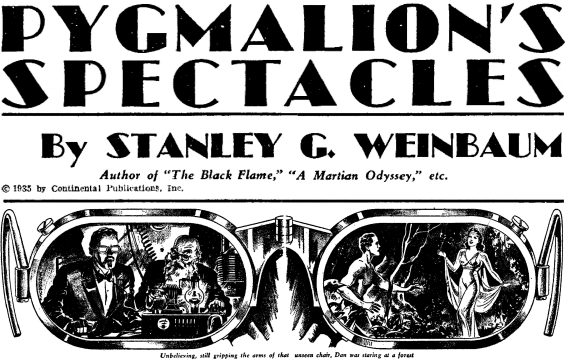
Pygmalion's Spectacles by Stanley G. Weinbaum

Here is a |PDF| made from the Pygmalion’s Spectacles publication in Fantastic Story. And here are two LibriVox versions (my advice, go for the first one):

LibriVoxPygmalion’s Spectacles
By Stanley G. Weinbaum; Read by Gregg Margarite
1 |MP3| – Approx. 43 Minutes [UNABRIDGED]
Publisher: LibriVox.org
Published: January 13,2009
He put on the glasses and fell in love with a dream… First published in Wonder Stories, June 1935.

LibriVoxPygmalion’s Spectacles
By Stanley G. Weinbaum; Read by Chrystal Layton
1 |MP3| – Approx. 45 Minutes [UNABRIDGED]
Publisher: LibriVox.org
Published: November 17, 2007
He put on the glasses and fell in love with a dream… First published in Wonder Stories, June 1935.

Pygmalion’s Spectacles illustration by Lumen Winter (from Wonder Stories, June 1935):
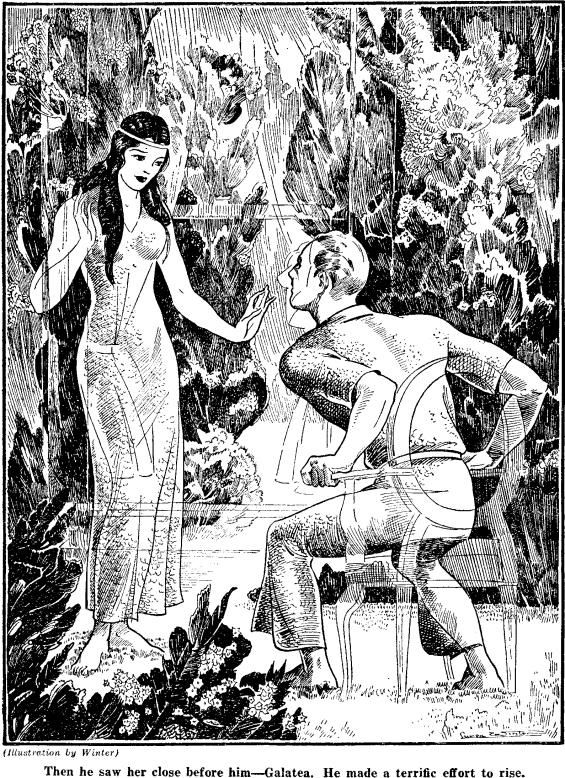
Pygmalion's Spectacles -  illustration by Lumen Winter

Pygmalion’s Spectacles illustration by Virgil Finlay (from Fantastic Story Magazine, Spring 1955):
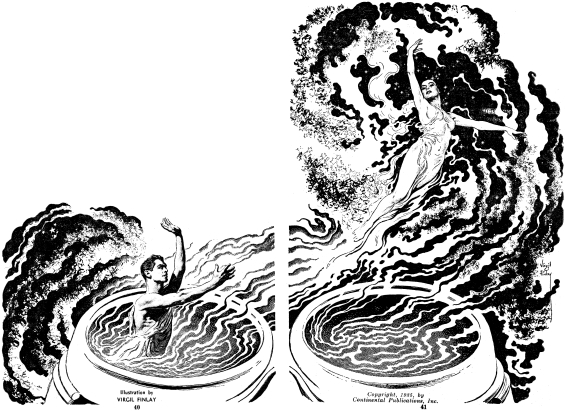
Pygmalion's Spectacles - illustration by Virgil Finlay

Painting of Pygmalion and the statue by Jean-Baptiste Regnault:
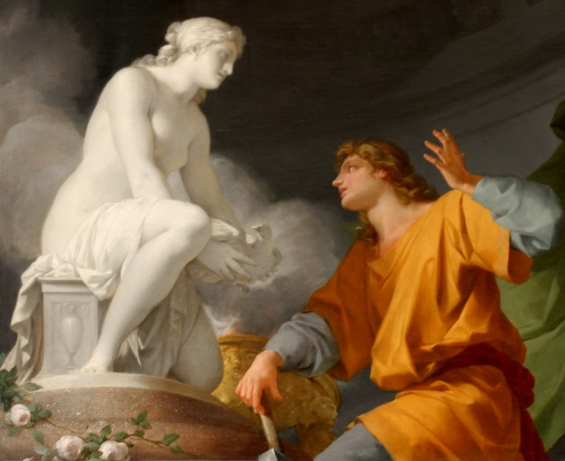
Jean-Baptiste Regnault - Pygmalion

[Thanks to Tim at The Drama Pod for the reminder]

Posted by Jesse Willis

The Partially Examined Life: Candide by Voltaire and No Country For Old Men by Cormac McCarthy

SFFaudio Online Audio

The Partially Examined LifeThe Partially Examined Life is a philosophy podcast by “some guys who were at one point set on doing philosophy for a living but then thought better of it.” I started following it after SFFaudio Podcast #115 when Anne, from the Anne Is A Man blog, suggested I try it. Since then I’ve been listening to it pretty steadily. Their most recent two podcasts are a great jumping on point for those only casually interested in philosophy as they are both discussions of philosophical novels.

Episode 62 is a discussion of Candide by Voltaire and Episode 63 is a discussion of Cormac McCarthy’s No Country For Old Men. I’ve read the first book, and now I want to read the second. Indeed, there are very few podcasts that give me the same kind of pleasure, an intellectual pleasure, as recording our own READALONGs. These last two podcasts are such.

Here are the specifics:

Episode 62: Voltaire’s Novel “Candide |MP3|
On Candide: or, Optimism, the novel by Voltaire (1759). Is life good? Popular Enlightenment philosopher Leibniz argued that it’s good by definition. God is perfectly good and all-powerful, so whatever he created must have been as good as it can be; we live in the best of all possible worlds.

Episode 63: Existentialist Heroes in Cormac McCarthy’s “No Country For Old Men |MP3|
On philosophical issues in McCarthy’s 2005 novel about guys running around with drug money and shooting each other, and about fiction as a form for exploring philosophical ideas.

Podcast feed: http://feeds.feedburner.com/ThePartiallyExaminedLife

Posted by Jesse Willis

The Dog And The Horse by Voltaire

Aural Noir: Online Audio

One of the earliest detectives in history, or at least the history of literature, is Zadig. Zadig is the main character of Voltaire’s philosophical novel Zadig; Or The Book Of Fate – An Oriental History. I stumbled across it’s existence while reading an old issue of Ellery Queen’s Mystery Magazine in which one chapter was featured under the title The Dog And The Horse. The brief editorial introduction, and some further researches on my own, assert that Zadig in this chapter may have been the inspiration for Edgar Allan Poe’s C. August Dupin!

I can sort of see it too, for The Dog And The Horse shows a kind of giant first step in an evolutionary process of the detective – seeing his marriage turn sour Zadig turns to the study of nature for his joy. A kind of passionate interest in the world is necessary for both the scientific detective and the more Sherlockian sort of detective.

The story is damn funny too.

LibriVoxThe Dog And The Horse
By Voltaire; Read by Lucy Burgoyne
1 |MP3| – Approx. 13 Minutes [UNABRIDGED]
Publisher: LibriVox.org
Published: January 31, 2008
First published in 1747.

|ETEXT|
|PDF|

Posted by Jesse Willis

Lit2Go: The Philosophy Of Composition by Edgar Allan Poe

SFFaudio Online Audio

Lit2GoI’ve been looking for an audio copy of this wonderful 5,000 word essay, and I’ve just found it. In this 27 minute long reading of The Philosophy Of Composition Edgar Allan Poe explains the creation of The Raven – showing the necessity of all of the components of the poem – and in the process, explaining what’s wrong with most fiction – Poe argues that most composition (poetry and prose) is typically aiming at the sufficient and not the necessary.

|MP3|

The full text is also HERE.

Posted by Jesse Willis