Review of Live Free or Die by John Ringo

SFFaudio Review

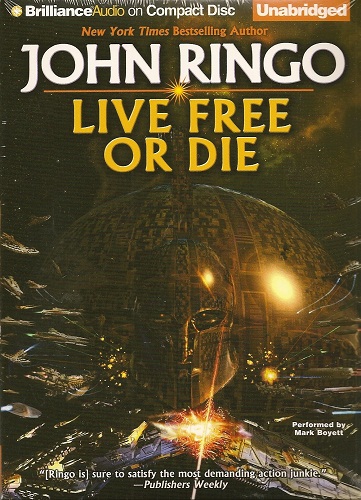
Science Fiction Audiobook - Live Free or Die by John RingoLive Free Or Die
By John Ringo; Read by Mark Boyett
17 Hours – [UNABRIDGED]
Publisher: Brilliance Audio
Published: 2010
Themes: / Science Fiction / Military / Politics / Aliens / First contact /

All authors have political opinions. Those opinions reveal themselves in authors’ novels. Most authors reveal those opinions subtly, probably figuring an in-your-face approach will only turn off some readers.

John Ringo is not most authors. In Troy Rising: Live Free or Die, Ringo (and his Mary Sue protagonist, named Tyler Vernon) wear their politics on their sleeves. It is a robust libertarian brand of politics. This is a little refreshing, and a lot distracting. Readers who dislike celebrations of conservative culture and Don’t Tread On Me economics are going to have to work very hard to ignore the constant needling. In particular, “socialist p***ies” are urged to approach this novel with deflector shields set to maximum.

Even plot points fulfill Ringo’s wishes in surprising ways. When aliens drop rocks on our cities, the result is that the surviving electorate skews rural. . .and conservative. This is just the kind of thinking-through-the-implications work that a good speculative fiction author is required to do. Yet, Ringo takes just a tiny bit of, well, satisfaction from the deaths of millions of misguided liberal urbanites. More blatantly self-indulgent is a plot point involving an alien-engineered virus that makes all the blond women in the world soooper horny. No joke.

You can call this space opera; ear candy; action-packed. The prose is breezy and the plot is intelligently constructed. The narration, by Mark Boyett, is a pleasure to listen to. He’s either an enthusiastic conservative, or a liberal with superb acting skills. (Either scenario is plausible.)

The novel divides into three clear sections. The first act describes a first-contact scenario, with aliens installing an interstellar transport gate in our solar system with precious little warning. The resulting transformation of all human civilization into a galactic third-world country is quite plausible. It’s a disturbing reminder of the way colonial powers are viewed by the colonized.

The second act tells of the ascendancy of Tyler Vernon from unemployed everyman to the richest tycoon in human history. He finds the one commodity unique to Earth that aliens value. Here, the novel becomes less plausible—a little silly, really—and worse, the idea is not original, resembling a plot device in Harry Turtledove’s WWII alt history, where gingerroot turns aliens into crackheads. I won’t give away what the substance is in this case; suffice it to say it comes from a region of the world known for its culture of prickly independence, which dovetails with Ringo’s politics with neat precision. A nifty authorial trick, that.

The third act is the longest, and it describes the building the Troy, an excellent Big Dumb Object—a fantastically massive battle station. Even more impressive is a system of mirrors that concentrate sunlight into powerful beams measured in terawatts or even petawatts. These weapons give Earth a fighting chance against the oppressors. The question nags: could humans think up technology that surprises millennia-old civilizations? Very unlikely.

This book brings to mind another tale of lowly humans besting an established galactic order. Poul Anderson’s The High Crusade describes how medieval knights commandeer an alien space ship and, ultimately, overthrow a space empire. That book is more enjoyable because it’s not even remotely serious. Live Free or Die aspires to a more serious level, but ultimately works only if the reader’s sense of fun can withstand the concentrated sunlight of plausibility.

Posted by the Fredösphere

LibriVox: The Iron Heel by Jack London

SFFaudio Online Audio

LibriVoxThe Iron Heel, one of the books from our 4th Annual SFFaudio Challenge. It is now complete and available free from LibriVox! Narrator Matt Soar sez:

I have just this afternoon finally finished the last chapter of Jack London’s The Iron Heel. Phew! It’s been quite an experience – begun in Montreal, completed in France, six months in the making.

He actually wrote that two months ago. See, Matt decided to make a planned creative commons release release PUBLIC DOMAIN! Woohoo! It’s on LibriVox and it has now been catalogued!

And, over in the “about” section of Matt’s site, TheIronHeel.net Matt wrote:

The entire expe­ri­ence has been intrigu­ing, if not uncanny: The story, about an over­bear­ing, immoral gov­ern­ment char­ac­ter­ized by decep­tion, tor­ture, and war­mon­ger­ing, against a back­ground of civil­ian exploita­tion and reli­gious zealotry, is mainly remark­able for the fact that it was writ­ten a hun­dred years ago — rather than, say, five.

Per­haps the only aspects of The Iron Heel that really age it are its breath­lessly roman­tic hero­ine, occa­sion­ally pro­saic lan­guage, and the author’s fleet­ing use of dubi­ous terms to describe eth­nic minori­ties. These quib­bles aside, I’m really glad I took the time to record it, and hope you enjoy it too.

LIBRIVOX - The Iron Heel by Jack LondonThe Iron Heel
By Jack London; Read by Matt Soar
26 Zipped MP3 Files or Podcast – Approx. 8 Hours 18 Minutes [UNABRIDGED]
Publisher: LibriVox / TheIronHeel.net
Published: July 16, 2010
Generally considered to be the earliest of the modern dystopian novels, The Iron Heel chronicles the rise of an oligarchic tyranny in the United States. It is arguably the novel in which Jack London’s socialist views are most explicitly on display. A forerunner of “soft science fiction” novels and stories of the 1960s and 1970s, the book stresses future changes in society and politics while paying much less attention to technological changes.

Podcast feed: http://librivox.org/rss/4342

iTunes 1-Click |SUBSCRIBE|

[Thanks a ton Matt!]

Posted by Jesse Willis

Aural Noir Review of Gentlemen Of The Road by Michael Chabon

Aural Noir: Review

RANDOM HOUSE AUDIO - Gentleman Of The Road by Michael ChabonGentlemen Of The Road: A Tale Of Adventure
By Michael Chabon; Read by Andre Braugher
Audible Download – Approx. 4 Hours 13 Minutes [UNABRIDGED]
Publisher: Random House Audio
Published: October 2007
Provider: Audible.com
Themes: / Adventure / Crime / Jewishness / War / Politics / Mercenaries / Con-men / Khazaria /

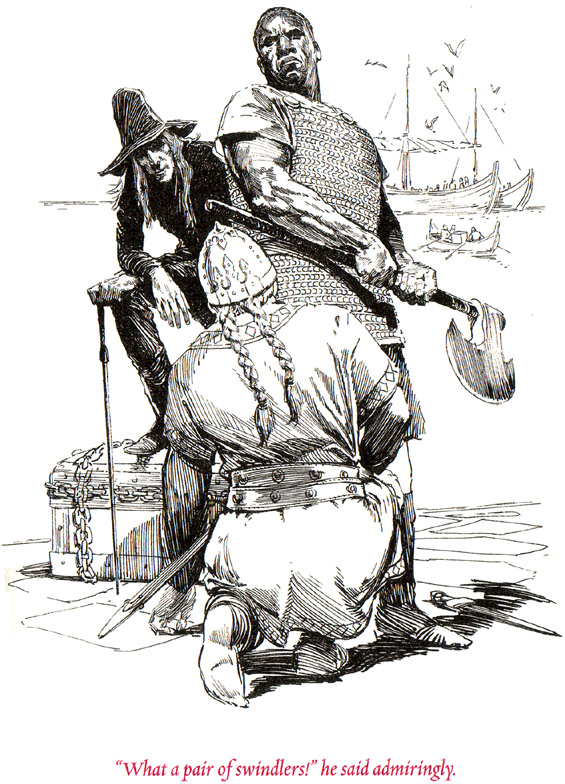
Gentlemen Of The Road was first published as a serial in The New York Times Magazine. Despite it’s sword and sorcery feel, it is not actually a Fantasy novel, but is instead a “swashbuckling adventure” set in an obscure, but real, historical setting. Its heroes, Amram and Zelikman, are an odd, but vaguely familiar, pair. Familiar in their companionable rivalry and clearly inspired by Fritz Leiber’s famed pair of characters: Fafhrd and Grey Mouser. But, instead of one being a short, urban thief and the other a hulking Northern barbarian, the two are instead the titular gentlemen of the road, wandering Jews, or as Chabon himself states in the audiobook’s afterword “Jews With Swords.” And that’s what was really important in this story; though each of these two Jews looks entirely unalike from the other, they are tied together by far flung tradition, common heritage and similar tales of woe. The larger of the pair is Amram, a swarthy Abyssinian with a penchant for shatranj and quite literally an axe to grind. The slighter and paler of the pair is Zelikman, a fair haired Frank, who far from being a member of the thieves guild is actually a doctor (he wields an “over-sized bloodletting lance as a rapier”). Together they are a neat pair of dark age sell-swords/con-men, working the taverns and inns of southern Eurasia. It is, all in all, one of the neatest set-ups for a book I’ve ever heard. And you couldn’t find a funner fictional premise for illustrating the Jewish diaspora in an adventure novel.

One evening (circa AD 950), a chance encounter at a roadside inn in the kingdom of Aran leads to a body-guard job. The job involves a journey to the neighboring khaganate of Khazaria. Along the way they meet many a fellow road traveler and have some less than polite encounters. Eventually, Amram and Zelikman (A & Z) find themselves fully entangled in a rebellion and plot aimed at restoring a displaced Khazar prince to the throne.

Narrator Andre Braugher is a television actor that I’ve admired since his portrayal of the unwaveringly professional detective Frank Pembelton on Homicide: Life on The Street. Braugher has a powerful voice that he uses to deliver Chabon’s ornately constructed descriptive scenes and dialogue. You can tell, with every sentence of Braugher’s delivery, that Chabon loves language. I thoroughly enjoyed the book after I got into it. But it wasn’t easy, I really had to shift gears. This is embellished storytelling, it feels both old-fashioned and unrepentantly ostentatious. It has very little of the usual fantasy stylings, it dumps any ordinary flat or prosaic description in favour of the deliberately lavish. Once I did get into it, I loved it. There’s a lot of detail to enjoy here. Chabon’s hulking Abyssinan, for instance, has a battle-axe. He gained it after combat with the Varangian Guard in Byzantium. A runic inscription on it roughly translates into “defiler of your mother.” Another writer would have done it another way – another writer wouldn’t have done it at all. This is what makes Chabon, his books and this novella in particular so special.

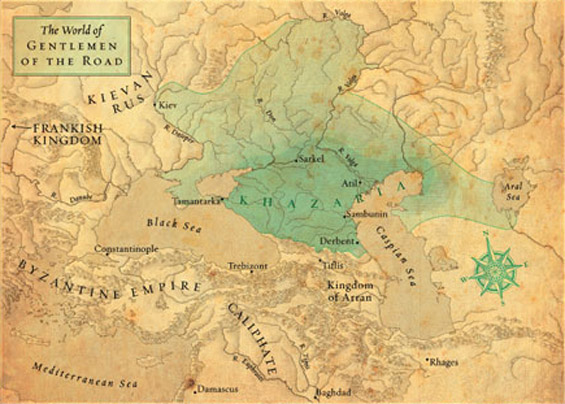
Sadly, the audiobook lacks the map and the 15 terrific black and white illustrations (by Gary Gianni ) found in the paperbook. Here is a peek at both:

Gentlemen Of The Road - MAP

Gentlemen Of The Road - PAGE 161

Posted by Jesse Willis

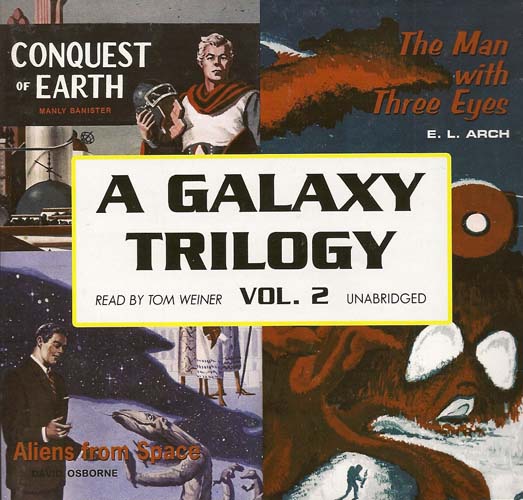
Review of A Galaxy Trilogy Volume 2 – A Collection of Tales from the Early Days of Science Fiction

SFFaudio Review

A Galaxy Trilogy, Vol. 2A Galaxy Trilogy, Vol. 2 – A Collection of Tales from the Early Days of Science Fiction
By David Osborne, E.L. Arch, and Manly Banister; Read by Tom Weiner
11 CDs – Approx. 13 hours [UNABRIDGED]
Publisher: Blackstone Audio
Published: 2009
ISBN: 9781433291081
Themes: / Science Fiction / Aliens / First Contact / Politics / Cold War / Russia / Washington, D.C. / Colorado / Amnesia / Prophecy / Sociology / Iowa / Teleportation /

Back in the 1950s at the dawn of science fiction, writers were turning out wildly imaginative stories for the pulp magazines. Robert Silverberg, writing as David Osborne, estimates he wrote over a million words in one year. Here are three more exciting stories from those heady days from the pioneers of science fiction.

Discs 1 – 3: Aliens From Space by David Osborne (Robert Silverberg)

First published in 1958, under a pseudonym, this Robert Silverberg short novel is set in a fascinatingly futuristic 1989. It is in a period of relative peace on Earth since the recent collapse of communism in Eastern Europe. With this new détente in the offing only an outside influence could disrupt the path to global harmony. And that is exactly what happens when an alien spacecraft lands in an Iowa cornfield. It seems that these aliens have been watching Earth for millennia, and now we are on the cusp of ‘regular interplanetary travel’ these alien beings wish Earth to accept their hand/tentacle in friendship. This aid would be especially needed too as it seems there is another alien species out there in the galaxy – one which would likely destroy the Earth, and all humans, given half a chance. A team of diplomats and scientists from around the world is quickly assembled to negotiate a treaty and alliance. Among them is Professor Brewster, a prominent scientist of psychosociology. He thinks the aliens are hiding something. But could it just be their very alienness? He points out the advanced technology they offer comes with its own problem; receiving technology from an technologically advanced civilization doesn’t advance the recipient’s own culture – it merely makes the culture dependent upon the giver’s civilization. But is that a small cost compared with annihilation?

A friend of mine pointed out that Greg Bear’s 1987 novel The Forge Of God has a similar premise. There are many terrific ideas in the gloriously short novel. Aliens From Space is a kind of cold war apologue, a prisoner’s dilemma situation. Wrong action invites destruction or at the very least, great loss. In a way the Brewster character reminded me of Jared Diamond (of Guns, Germs And Steel fame). Diamond and Brewster, by asking interesting questions, find interesting answers.

Discs 4 – 7: The Man With Three Eyes by E.L. Arch (Rachel Cosgrove Payes)

The Man With Three Eyes is not a terrific Science Fiction novel. But, it is a fair meta-Science Fictional story. It works well as a quasi-period piece/alien invasion story/Agatha Christie-style mystery. It’s set in 1967 New York, more specifically in Greenwich Village. It’s protagonist, I won’t call him a hero, is an Irishman, Dan Gorman. He works as a Science Fiction magazine illustrator and lives in Mrs. Mumble’s boardinghouse. That’s the central location for the plot, as it’s a virtual United Nations of ethnically diverse characters. There’s an Afghan, a German, a Mohawk, a Welshman, an Eskimo (not an Inuit), an Ethiopian, and a refugee from Hong Kong. They all seem to get along pretty well until Dan accidentally places himself in the middle of an alien espionage ring operating out of a dead drop joke shop. There, he picks up a “third eye” and takes it to a party to impress a girl. It doesn’t work like he expects (but then I can’t imagine it’d work at all), and instead acts like the titular object in H.G. Wells’ short story The Crystal Egg (giving the user a vision of aliens on another planet). Dan then leaves the party and looses the eye in his own apartment. The next two thirds of the novel feature everyone hunting for it.

Sound confusing? It is, at least a bit. I found myself wondering how fast E.L. Arch had written The Man With Three Eyes Or if he had written it on a bet. But, like I said, I think it kind of works anyway. It’s not really a good Science Fiction story, but it ain’t a bad story and can probably tell you a lot about how Science Fiction stories were written in the mid 1960s New York. It felt quite a bit like what I imagine time travel to Greenwich Village in the 1960s would feel like.

Discs 8 – 11: Conquest Of Earth by Manly Banister

The aliens came to earth more than two ice ages ago. Now, under millenia of domination by these invaders, one Man amongst a small cadre of six Men with mental powers, elite combat training and a deep education in all things human, can manoeuver to throw off the chains that have sapped Earth of most of its precious resource, water.

Like the Bene Gesserit from Frank Herbert’s Dune, Manly Banister has created a far future quasi-planetary romance with and especially compelling depiction of what it would mean to be trained to detect and interpret every nuance of human physiology. In fact this whole short novel is like a pocket version of Dune – what with all the quasi-religious/scientific ideas, the overlords, the secret societies and the deserty planet-ness. Conquest of Earth may have more ideas per hour as any other audiobook I’ve listened to in the last decade. When Kor Danay (aka the Scarlet Sage) graduates from his training he begins a quick journey across Earth that leads to scenes of assassination, disguise, mind reading and later an unusual trip off-world with a quickly romanced wife named, get this, Soma! One reviewer called the plot “aimless” and “desultory” and I can see that. The whole story feels disjointed in a way that cannot really be understated. Kor has many abilities the set him apart from other people, and even his fellow “Men.” First up, he has the ability to speed up the molecules of his body so as to, from his perspective, stop time! This trope, by the way, was probably first proposed in the The New Accelerator by H.G. Wells, and later by Star Trek in an episode called “Wink Of An Eye.” One lengthy later sequence features another quasi-Star Trek fore-echo too, namely in “The Paradise Syndrome.“ Did I mention that Kor also has a ”Divisible Mind” which may be the key to defeating the enemy Trisz? He does!

In terms of the style of writing, well, there is a nice soliloquized-style explanation of why the Trisz should not be thought of as actually evil despite being insidious energy beings or a being who rule (or rules) the Earth with an iron fist. There is a lot of other zany stuff going on in this novel: teleportation, trickery, a prophetic computer, and a dose of amnesia (for good measure). I will admit Conquest Of Earth comes off as if it was plotted by a mish-mash of meth’d up aliens in order to win a stream of consciousness contest, but somehow it really didn’t seem to bother me. And, I wouldn’t be surprised to hear it had won.

David Osborne is an acknowledged pseudonym of Robert Silverberg. E.L. Arch was a pseudonym of Rachel Cosgrove Payes (being an anagram of her first name: “Rachel”). But it is entirely unclear to me who Manly Banister is or was. There is some discussion of the improbably named Manly Banister HERE, but no Wikipedia article currently exists on this person. Even the narrator name, Tom Weiner, is an alias.

Narrator Tom Weiner’s voice lends depth and presence to the three novels – he adds an appropriate alien lisp to some of the alien speakers, plays around with accents and delivers it all a gravitas and seriousness that doesnt mock this fun material. Listening to A Galaxy Trilogy Volume 2 felt very rewarding!

A minor issue with this collection includes the distinct lack of markings on the discs. 11 CDs are in the set, with three short novels, but none of them is marked with which novels are on which discs. On the other hand, all three novels begin at the beginning of a CD.

Posted by Jesse Willis

Review of Red Planet by Robert A. Heinlein

SFFaudio Review

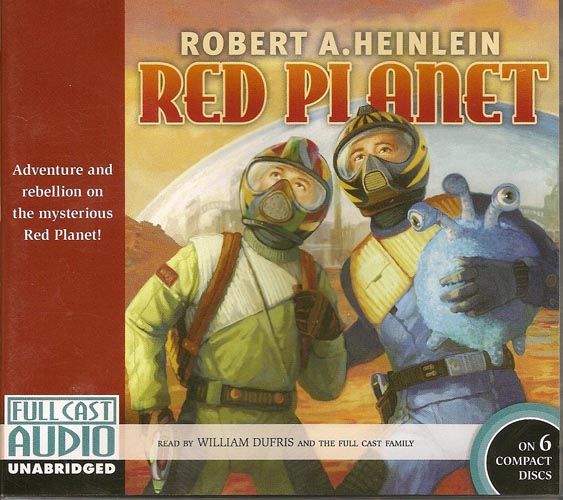
Science Fiction Audiobook - Red Planet by Robert A. HeinleinSFFaudio EssentialRed Planet
By Robert A. Heinlein; Read by a full cast
6 CDs – 7 Hours [UNABRIDGED]
Publisher: Full Cast Audio
Published: 2009
ISBN: 9781934180518
Themes: / Science Fiction / Mars / Politics / Gender /
Sample |MP3|
Jim Marlowe’s Martian pet, Willis, seems like nothing more than an adorable ball of fur with an astonishing ability to mimic the human voice. But when Jim takes the creature to academy and runs afoul of a militantly rigid headmaster, his devotion to his pet launches the young man on a death-defying trek across Mars. Accompanied by his buddy, Frank, Jim must battle the dangers of a hostile planet. But it is not only the boys’ lives that are at stake: They have discovered explosive information about a threat to the survival of the entire colony—information that may mean life or death for their families.

Listening to Heinlein’s stories brought to life is a wonderful experience. One of the things I enjoy most about Heinlein’s quirky novels is that the politics are never fully aligned with any conventional ideology. There are repeated themes, to be sure, but they play out fairly differently in each story. I had read Red Planet at least once before and upon listening to this terrific audiobook version I was actually quite surprised by the relevance to modern politics and social phenomena. First published in 1949, and set on a Mars that is surprisingly believable, it has some very modern protagonists teenagers. Jim Marlowe and Frank Sutton get into some rather exciting adventures. They spend chilly days outside on Mars suited up in mechanical counter-pressure suits, with supercharging helmets that provide a suitable pressurized oxygen from the wispy (but oxygenated) atmosphere of Heinlein’s Mars. These suits, are much lighter than conventional air pressure suits and allow the extreme mobility needed for their skating down the frozen canals of Mars. When not outside fighting off water seekers Jim, Frank, and almost every other colonist on Mars dresses like they live on a tropical beach (they live, go to school, and work in pressurized domes). Virtually no one goes outdoors during the Martian nights (or winters) as they are cold enough to freeze even a stolid martian kid solid. Indeed, part of the excitement of the novel comes when Jim, and Frank find themselves trapped in the Martian desert far from any habitable shelter just as sunset is approaching. Heinlein’s solution is both ingenious and original.

Unlike some previous Heinlein novels produced by Full Cast Audio, Red Planet is not told in first person by the main character. Instead the voice talent of William Dufris is employed to narrate. I’m a big fan of Dufris’ narrative abilities, and he does a terrific job with Red Planet. Jacob Coppola as Jim Marlowe, and Christopher Reiling as Frank Frank Sutton are both vigorous and youthful but also distinct enough to tell apart. The rest of the cast supports the story with an assortment of villainous, larcenous good humor, and stubborn contrariness – in other words nearly the full Heinleinian character spectrum. One other note, the voice of Willis is often performed by whichever actor Willis is imitating and this works just fine! Finally, check out the gorgeous cover art by Jerry Russell, it’s absolutely fantastic!

Posted by Jesse Willis

Review of Podkayne Of Mars by Robert A. Heinlein

SFFaudio Review

[Jesse’s Note: This is a first time review from one of my students. Rose sat down with a tattered old paperback copy of Podkayne Of Mars and a brand new Blackstone Audio CD audiobook of Podkayne Of Mars for a readalong – the result was this terrific review – Thanks Rose!]

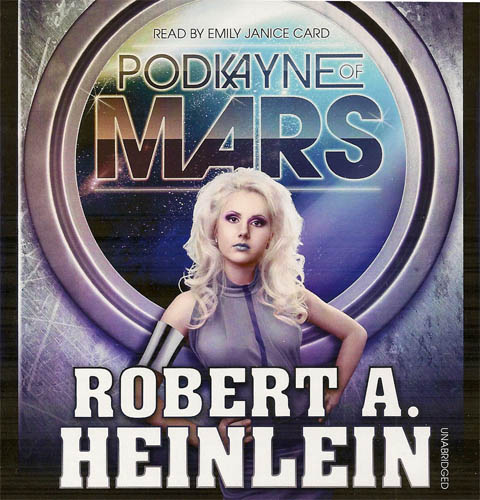
Fantasy Audiobook - Podkayne of Mars by Robert A. HeinleinSFFaudio EssentialPodkayne of Mars
By Robert A. Heinlein; Read by Emily Janice Card
5 CDs – Approx. 6 Hours [UNABRIDGED]
Publisher: Blackstone Audio
Published: 2009
ISBN: 1433251612
Themes: / Science Fiction / Adventure / Reproduction / Politics / Family / Gambling / Venus / Mars /

From the author of Friday and Rocketship Galileo comes this classic tale featuring the grand master of science fiction’s most remarkable heroine. Podkayne Fries, a smart and determined maid of Mars, has just one goal in life: to become the first female starship pilot and rise through the ranks to command deep-space explorations. So when she is offered a chance to join her diplomatic uncle on an interstellar journey to distant Earth via Venus, it’s a dream come true—even if her only experience with diplomacy is handling her brilliant but pesky younger brother, Clark. But she’s about to learn some things about war and peace because Uncle Tom, the ambassador plenipotentiary from Mars to the Three Planets Conference, is traveling not quite incognito enough, and certain parties will stop at nothing to sabotage negotiations between the three worlds….

This is the first Robert A. Heinlein audiobook, or Heinlein book, and my first audiobook that I have ever read. I also hadn’t read any Science Fiction before. This was mostly because I thought Science Fiction was just fiction that was “beyond reality,” so I wasn’t really interested in it. However, after reading and listening to Podkayne Of Mars, I found myself considering reading another. Heinlein’s idea, that to freeze babies and decant them whenever the parents want, is fascinating. Since many women are busy with their work and have no time to take care of their babies, I think this practice and technology may come true in the future. One issue for me was I didn’t really like Clark at first. He acts brusquely, seemed selfish and didn’t seem to care about his family. I was, therefore, impressed by Clark when he decided to become more responsible and caring.

Emily Janice Card, daughter of Orson Scott Card, narrated Podkayne Of Mars. Card narrates the whole 176 page story all as Poddy, except seven pages from the end when Clark, her younger brother, takes over. I think Card’s voicing of Poddy was in-sync with a sentimental, skeptical, and ambitious young teen. It made me feel as if Poddy was reading her own story. However, Card’s voicing of Clark wasn’t as harmonious. Probably, this was because she is female. Compared to 1979 paperback edition, Poddy on this cover doesn’t really look like Poddy. Poddy looks quite cynical. I much prefer the 1979 edition because there Poddy looks more of a sentimentalist.

Posted by Rose [장미]