Review of On the Road with Ellison: Volume One

SFFaudio Author of the Month

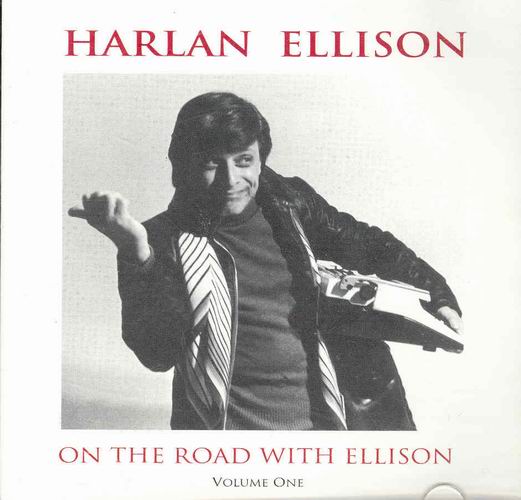
On the Road with Ellison, Vol. 1On The Road With Ellison, Volume 1
Live performance by Harlan Ellison
1 CD – 60 minutes
Publisher: Deep Shag Records
Published: 2001 (reissue from 1983)
UPC: 809879000322
Themes : / Non-fiction / Writing / Politics / Publishing /

On the Road with Ellison, Volume 1 is a collection of live lecture/performances by Harlan Ellison in 1981, 1982, and 1983 in front of three different university corwds. When he talks of mailing a dead gopher to an editor (er… comptroller) he’s hilarious, and when he reads an essay he wrote (“An Edge in My Voice: Installment #54”) he rattles our collective cage, making us look at a man who threatened to blow up the Washington Monument in a whole new way.

From the very first track, where he warns audience members to leave if words offend them, Ellison is abrasive yet totally engaging. Or perhaps he’s totally engaging because he’s so abrasive. Either way, the tracks are thoroughly enjoyable, and the album is worth grabbing.

And yes, there’s a Volume 2, also available from Deep Shag.

Posted by Scott D. Danielson

Review of The Answer by Philip Wylie

SFFaudio Audiobook Review

Science Fiction Audiobook - The Answer by Philip WylieThe Answer
By Philip Wylie; Read by Joel Grey
1 Cassette – Approx. 90 Minutes [UNABRIDGED]
Publisher: Dove Audio
Published: 1996
ISBN: 0787105139
Themes: / / / / / / /

“What egotism, what stupid vanity, to suppose that a thing could not happen because you could not conceive it!”
– Philip Wylie & Edwin Balmer from When Worlds Collide

This audiobook of The Answer (subtitled A Parable For Our Times), was produced by Stefan Rudnicki. You should care because whenever Rudnicki gets involved with a project you’re pretty much guaranteed of two things: 1. A quality story. 2. A quality production. Rudnicki is himself a talented narrator, he’s been involved with some of the best short story collections on audio, won two big fistfuls of Audie awards and even a Grammy. Most impresive of all he was the mastermind behind the SFFaudio essential audiobook edition of Ender’s Game by Orson Scott Card! I was only vaguely familiar with Philip Wylie’s work prior to this novellette, I’d heard his dystopian novel The End Of The Dream and known that he had co-written the novel that became the feature film When Worlds Collide. So I did some research, The Answer was originally published in “The Saturday Evening Post” in 1955, adapted to television the same year and then republished several times in paper-book form since. The story was written in the shadow of the cold war the context for which the unstated question is asked – with that shadow faded the story still has power, but I suspect that it has been somewhat diminished.

Aboard a United States aircraft carrier in the South Pacific a distinguished team of nuclear scientists, politicians, naval and air-force officers await the impending test of an atomic bomb. The test, code named Operation Bugaboo, makes one officer question the very fabric of his belief, or rather his lack thereof. Major General Marcus Scott is an agnostic and skeptic, a veteran of WWII with a long and distinguished career behind him. But after the test is conducted and a single unforseen casualty is reported Scott’s entire worldview is shaken to its foundations. Discovered, as an apparent casualty of the tremendous hydrogen bomb blast is a winged figure, one even his ubelieving eyes can only describe as an angel.

While at first very satisfing on a level of sheer storytelling I noticed upon repeated listening Wylie’s writing scaffolding, the somehat forced structure upon which the story relies for power. For believability’s sake there are really too many coincidences. The scientifically testable circumstances, which are what you are buying when you listening to science fiction – are flushed away into circumstances no easier to swallow than ‘historical’ reports of angels, as the subtitle suggests “a parable for our times?”. Is it really meant to be a parrallel with historical reports of angels? Or is the structure simply in place to give narrative meaning to the story? I don’t know. But no matter how it was made, the story is only going to be offering comforting evidence to a believer, and however well meaning the point of the story, “the answer” of the title is at very best, in my opinion, only a wishful maxim. Flavour me unconvinced while still having been emotionaly involved by the tale.

An added music consists of a pipe organ, woodwind and stringed instruments. These are used to subtly underscore the emotions of the two viewpoints shown. Varied music gives ethereal holiness, timelessness or thoughtful reflection to specific scenes and to underscore others with their absence. Though generally I prefer unaccompanied readings it isn’t overwhelming here. Reader Joel Grey shines, by packing an emotional wallop witout doing much in the way of characterization. He’s able to confer the general mood of frustrated sadness that the story requires given the limited role the characters have. This audiobook is now out of print but you can still get it through Audible.com.

Posted by Jesse Willis

Review of Saturn’s Race by Larry Niven and Steve Barnes

SFFaudio Audiobook Review

Science Fiction Audiobook - Saturn's Game by Larry Niven and Steve BarnesSaturn’s Race
By Larry Niven and Steve Barnes; Read by Scott Brick
10 Cassettes or 12 CDs – 13 Hours 54 Minutes [UNABRIDGED]
Publisher: Books On Tape, Inc.
Published: 2000
ISBN: 0736659374 (cassette), 0736671366 (cd)
Themes: / Science Fiction / Artifical Intelligence / Consciousness Uploading / Cyborgs / Politics / Population Control / Life Extension /

Chaz Koto is a citizen of Xanadu, a near future perfect society hosting the wealthiest men and women on Earth. Along with his fellow citizens, he bears the burden of a dark secret that the outside world would be shocked to hear. Lenore Myles is a student who travels to Xanadu and becomes involved with Koto. When Koto unwittingly lends her his access codes, Lenore stumbles upon the grisly truth behind Xanadu’s glittering facade.

The title is deceptive. The planet Saturn plays no role in the plot and nobody in the book is racing anywhere. This is an earth-bound adventure set in the near future. I figured out what the title meant near the end of the book, but the rest of the novel was relatively predictable. For instance, there is a revelation that happens within the first couple of chapters but it was so broadly telegraphed in the first scene the involved character shows up in that I was bored by the revelation rather than surprised by it. Ultimately Saturn’s Race is one of those novels that just fails to gel. There’s a plot, plenty of interesting ideas and a resolution, but frankly the plot is mediocre, the ideas relatively minor, and the resolution comes through only on the most basic level.

For me, the most memorable concept used in Saturn’s Race is that of “metaphors.” Basically Niven and Barnes illustrate that metaphors, like computer languages or a computer graphic interface, are used as handy tools to leverage work. It’s why poetry can say so much with so few words – the words are densely packed, brimming with meaning. It is also why a little pointer dragging a few color pixels across a screen can unmake or move a file in ways far quciker and easier than by command line interface. In other words computer programs are really elaborate metaphors for the manipulation of data. This is brought to life in the novel when a character runs an artifical intelligence program that simulates Rex Stout’s corpulent detective Nero Wolfe. It’s a neat idea. But ultimately the novel didn’t move me as I had hoped it might. Overall, this is passable faire, but I doubt I’d need to listen to it again anytime soon.

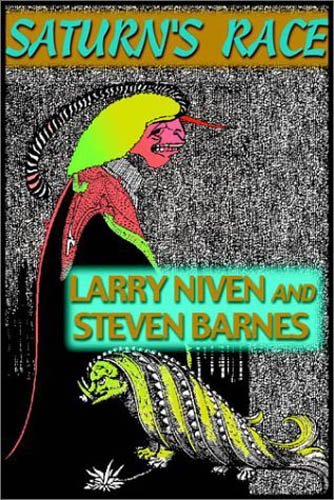
The cover art for Saturn’s Race is almost incomprehensible. Is that a seahorse on there? I can’t tell. The paperback version has a painting of two genetically-modified sharks on the cover. That would have been more apropos. Reading the book is the ubiquitous Scott Brick. Scott does his very best to bring energy to the lackadaisical pace. For the most part it works, since the novel doesn’t bore in the listening, though I’m sure I’d have stopped reading were I experiencing the paper edition. Saturn’s Race is still available to be purchased from the Books On Tape website. But who knows how long that will be for? BOT was forced to dump a good chunk of its older science fiction titles when it got purchased by the aptly titled Random House a couple years ago and this fact has made many of its excellent unabridged titles quite valuable on the secondary market. The same loss may happen again soon to the remaining BOT library. I don’t think out of print copies of Saturn’s Race will be selling for thousands any time soon, but if you think you ever might want a copy acting sooner rather than later may save you some money.

Posted by Jesse Willis

Review of The Gripping Hand by Larry Niven and Jerry Pournelle

SFFaudio Radio Drama Review

Science Fiction Audio Book - The Gripping Hand by Larry Niven and Jerry PournelleThe Gripping Hand
By Larry Niven and Jerry Pournelle; Read by Jay O. Sanders
2 Cassettes – Approx. 3 Hours [ABRIDGED]
Publisher: Simon & Schuster Audio
Published: 1993
ISBN: 0671791109
Themes: / Science Fiction / Hard SF / Biology / Politics / Economics /Galactic Civilization / Galactic Empire / Mormonism /

Twenty-five years have passed since the second Empire of man quarantined the mysterious aliens known only as Moties within the confines of their own solar system – afraid of the threat these aliens may pose to man kind. But the wall seperating man from the Moties is beginning to crumble…

The Gripping Hand is set in a the “CoDominium” universe originated by Jerry Pournelle. This is the sequel to their first novel together, The Mote In God’s Eye (not available on audio). The setting is that of a future interstellar empire in which humanity has only one major rival for complete dominance. The so-called “Moties” are an intelligent species that is so war-like, so very dangerous, that an enitre human naval task force sits blockading the Motie system’s only exit. The Moties are a species divided into distinct biological forms, each serving a different function. Master. Mediator. Engineer. Warrior. Each type is supremely adapted to its task, and only constant civil war has kept their population in check. Combined with the specialization is a terrible burden; if Moties don’t breed they die agonzing deaths.

For those who haven’t already read The Mote In God’s Eye, you may want to stop reading now as spoilers must follow. At the end of The Mote In God’s Eye, Sir Kevin Renner and His Excellency Horace Bury were secretly enlisted into Imperial Naval Intelligence. For the twenty-five years since then, they’ve acted as unpaid spies, keeping a watchful eye for “outies” (human raiders) in order that the empire might focus its meager resources on the overwhelming Motie threat. Bury is a merchant prince whose dealings allow him access to the underworld of many border worlds. Renner, a former naval officer, now acts as a field agent in the employ of Bury. When a botched Mormon kidnapping plot appears to involve a Motie phrase “the gripping hand”, Bury demands to inspect the fleet blockading the Motie system. His journey leads him to several surprises.

There’s a bit of bad news about this audiobook. If the abridgement had been longer there would still be some question as to whether or not we’d know what is going on in this book. I’ve listened about three times now and I’m pretty impressed at how much sense I’ve managed to make of it in spite of what little of the novel is there. It almost works. It has the barest framework of the plot left, lots of interesting characters, some very good dialogue, and a few simply brilliant SF ideas – but the final feeling I was left with at the end is great disappointment. We would really could have had a special audiobook here, if Simon & Schuster hadn’t knocked out so much in their drive to release 2-cassette abridgments as they did back in the early 1990s. This all is especially upseting because narrator Jay O. Sanders does a fantastic job with the accents and character voices. I think it is safe to say that the fad of abridging the snot out of every novel that comes down the pipe is over. That’s a good thing. It came to late for this audiobook. Some publisher out there should get a hold of The Mote In God’s Eye and record it, complete and unabridged, and while they’re at it they should get Jay O. Sanders to do the reading. We know he’ll do a good job.

Posted by Jesse Willis

SF has an influence in the real world. Need proo…

Online Audio

SF has an influence in the real world. Need proof? Big Brother isn’t just an idea in an George Orwell novel. Political Science Ficion is good stuff and finally there’s someone out there proving it…

Good old Doc Brown (Professor Courtney Brown Ph.D) of Emory University in Georgia (USA) is offering a Political Science course entitled Science Fiction and Politics (Political Science 190) and he’s making the lectures available as a podcast. The spring 2006 semester has already started, but don’t worry there’s no cost to audit. SFFaudio gives it an A+!

Lectures already available include:

Class #01: Introduction and Overview |MP3|
Class #02: Foundation by Isaac Asimov (1 of 2) |MP3|
Class #03: Foundation by Isaac Asimov (2 of 2) |MP3|
Class #04: Foundation And Empire by Isaac Asimov |MP3|
Class #05: Second Foundation by Isaac Asimov |MP3|
Class #06: Brave New World by Aldous Huxley (1 of 2) |MP3|
Class #07: Brave New World by Aldous Huxley (2 of 2) |MP3|
Class #08: The Left Hand Of Darkness by Ursula K. Le Guin (1 of 2) |MP3|
Class #09: The Left Hand Of Darkness by Ursula K. Le Guin (2 of 2) |MP3|
Class #10: The Uplift War by David Brin (1 of 2) |MP3|
Class #11: The Uplift War by David Brin (2 of 2) |MP3|
Class #12: Darwin’s Radio by Greg Bear (1 of 2) |MP3|
Class #13: Darwin’s Radio by Greg Bear (2 of 2) |MP3|
Class #14: How to write your essays |MP3|
Class #15: Ender’s Game by Orson Scott Card (1 of 2) |MP3|
Class #16: Ender’s Game by Orson Scott Card (1 of 2) |MP3|
Class #17: The Forever War by Joe Haldeman (1 of ?)|MP3|
Class #18: ??? |Forthcoming|
Class #19: ??? |Forthcoming|
Class #20: ??? |Forthcoming|
Class #21: ??? |Forthcoming|

Forthcoming lectures will cover Neuromancer, Do Androids Dream of Electric Sheep? and The Moon Is A Harsh Mistress.

Were I attending the classes in person I’d have banged my shoe on the desk and insist we talk about a Mack Reynolds novel. Maybe later in the course?

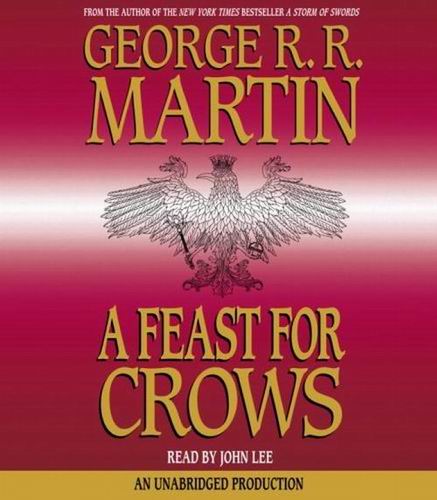
Review of A Feast for Crows by George R.R. Martin

Fantasy Audiobook Review

Fantasy Audiobook - A Feast for Crows by George R.R. MartinA Feast for Crows
By George R.R. Martin; Read by John Lee
26 CDs – Approx. 31 Hours [UNABRIDGED]
Publisher: Random House Audio
Published: 2005
ISBN: 0739308742
Themes: / Fantasy / Epic Fantasy / Medieval setting / Power Struggle / Dragons /

There’s a long story behind A Feast for Crows, but I’ll make it short. George R.R. Martin, while writing the fourth installment of the superior A Song of Ice and Fire epic fantasy series, found it was getting too long. Long enough, in fact, that if he published it as-was, it would need to be broken up into two volumes. So, rather than break the book into two pieces at the middle, he split the book by character, including the complete story of select characters in one volume, leaving the rest of the characters to appear in the next volume. A Feast for Crows, then, is the fourth book, and a new fifth book (A Dance with Dragons) will be published relatively soon. This novel is a bit shorter than the previous volumes, but still clocks in at 31 hours on unabridged audio.

Roy Dotrice read the first three volumes in the series, but this time British actor John Lee narrated. I’m not sure why the change was made; the narrators were very different. While Dotrice has a rough, earthy delivery, Lee’s style is smooth and skilled. Both narrators succeed with Martin’s story, because with such a large number of characters, ranging from royalty to peasants, each found places to shine.

The myriad of characters brings me to my next point. This is the first of these large novels that I’ve heard before I read. Some listeners have complained that the novels are difficult to follow on audio because there are so many entrances, but I didn’t feel that way until now. With this novel, I found that the portions of the book that involved characters I didn’t know from previous books were indeed difficult to follow. When a character I knew arrived on the scene, I was fully engaged with the story.

There is a very simple remedy to this. There are acres of real estate on the packaging for large audiobooks. Why not include a Cast of Characters (Dramatis Personae)? Why not include the maps from the print version? Both of these items would have been welcome.

I thoroughly enjoyed this book. I am a huge fan of Martin’s, and especially this series. I felt that this one started a bit slowly, but ended with a bang. I reveled in being in Westeros again. Many of the characters I like were not included in this novel, which both disappointed me and heightened my anticipation for the next volume. A Feast for Crows delivers much – I was riveted to the last third of this audiobook – but I can’t help to feel that it is incomplete, because of the missing characters and because it is the middle of a long wonderful saga that I am patiently waiting to see through.

Posted by Scott D. Danielson