News, Reviews, and Commentary on all forms of science fiction, fantasy, and horror audio. Audiobooks, audio drama, podcasts; we discuss all of it here. Mystery, crime, and noir audio are also fair game.
Talked about on today’s show:
the classic Tarzan yodel, the dum-dum service, Tarzana, California, those beautiful Burroughsian run-on sentences:
“From this primitive function has arisen, unquestionably, all the forms and ceremonials of modern church and state, for through all the countless ages, back beyond the last uttermost ramparts of a dawning humanity our fierce, hairy forebears danced out the rites of the Dum-Dum to the sound of their earthen drums, beneath the bright light of a tropical moon in the depth of a mighty jungle which stands unchanged today as it stood on that long forgotten night in the dim, unthinkable vistas of the long dead past when our first shaggy ancestor swung from a swaying bough and dropped lightly upon the soft turf of the first meeting place.”
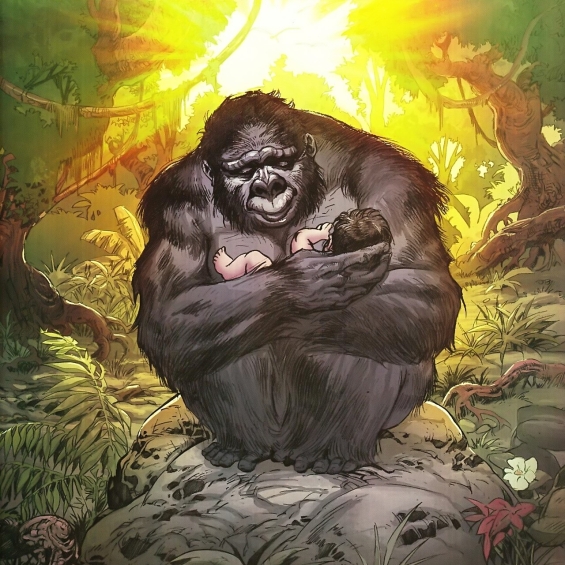
A Connecticut Yankee In King Arthur’s Court by Mark Twain (and SFBRP #151), Edgar Allan Poe should be read aloud, The Return Of Tarzan, racism, Esmeralda, Gone With The Wind, minstrel shows, Chicago, Arizona, the mammy archetype, radio drama racism, Jar Jar Binks, Star Wars: Episode III, October 1912, historical dialect, Jane (the white lady), “you just shot a woman in the head”, cannibalism, Conan Tarzan lynches his mother’s killer, rope tricks, out of context vs. in context, Tarzan as a god, Ballantine Books, the dum-dum scholars, Project Gutenberg edition, ERB Incorporated, Tarzan The Censored by Jerry L. Schneider, Tarzan Of The Apes censorship and “improvements” since the original publication, “an English grammar Nazi”, The Heathen by Jack London, taking out or changing a few words can hurt the story, Earnest Hemingway and William Shakespeare are “too wordy”, Tab Cola, Tarzan’s relationship with the cannibal villagers, “mankind and civilization aren’t”, colonialism, the Belgian Congo, King Leopold II, contemplating cannibalism, “the white god of the woods”, Greystoke: The Legend of Tarzan, Lord of the Apes (1984), Wisconsin, Tarzan’s ape father is driven away by Kerchak (and turned into a museum exhibit), “the Evil village of Scotland”, the sadness that comes with the deaths is powerful, Paul D’Arno, Obi Wan Kenobi, “Tarzan was the blockbuster hit of the twentieth century”, A Princess Of Mars, Ruritania, The Mad King, “complete in one issue”, All-Story, the scanty Science Fiction elements, feral children, Romulus and Remus, Mowgli, Tarzan is a wild child, “this line from a book”, all of Burroughs characters are excellent language learners, when Tarzan writes a note, Lord Of The Jungle (Dynamite Entertainment), the mistaken dual identity, “Jane has massive bosoms”, Green Mansions (starring Rima, The Jungle Girl), Johnny Weissmuller, “the Sheena of South America”, Audrey Hepburn and Anthony Perkins, Psycho, significantly more significant, the primary driver of fiction of this period is character, Nancy Drew, book serials, Rudyard Kipling dissed Burroughs’ writing and grammar, White Fang is kind of like Tarzan Of The Apes, first person vs. third person, you can’t admire the character from afar if the story is told first person, Sherlock Holmes, “that turn towards character is a turn towards the third person omniscient POV”, “that heroic distance” (1910-1950), Raymond Chandler, “I read Chandler”, Tarzan is the only Burroughs series that doesn’t turn to first person narration, John Carter’s character, why is Tarzan such a big character, Tarzan Alive: A Definitive Biography Of Lord Greystoke by Philip José Farmer, Tarzan as a quiet sophisticate, Doc Savage, The Green Odyssey by Philip José Farmer, Farmer is a fan of character, a stranger in a strange land, what ruined Julie for religion, The Mastermind Of Mars (is PUBLIC DOMAIN), “Tur is Tur.”, copyright, copyfight, jungle Tarzan vs. cafe absinthe drinking Tarzan, “the machine”, the Weissmuller Tarzan, where does he get his razor?, “that knife was his father”, “next book please”, Tarzan And His Mate , “lots of wet people”, “skin friendly”, melon-farmer vs. motherfucker, Boy and Cheeta are Hollywood, Scrappy-do, what did Tantor have to say?, Sabor the lioness, “there are no tigers in Africa, Ed”, Crocodile Dundee, Beyond Thirty, The Mucker, yellow peril looking dudes, The Girl From Hollywood, The Man Eater, early road trips, The Land That Time Forgot, The Lost World, the Caspak series, WWI, “sheer headlong adventure”, The Asylum, closing words, “it’s not what you think”, “really really good fun”, baby ape skeleton in the cradle, a classic of writing, a touching story, “and vengeance is his”, serialization in newspapers, cliffhangers, Charles Dickens, Wilkie Collins,
Here’s a terrifically interesting story of romantic adventure, and love, between two very heterosexual men.
Did I mention they are heterosexual?
Well they are.
They have wives!
That’s all there is to it.
The Heathen interweaves Jack London’s racist ideas with his experiences as a sailor to make a truly he-manish tale of two macho sailors who form an unbreakable seventeen-year bond after being shipwrecked in the South Pacific. This is manly beefcake Jack London from 1910, working the blood and breed obsessed vein of fiction and friendship that Robert E. Howard did so masterfully in stories like Queen Of The Black Coast and Hills Of The Dead.
Unfortunately, the version that my good friend Gregg Margarite read for LibriVox, a couple years back, was abridged (or perhaps sanitized) – the PDF version below includes a couple of extra lines here, there, and at the end. Important lines. It also includes more swearing.
Damn those abridgers and sanitizers.
Gregg is dead.
I’m confident he’d have wanted to have read the unsanitized and unabridged original had it been available.
The Heathen
By Jack London; Read by Gregg Margarite
1 |MP3| – Approx. 46 Minutes [UNABRIDGED]
Publisher: LibriVox.org
Published: December 3, 2009
First published in Everybody’s Magazine, August 1910.
Here’s a beautiful |PDF| made from a scan of the magazine.
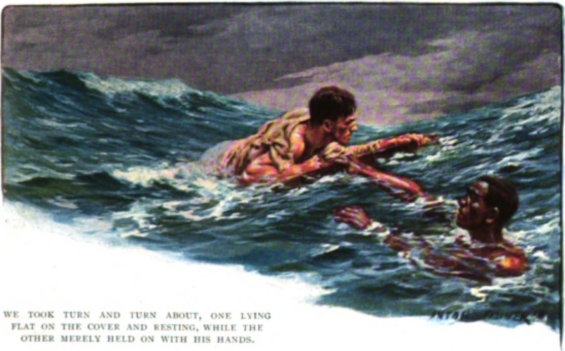
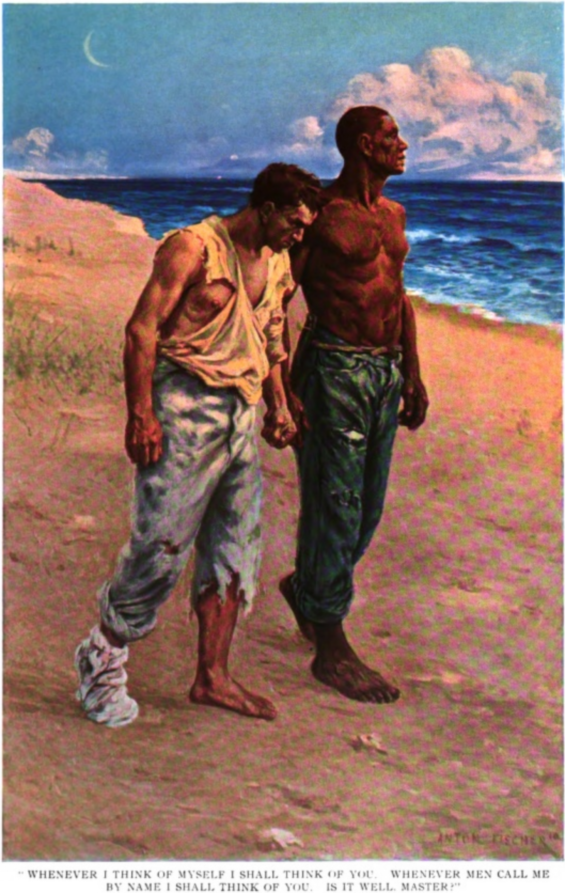
Here are the rest of the terrific illustrations by Anton Fischer:
“In a remarkable short story, ‘The Grove of Ashtaroth,’ the hero finds himself obliged to destroy the gorgeous little temple of a sensual cult, because he believes that by doing so he will salvage the health and sanity of a friend. But he simultaneously believes himself to be committing an unpardonable act of desecration, and the eerie voice that beseeches him to stay his hand is unmistakably feminine.”
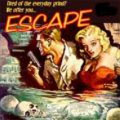
The Grove Of Ashtaroth was written by the fifteenth Governor General of Canada, John Buchan. Despite that high position, he was the viceregal representative of the Canadian monarch for five years in the 1930s, Buchan is probably better known today as the author of The Thirty-Nine Steps. Buchan’s novelette has been described as a “weird story” (by the makers of Escape) or as “high fantasy” (in The Fantastic Imagination) by editors Robert H. Boyer and Kenneth J. Zahorski, a 1977 anthology).
I’m not sure exactly what it is, except very interesting and certainly within the vague borders of the Fantasy genre. The Grove Of Ashtaroth reminds me of a short story by Philip K. Dick, Of Withered Apples.
You can judge for yourself what you think it is most like.
There’s a hurried, but unabridged, reading available |MP3|. It’s read by Libby Hill for the TV On The Internet podcast (beginning shortly after the twenty minute mark).
But your best bet, in audio, for the moment at least, is to listen to the 1948 Escape radio dramatization!
Escape – The Grove Of Ashtaroth
Adapted from the novelette by John Buchan; Adapted by Les Crutchfield; Performed by a full cast
1 |MP3| – Approx. 31 Minutes [RADIO DRAMA]
Broadcaster: CBS
Broadcast: February 29, 1948
Provider: Archive.org
Cast:
Paul Frees as John Buchan
William Conrad as Lawson
And if you were wondering, the only major difference between the original story and the dramatization is that the unnamed narrator is named (after Buchan himself) in the dramatization.
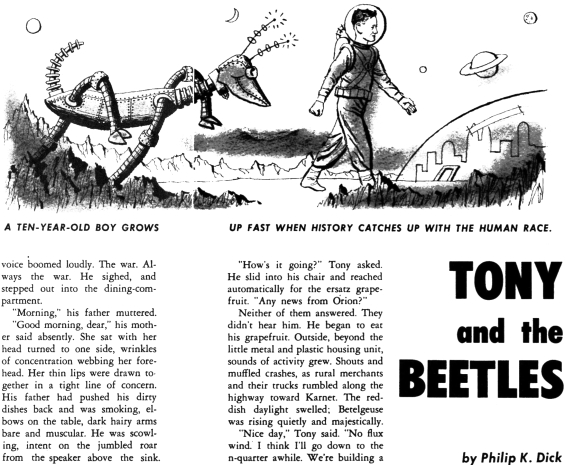
This 4,712 word story may not be among Philip K. Dick’s best, but it is certainly worth looking at, and hearing!
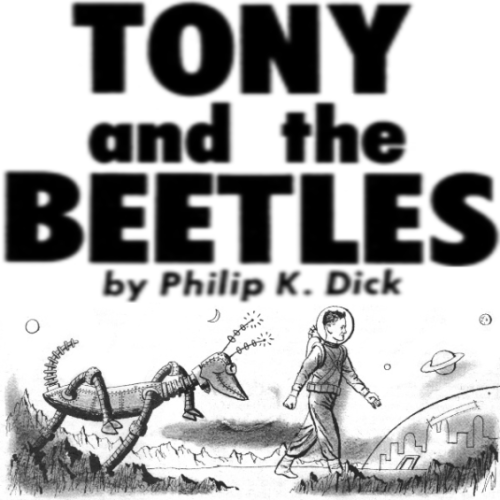
Tony And The Beetles is a bit unusual too, having an almost juvenile or YA feel to it. Maybe that’s because it’s not nearly as horrific as many of Dick’s fantasy tales – there are some frightening elements, but the general tone is that of an ungroundedness. I see Tony And The Beetles as a kind of historical allegory and I’m not the only one. Phil Chevernet, the narrator who recorded it for LibriVox, wrote “I think [Dick] was commenting on imperialism in the 40s and 50s.” I think he’s right, but I think the comment is somewhat ambiguous, rather depressing, and almost wholly unhopeful. Dick grew up during World War II and little PKD was a very sensitive fellow, kind of like Tony.
Here’s the setup:
Young Tony Rossi has grown up on an alien world. As a child he’s known little else than bubble helmets, pressure suits, and robot pets. His playmates and schoolmates have all been the non-human children of the planet, but around him swirl the forces of history and when news of the ongoing war breaks Tony’s parents don’t seem to hold the same opinions of what it all means.
Tony And The Beetles
By Philip K. Dick; Read by Phil Chevernet
1 |MP3| – Approx. 34 Minutes [UNABRIDGED]
Publisher: LibriVox.org
Published: October 16, 2012 A ten-year-old boy grows up fast when history catches up with the human race. First published in Orbit, volume 1 number 2, 1953.
And here’s a |PDF| made from it’s original publication in Orbit.
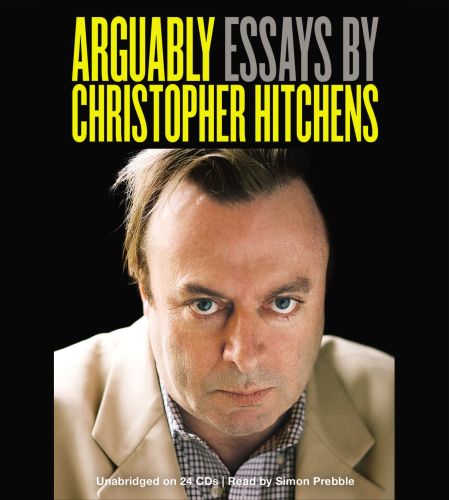
Arguably: Essays
By Christopher Hitchens; Read by Simon Prebble
24 CDs – Approx. 28.5 Hours [UNABRIDGED]
Publisher: Hachette Audio
Published: September 1, 2011
ISBN: 9781611139068
Themes: / Non-fiction / History / War / Biography / Science Fiction / Fantasy / Iran / Afghanistan / Germany / North Korea / France / Dystopia / Utopia / Religion / Tunisia / Piracy / Terrorism / Feminism / Pakistan /
The first new collection of essays by Christopher Hitchens since 2004, Arguably offers an indispensable key to understanding the passionate and skeptical spirit of one of our most dazzling writers, widely admired for the clarity of his style, a result of his disciplined and candid thinking. Topics range from ruminations on why Charles Dickens was among the best of writers and the worst of men to the haunting science fiction of J.G. Ballard; from the enduring legacies of Thomas Jefferson and George Orwell to the persistent agonies of anti-Semitism and jihad. Hitchens even looks at the recent financial crisis and argues for arthe enduring relevance of Karl Marx. The audio book forms a bridge between the two parallel enterprises of culture and politics. It reveals how politics justifies itself by culture, and how the latter prompts the former. In this fashion, Arguably burnishes Christopher Hitchens’ credentials as-to quote Christopher Buckley-our “greatest living essayist in the English language.”
Here’s a question I was thinking about while listening to Arguably.
What is fiction for?
One answer, the bad one, is that it’s for entertainment. That’s certainly where many readers are willing go, and the fiction writers who write it too. Maybe that’s precisely why so much fiction is just so very shitty.
To me, if you aren’t exploring ideas in your fiction, then you really aren’t serving a greater purpose. Idea fiction, fiction with ideas rather than just action and plot, is to my mind a kind of supplement to the wisdom found in writings on history, biography and science.
Of the many lessons learned I in listening to the 107 essays in Arguably I was particularly struck by the wisdom Christopher Hitchens gleaned from his reading of fiction. Hitchens reviews many books in this collection, nearly half of the essays are book reviews. Books like 1984, Animal Farm, Flashman, The Complete Stories Of J.G. Ballard, Our Man In Havana, and even, surprisingly, Harry Potter And The Deathly Hallows all get fascinating, critical, and reverent reviews.
Yet Hitchens also takes the lessons with him into his writing about his travels. Hitchens writes about visits to such places as North Korea, Cyprus, Afghanistan, and Kurdish Iraq. When talking about his visit to Beirut we see what comes when Hitchens, a man of ideas, acts upon them. The essay, The Swastika and the Cedar sees the convictions of the commited anti-fascist Hitchens beaten and nearly kidnapped for an act of vandalism on a prominently displayed swastika. Writes Hitchens:
“Well, call me old-fashioned if you will, but I have always taken the view that swastika symbols exist for one purpose only—to be defaced.”
In a review of two books, Lolita and The Annotated Lolita, Hitchens applies the controversial subject in a real life look at the modern, and very non-fictional oppression and objectification of women. Indeed, the ideas he appreciated in fiction helped Hitchens to come to grips with the real world.
I think the worst essay in this collection is the one on the serving of wine and restaurants, Wine Drinkers Of The World, Unite. It was simply a waste of the talent, too light, too easy a target. And yet, even that essay, the worst essay in all 107 has a memorable anecdote: “Why,” asks Hitchens’ five year old son, “are they called waiters? It’s we who are doing all the waiting.”
As to the narration of the audiobook. I’m ashamed to admit that I was initially dismayed when I saw that Christopher Hitchens had not narrated this audiobook himself. I was wrong to worry. Incredibly, Simon Prebble seems to have have become Hitchens for this narration. Prebble perfectly captures the erudite words, so eloquently performs them, and with an accent so like that of Hitchens’ own so as to make me think that it was Hitchens who had actually read it.
I think the worst essay in this collection is the one on the serving of wine and restaurants, Wine Drinkers Of The World, Unite. It was simply a waste of the talent, too light, too easy a target. And yet, even that essay, the worst essay in all 107 has a memorable anecdote: “Why,” asks Hitchens’ five year old son, “are they called waiters? It’s we who are doing all the waiting.”
Here’s a list of the book’s contents, with links to the original etexts when available, along with my own notes on each:
The Private Jefferson – a review of Jefferson’s Secrets: Death And Desire At Monticello by Andrew Burstein
Jefferson Vs. The Muslim Pirates – a review of Power, Faith, And Fantasy: America In The Middle East: 1776 To The Present by Michael B. Oren
Benjamin Franklin: Free And Easy – a review of Benjamin Franklin Unmasked: On the Unity of His Moral, Religious, And Political Thought by Jerry Weinberger
John Brown: The Man Who Ended Slavery – a review of John Brown, Abolitionist: The Man Who Killed Slavery, Sparked The Civil War, And Seeded Civil Rights by David S. Reynolds
Abraham Lincoln: Misery’s Child (aka Lincoln’s Emancipation) – a review of Abraham Lincoln: A Life by Michael Burlingame
JFK: In Sickness And By Stealth – a review of An Unfinished Life: John F. Kennedy, 1917–1963 by Robert Dallek
Saul Bellow: The Great Assimilator – review of six novels by Saul Bellow (The Dangling Man, The Victim, The Adventures Of Augie March, Seize The Day, Henderson The Rain King, and Herzog)
Vladimir Nabokov: Hurricane Lolita – reviews of Lolita by Vladimir Nabokov and The Annotated Lolita edited and annotated by Alfred Appel, Jr.
John Updike: No Way – a review of The Terrorist by John Updike (with reference to The Coup too) John Updike: Mr. Geniality – a critical review of the affable Due Considerations: Essays And Considerations by John Updike
Vidal Loco – Gore Vidal went crazier, more elitist and perhaps more racist as he got older (with attention and quips for Quentin Crisp and Oscar Wilde and Joyce Carol Oates)
America The Banana Republic – Hitchens on the “socialistic” bank bailout of 2008 (“socialism for the rich and free enterprise for the rest”)
An Anglosphere Future – a review of The History Of The English Speaking Peoples by Andrew Roberts (with reference to both Sherlock Holmes and The White Company by Sir Arthur Conan Doyle as well as to Cecil Rhodes and Rudyard Kipling)
Political Animals – a review of Dominion: The Power Of Man, The Suffering Of Animals, And The Call To Mercy by Matthew Scully
Old Enough To Die – on capital punishment as applied to children In Defense Of Foxhole Atheists – a visit to the United States Air Force Academy and the tax funded proselytizing
ECLECTIC AFFINITIES Isaac Newton: Flaws Of Gravity – a stroll through the medieval streets of Cambridge with the scientists, mathematicians, and philosophers who worked there
Gustave Flaubert: I’m With Stupide – a review of Bouvard et Pécuchet by Gustave Flaubert translated by Mark Polizzotti The Dark Side Of Dickens – a review of Charles Dickens by Michael Slater a biography (Hitchens was a not uncritical admirer of the subject)
Marx’s Journalism: The Grub Street Years – a glowing review of Dispatches for the New York Tribune: Selected Journalism Of Karl Marx edited by James Ledbetter, foreword by Francis Wheen (Marx admired the United States, and other fascinating facts about the father of communism)
Rebecca West: Things Worth Fighting For – an introduction to Black Lamb and Grey Falcon: A Journey Through Yugoslavia by Rebecca West
Ezra Pound: A Revolutionary Simpleton – a review of Ezra Pound, Poet: A Portrait Of The Man And His Work: Volume I: The Young Genius, 1885-1920 by A. David Moody (a biography of the fascist poet)
John Buchan: Spy Thriller’s Father – a review of John Buchan The Presbyterian Cavalier by David R. Godine (with discussion of The 39 Steps and a fantasy novelette The Grove Of Ashtaroth)
Fraser’s Flashman: Scoundrel Time – a look at the George MacDonald Fraser series of Flashman books and the connection with The Adventure Of The Empty House
AMUSEMENTS, ANNOYANCES, AND DISAPPOINTMENTS Why Women Aren’t Funny – a controversial essay on why more comedians are male and why women laugh at them the way they do
As American As Apple Pie – a literary and chronological history of the blowjob, with reference to Valdamir Nobokov’s Lolita
So Many Men’s Rooms, So Little Time – a fascinatingly insightful argument on what’s was going on with the Larry Craig bathroom airport scandal and related phenomena
A War Worth Fighting – a persuasively systematic review of Churchill, Hitler And The Unnecessary War: How Britain Lost Its Empire And The West Lost The World by Pat Buchanan
Just Give Peace A Chance? – a critical review of Human Smoke by Nicholson Baker
Don’t Mince Words – the disenfranchisement of south Asians in Britain isn’t the cause of bombings, hatred of women is.
History And Mystery – al-Qaeda in Iraq, jihadists, or “insurgents”? Do words matter? Of course they bloody well do.
Words Matter – political slogans make of “every adult in the country” an “illiterate jerk who would rather feel than think”
This Was Not Looting – how can a government “loot” it’s own weapons manufacturing facility? The government of Iraq managed it according to The New York Times.
The “Other” L-Word – a lighthearted piece on the prominence of the word “like” and it’s use
The You Decade – what’s wrong with you (marketing to the selfish)
Suck It Up – the Virginia Tech shootings prompted the wrong response from the world (namely that it prompted one)
A Very, Very Dirty Word – the English empire, in centuries to come, may only be remembered for soccer and the phrase “fuck off”
I bet most folks think that the closest Robert A. Heinlein came to tackling the topic of religion was Stranger In A Strange Land. But I think that novel has got too much other stuff going on in it. To get a better idea, check out his terrific 1941 short story Universe (later combined with another short story for the fix-up novel entitled Orphans Of The Sky).
The people of Universe live under an oppressive theocracy, with the death penalty given for heretical ideas. In the script for the radio dramatizations one character describes it as a society of “regimented slaves.”
Universe offers many, many sparky ideas – all of which are centered around religion and cosmology.
When asked about heaven the main character says this:
“The peasants believe [in] it literally but many of the younger scientists, like myself, know that it is figurative, symbolic.”
Turns that he’s wrong, that the foundations of his religion are based in a real history, that his god was once alive, and that the belief he scoffs at (and others kill in the name of), are based facts about their universe. It’s absolutely thought provoking soft sf bounded by a hard SF that only someone like Robert A. Heinlein could pull off.
And, unlike the original short story, which is rather hopeful, the end of the radio dramatization is deeply noir.
Dimension X – Universe
Adapted by George Lefferts; Adapted from the story by Robert A. Heinlein; Performed by a full cast
1 |MP3| – Approx. 30 Minutes [RADIO DRAMA]
Broadcaster: NBC
Broadcast: November 26, 1950
Provider: Archive.org
X-Minus One – Universe
Adapted by George Lefferts; Adapted from the story by Robert A. Heinlein; Performed by a full cast
1 |MP3| – Approx. 28 Minutes [RADIO DRAMA]
Broadcaster: NBC
Broadcast: May 15, 1955
Provider: Archive.org
Illustrations of strong>Universe by Hubert Rogers and Charles Schneeman from the May 1941 of Astounding:


 The SFFaudio Podcast #187 – Jesse, Tamahome, Julie Hoverson, Luke Burrage, and David Stifel talk about the audiobook and podcast of Tarzan Of The Apes by Edgar Rice Burroughs.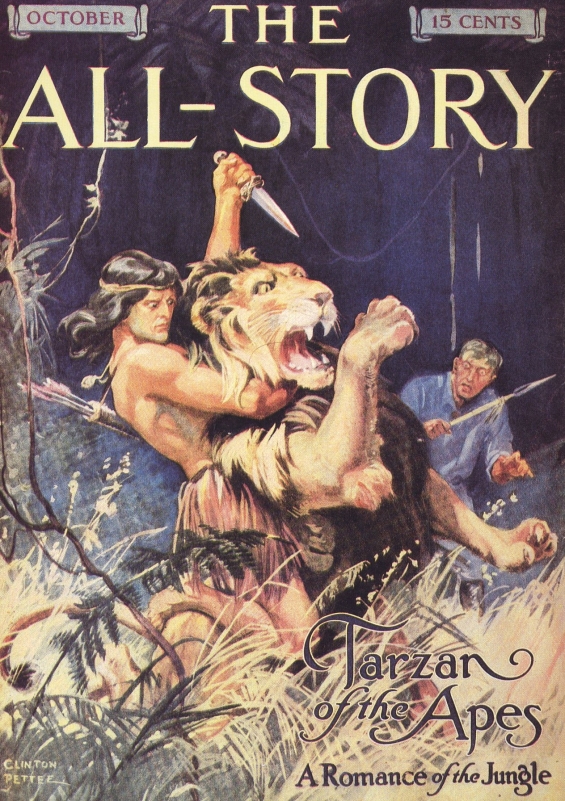




 The Heathen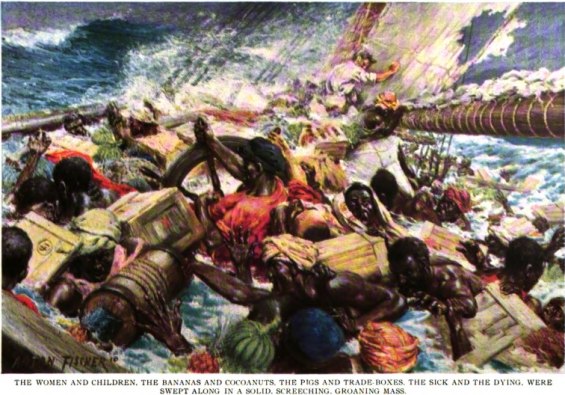

 Arguably: Essays
 Dimension X – Universe
 X-Minus One – Universe


