LibriVox: The Watcher by R.H. Benson

SFFaudio Online Audio

E.F. Benson, A.C. Benson, and R.H. Benson were three brothers, all writers. They wrote weird fiction, Science Fiction and ghost stories.

R.H. Benson, the youngest of the three, started off as a clergyman in the Church of England, but later switched to the Roman Catholic Church and became an assistant to the Pope. An interesting choice since his biological father had been the Archbishop of Canterbury.

This short story of his, The Watcher, is somewhat difficult to classify. Reading it, it sounds like it could almost have been a true story – but it’s from a collection of fifteen stories depicting a fictional priest’s supernatural experiences.

I think it’s an allegory.

But the question is … an allegory for what?

Find out for yourself with Peter Yearsley’s fun reading of it…

LibriVoxThe Watcher
By R.H. Benson; Read by Peter Yearsley
1 |MP3| – Approx. 12 Minutes [UNABRIDGED]
Publisher: LibriVox.org
Published: January 7, 2007
A face in a bush takes delight in the death of a thrush. First published in 1903.

And here’s a |PDF|.

Posted by Jesse Willis

LibriVox: My Favorite Murder by Ambrose Bierce

Aural Noir: Online Audio

My Favorite Murder by Ambrose Bierce

There are two readings of My Favorite Murder, by Ambrose Bierce, on LibriVox. Bill Mosley’s reading has a more appropriate accent, but Peter Yearsley’s is funnier, perhaps because of his English accent. The high minded language of the protagonist, combined with the frightening descriptions, makes Yearsley’s version more essentially hilarious.

If you’re familiar with Jack London’s Moon-Face, and liked that story, I think you’ll like this one too.

LibriVoxMy Favorite Murder
By Ambrose Bierce; Read by Bill Mosley
1 |MP3| – Approx. 25 Minutes [UNABRIDGED]
Publisher: LibriVox.org
Published: June 3, 2010
First published in the San Francisco Examiner, September 16, 1888.

LibriVoxThe Parenticide Club – My Favorite Murder
By Ambrose Bierce; Read by Peter Yearsley
1 |MP3| – Approx. 49 Minutes [UNABRIDGED]
Publisher: LibriVox.org
Published: December 29, 2005

And here’s a printable |PDF|.

Posted by Jesse Willis

The SFFaudio Podcast #170 – READALONG: The Fountains Of Paradise by Arthur C. Clarke

Podcast

The SFFaudio PodcastThe SFFaudio Podcast #170 – Jesse, Tamahome, and Jenny discuss the Brilliance Audio audiobook of The Fountains Of Paradise by Arthur C. Clarke.

Talked about on today’s show:
Skyhooks and space elevators, Sri Lanka, “my first space elevator book”, Robert A. Heinlein, Friday, “it feels like a novel”, “the fictional accounting of a real construction project”, history, Colombo, afterwords, sources and acknowledgements, “what a rip-off”, Sigiriya’s Lion Paws Gate, King Kashyapa I, “past, present, and future”, engineering fiction vs. science fiction, Taprobane, Paradise Regained by John Milton, Jo Walton’s review of The Fountains Of Paradise, religion, “Heinlein in a dress”, an idea book, to think interesting Science Fictional thoughts, hard SF, Clarke’s Laws, space probe, a game changer, Gregg Margarite, Shri Jawaharlal Nehru, The Nine Billion Names Of God, Sigmund Freud, growing out of religion?, Thomas Aquinas, symbolic logic, Bertrand Russell, satellites and their uses, unseen benefits to giant engineering projects and science, Sydney Opera House, the Eiffel Tower, Burj Khalifa, Mission: Impossible – Ghost Protocol, “this is what we’re meant to do”, the space age, the 1970s, Jenny gets depressed, Terpkristin‘s visit to French Guiana (PICS!), will we have a Chinese moonbase by 2022?, innovation vs. exploration, Jerry O’Neil, good reasons to go to space, we ought to do things that we can do, Leviathan Wakes by James S.A. Corey, the daily life challenges of a space born population, The Island Worlds by Eric Kotani and John Maddox Roberts, the probe is a person, The Geek’s Guide To The Galaxy #64: John Scalzi, (Star Trek holds us back), “the God Particle”, “you’re going to die soon”, can we empathize with a character that isn’t a human being?, a complimentary cosmonaut, 2001: A Space Odyssey, one day in Jerusalem, the transhuman future in the end of The Fountains Of Paradise, Starglider/Starholme, a well developed solar society, the Wikipedia entry for The Fountains Of Paradise, The Last Theorem, The City And The Stars, a non-off putting post-human story, Childhood’s End by Arthur C. Clarke, Fahrenheit 451 by Ray Bradbury, Ted Chiang, Charles Stross, sequels and science, Star Trek: The Next Generation, Alastair Reynolds, Kim Stanley Robinson, in SF ideas build can on one another whereas others books are more parasitizing upon those ideas, why does it have to be a new book?, ‘these were the stepping stones to today’, a balance of both a good story and good ideas, William Gibson, Embassytown by China Miéville, The City And The City, “garbage, garbage, garbage”, 2312, Playboy’s serialization of The Fountains Of Paradise, Buckminster Fuller, why did Sir Arthur C. Clarke live in Sri Lanka?, Milton is literature, Dante’s Inferno, Lucifer’s fall from heaven, Brilliance Audio, A Fall Of Moondust by Arthur C. Clarke, BBC Radio dramatization of A Fall Of Moondust, Crisis On Conshelf Ten by Monica Hughes, “best book ever”, The Abyss, Tom Swift, Aquaman vs. The Sub-Mariner, Blue Remembered Earth by Alastair Reynolds, The Prefect, Ray Of Light by Brad Torgeson, “Alien sun mirror block deepwater living daughter Glimmer Club surface discovery.”, the Mars tangent, Phobos and Deimos, John Scalzi, “I liked that he didn’t explain it.”, “we don’t build em that way”, “I want it to be hard”, Phobos interference would be a feature not a bug, “wiggle the thread”, atmospheric density and windspeed, carbon nano-tubes vs. buckminsterfullerene, Roald Dahl, Charlie And The Great Glass Elevator, horror, The BFG, Jack McDevitt, a waking dream, in the shadow of Vesuvius, the Prime Directive, Doctor Who, Fantasy vs. Science Fiction, Inferno (Doctor Who episode), Sliders, Doorways by George R.R. Martin, Tom Baker.

BRILLIANCE AUDIO - The Fountains Of Paradise by Arthur C. Clarke

Caedmon - Arthur C. Clarke reads Fountains Of Paradise

Del Rey paperback - The Fountains Of Paradise by Arthur C. Clarke

Playboy, January 1979 - The Fountains Of Paradise by Arthur C. Clarke - illustration by Ignacio Gomez

Playboy, February 1979 - The Fountains Of Paradise by Arthur C. Clarke - illustration by Ignacio Gomez

Posted by Jesse Willis

Blogging Heads TV: interview with Jonathan Haidt

SFFaudio Online Audio

Blogging Heads TVA friend of mine has been considering buying The Righteous Mind: Why Good People Are Divided By Politics And Religion (a new book by Jonathan Haidt). I told him it didn’t appear to exist as an audiobook – at least not yet.

He had said he wanted to read it because he thought it might offer a hope of explaining the behavior of the strange people around him, and how he might better understand it and them.

I guess he wasn’t satisfied with my own hypothesis:

“perhaps hypocrisy can only be seen by people with two brain cells to rub together”

And while there still doesn’t appear to be an audiobook available my friend wrote to me last night saying:

“no need to buy the book, this is better…

http://bloggingheads.tv/videos/9376”

I’ll now admit, after hearing the author speak his book’s thesis, it does sound fairly interesting!

|MP3|

Here’s the official description of the book itself:

“Why can’t our political leaders work together as threats loom and problems mount? Why do people so readily assume the worst about the motives of their fellow citizens? In The Righteous Mind, social psychologist Jonathan Haidt explores the origins of our divisions and points the way forward to mutual understanding.

His starting point is moral intuition—the nearly instantaneous perceptions we all have about other people and the things they do. These intuitions feel like self-evident truths, making us righteously certain that those who see things differently are wrong. Haidt shows us how these intuitions differ across cultures, including the cultures of the political left and right. He blends his own research findings with those of anthropologists, historians, and other psychologists to draw a map of the moral domain, and he explains why conservatives can navigate that map more skillfully than can liberals. He then examines the origins of morality, overturning the view that evolution made us fundamentally selfish creatures. But rather than arguing that we are innately altruistic, he makes a more subtle claim—that we are fundamentally groupish. It is our groupishness, he explains, that leads to our greatest joys, our religious divisions, and our political affiliations. In a stunning final chapter on ideology and civility, Haidt shows what each side is right about, and why we need the insights of liberals, conservatives, and libertarians to flourish as a nation.”

Posted by Jesse Willis

Review of The Folded World by Catherynne M. Valente

SFFaudio Review

The Folded World (A Dirge for Prester John, #2)The Folded World (A Dirge for Prester John #2)
By Catherynne M. Valente, Read by Ralph Lister
9 hours 18 minutes [UNABRIDGED]
Publisher: Brilliance Audio
Published: November 2011
ISBN: 1597802034
Themes: / Fantasy / Creatures / Monks / Quest / Immortality / War / Crusades / Parenting

Publisher Summary: When the mysterious daughter of Prester John appears on the doorstep of her father’s palace, she brings with her news of war in the West–the Crusades have begun, and the bodies of the faithful are washing up on the shores of Pentexore. Three narratives intertwine to tell the tale of the beginning of the end of the world: a younger, angrier Hagia, the blemmye-wife of John and Queen of Pentexore, who takes up arms with the rest of her nation to fight a war they barely understand, Vyala, a lion-philosopher entrusted with the care of the deformed and prophetic royal princess, and another John, John Mandeville, who in his many travels discovers the land of Pentexore–on the other side of the diamond wall meant to keep demons and monsters at bay.

These three voices weave a story of death, faith, beauty, and power, dancing in the margins of true history, illuminating a place that never was.

To fully appreciate this book, it is essential to first read The Habitation of the Blessed (A Dirge for Prester John #1), because The Folded World starts off right where the last book left off. The mythology of this trilogy is thick, and the second book builds nicely on what is developed in the first.  Where in The Habitation of the Blessed, the reader is introduced to all the fantastical creatures and the ways of the new lands, The Folded World digs deeper into the stories of some of the characters.  Although Prester John himself has lived with his blemmye wife for some time, he is still experiencing life as an outsider as he tries to put his own religion through the filters of the various beings he encounters.

It doesn’t help that the Crusades are going on, and the armies are getting closer.  Prester John doesn’t exactly fit in with his old life the way he used to.  This conflict is central to the development of the overarching story that I’m sure will continue in book #3.

While The Folded World lacked the breathtaking impact of the first book, probably just because the overall world was familiar to me, the same elements that I loved are present here – beautiful writing, a detailed mythical place with its own history and stories, and the clash between worlds.  There is one more book planned in this series, with the release date tentatively set for November 2012.

Posted by Jenny Colvin

The SFFaudio Podcast #148 – READALONG: The Odyssey by Homer (Books I – IV)

Podcast

The SFFaudio PodcastThe SFFaudio Podcast #148 – Scott and Jesse, in the first of a six part series, discuss the first four books of The Odyssey by Homer (books I, II, III and IV).

Talked about on today’s show:
Odysseus doesn’t appear in the first four books of The Odyssey, planting the seeds for the end of the story, The Iliad, and the missing epics, why not read The Iliad first?, novel vs. tragedy, Robert Fagles, E.V. Rieu, Ian Mckellan’s narration, The Apology Of Socrates by Plato, Telemachus’ dilemma, The Teaching Company, The Telemache (the first four books of The Odyssey), xenia, xenos (guest, host, foreigner, and friend), hospitality and the ancient world, an exploration of the concept of xenia, Pallas Athena, disguised, “he’s a suitor”, O Brother, Where Art Thou?, war orphans, embracing the stranger, xenophilia, the recurring turns of phrase, “the wine dark sea” and “bright eyed Athena”, the wise don’t lie, Basil Fawlty is not a very wise man, gearing down, Dan Simmons’s Hyperion, a story for a nation of city states, Nestor’s son was the fastest runner, wisdom comes in many flavours, Helen as a host, was Helen complicit with her kidnapping?, how should we read Helen?, dosing the household, the status of women in ancient Greece, the Entitled Opinions podcast (on Homer And Homeric Epics), The Odyssey is the story of a marriage, adventure with gods, the role of The Odyssey in ancient Greek religion, Socrates was convicted (in part) of denying the gods, miracles as an intervention, why do the gods disguise themselves?, are the gods simply external manifestations of human thought?, were the ancient Greeks more gullible than we?, the editorial introduction by E.V. Rieu, one of the greatest books ever, next time will be books V, VI, VII and VIII.

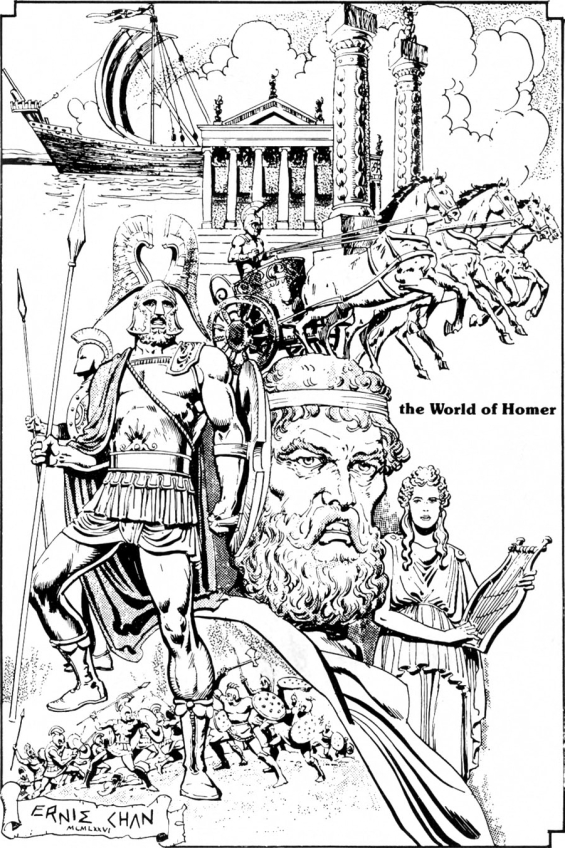
The World Of Homer - illustrated by Ernie Chan

Posted by Jesse Willis