Review of Lamentation by Ken Scholes

SFFaudio Review

Lamentation by Ken ScholesSFFaudio EssentialLamentation
By Ken Scholes; Read by Scott Brick, William Dufris, Maggi-Meg Reed, and Stefan Rudnicki
12 CDs – 15 Hours [UNABRIDGED]
Publisher: Macmillan Audio
Published: 2009
ISBN: 9781427206251
Themes: / Fantasy / Epic Fantasy / Religion / Politics /

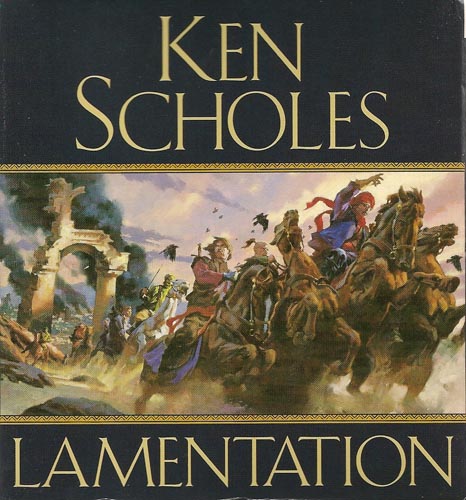
A pillar of black smoke rises from the plains where the ruins of a city lie. Four people watch it. Petros, an old fisherman; Nebios, a boy who is the only eyewitness; Rudolfo, the Gypsy King and Lord of the Ninefold Forest; and Jin Lee Tam, consort of a powerful madman. Each takes up the story in turn and we learn as they do what has happened and what changes it bodes for the Named Lands.

Through their eyes, Ken Scholes masterfully unfolds layer upon layer of complexity to reveal an epic tale of the struggle not only for power but to serve the Light. This struggle between vengeance, knowledge, mercy, and justice is what drives the main characters. Scholes takes us into a world where Machiavellian politics are constantly intertwined between characters’ motivations. However, because he uses interesting characters to tell his story, it always feels personal and we realize the “epic” quality only as we look back over storyline development. As well, he skillfully manipulates these believable people (and, let us admit it, his readers as well) so that I literally went from worrying about one character being killed to hating him to coming back into sympathy and understanding again by the end of the book. In the end, what we see is that despite epic qualities, the question the book is asking is a simple one. Who was the evil mastermind that destroyed Windwir and why?

Scholes’ world is a mesh of societies that come from disparate sources but which blend seamlessly into an intriguing whole. Reminiscent of medieval times are the city-states and trading factions wielding great power. The people of the Ninefold Forests put one in mind of Robin Hood with their wood-wise ways that shun large, established cities. The Church has a pope and an Androfrancine order that seeks ceaselessly to acquire knowledge and store it for the common good. This too hearkens back to our historical past, yet there are also distinct elements informing us that this is instead a distant future after mankind’s knowledge was used to wreak a terrible calamity resulting in The Time of Laughing Madness. There is a distinctive steam-punk flavor to be found in the inventions that are discovered and released by the monks into general society.

This is a world in which long distance communication is done by messenger bird but where robots exist (mecho-servitors). As well as spoken, coded conversation, there is a fascinating finger tapping code used by those in the know. We also meet one of the mecho-servitors, Isaak, whose suffers from extreme guilt over possibly being used for the destruction and who seems to be developing a soul.

Finally, although we breathlessly follow the characters on their journeys, knowing that there are several books to follow in the series, Scholes does us the courtesy of tying up the story lines for all but a very few situations. This was extremely refreshing and much appreciated. Simultaneously, he opened a few intriguing threads of possibility that lead us to eagerly await the next novel. True to the mastery that we saw in the rest of the book, he does so with a few well written scenarios that leave the reader realizing that these are situations that were hinted at but essentially “hidden in plain sight” until the author decided to pull them into use.

Narration was brilliantly voiced by Stefan Rudnicki, Scott Brick, William Dufris, and Maggi-Meg Reed. All were perfect for their parts, with Brick doing the heavy lifting on any sections told from a point of view that came from other than the main four characters. What I found most interesting was the opportunity for comparison between how the four readers interpreted different characters. The book changes point of view between characters by stating the person’s name and then using what might be called over-the-shoulder story telling in third person from that point of view. Therefore, each of the narrators is called upon to do dialogue for various characters as they engage in conversation with the protagonist of the moment. Hearing how each interpreted Isaak’s robotic voice or Petros’s aged tones provided fascinating contrasts.

Highest recommendations go to this audio book and author Ken Scholes.

Posted by Julie D.

Review of Star Wars: Millennium Falcon by James Luceno

SFFaudio Review

Star Wars: Millennium Falcon by James LucenoStar Wars: Millennium Falcon
By James Luceno, Read by Marc Thompson
8 CDs – 10 hours [UNABRIDGED]
Publisher: Random House Audio
Published: 2008
ISBN: 9780739377130
Themes: / Star Wars / Science Fiction / Fantasy / Religion / Space Travel / Adventure / Hardware /The Star Wars audiobook has been around for a long time. I use them often to illustrate the evolution of the audiobook: they started with two cassette abridgments, moved to CD, then the abridgments got longer, and now, as we are seeing the rest of the industry move (nearly) completely away from abridged audio, Star Wars novels are now… unabridged.

Marc Thompson does the reading here, after a very long stretch of excellent Star Wars narration by Jonathan Davis. The series is in good hands. Marc Thompson is a bit of a impressionist, able to invoke Harrison Ford’s Han Solo merely by the tone and meter of his voice. Most of the time it works great, but every now and then I got a clear view of David Puddy in my head (Elaine’s boyfriend from Seinfeld, played by Patrick Warburton). Who knew that Ford’s and Warburton’s voices were so near each other? These times are few, though, and Marc Thompson is a narrator I’d listen to any time.

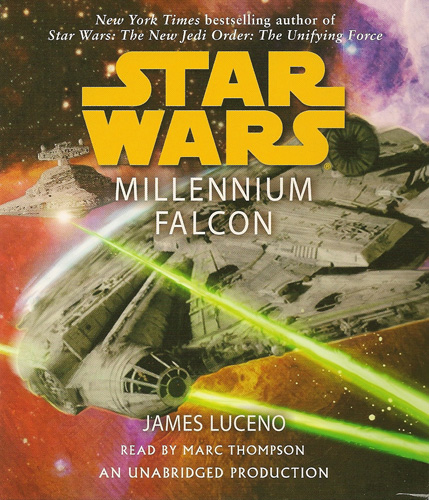
Star Wars: Millenium Falcon spans a lot of history. The famous ship has been around, and James Luceno takes us on a tour of its busy life. Han Solo and Leia are married, for those who haven’t been keeping up, and have grandkids (yes, a LOT has happened), one of which is named Allana. One day she asked Han about the history of the ship, which prodded him into looking more into it.

In the meantime, a previous owner of the ship (before Lando) has been in stasis for quite a few years. He wakes up and immediately goes after something he left on the ship. Eventually, their paths cross.

This is an entertaining adventure that ties together the whole Star Wars saga through the history of the Millenium Falcon. It’s extremely well done, and lots of fun for a fan like me.

Random House Audio Star Wars page

After listening to this audiobook, I was curious – did the Millennium Falcon make an appearance in Episodes I, II, or III? The answer is yes, but only briefly:

Posted by Scott D. Danielson

Review of Inferno by Larry Niven and Jerry Pournelle

SFFaudio Review

Inferno by Larry Niven and Jerry PournelleInferno
By Larry Niven and Jerry Pournelle; Read by Tom Weiner
5 CDs – 5.5 Hours [UNABRIDGED]
Publisher: Blackstone Audio
Published: 2008
ISBN: 9781433259050
Themes: / Science Fiction / Fantasy / Bangsian Fantasy / Religion / Literature / Evil /

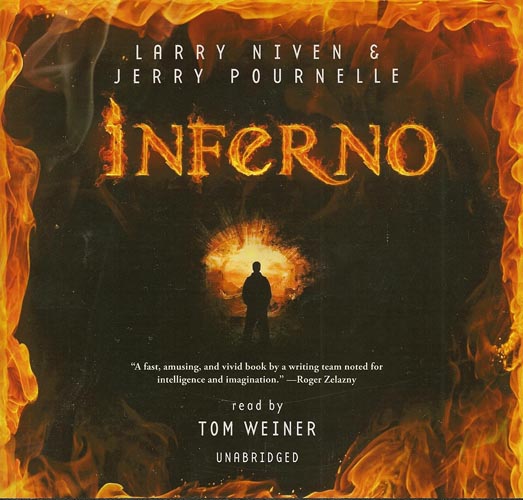
After being thrown out the window of his luxury apartment, science fiction writer Allen Carpentier wakes to find himself at the gates of hell. Feeling he’s landed in a great opportunity for a book, he attempts to follow Dante’s road map. Determined to meet Satan himself, Carpentier treks through the Nine Layers of Hell, led by Benito Mussolini, and encounters countless mental and physical tortures. As he struggles to escape, he’s taken through new, puzzling, and outlandish versions of sin—recast for the present day.

I don’t like that the book’s copywriter has spoiled the revelation of Benito’s last name. I figure most people would figure it out PDQ anyway, but it’s not actually revealed until more than half way through this novel. This is a rather interesting book, I’d heard about the title a few times over the years, along with the mention that Niven/Pounelle had written it, but had never actually got my hands on a copy until this year. It’s rather fitting that it’s been re-released now with all the hubub about religion vs. atheism going on. But the timing on the re-release probably has more to do with the imminent (like now) release of the sequel, Escape From Hell.

The Allen Carpentier character is, I assume, an analogue of Niven/Pounelle, an SF writer of the Hard variety. Carpentier is one of those folks who likes all those Fantasy ghouls and goblins to be either nailed down under a microscope for proper cataloging or poofed away in puffs of neuro-psychological explanation. Basically, a guy like me. When Carpentier finds himself alive, or at least not dead, after falling from a balcony, trapped in a place that resembles Dante Alighieri’s Inferno he insists the place is an “Inferno-land”, a kind of twisted Disneyland, created by something he mentally marks down as “Big Juju” (possibly an immensely powerful alien) rather than “God.” As a book it does stand well on its own, but leaves the ultimate revelations off-pages – something the sequel is pretty much going to have to address if it’s gonna be a satisfying sequel. This book however offers an effective and nuanced rumination on the nature of evil. I found myself sympathizing with the injustices Carpentier sees perpetrated throughout “Inferno-land” – sure a lot of the residents are highly contemptible, selfish, short sighted, and maybe even evil – but is any bad act enough to garner naught but eternal torture? That “Big Juju” character has just gone too far!

Tom Weiner delivers another terrific reading, providing vocal shading and accents for each character in the novel. It’s an even handed delivery, straddling the knife edge between the comedic possibility and the main character’s skeptical POV. Allen Carpentier often talks to himself, mentally checking his sanity as his highly skeptical eyes confront the pervasive reality of a manifest hell.

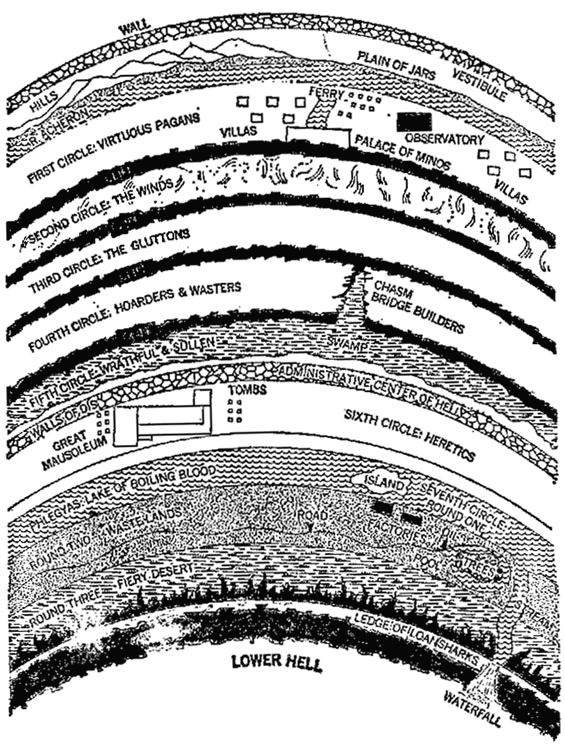
A Map of HELL (from the 1976 paperbook of Inferno):

Map Of Hell

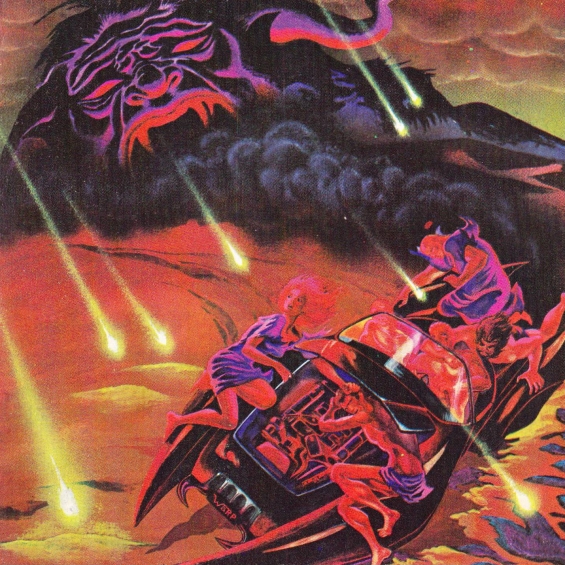
Cover for Galaxy, October 1975 - Illusted by Richard Pini and Wendy Pini (INFERNO by Larry Niven and Jerry Pournelle)

Posted by Jesse Willis

Review of Ender In Exile by Orson Scott Card

SFFaudio Review

Ender in Exile by Orson Scott CardEnder in Exile
By Orson Scott Card; Read by David Birney, Cassandra Campbell, Emily Janice Card, Orson Scott Card, Gabrielle de Cuir, Kirby Heyborne, Don Leslie, Stefan Rudnicki, and Mirron Willis
12 CDs – Approx. 14 Hours [UNABRIDGED]
Publisher: Macmillan Audio
Published: 2008
ISBN: 9781427205124
Themes: / Science Fiction / Colonization / Starships / Religion / Politics / War / Aliens /

Over the last six years or so, Orson Scott Card has had nearly everything he’s written published as an audiobook. His writing is particularly suited to audio; his style is dramatic, clear, and driven by conversations, both internal and external. Card’s storytelling ability is also first rate.

The other half of an audiobook is its presentation, and here Card’s audiobooks also excel. In the Ender and Ender’s Shadow series of audiobooks, Stefan Rudnicki has led a talented crew of narrators in expert productions. Ender in Exile is the ninth novel written in the universe started by Ender’s Game, and all of them have been produced in a similar manner – with multiple narrators that change with shifts in the point of view of the story.

The entire novel takes place between the last two chapters of Ender’s Game. I’ll try not to spoil Ender’s Game for those who haven’t read it, but the main events of that book have finished, and the teenaged Ender Wiggin can not stay on Earth for various and interesting reasons. He is put on a colony ship, and much of the book takes place there. The conflict for him is not over. He’s distrusted by powerful adults, and because of his fame he distrusts the motives of everyone else. He’s still very much alone.

You’d think after four novels about Ender Wiggin that there wouldn’t be anything else to say about him. But Ender in Exile is one of the best novels in the series, mostly because of the insight it provides into the most interesting aspect of Ender Wiggin’s life: his transformation from Battle School student to Speaker for the Dead.

An atypical aspect of this novel is that it is really a sequel to two books: Ender’s Game and Shadow of the Giant. Because of the relativistic effects of space travel, three of the four Shadow novels take place while Ender is en route to his colony. Some of the things that happen in those books affect events in this one.

Despite all that, this book can be read standalone, though a good experience is made even better by knowing the whole story.

And, a bonus mini-review from DanielsonKid: It was very good, but I wouldn’t call it one of his best.

Posted by Scott D. Danielson

Review of The Halloween Tree by Ray Bradbury

SFFaudio Review

The Halloween Tree (audio drama) by Ray BradburyThe Halloween Tree
By Ray Bradbury; Performed by a full cast
2 CDs – 2 hours – [AUDIO DRAMA]
Publisher: Blackstone Audio
Published: 2008
ISBN: 9781433232145
Themes: / Fantasy / Halloween / Death / Religion / Time Travel / Witchcraft / Paganism /
What is Halloween? How did it start? Where, why, what for? Witches, cats, mummy dust, haunts… it’s all there in the country from which no one returns. Would you dive into the dark ocean, boys? Would you fly in the dark sky?

This review may be a little out of season, but it was with relatively recent memories of carving jack-o’lanterns and taking my costumed children out to trick-or-treat that I listened to The Colonial Radio Players dramatized adaptation of The Halloween Tree by Ray Bradbury. This neat little tale is ostensibly for children and young adults, but it contains an illuminating look into the origins of Halloween as well as an honest exploration of our own cultural view of death, that greatest of all mysteries.

The Halloween Tree opens with eight young boys gathered together on Halloween night to go trick-or-treating. A ninth boy, Pipkin, is notably absent from the group, and when he finally emerges from his house it’s apparent something is terribly wrong: He’s pale, moving gingerly, and clutching at a lancing pain his side. But the call of Halloween is too strong and he joins his friends. Later we learn that Pipkin is suffering from an acute bout of appendicitis.

The boys decide to go trick-or-treating at a haunted house, and there they encounter the ghostly, skeletal, white-haired Mr. Moundshroud. Moundshroud takes the boys to see The Halloween Tree. En route they have to cross a deep ravine, which proves to be a metaphor for the Valley of Death, and Pipkin fails to reach the other side. When the boys call to him, his pumpkin light goes out and he vanishes from sight.

Moundshroud offers to take the boys on a dreamlike trip back through time in order to save Pipkin. Along the way he reveals the origins of Halloween and its association with death. The boys travel back to ancient Egypt and view that culture’s reverence of the dead, including its great pyramid-tombs, mummies, and the worship of the sun god Osiris, murdered each night by his jealous brother only to rise again the next morning. They are whisked away to pre-Christian Europe and encounter the cowled, scythe-wielding Samhain, the druidic god of death from which Halloween derives its origins.

The boys witness the extinction of the druids and their religion at the hands of the murdering Romans, whose polytheistic approach to religion is itself eradicated by the coming of Christ. “Now the Christians come and cut the Romans down—new altars, boys, new incense, new names,” Moundshroud says. Here I’ll mention that The Halloween Tree includes a subversive view of Christianity, as the boys witness the persecution of innocent witches in the dark ages in the name of Christ.

The boys’ journey continues to 16th century Paris and Notre Dame Cathedral and finally to Mexico for the Day of the Dead celebration. Their strange, dreamlike trip not only reveals the origins of Halloween, but also illuminates our own view of death here in the United States—cemeteries are lonely, cold places, and when someone dies we turn our attention to moving on and forgetting, rather than remembering and honoring our deceased loved ones. When contrasted with Bradbury’s bright description of The Day of the Dead, our cultural reaction to death seems stunted and sad in comparison:

By every grave was a woman kneeling to place gardenias, or azaleas, or marigolds, in a frame upon the stone. By every grave knelt a daughter, who was lighting a new candle, or lighting a candle that had just blown out. By every grave was a quiet boy, with bright brown eyes, and in one hand a small papier-mâché funeral parade, glued to a shingle, and in the other hand a papier-mâché skeleton head, which rattled with rice or nuts inside.

Halloween, this odd, out-of-place holiday that has persisted through the ages, and remains with us now as a night to beg for candy in a costume, is revealed as an ancient ritual denoting the end of the harvest season and the onset of cold winter, of night, and of death. Its origins trace back thousands of years and span multiple cultures. “Four thousand years ago, one hundred years ago, this year, one place or time, but the celebration’s all the same—the Feast of Samhain, the Time of the Dead Ones, All Souls, All Saints, the Day of the Dead, El Dia de los Muertos, All Hallows, Halloween,” Bradbury writes.

In the end the boys are presented with a difficult choice to bring Pipkin back from the dead, one that involves a paganistic sacrifice to the dark gods. I won’t spoil the ending. But there’s a great line where one of the boys asks Moundshroud, “Will we ever stop being afraid of the night and death?” Moundshroud (who may be death himself, or the spirit of Halloween) replies reassuringly, “When you reach the stars, boy, yes, and live there forever, all the fears will go, and death himself will die.”

I had a few minor quibbles with the presentation of the story. The Colonial Radio Theatre presentation at times relies too heavily on unnecessary sound effects and crashing music that threatened to overwhelm the story, although the voice of Moundshroud, Jerry Robbins, was excellent, as were the production values. The tale also contained a bit more whimsy (a giant kite that whisks the boys back through time, etc.) than I typically like, but Bradbury is such a gifted, poetic writer that it mostly works.

Death may be our greatest mystery, but Bradbury is not afraid to look into its cold, impenetrable depths in search for meaning. The Halloween Tree illuminates the subject with a ghostly pumpkin candle whose light remained with me long after the tale was over, which is one sure mark of a good book.

Posted by Brian Murphy

Review of The Accidental Time Machine by Joe Haldeman

SFFaudio Review

Science Fiction Audiobook - The Accidental Time Machine by Joe HaldemanThe Accidental Time Machine
By Joe Haldeman; Read by Kevin R. Free
7 CDs – 8 Hours [UNABRIDGED]
Publisher: Recorded Books
Published: 2008
ISBN: 9781436120418
Themes: / Science Fiction / Time Travel / Artificial Intelligence / Religion / Academia / Los Angeles / Massachusetts / MIT /

Things are going nowhere for lowly MIT research assistant Matt Fuller—especially not after his girlfriend drops him for another man. But then while working late one night, he inadvertently stumbles upon what may be the greatest scientific breakthrough ever. His luck, however, runs out when he finds himself wanted for murder—in the future.

When an MIT graduate student Matt Fuller accidentally invents a time machine he get’s himself into a load of trouble. Not only is his supervising professor a hard-ass thief of academic proportions, the stupid time travel machine can only travel forward into the future! Every time Matt presses the ‘go button‘ he ends up twelve times farther than last time, he’s invented a time machine that only got a one way ticket to the future. Fueled by caffeine, job worries, and a murder charge, Matt blasts himself forward 12 x 12 x 12 into the future – where the only thing stranger than Jesus returning to Earth is a visit from the personified city of Los Angeles. Haldeman’s inventiveness is unparalleled in time travel SF. His hero Matt is picaresque, he’s on an inventive journey and the adventure is unpredictable and compelling. I loved it.

Kevin R. Free, a narrator new to my ears, performs this novel to perfection. Everyone I’ve recommended this novel to has enjoyed the heck out of it – if Recorded Books keeps picking novel/narrator combinations like this we’re in for a real treat. Speaking of Recorded Books, The Accidental time Machine is one of the inaugural publications in their new Sci-Fi imprint. Also terrific, there’s cool art custom cover just this edition [see above], it features actual details from the book – that’s refreshing. A great and peppy novel, an excellent, excellent, reading, fast moving and not too long. This is the kind of Science Fiction story I want to see more of. Speed on over to RecordedBooks.com, or your local library, and request a copy of this audiobook.

Posted by Jesse Willis