The SFFaudio Podcast #149 – TOPIC: METAPHOR in Science Fiction and Fantasy

Podcast

The SFFaudio PodcastThe SFFaudio Podcast #149 – Jesse, Luke Burrage, and Professor Eric S. Rabkin talk about METAPHOR in Science Fiction and Fantasy.

Talked about on today’s show:
Science Fiction and Fantasy sort of undercut the scholastic meaning of metaphor, my friend Bill, metaphors come in two parts – the vehicle and the tenor, giants vs. ogres, denuding the metaphor, Aldebaran 6 has astonishingly beautiful humanoids, unknown vehicles deliver us, The Monsters by Robert Sheckley, The War Of The Worlds, a Tolkienesque task, A Voyage To Arcturus by David Lindsay, Dark Universe by Ron Goulart, Plato’s cave, blindness, dead metaphors, the Burning Bush, Saul vs. Paul, a sound idea, Germanic grounds for divorce, Star Maker by Olaf Stapledon, The Door Into Summer by Robert A. Heinlein, 1984 by George Orwell, “the clock stuck thirteen”, constructing meaning, William Shakespeare, awful as in creating awe, Moses and Mount Sinai, “shining like the sun”, a sun god, Sampson, hairy like the sun, bald like the moon, Genesis, “you may look upon my hindparts”, Childhood’s End by Arthur C. Clarke, unconscious metaphors, Frankenstein by Mary Shelley, wretch, catwomen from Venus, voluptuous sex objects, building up the vocabulary, Halting State by Charles Stross, Neuromancer‘s opening line, text adventure, Enoch lived 365 years (the sun god), The Tower Of Babel by Ted Chiang, comparing the constructed worlds of video games with the constructed worlds of Science Fiction, Battlefield 2, a meta-metaphor for understanding what Science Fiction does for understanding our world, hamartia needs range finding, The Time Machine by H.G. Wells, “any fool can see”, a system of metaphors for the characters and the reader provides meta-uses, metaphor means “carry across”, Greek moving vans are called metaphore, the Morlocks are the workers, the Eloi are the owners, the Time Traveler is the manager, Get That Rat Off My Face by Luke Burrage, Science Fiction as thought experiment, Michael Crichton, deus ex machina, The War With The Newts by Karel Čapek, Finnegan’s Wake, experimental novels, Germinal by Émile Zola, Flatland by Edwin A. Abbott, allusion vs. metaphor, Sampson vs. Goliath, Luke and Eric prime each other, is Science Fiction useful?, should SF be useful?, Science Fiction and Personal Philosophy (SFBRP #100), reading only the Bible, The Cold Equations by Tom Godwin, the hard lesson namely: “sometimes you’re just fucked”, Star Trek II, cannibalism, Eric objects, the physical world vs. unconditional love, NASA staff need to read The Cold Equations, Steve Jobs (and his reality distortion field), a world full of things other than minds, smart by accident, Apollo 13, give the astronauts poetry, the title itself crystallizes the meaning, The Scarlet Letter by Nathaniel Hawthorne, a parametric center, how do we maintain individuality in the face of fascism?, the vehicle/tenor heuristic, The Great Gatsby by F. Scott Fitzgerald, Nick Carraway, the car is the parametric central of The Great Gatsby, martian vampires, Apollo 1 disaster, Velcro and oxygen, “a failure of imagination”, learning from the past, the metaphor falls and leaves behind a lesson about reality.

Posted by Jesse Willis

William H. Patterson, Jr. talking about Robert A. Heinlein at the Cato Institute in 2010

SFFaudio News

William H. Patterson, Jr., author of Robert A. Heinlein: In Dialogue With His Century a new biography of Robert A. Heinlein, is the speaker in this Cato Institute video from 2010. Here’s the official description:

Robert A. Heinlein is regarded by many as the greatest science fiction writer of the 20th century. He is the author of more than 30 novels, including Starship Troopers, Stranger in a Strange Land, and the libertarian classic The Moon Is a Harsh Mistress. According to biographer William H. Patterson Jr., Heinlein’s writings “galvanized not one, but four social movements of his century: science fiction and its stepchild, the policy think tank; the counterculture; the libertarian movement; and the commercial space movement.” This authorized biography, reviewed enthusiastically by Michael Dirda in the Washington Post, is the first of two volumes, covering Heinlein’s early ambition to become an admiral, his left-wing politics, and his first novels. Heinlein later became strongly libertarian.

The speech itself is short, and isn’t particularity exciting, but Patterson gives some very detailed and interesting answers to audience questions. Some are about the connections between Ayn Rand and Robert A. Heinlein, the philosophy of Heinlein, socialism in the U.S.A., and Heinlein’s mysticism.

But one question asked, about how to rebuff arguments that Heinlein’s ‘Starship Troopers is fascist’, has Patterson point to the compulsory military service in Switzerland. He equates it with being a part of Swiss citizenship. However, military service is only compulsory for Swiss men. In South Korea, where the threat of war is much more pressing, compulsory military service works the same way – only men are compelled. In fact compulsory military service works, and has worked, that way just about everywhere – including in Nazi Germany and Fascist Italy. A much better example of equating military service with citizenship would be Israel, where compulsory military service includes both men and women – and there aren’t very many exemptions. Problem is, this isn’t what the book, or the movie, has. Heinlein has voting rights for veterans – soldiers can’t vote and anybody who doesn’t join the military can’t vote. That’s not fascism. I don’t know what it’s called but it is not fascism.

Posted by Jesse Willis

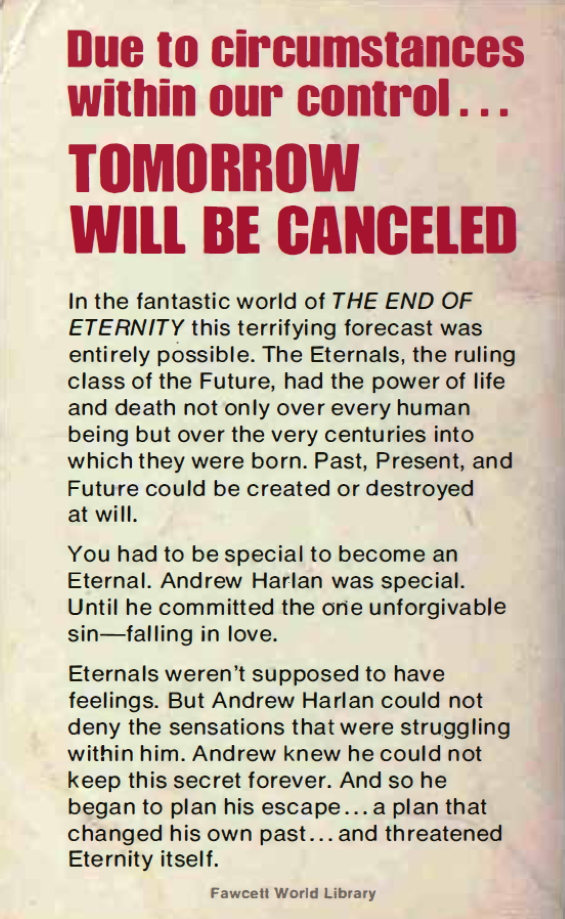
SFBRP #152: Time Travel Special, part 2 – Isaac Asimov’s – The End Of Eternity

SFFaudio Online Audio

The Science Fiction Book Review Podcast Episode #152 of The Science Fiction Book Review Podcast is a discussion of Isaac Asimov’s The End Of Eternity. It’s also a follow-up to the previous time travel episode (#151). Luke and I discuss the book and related time travel tales.

|MP3|

Podcast feed: http://www.sfbrp.com/?feed=podcast

Discussed on the show:
A Connecticut Yankee In King Arthur’s Court by Mark Twain, a flexible chronology, Luke’s first Isaac Asimov review for SFBRP, Robert A. Heinlein, Nightfall by Isaac Asimov (and Robert Silverberg) is bad, Isaac Asimov has ideas to spare, the Wikipedia entry for The End Of Eternity, “what clever idea can I use, in time travel, that hasn’t been used before”, time loops, time barriers, “are you your own grandpa?”, Poul Anderson’s time corps, bureaucracy, how does time travel work?, time travel is discovered, eternity is a place outside of time, powering a time travel technology is easy if you can time travel, The Time Machine by H.G. Wells, the “kettle”, Ray Bradbury’s A Sound Of Thunder, A Gun For Dinosaur by L. Sprague de Camp, time lords?, Adjustment Team by Philip K. Dick, Back To The Future, remembering the works of culture and developments in realities that no longer exist, 13 different versions of the complete works of William Shakespeare, the academic background of professorial jockeying, are there two different endings for The End Of Eternity?, being outside of time, “the outside of the inside of eternity”, the malleability of reality through time travel, a limited butterfly effect, the inertia of history, killing Hitler, William The Conqueror vs. King Harold Godwinson, Genghis Kahn’s descendants, computers (the vocation) vs. computers (the devices), technicians don’t get any respect, “They feel an unspoken collective guilt which causes them to scapegoat the ‘Technicians’, the experts who actually execute Reality Changes by doing something that will alter the flow of events.”, a caste system, Minding Tomorrow by Luke Burrage, making changes by setting your mind to it, Bill And Ted’s Excellent Adventure, Harlan is a bit of a dim bulb, Demolition Man, time travel as a secret (paralleling magic as a secret), The Accidental Time Machine by Joe Haldeman, mutable realities, the grandfather paradox, unmanipulated reality, alternate history, Sidewise In Time by Murray Leinster, later Heinlein novels, unrestricted freedom in multiple realities can be extremely disheartening, Groundhog Day, infinite universes are boring, By His Bootstraps by Robert A. Heinlein, All You Zombies by Robert A. Heinlein, making a knot out of your own timeline, giving a young William Shakespeare a copy of The Complete Works Of Shakespeare, motherless objects and motherless ideas, giving your younger self an object (or advice), multiple timelines, “if that’s possible then that’s not possible”, time traveller’s convention, BoingBoing’s time travelers (I and II), European Juggling Convention 2003, Time Travel #2 Advanced Time Travel Techniques, Paradoxes For Beginners, Harlan Ellison, Murder At The ABA by Isaac Asimov, Darius Dust (dry as dust), Tales Of The Black Widowers, sexism, women are not suitable time travelers, an apocryphal tale of the Obamas, energy bodies, sending a message from the past to the future, you have an energy body but paper magazines?, a future vs. the future, The Door Into Summer, Escape Pod’s recording of All You Zombies, Asimovian characters, The End Of Eternity is about Earth, House Of Suns by Alastair Reynolds, something so big and so mind bogglingly complex, SFFaudio Podcast #073 George R. Stewart’s Earth Abides, “Gregg Margarite and that other guy (Jesse) are losers”, batshit theories, Eric S. Rabkin, Adam and Eve, fairy tales, sex, “the unconscious does exist”, Luke’s original fiction, “we do these podcasts for ourselves”, interesting bullshit, Luke’s Creative Podcast (with Gregg Margarite), “make your own podcast if you don’t like one.”

Ed Emshwiller cover illustration of Isaac Asimov's The End Of Eternity

FAWCETT The End Of Eternity by Isaac Asimov

Posted by Jesse Willis

SFBRP #151: Time Travel Special, part 1 – Mark Twain – A Connecticut Yankee in King Arthur’s Court

SFFaudio Online Audio

The Science Fiction Book Review Podcast Episode #151 of The Science Fiction Book Review Podcast is a special episode on Mark Twain’s A Connecticut Yankee in King Arthur’s Court and similar time travel tales. It is both special and strange. First it’s strange because it’s the first part of a two part discussion of time travel and not a regular book review. Secondarily it is special because I participated in it!

Or as Luke puts it:

Time Travel Special part 1: Luke and Jesse discuss A Connecticut Yankee in King Arthur’s Court by Mark Twain as a jumping off point for the topic of “A being out of time.”

|MP3|

Podcast feed: http://www.sfbrp.com/?feed=podcast

Discussed on the show:
The Invisible Man by H.G. Wells, Smoke by Donald E. Westlake, romance and time travel, science fiction’s hold on time travel, the process of time travel vs. the man out of time, Army Of Darkness, A Connecticut Yankee in King Arthur’s Court is totally political, retellings and abridgements of A Connecticut Yankee in King Arthur’s Court, Jonathan Swift’s Gulliver’s Travels, framing stories, “a dispute with crowbars”, the LibriVox audiobook edition, 1889 illustrations on Gutenberg.org, the Blackstone Audio audiobook, Stuart Langton, Yankee vs. English accents, the Arthurian characters, Idiocracy, taking the piss out of the British, a very thin satire, The Marching Morons by C.M. Kornbluth, The Ugly Little Boy by Isaac Asimov, The Door Into Summer by Robert A. Heinlein, The Accidental Time Machine by Joe Haldeman, the effect on electricity on progress, Thomas Edison, dynamite, SFBRP #100, Then End Of Eternity by Isaac Asimov, comparing the 19th century man with the 21st century man, smartness man and the most moral man, democracy, “what we really need are newspapers”, the tyrannies of monarchy and religion, pick your own oppression, the man from the past comes to the present, adventures, “the Vulcan project”, great insults, Sandy’s reproach, “Mark Twain is fucking hilarious”, the characters bamboozle each other (and the reader too), attributed to Mark Twain, Oscar Wilde, Will Rogers, Groucho Marx, “he is his own target”, occupy Wall Street, Ray Nelson’s Eight O’Clock In The Morning, John Carpenter’s They Live, the 1%, the Robber Barons, Carnegie and Nobel, A Connecticut Yankee in King Arthur’s Court is an essential adult read!, “you think you might know this book, but really you don’t know this book”, Luke gives it 4 out of 5 stars, sfbrp.com/episode-lists, feedback from #150 (ebooks, audiobooks and paperbooks)

After The Explosion

Protection / Capitalism

The Chruch, The King, The Nobleman, The Freeman

Blackstone Audio - A Connecticut Yankee in King Arthur’s Court by Mark Twain

Posted by Jesse Willis

The SFFaudio Podcast #145 – READALONG: Little Brother by Cory Doctorow

Podcast

The SFFaudio PodcastThe SFFaudio Podcast #145 – Little Brother by Cory Doctorow. Jesse, Tamahome, Professor Eric S. Rabkin and Jenny discuss Little Brother by Cory Doctorow. |ETEXT|

Talked about on today’s show:
Tam can’t trust anyone over 25, Jesse’s review in 2008, re-reading Little Brother in 2012, South Carolina, did Jenny vote Herman Cain (Stephen Colbert)?, SOPA/PIPA, non-fiction essay combined with YA, cliche, didacticism vs. propaganda vs. agitprop, we loved the infodumping, the underlying Oedipal structure, Robert A. Heinlein, libertarian bent, The Moon Is A Harsh Mistress, Starship Troopers, Ray Bradbury, Something Wicked This Way Comes, ‘this book has well devolved mythic structure’, levers vs. buttons, relevance, Homer, Electronic Frontier Foundation, the future of money, Luke Burrage’s review of Down And Out In The Magic Kingdom, money is hard to understand, Little Brother is a call to arms, National Defense Authorization Act (suspending habeous corpus as outlined in Article One of the United States Constitution), Nineteen Eighty-Four, George Orwell, Ms. Galvez’s Social Studies class, history, Heinleinian straw men vs. Doctorowan straw men, DHS, TSA, pebbles in your shoes, gait recognition, Oedipus = lame-foot, Charles Walker, the yippies, “this is a masterwork”, Jesse hates sequels, will the sequel to Little Brother deliver anything like what we might expect?, idea based writing vs. character based writing, w1n5t0n, trust, Marcus’ moral problem (RFID cloning without consent for the “greater good”), what act of violence is allowable?, moral relativism, the ends vs. the means, adolescence, “when is it time to overthrow the government?”, treason, Jenny makes “a gorgeous point”, Cory Doctorow’s choice to set Little Brother in, Law & Order (Lenny Briscoe), British North American Act, Canada didn’t have a bill of rights until 1981, The Charter Of Rights And Freedoms, Canada’s founding fathers are not demi-gods, Byron Sonne, G-20, is Little Brother a libertarian book?, “freedom is something you have to take for yourself”, Friedrich Hayek, Prometheus Award, the government of California is the hero (or the CHP), authority tries to perpetuate itself, UC Berkley, sex, juvenile vs. YA, “we live on Mars but we keep our houses extremely hot”, Snow Crash by Neal Stephenson, The Dervish House, Ready Player One, The Diamond Age, Eric makes a minor discovery, Big Brother -> Little Brother, Star-Begotten by H.G. Wells has the origin of “Big Brother”, Olaf Stapledon, “man is the boy who won’t grow up”, Spanish Civil War, The Midwich Cuckoos by John Wyndham (aka The Children Of The Damned), The Iron Heel by Jack London, comparing Doctorow with London, what is propaganda?, pamphleteering, Joseph Goebbels, Eric thinks etymologically, propagation and ideology, the Wikipedia entry on propaganda, is The Moon Is A Harsh Mistress propaganda?, “Oceania is now”, more strawful men, Sinclair Lewis, agitprop fiction, Science Fiction, “it’s a call to arms”, being a hacker, “go forth and hack my children”, “pay attention”, Gitmo by the bay, Iraq, Hacking The X-Box, Mac vs. PC ads, the hacker ethic is the science ethic, LARPing, “just to be smarter about the world around me”, alternative schooling, BART (Bay Area Rapid Transit), SkyTrain, The People Mover (The DPM), jitney, first person perspective, how to care, the terrorism detector and super-AIDS, Jane Jacobs, Jenny’s favourite character was Andrew, crystallizing the Oedipal issues, the Scoville scale, “the word is mister”, Ange vs. mom, The Tempest, severe haircut lady’s sadism, The Dark Knight Returns, is there a hero-normative angle?, The Puppet Masters, Friday, Have Spaceship-Will Travel, the ideal audience, Good Night Moon, Kirby Heybourne’s narration, transitional objects, Cory’s analogies are wonderful, taking a hiatus from Science Fiction, a pleased (but silent) smile, Jesse still has all his LEGO, a balding grey haired kid, Paranoid Linux, Jenny is ambivalent about whether she is of two minds, that couldn’t really happen here … could it?, Erich Fromm’s Escape from Freedom, the closer you get to power the more obvious it becomes, idelogical blindness, Drew wants to be able to believe, “He loved big brother.”

Kaiser Wilhelm II biting the world
Govenment Tech Support

Posted by Jesse Willis

Commentary: How (and why) I make ebooks out of paperbooks

SFFaudio Commentary

When you’ve got an old paperback book that’s coming apart at the spine, with pages falling out all over the place it’s time to consider making it immortal. In order to do that, in a reasonable period of time, you must kill the book. That’s the hardest part of the process. The actual transformation is pretty easy.

To do it I use a Fujitsu ScanSnap S1500 which came with Adobe Acrobat Standard 9. Here are three videos I put together that show the process of turning a paperback into an ebook:

And here’s a PDF |SAMPLE| of the result.

Update:
John writes in to say:

I read your recent post about digitizing print books with interest. I wondered if you might be able to expand on your process a bit, as it seemed to me like a few steps were missing from your video.

Indeed, here are my answers to some specific questions:

How do you actually sever all the pages from the book?

Most of the time this can be done just with your hands, at least with paperbacks and old magazines. The only tools I’ve ever needed to use are flathead screwdriver, to pry up staples found in some mags from the 1960s and 1970s, and scissors which I’ve used to trim out glued edges. If you’re doing a hardcover with sewn binding you’d probably be able to do it with just an X-Acto knife.

When you run the pages through the scanner, does it scan both sides of the page simultaneously? Or do you have to scan them all twice?

The Fujitsu ScanSnap is not only superfast, it’s also supersmart, it scans both sides at the same time (technically the term is “duplex”).

If so, how do you collate them so the pages are all in the right order?

The bundled software, called ScanSnap Manager, allows you to customize the named output files. I usually have them just come out as 001, 002, 003, etc..

How long does it take you to digitize a single book?

Lets see I’ve just scanned the February 1976 issue of Fantasy & Science Fiction which has 128 pages (64 leaves). In the scanning itself I set a stopwatch. It took 1 minute 30 seconds to scan the entire mag. The software took another 45 seconds of processing. And I spent about 30 seconds correcting orientation on a few pages. So under three minutes for 128 pages

Have you tried this on hardcovers as well, or just paperbacks?

I don’t think I’ve done more than a couple of hardcovers, they were really easy though as they were essentially unbound already.

Posted by Jesse Willis