BBCR4+RA.cc: Metropolis (2006) RADIO DRAMA

SFFaudio Online Audio

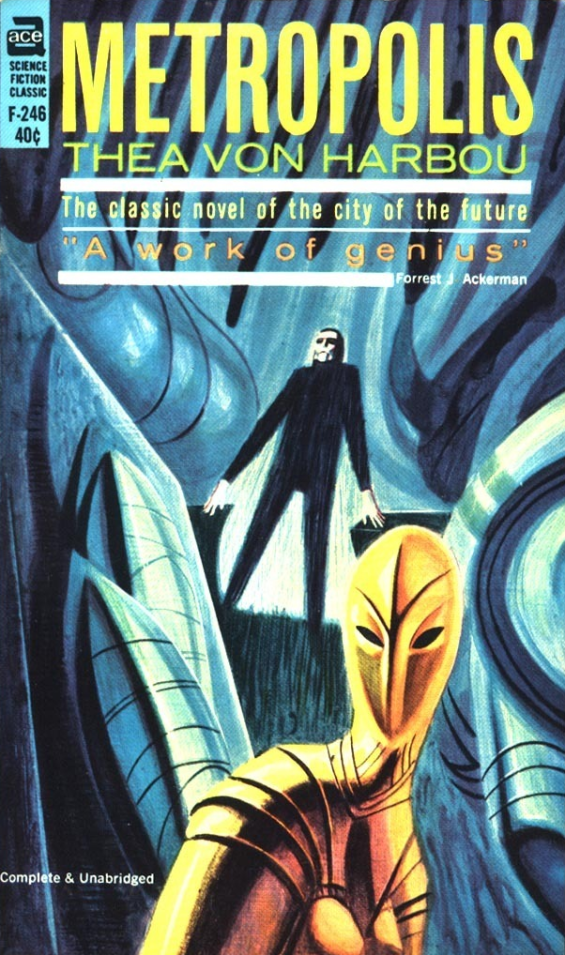
Ace Books F-246 - Metropolis by Thea Von Harbou

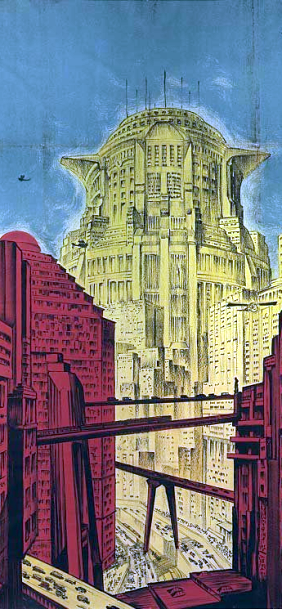
The Tower of Babylon in MetropolisI wrote about it airing six year ago, but I’ve just now heard it.

Metropolis, an astoundingly great radio dramatization of a famous novel that was turned into a famous movie, is nuanced, deep, surprising, and totally, idea based.

I’m astounded, really and truly astounded and amazed too at the depth and power an hour long program is able to achieve.

The script has humor, skepticism, cynicism, hope, sex, romance, informative infodumps, and a city full of pathos.

The production, acting, pacing, and composite audio experience is completely awe inspiring.

What gets me most is that even though it is based on a 1926 novel by Thea von Harbou, this version of Metropolis is, arguably, even more relevant than either Brave New World (1931) or 1984 (1949).

Those two classics don’t feel wholly and completely modern – this production of Metropolis does. It’s modernity is ripe, it’s like an episode of Black Mirror, and it should be on your radar.

Still not sold? Then imagine a Science Fiction version of Fight Club but set in the world of The Space Merchants or Judge Dredd and imagine it written by either Philip K. Dick or Frederik Pohl.

Here’s a review by Elisabeth Mahoney of The Guardian:

An audacious portrayal of a futuristic city as much as a state of mind, and an iconic film to boot, Metropolis (Radio 4, Friday) doesn’t exactly scream radio adaptation. But writer Peter Straughan and director Toby Swift, who won the Prix Italia in 2004 for their adaptation of Fritz Lang’s M, clearly aren’t put off by such hurdles. Their Metropolis was all deliciously claustrophobic intensity and dark interiority; their mega-city full of bubbling, menacing sounds you soon wanted to shut out. Without the famous visuals, you never really got a sense of the scale of Lang’s vision – you didn’t believe in the 62 million workers in Metropolis – but you did get the chilling psychological dimension of the dystopia. Edward Hogg, as Freddy, though sounding like a young Woody Allen at times, convinced as the alienated, lonely outsider who manages to subvert the mega-state from within. There were laughs, too, at least early on. “When was the last time you slept?” a therapist asks a suicidal Freddy. “About eight years ago,” says Freddy. “No,” the therapist concludes, “I don’t think that’s significant.”

Peter Straughan, the adaptor, and Toby Swift, the director, have achieved a classic for our time and for the ages – this is highly, highly recommended!

BBC Radio 4RadioArchives.ccThea von Harbou’s MetropolisSFFaudio Essential
Adapted by Peter Straughan; Performed by a full cast
MP3 via TORRENT – 57 Minutes [RADIO DRAMA]
Broadcaster: BBC Radio 4 (Friday Drama)
Broadcast: March 24, 2006
Available via RadioArchive.cc
Freder, the protagonist of Metropolis is an underworked “captain” in a high level position in the futuristic consumer society of the mega city named Metropolis. Feeling suicidal, but unable to understand why, Fredor switches identities with a low level “product insertion” – a kind of telemarketing – but failing at that Fredor soon finds himself working for Maria, an imperfect beauty with all the answers. Maria plunges Fredor into the depths of her underground conspiracy to disrupt the workings of society.

Directed by Toby Swift

Cast:
Freder – Edward Hogg
Maria – Tracy Wiles
Josaphat – Damian Lynch
Schmale – Peter Marinker

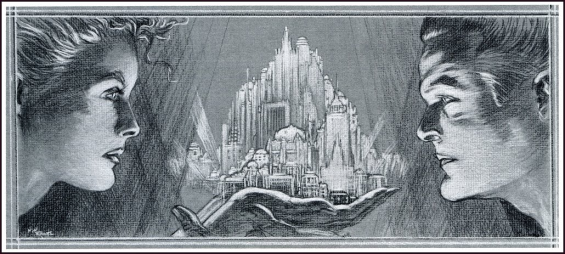
Michael W. Kaluta illustration of Maria and Freder

Posted by Jesse Willis

[Use Omitron! Omitron, use it! Use Omitron, it’s great!]

Earbud Theater: Clang! by Casey Wolfe AUDIO DRAMA

SFFaudio Online Audio

Earbud TheaterEarbud Theater has a new show they want you to hear. Written by Casey Wolfe, it’s entitled CLANG! and it features a cast you may recognize from other podcasts and movies and elsewhere around the universe.

Have a listen: |MP3|

Here’s the official description:

As any parent knows, balancing work and family can be difficult to say the least. For Gern and Betty Steadfast the two are about to slam together with a great… big… CLANG!

Cast:
Stephen Tobolowsky as Gern Steadfast
Meeghan Holoway as Betty Steadfast
Sean Keller as The General & Gabriel Edgar Wech
Alex Wagner as Jenni & Ellie
Lindsay Zana as Tyler & Jack

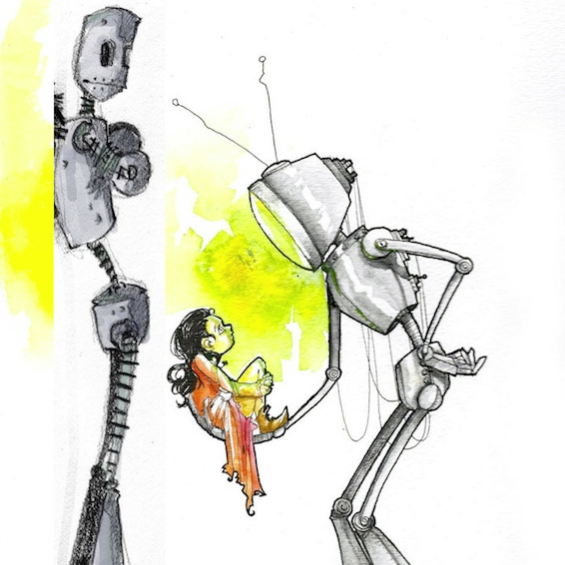
Earbud Theater - CLANG! - illustration by Megan Hutchinson

Posted by Jesse Willis

Tony And The Beetles by Philip K. Dick

SFFaudio Online Audio

Tony And The Beetles by Philip K. Dick

This 4,712 word story may not be among Philip K. Dick’s best, but it is certainly worth looking at, and hearing!

Tony And The Beetles is a bit unusual too, having an almost juvenile or YA feel to it. Maybe that’s because it’s not nearly as horrific as many of Dick’s fantasy tales – there are some frightening elements, but the general tone is that of an ungroundedness. I see Tony And The Beetles as a kind of historical allegory and I’m not the only one. Phil Chevernet, the narrator who recorded it for LibriVox, wrote “I think [Dick] was commenting on imperialism in the 40s and 50s.” I think he’s right, but I think the comment is somewhat ambiguous, rather depressing, and almost wholly unhopeful. Dick grew up during World War II and little PKD was a very sensitive fellow, kind of like Tony.

Here’s the setup:

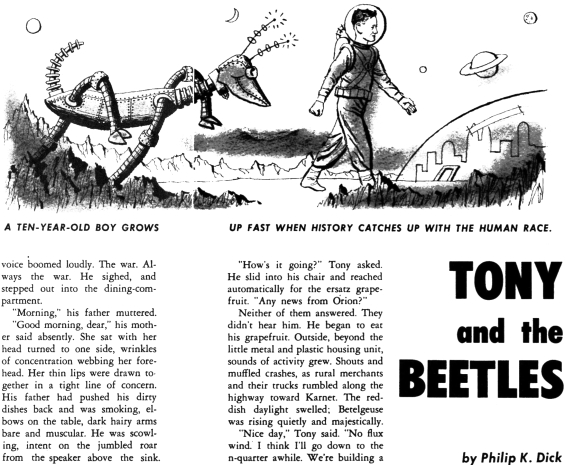
Young Tony Rossi has grown up on an alien world. As a child he’s known little else than bubble helmets, pressure suits, and robot pets. His playmates and schoolmates have all been the non-human children of the planet, but around him swirl the forces of history and when news of the ongoing war breaks Tony’s parents don’t seem to hold the same opinions of what it all means.

Tony And The Beetles by Philip K. DickTony And The Beetles
By Philip K. Dick; Read by Phil Chevernet
1 |MP3| – Approx. 34 Minutes [UNABRIDGED]
Publisher: LibriVox.org
Published: October 16, 2012
A ten-year-old boy grows up fast when history catches up with the human race. First published in Orbit, volume 1 number 2, 1953.

And here’s a |PDF| made from it’s original publication in Orbit.

Posted by Jesse Willis
The Midas Plague by Frederik Pohl

SFFaudio Online Audio

“the curse of want gives way to the curse of plenty”
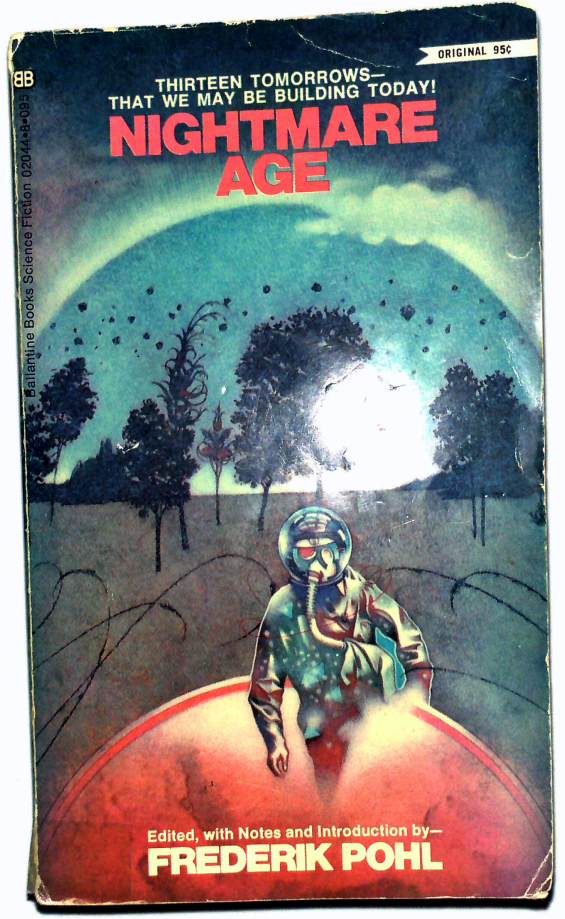
-Frederik Pohl, in the anthology Nightmare Age

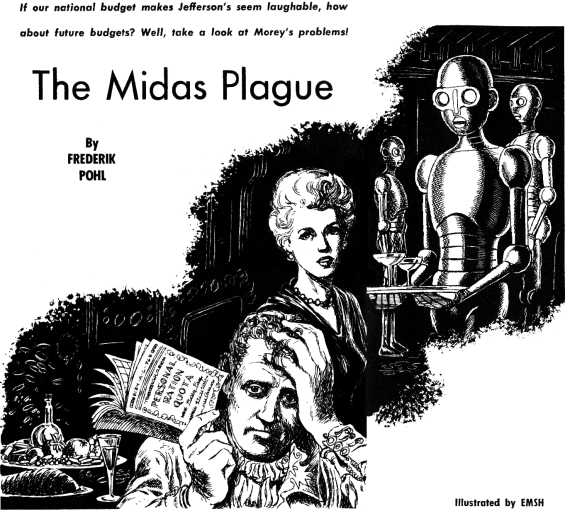
Broadcast on BBC Radio 4, as a part of “The Shape of Things to Come” season in 1991 (a series of plays looking at the future) The Midas Plague was adapted from the acclaimed novella by Frederik Pohl.

Now, thanks to the terrific service RadioArchive.cc you can experience this positively smirk inducing satire of a consumer society flipped on it’s head.

Here’s my description of the premise:

Morey Fry lives in a post-scarcity world where cheap production has made commodities, consumer goods, and food ubiquitous. The “poor” are forced to spend their lives in a constant state of frantic consumption, continually upgrading their devices, clothes, jewelry, and appliances. But “poor” Morey can only wear-out his shirts so fast, and taking double cream in his coffee is giving a sick feeling. Meanwhile a black market in counterfeit ration book stamps flourishes, yet Morey is an honest man. When poverty stricken Morey marries a “rich” girl from the right side of the tracks they move into his well appointed mansion. There, the efficient household staff of robot butlers, valets, maids, cooks, and footmen foist endless consumer goods upon them both at a furious rate, something that upsets Morey’s new “wealthy” spouse – after all she’s is accustomed to a certain luxurious lifestyle.

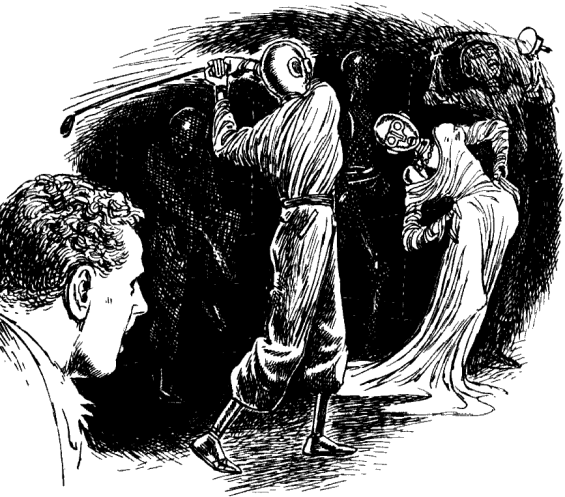
The Midas Plague, illustrated by Emsh - from Galaxy, April 1954

BBC Radio 4RadioArchives.ccThe Midas Plague
Adapted by Mark Power from the story by Frederik Pohl; Performed by a full cast
1 MP3 (via TORRENT) – Approx. 44 Minutes [RADIO DRAMA]
Broadcaster: BBC Radio 4
Broadcast: September 4, 1991

Directed by Alec Reid

Cast:
Morrey Fry – Michael Drew
Cheri Fry – Diane White
Howland – Alan Covenay
Judge Elon – Eric Allen
Grace Elon – Caroline Hunt
Semmelweiss – Nick Chivers
Newman – Nick Chivers
Fairless – Clarence Smith
Sam – Clarence Smith
Wally – Richard Pearce
Blaine – Richard Pearce
Tanaquil – Catherine Neal
Wainwright – Fraser Kerr
Henry, the Robot – Geoffrey Collins
Profirio – Geoffrey Collins

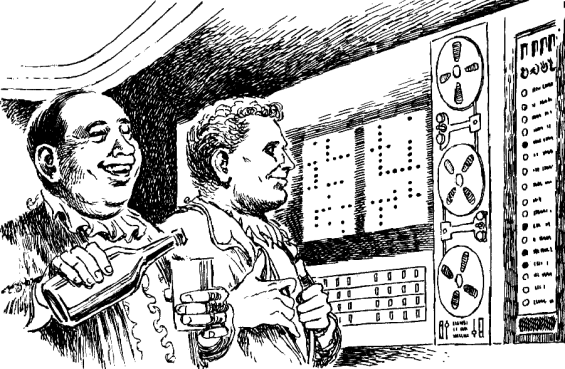
More illustrations from the publication in Galaxy, April 1954:
The Midas Plague, illustrated by Emsh - from Galaxy, April 1954

The Midas Plague can also be found in…
Ballantine Books - Nightmare Age edited by Frederik Pohl

and…
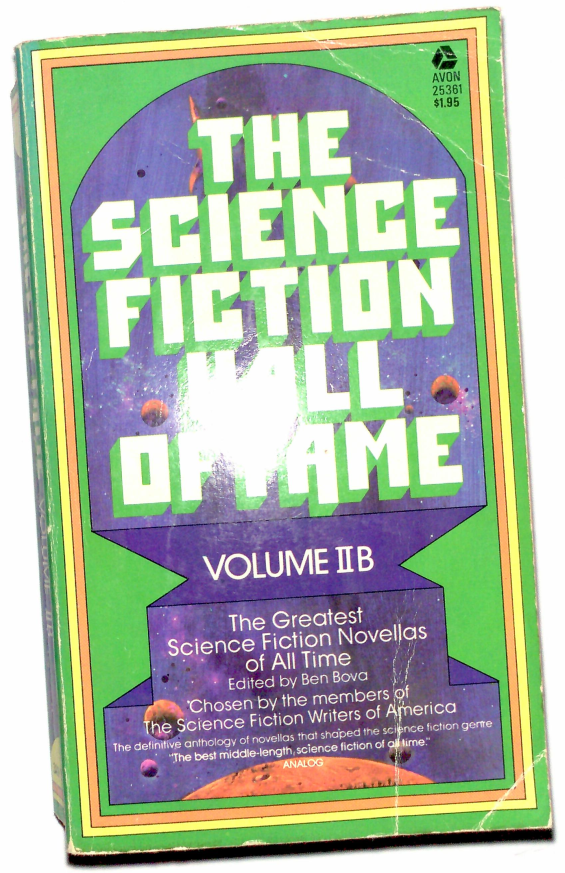
The Science Fiction Hall Of Fame, Volume II, B

Posted by Jesse Willis
Review of Steel by Richard Matheson (from Steel And Other Stories)

SFFaudio Review

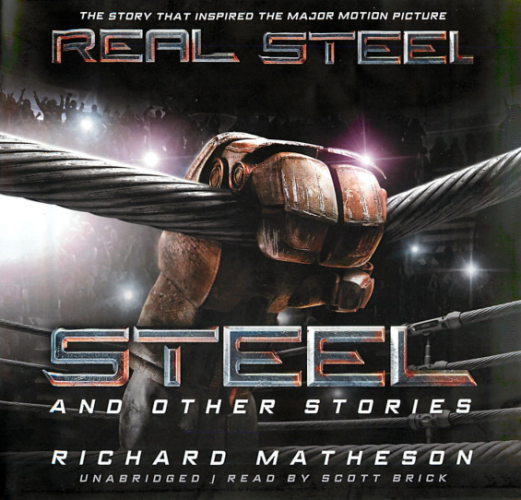
BLACKSTONE AUDIO - Steel And Other Stories by Richard MathesonSteel And Other Stories – Steel
By Richard Matheson; Read by Scott Brick
Approx. 59 Minutes [UNABRIDGED]
Publisher: Blackstone Audio
Published: 2011
ISBN: 1455112127
Themes: / Science Fiction / Boxing / Robots /

Steel, a novelette, was first published in the May 1956 issue of The Magazine of Fantasy & Science Fiction.
The editorial introduction preceding it described Steel as a “tale of strength and endurance” and as “a science fiction sports story so realistic, simple and powerful that it should prove moving even to sports-loathing readers who have never let a boxing bout darken their television screens.” The story would just a few years later, in a 1963 adaptation as an episode of the Twilight Zone brighten the living rooms of many. And, in 2011 it would inspire the big budget movie Real Steel. So, how does the original novellete, stand up to repeated blows of history?

Pretty well. If you like Matheson’s writing Steel is definitely worth hearing. This story captures in a relatively short space the oddity, the kind of quirk that Matheson seems forever working on. It’s something I’ve noticed in practically every story by Matheson that I’ve read. His main characters always seem to want to make a human connection with strangers, and in their efforts to do so always fail – and always for the same reason. In their desire to be heard, and be understood, they always disregard the needs and desires of those strangers. I’ve never seen a writer tackle anthing like this, over and over, like Matheson always seems to. Let’s tale Steel as our example. One of the two main characters, Paul, goes to great lengths to get engage an uninterested stranger in a conversation about the exploits of his dilapidated robot boxer. That the stranger, who doesn’t know anything about boxing, doesn’t care about boxing, and has never even heard of Paul’s robot, is obviously completely uninterested in what Paul is saying. This doesn’t seem to occur to Paul. It’s as if Paul’s own need to reach out and be heard – to be something – is greater than the interests of the stranger – whatevber those interests might be. It’s not so much a Science Fiction issue as it is an existential one. It’s almost as if Matheson is using his fiction to try to find a way to navigate around a massive blind spot in human relations. Like in his novel The Incredible Shrinking Man Matheson has the plot of Steel be a manifestation of a character’s internal difficulties.

Scott Brick narrates this bare bones dialogue driven story. I’m often ambivalent about Brick’s narrations. Sometimes he works for me, sometimes he doesn’t – and I think I’ve finally realized why. Brick is excellent at delivering emotion. But if the emotion is from a third person perspective it comes across as too operatic. But, if the story is told in first person perspective then it work well. In Steel there are basically only two voices – Paul’s and Kelly’s. And when Brick voices either one I can’t readily enough distinguish difference between them. Yet when a story is told in first person Brick’s narration really works. Take this sample |MP3| from Nelson DeMille’s The Lion’s Game (which is first person perspective). And now compare it with this |MP3| from Steel.

I came away feeling somewhat unsatisfied with Steel. It’s not that the story is uninteresting, or unoriginal, Steel is both original and interesting. Kelly and Paul are a pair of boxing enthusiasts – and I’m more of an enthusiast of ideas. There’s just not enough intellectual heft to their journey. I think The Twilight Zone adaptation, penned by Matheson himself and starring Lee Marvin, does the story better mostly because it’s a lot quicker too it. The movie version is hardly an adaptation, being much more of a family father and son traditional conservative values tale than an existential exploration. None of versions of the story did what I wanted them to do, namely get into the robot’s POV. The fact that none of the adaptations treat the robot as anything other than an external manifestation of their root interests is kind of depressing. But then again, I don’t go to Matheson for uplifting, I like his depressing ideas.

Posted by Jesse Willis
Moxon’s Master by Ambrose Bierce

SFFaudio Online Audio

Moxon's Master by Ambrose Bierce

I’m not a very good chess player, but I love playing. There’s a an elegance and a simplicity to the basics of it. And from those basic rules an incalculable complexity emerges – one that makes every game different. But I don’t much like playing against a computer. There’s little sense of victory if I win and if I lose I tend to question the point in playing at all. There’s something about pitting a mind against a mind – and most chess programs I’ve played against don’t seem to have one.

Moxon’s Master, by Ambrose Bierce, is about chess. It uses some basic analogies and metaphors – in just the way H.G. Wells does so well to make the implausible sound plausible. Bierce wields facts about plant tropism and Herbert Spencer’s definition of life in a skillful argument for machine intelligence. It’s rather masterful actually!

LibriVoxMoxon’s Master
By Ambrose Bierce; Read by Roger Melin
1 |MP3| – Approx. 28 Minutes [UNABRIDGED]
Publisher: LibriVox.org
Published: May 2, 2012
First published in the San Francisco Examiner, April 16, 1899.

|PDF|

[Thanks also to Laura Victoria and Barry Eads]

Posted by Jesse Willis