Review of Winterfair Gifts by Lois McMaster Bujold

SFFaudio Review

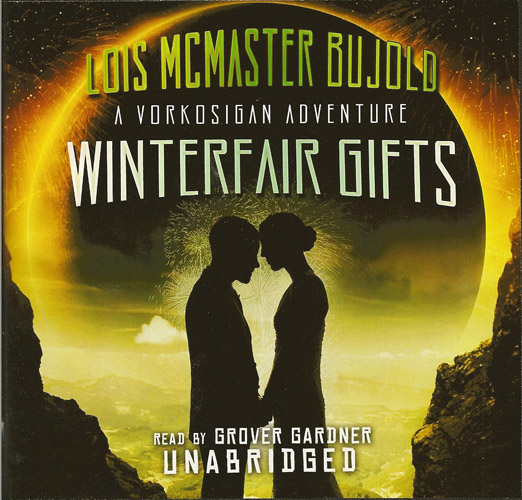
Science Fiction Audiobook - Winterfair Gifts by Lis McMaster BujoldWinterfair Gifts
By Lois McMaster Bujold; Read by Grover Gardner
2 CDs – 2.5 Hours [UNABRIDGED]
Publisher: Blackstone Audio
Published: 2008
ISBN: 9781433250170
Themes: / Science Fiction / Romance / Genetic Engineering / Crime /

This Hugo-nominated novella adds a delightful extra chapter to Bujold’s Vorkosigan series, describing the wedding of Miles and Ekaterin and events leading up to it. In the festive season of Winterfair on the planet Barrayar, Lord Miles Vorkosigan is making elaborate preparations for his wedding. The long-awaited event stirs up romance and intrigue among his eccentric family and friends, particularly for bioengineered space mercenary Sergeant Taura and shy, diffident Armsman Roic. But Miles also has an enemy who is plotting to turn the romantic ceremony into a festival of death.

I generally like most of the things I read. This is probably because I pick what I’m going to read fairly carefully. It’s rare when I sit down with an a book and it isn’t something I’ve already read something about. One of the things that tends to keep me away from a book is an excessive length. I find far too much of today’s fiction overly wordy. I want the ideas in the book, the experiences, I don’t need to see it hit a certain pagecount. The style of the moment is to go long. Often this leads to entirely pointless writing within a story. It’s like I’m Paul Newman in Fat Man And Little Boy. My mantra is: “Just give it to me.” Give me the story – don’t flower it up or string it out. Just give me the bloody story!

Lois McMaster Bujold doesn’t bloat out her stories. This audiobook, a novella, is a good example of that economy. Sure it’s part of a series, but it can and does stand alone. The story is slowly paced, but not slow to read. Readers, like me, who haven’t been oh-so-carefully following the Miles Vorkosigan adventures can still follow the story of any particular novel (or novella) and enjoy it for what it is – a good read. Those who have been following along carefully, and who pick up on some of the timeline and character clues, will probably get an extra bit of enjoyment out of it.

Bujold is one of the few female SF authors I have no problem reading. This is despite her coming at SF from what I see as a very female point of view. Emotion, humor and romance are key for Bujold. Character, something I usually don’t care that much about, is also one of Bujold’s major strengths. In this novella, we get two minor Vorkosigan players meeting and working together for the first time. Its mostly a character piece – with the mechanics of the crime and the science fictional elements taking a serious back seat to a budding romance. It’s the same sort of work/romance thing you get in Bones and Moonlighting. Nobody enjoys those stories for the groundbreaking writing. Now that may sound like I’m damning Winterfair Gifts with faint praise. I’m really not. Winterfair Gifts is fun, skillful storytelling set in an SF universe. This is a gentle romance with a bittersweet twist. A romance story dudes can enjoy. Bujold is a fine writer and Winterfair Gifts is a damn fine audiobook. Consider this fresh series as an alternative to the increasingly devalued Dune series.

Sergeant Taura and Armsman Roic, two trusted members of the extended Vorkosigan security services (and everyone else in this book) are voiced by veteran narrator Grover Gardner. Gardner is one of the old school narrators who long time audiobook fans just love to listen to. His voice is rather odd, almost sounding artificial – but not at all in a bad way. Audiofile Magazine has a quote describing his voice as “sandpaper and velvet” – which really doesn’t tell you much – unless you’ve heard his voice. He’s a skilled narrator and is well chosen for the Vorkosigan saga.

Posted by Jesse Willis

FREE @ Audible.com – My Soul To Lose by Rachel Vincent

SFFaudio Online Audio

Harlequin Books has been releasing audiobooks through Audible.com for a while now. They’ve even got an official webpage for their wares. What is new is that they’ve got a new “paranormal romance” series aimed at teenagers. It’s called “SOUL SCREAMERS.” Is this the start of a new sub-genre? A Sweet Valley High with witches? A Buffy with pining? Is there a market for YA Paranormal Romance? Would PG-13 Anita Blake interest you? If so, Audible.com’s got a novelette length tale to try out for free…

My Soul To Lose by Rachel VincentMy Soul to Lose
By Rachel Vincent; Read by Amanda Ronconi
Audible Download – Approx. 1 Hour 48 Minutes [UNABRIDGED]
Publisher: Harlequin Audio
Published: 2009
Provider: Audible.com
Kaylee Cavanaugh’s trip to the mall ends with a brutal panic attack and a brainscrambling shriek she can’t stop. Her secret fear is exposed. It’s the worst day of her life. Until she wakes up in the psychiatric unit. But the hospital isn’t a safe place for Kaylee, and getting out won’t be easy because everyone thinks she’s crazy. Everyone except Lydia, who has a secret of her own…

Here’s a sample |MP3|.

There’s a |PDF| version available too.

[via Mary Burkey’s Audiobooker Blog]

Posted by Jesse Willis

Review of Elantris, Part 1 by Brandon Sanderson

SFFaudio Review

We are so pleased to post this review by Susan Dunman, aka AudiobookDJ. You can find her at her wonderful AudiobookDJ blog, or over at SF Site talking audio. Thanks Susan!

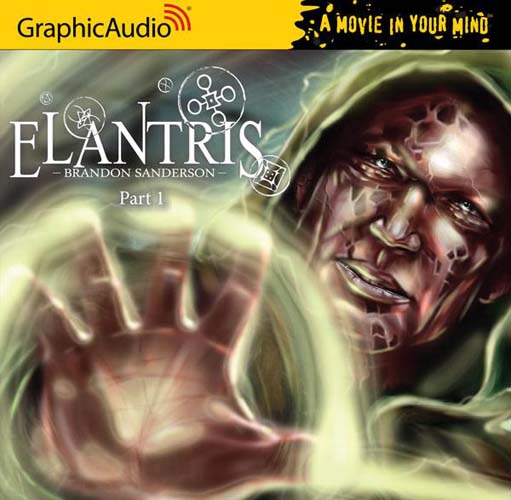
Fantasy Audiobook - Elantris Part 1 by Brandon SandersonElantris, Part 1
By Brandon Sanderson; Performed by a Full Cast
Adaptation by Johann Dettweiler
6 CDs – 7 hours – [AUDIO DRAMA]
Publisher: Graphic Audio
Published: 2009
ISBN: 9781599505558
Themes: / Fantasy / Audio Drama / Religion / Romance / Leadership / Magic /

Elantris was once the city where all men dreamed of living. Full of magic and marvels, its citizens were godlike in their appearance and had superhuman abilities. But now, Elantris is a place for the damned, offering only misery and despair for those unfortunate enough to be locked inside the walled city.

For something is terribly wrong with the Dor, a mysterious force that randomly and instantaneously changes individuals from mortals to immortals. Now that change, called the shaod, transforms people, not into gods, but into grey-skinned, hairless creatures whose bodies cannot heal from wounds or illness. However, those same pain-racked bodies cannot die and are banished to the crumbling city of Elantris, away from the “normal” population of Arelon.

The Crown Prince of Arelon awakens one morning to find his skin covered in the black splotches that are the first signs of the shaod’s transforming power. That same day his father orders the priests to perform a funeral service and send Prince Raoden to Elantris – a fate that befalls all who are considered “dead” after their transformation because they cease to have a heart-beat and do not need food or water to survive.

This turn-of-events is not only disastrous for Prince Raoden, but also for his fiancee, Princess Sarene. She has just arrived from a neighboring country to meet her soon-to-be husband for the first time. Serene is only told that the prince is dead – not that he has been condemned to Elantris. But the suspicious Serene decides to remain in Arelon despite her betrothed’s death, vowing to uncover the truth about Prince Raoden’s untimely demise.

This sets the stage for listeners to experience a remarkable story – made even more enticing by this audio adaptation. With a full compliment of narrators (28 to be exact), sound effects and background music, listeners can hear a three-dimensional production of Sanderson’s work – it’s like wearing 3-D glasses for your ears. To do justice to the book, this adaptation is produced in three parts, each approximately seven hours long.

I know some audiobook fans prefer single voice narration, but if you do enjoy audio drama, or have never tried it, then you should listen to a Graphic Audio production. The sound effects can be powerful,
but only rarely do they invade the narrator’s sound space. In addition, the background music really sets the tone for the various scenes. And if you listen closely, you might find surprises. For example, in one ballroom scene, the music playing softly in the background is The Blue Danube Waltz, making me wonder if Johann Strauss, Jr. had done some kind of universe/time shift maneuver to get his music played in Arelon.

Elantris was Sanderson’s first published work, coming out in April of 2005. He explores themes of love, politics, religion, and eternity in intriguing and imaginative ways. This audio production compliments his work in a very satisfying way and I’m looking forward to hearing part two!

Note: For those who do prefer single-voice narration, Recorded Books offers an unabridged narration by Jack Garrett.

Posted by Susan Dunman

Forgotten Classics: The Moon-spinners by Mary Stewart

Aural Noir: Online Audio

Forgotten ClassicsOn her latest Forgotten Classics podcast my friend Julie Davis has an excerpt from a 1962 novel by Mary Stewart called The Moon-spinners.

Young, beautiful and adventurous, Nicola Ferris loves her life as a secretary at the British Embassy on the lush island of Crete. Then, on her day off, she links up with two hiking companions who have inadvertently stumbled upon a scene of blood vengeance. And suddenly the life Nicola adores is in danger of coming to an abrupt, brutal, and terrifying end…

Wikipedia says Stewart is one of the founders of the “romantic suspense subgenre” which blends romance with mystery. She also wrote a bunch of King Arthur/Merlin novels. Chivers Audio (now called BBC Audiobooks) recorded a bunch of unabridged Mary Stewart novels back in the 1980s and 1990s, they’re rather hard to find now and quite collectible.

Going back to the podcast – I always dig Julie’s picks as they’re typically something I’ve never read and at the same time well worth reading. The one drawback, her podcasts tend to make me hungry. Have a listen |MP3|.

Subscribe to the feed:

http://huffduffer.com/JulieD/rss

iTunes 1-Click |SUBSCRIBE|

Posted by Jesse Willis

Review of White Witch, Black Curse by Kim Harrison

SFFaudio Review

White Witch, Black Curse by Kim HarrisonWhite Witch, Black Curse
By Kim Harrison; Read by
Marguerite Gavin
15 CDs – Approx. 18 hours [UNABRIDGED]
Publisher: Blackstone Audio
Published: 2009
ISBN: 1433270314
Themes: / Fantasy / Urban Fantasy / demons / vampires / banshees / pixies / memory / detective / romance /

White Witch, Black Curse is the seventh entry in Kim Harrison’s Hollows series, also called the Rachel Morgan series after its protagonist. For the sake of full disclosure, I should state that I haven’t read the previous books in the series. It’s a testament to Harrison’s storytlling that I was still able to jump into the tale with only a minimal perusing of Wikipedia for character background. That said, purists will probably want to start with the first book in the series,  Dead Witch Walking, as indeed I intend to do.

Rachel Morgan is a witch who, along with her vampire companion Ivy Tamwood, runs a supernatural investigative agency called Vampiric Charms. She’s the supernatural equivalent of Janet Evanovich’s Stephanie Plum. Modern Cincinatti, in Harrison’s alternate history world, knows of the existence of supernatural beings, collectively dubbed inderlanders. Two federal agencies, the human-staffed Federal Inderlander Bureau and the otherworldly Inderlander Services security agency, maintain relations between the human world and that of the “ever-after” whence all other races came. Vampires, pixies, witches, and other strange beings walk the streets of Cincinatti, and not once in White Witch, Black Curse does their presence pass for comment among the book’s human characters. This marks a refreshing departure from other urban fantasy I’ve read, in which supernatural beings live underground, beyond the awareness of most everyday people.

As the novel opens, Rachel is attempting to solve the murder of her vampire boyfriend Kisten. In theory, this shouldn’t pose a problem, since she was present when the crime took place. But someone, somehow, has wiped her memory of that night’s events, and as she examines the crime scene she experiences only brief flashes of recollection and insight. A recent string of attacks apparently connected to a banshee also calls for her attention. As in most mysteries, these seemingly separate plotlines inevitably intersect at certain points as the novel progresses. The narrative hits several satisfying crescendos and climaxes throughout the book, but on the whole the plot plods along without any clear impetus to drive it forward.

The depth and dynamism of protagonist Rachel Morgan, however, redeems the novel from its mediocre plot. Like many heroines of urban fantasy and paranormal romance, she’s a badass. Unlike many other heroines, her character is balanced by a believable measure of insecurity, self-doubt, and even a hint of self-loathing. As a witch, she’s mostly confident in her magical abilities, but even in this realm she sometimes expresses hesitance. In the sphere of romance, she questions her suitability as a partner, calling herself an “albatross” who brings ruin upon those upon whom she bestows her love. No doubt this has something to do with the death of her former lover Kisten, and events in earlier novels might well bear this belief out as well. She also exhibits the tendency to rush bullheadedly into situations without considering the implications for herself or her circle of friends.

And Rachel is blessed with fast friends, family,  and other acquaintances who don’t comfortably fit into a single category. The unlikely highlight among the cast of supporting characters is the pixie Jenx, who often accompanies Rachel on her adventures. The foul-mouthed, irreverent little guy at first appears to serve as nothing more than comic relief, flitting around on a trail of pixie dust and spouting clever obscenities. Yet he stands–flutters?–by her when the going gets tough and many others have abandoned her.

The emotional textures of White Witch, Black Curse further offset the deficit of the novel’s mediocre plot. Rachel’s relationships seldom develop in predictable ways. Her friendships with her partner Ivy, FIB agent Captain Edden, and even the pixie Jenks, all come under occasional strain. The Morgan family dynamics are alo fraught with tension. And then there’s the romance. Rachel seldom devolves into the weak-kneed, crooning damsel of other romance novels. For the most part, she’s remarkably intellectual and circumspect in approaching relationships.

The book’s emotional power even extends to its magic. While not particularly organized or systematic in any “scientific” sense, the magic of the Hollows also hinges on feelings. FIB psychologist Ford has the empathic gift of reading emotional states of those around him. Auras also figure heavily into the plot as an external representation of a character’s internal state. Even a character of sound physical health might be in danger if their aura has been weakened by a recent traumatic experience.

Marguerite Gavin’s performance of White Witch, Black Curse isn’t the best audio rendition of urban fantasy I’ve heard, but it certainly does Harrison’s writing justice. Again, Jenx the pixie is the standout; she lends a nasal, sing-song voice to the spry winged creature which sparkles nearly as much as he does. On the whole, though, the best I can really say about Gavin’s performance is that it’s unobtrusive.

Fans of Kim Harrison’s Hollows series will find White Witch, Black Curse a satisfying continuation to the series. Urban fantasy and paranormal romance enthusiasts will also likely find much to like in Harrison’s unique world. Hardcore fantasy readers, on the other hand, might find themselves put off by a hit-and-miss plot and a lack of any real intellectual depth. Still, the book’s strong characters and emotional power make it a good candidate for some fun summertime reading.

Posted by Seth Wilson

Review of Witchling by Yasmine Galenorn

SFFaudio Review

Greetings fellow SFFaudio readers! I just thought I’d introduce myself as one of the new geeks slated to post reviews for the site. I’m legally blind, and have relied on SFFaudio for years to direct me to fantasy and SF audio, from new blockbuster releases to hidden diamonds in the rough scattered around the Interwebs. I’m therefore thrilled to be contributing to the site, and look forward to giving something back to this awesome community. Okay, that should suffice for an introduction–now on to the review!

Witchling by Yasmine GalenornWitchling
By Yasmine Galenorn; Read by Cassandra Campbell
Audible Download – 10 Hours [UNABRIDGED]
Publisher: Tantor Media
Published: 2008
Themes: / Supernatural Romance / Urban Fantasy / Vampires / Dragons / Faeries / Seattle /

I was a little hesitant to delve into Yasmine Galenorn’s Sisters of the Moon series, since it’s generally categorized as “supernatural romance”. Yes, this shows contempt prior to investigation on my part. I’ve never read any “paranormal romance”, or much “romance” at all, for that matter. Yet from the first page, I found myself enjoying the world and characters of Witchling. The book reaffirms my belief that genre labels like “paranormal romance” have more to do with marketing convenience than actual substance.

“Urban fantasy” hits nearer the mark. The events of Witchling unfold in Seattle and the surrounding countryside, including the stunning Mount Rainier. The story follows the three D’Artigo sisters, half-human half-faerie beings from Otherworld who conduct work for the Otherworld Intelligence Agency (OIA) to keep their homeland safe. The murder of Jocko the gentle giant by a demon sets the detective-story plot in motion, told through the voice of witch Camille D’Artigo.

For the most part, the pages of Witchling are populated with fantasy staples. Delilah D’Artigo is a changeling able to transform into a tabby cat, and the third sister Menolly was changed into a vampire. Dragons, demons, and sprites also lumber, skulk, and flit about. Though these might seem trite and cliché, Galenorn lends them all enough life and originality that they seldom detract from the story. More inventive figures also make appearances, most notably the Japanese kitsune (fox) demon Morio.

Like other first-person urban fantasy books I’ve read, Witchling’s style is contemporary, witty, and laced with humor. Despite hailing from Otherworld, Camille has apparently spent enough time on Earth to learn its ways, its slang, and its pop culture references, which she uses to good effect in her speech and exposition. The sprightly writing more than makes up for the slow pacing in the book’s first half. In fact, I really enjoyed the dialogue-driven, character-based opening chapters.

While at its heart Witchling is a fun trans-dimensional detective story, it does touch, in a desultory way, on some more serious themes. Since the D’Artigo sisters are half-bloods, born of a human mother and faerie father, they face prejudice and discrimination from both sides of the race divide. Sadly, this dynamic seldom crops up in the plot, but Camille does occasionally reflect on its ramifications for her family.

And, yes, there is romance. Throughout the novel, Camille is preoccupied to some degree with her love life, and this subplot moves apace with the main narrative thread. I found Camille’s libidinous mental musings distracting from the story at times, but overall the romantic scenes and trajectory fit the book’s tone.

Likable characters, an engrossing plot, and smart, snazzy, sexy writing make Witchling an enticing read. Hints throughout the novel and especially during its conclusion reveal that the events depicted are but the tip of the iceberg in an impending battle between faeries and demons, a battle in which it’s likely that humanity will become embroiled. I look forward to exploring Galenorn’s universe further in the sequel Changeling, which it appears is told from the perspective of werecat Delilah D’Artigo.

Cassandra Campbell’s narration of Witchling is solid but uninspired. She imbues a real sense of emotion into the characters, especially the three D’Artigo sisters. The novel’s contemporary style and numerous pop culture references flow naturally into her narration. Campbell sometimes has a tendency to drift into melodrama, however, and the male villains seem particularly overdrawn. On the whole, though, Campbell handles the material well.

For more information on Sisters of the Moon and Yasmine Galenorn’s other projects you can follow her on Twitter.

Posted by Seth Wilson