Recent Arrivals: AudioGo: H.P. Lovecraft’s Book Of The Supernatural edited by Stephen Jones

SFFaudio Recent Arrivals

Recently arrived, and currently being soaked in through my skin and ears, is this giant collection of weird fiction. Assembled from a list of stories found in H.P. Lovecraft’s essay Supernatural Horror In Literature, it is a collection of well known and obscure classics by authors that H.P. Lovecraft loved.

Looking at the table of contents I noted that I’d already read several of the stories in this collection – including The Turn Of The Screw (we did a podcast about that one), the engimatic Christmas horror Markheim, the scientific ghost tale What Was It?, the unutterably creepy and horrific The Voice In The Night very recently, and many years ago, perhaps in high school, The Yellow Wallpaper. But even though I’ve read some of these stories already I’m still very excited. Each of the stories seems to be preceded by some relevant words by Lovecraft himself – and at the very least I will be listening to the mini-introductions to those stories I am well familiar with.

Until then I will content myself in listening to the unknown ones. For example, the frightful first person narrative of Who Knows? by Guy de Maupassant is thrilling and wondering me in the exact same way The Horla almost exactly one year ago. It’s wonderful!

AUDIO GO - H.P. Lovecraft's Book Of The Supernatural edited by Stephen Jones

H.P. Lovecraft’s Book Of The Supernatural
Edited by Stephen Jones; Read by Bronson Pinchot, Stephen Crossley, Davina Porter, Madeleine Lambert, Mark Peckham
MP3 DOWNLOAD – Approx. 16 Hours 44 Minutes [UNABRIDGED]
Publisher: AudioGo
Published: August 1, 2012
Written by arguably the most important horror writer of the twentieth century, H.P. Lovecraft’s 1927 essay Supernatural Horror in Literature traces the evolution of the genre from the early Gothic novels to the work of contemporary American and British authors. Throughout, Lovecraft acknowledges those authors and stories that he feels are the very finest the horror field has to offer: Washington Irving, Edgar Allan Poe, Henry James, Rudyard Kipling, Bram Stoker, Robert Louis Stevenson, Guy de Maupassant, Ambrose Bierce, and Arthur Conan Doyle, each prefaced by Lovecraft’s own opinions and insights in their work. This chilling collection also contains Henry James’ wonderfully atmospheric short novel…The Turn of the Screw. For every fan of modern horror, here is an opportunity to rediscover the origins of the genre with some of most terrifying stories ever imagined.

Here’s the table of contents:
Introduction by editor Stephen Jones – Approx. 7 Minutes
Notes on Writing Weird Fiction By H.P. Lovecraft – Approx. 11 Minutes
The Tale of the German Student by Washington Irving – Approx. 14 Minutes
Markheim by Robert Louis Stevenson – Approx. 49 Minutes
Who Knows? by Guy de Maupassant – Approx. 34 Minutes
The Invisible Eye by Erckmann-Chatrian – Approx. 41 Minutes
The Torture by Hope by Villiers de l’Isle Adam – Approx. 15 Minutes
Ms. Found in a Bottle by Edgar Allan Poe – Approx. 29 Minutes
What Was It? by Fitz-James O’Brien – Approx. 34 Minutes
The Middle Toe of the Right Foot by Ambrose Bierce – Approx. 24 Minutes
The Turn Of The Screw by Henry James – Approx. 4 Hours 52 Minutes
The Dead Smile by F. Marion Crawford – Approx. 57 Minutes
The Wind In The Rose-Bush by Mary E. Wilkins-Freeman – Approx. 38 Minutes
The Yellow Wallpaper by Charlotte Perkins Gilman – Approx. 36 Minutes
The Recrudescence of Imray by Rudyard Kipling – Approx. 30 Minutes
The Hands Of Karma (Ingwa-banashi) by Lafcadio Hearn – Approx. 11 Minutes
The Burial Of The Rats by Bram Stoker – Approx. 1 Hour 7 Minutes
The Red Lodge by H.R. Wakefield – Approx. 35 Minutes
The Captain Of The Pole-Star by Sir Arthur Conan Doyle – Approx. 1 Hour 6 Minutes
The Villa Desiree by May Sinclair – Approx. 28 Minutes
The Voice In The Night by William Hope Hodgson – Approx. 36 Minutes
Novel of the White Powder by Arthur Machen – Approx. 48 Minutes

Posted by Jesse Willis

New Releases: AudioGo: H.P. Lovecraft’s Book Of The Supernatural

New Releases

AUDIO GO - H.P. Lovecraft's Book Of The Supernatural edited by Stephen Jones

H.P. Lovecraft’s Book Of The Supernatural
Edited by Stephen Jones; Read by Bronson Pinchot, Stephen Crossley, Davina Porter, Madeleine Lambert, Mark Peckham
MP3 DOWNLOAD – [UNABRIDGED]
Publisher: AudioGo
Published: August 1, 2012
Written by arguably the most important horror writer of the twentieth century, H. P. Lovecraft’s 1927 essay Supernatural Horror in Literature traces the evolution of the genre from the early Gothic novels to the work of contemporary American and British authors. Throughout, Lovecraft acknowledges those authors and stories that he feels are the very finest the horror field has to offer: Washington Irving, Edgar Allan Poe, Henry James, Rudyard Kipling, Bram Stoker, Robert Louis Stevenson, Guy de Maupassant, Ambrose Bierce, and Arthur Conan Doyle, each prefaced by Lovecraft’s own opinions and insights in their work. This chilling collection also contains Henry James’ wonderfully atmospheric short novel…The Turn of the Screw. For every fan of modern horror, here is an opportunity to rediscover the origins of the genre with some of most terrifying stories ever imagined.

The audio sample says it includes “20 classics of the macabre.” I’ll try to get a list.

Here’s the TOC:

an introduction by editor Stephen Jones
Notes on Writing Weird Fiction By H.P. Lovecraft
The Tale of the German Student by Washington Irving
Markheim by Robert Louis Stevenson
Who Knows? by Guy de Maupassant
The Invisible Eye by Erckmann-Chatrian
The Torture by Hope by Villiers de l’Isle Adam
Ms. Found in a Bottle by Edgar Allan Poe
What Was It? by Fitz-James O’Brien
The Middle Toe of the Right Foot by Ambrose Bierce
The Turn of the Screw by Henry James
The Dead Smile by F. Marion Crawford
The Wind in the Rose-Bush by Mary E. Wilkins-Freeman
The Yellow Wallpaper by Charlotte Perkins Gilman
The Recrudescence of Imray by Rudyard Kipling
The Hands of Karma (Ingwa-banashi) by Lafcadio Hearn
The Burial of the Rats by Bram Stoker
The Red Lodge by H.R. Wakefield
The Captain of the Pole-Star by Sir Arthur Conan Doyle
The Villa Desiree by May Sinclair
The Voice in the Night by William Hope Hodgson
Novel of the White Powder by Arthur Machen

[Thanks Amy!]

Posted by Jesse Willis

Damon Knight discusses early Science Fiction

SFFaudio News

James Gunn filmed this interview with Damon Knight sometime in the 1960s, it features Knight discussing Science Fiction from a time when there was no name for it. He begins with stories of of moon voyages (Lucian, Cyrano de Bergerac) and moves on to 19th century authors Edgar Allan Poe and Jules Verne.

H.G. Wells, Frank Herbert, Isaac Asimov, Rudyard Kipling, Hugo Gernsback, Jack Williamson, Edmund Hamilton, Olaf Stapeldon, E.E. Smith, and J.R.R. Tolkien are the focus for this second half…

[via AboutSF]

Posted by Jesse Willis

The SFFaudio Podcast #138 – AUDIOBOOK/READALONG: The Crawling Chaos by Winifred V. Jackson and H.P. Lovecraft

Podcast

The SFFaudio PodcastThe SFFaudio Podcast #138 – The Crawling Chaos by Winifred V. Jackson and H.P. Lovecraft, read by Wayne June. This is a complete and unabridged reading of the short story (21 Minutes) followed by a discussion of it (by Jesse, Tamahome, Jim Moon and Wayne June). Here’s the ETEXT.

“In The Crawling Chaos the narrator flees inland, taking his adjectives with him.” -L. Sprague de Camp (from Lovecraft: A Biography)

Talked about on today’s show:
Wayne June is still alive!, first impressions of The Crawling Chaos, Wikipedia’s plot summary of The Crawling Chaos, dream logic, an opium vision, the tripiness, the philosophy behind The Crawling Chaos, The Haunted Palace by Edgar Allan Poe, the self as a haunted palace, Poe is so 19th century, The Raven, The Fall Of The House Of Usher, entropy, there is no meaning in this uncaring universe, “and all the planets mourned”, you’d need a lot of Prozac (or opium) to go through a life like that, the catharsis of apocalypse, a cosmic apocalypse, the plot is a jumble of junk, the biblical echoes, “only the gods reside there” (in Teloe), a very old testament vibe, “lest you turn into a pillar of salt”, the protagonist is us (mankind), Lovecraft’s recurring themes, the ordinary man who swaps places with another, The Shadow Out Of Time, Polaris, Beyond The Wall Of Sleep, transcendental mind-swap stories, the story was a pseudonymous collaboration between Elizabeth Berkley (aka Winifred V. Jackson) and Louis Theobald, Jun. (aka H.P. Lovecraft), Nyarlathotep, “send me some money”, a lot of dross with a powerful effect, “the year of the plague”, the “oriel window” is an eyeball!, “calm down Howard”, “he’s in his own brain”, who or what is “the crawling chaos”?, the ocean pounding is his heart beating, “We’re all doomed!”, what is the crawling chaos?, S.T. Joshi, Rudyard Kipling, the peninsular beach house, Tiger Tiger (from The Jungle Book), The Tyger by William Blake, is the beautiful youth Mowgli?, who are “they”?, a fawn faced youth, Weena from H.G. Wells’ The Time Machine, did Winifred read The Time Machine before sleep?, what is the meaning of “Teloe”? is it teleology, reaching for meaning or purpose and losing it, Amber and Chalcedony, pleasure barges bound for blossomy Cytheron, Liquid Gold, Lord Dunsany, the heavenly host, the destruction of the physical (the corpse-like clay), black clouds like vultures, Supernatural Horror In Literature by H.P. Lovecraft, “the oldest and strongest emotion of mankind is fear”, City In The Sea by Edgar Allan Poe, opium addiction, why opium?, Confessions Of An English Opium-Eater by Thomas De Quincey, Charles Baudelaire, a waking dream, if the story was written in the 1960s…, LSD, morphine and Morpheus (dream), a waking dream, Aldous Huxley, Timothy Leary, The Doors Of Perception, out of Plato’s cave, Philip K. Dick, mindset and environment, mescaline, dreams vs. drug trips, journeys into the unconscious, Mouthpiece by Edward Wellen, decoding the death ravings of Dutch Schultz (HERE), William Burroughs, Robert Anton Wilson, “French Canadian Bean Soup”, stream of unconsciousness, Frances vs. French people, “swimming through New York”, The Librarian TV series, “perfectly ordinary strange adventures”, puns are big for the subconscious, Samuel R. Delany, Groucho Marx.

The Tyger by William Blake

The United Co-Operative, April 1921 - The Crawling Chaos

Posted by Jesse Willis
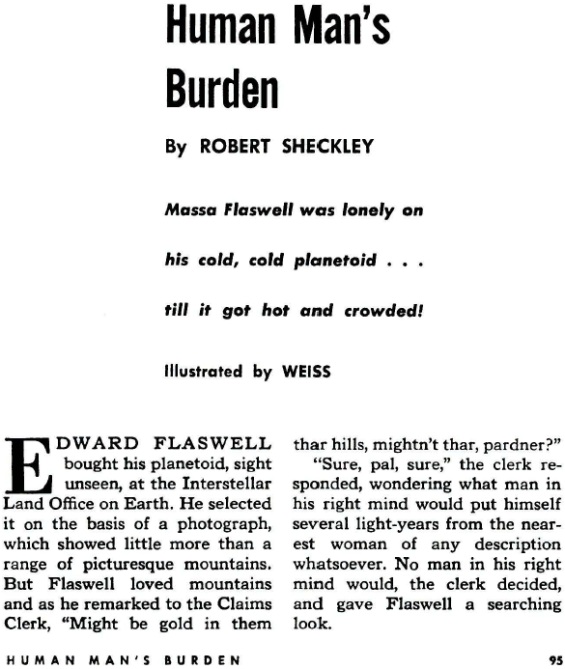
The SFFaudio Podcast #130 – READALONG: Human Man’s Burden by Robert Sheckley

Podcast

The SFFaudio PodcastThe SFFaudio Podcast #130 – Scott, Jesse, Tamahome and Jenny discuss Human Man’s Burden by Robert Sheckley.

Talked about on today’s show:
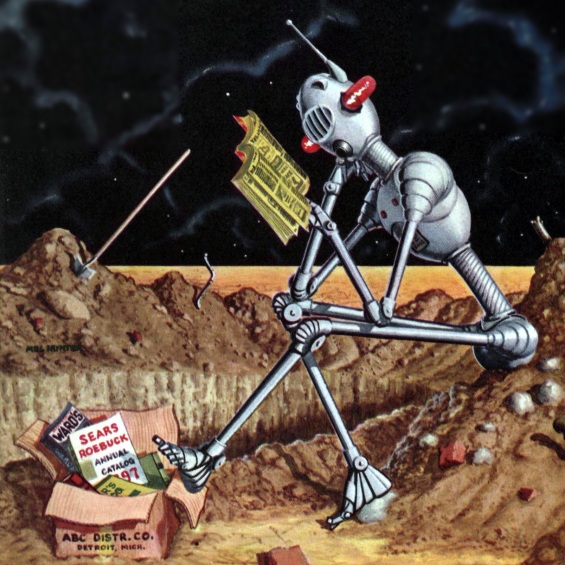
uppity damn robots, hilarious characterization, soulless robots, Galaxy Magazine September 1956, Star Trek, Harry Mudd, Sears Roebuck catalogues, freeze dried vs. flash frozen, Kiln People by David Brin, The Twilight Zone episode “The Lonely“, robot wives, manufactured fingernails, center of gravity, “could she have been a robot?”, Gunga Sam the foreman robot, duenna is Portuguese for chaperone, Gunga Din, the Writing Excuses podcast with Lou Anders, HuffDuffer, John Scalzi, Casablanca, The Dark Knight, Edward Flaswell, “Sure pal. Sure.”, Frontier Bride, mail order bride, freeze dried preacher, programmed by “a human supremacist of the most rabid sort”, was Flaswell talked into feeling bad, what is the Human Man’s Burden?, is it all a marketing ploy?, The Mote In God’s Eye, the Gold Rush, why is the combustion god?, “Him strong him good, believe me brothers, it is even as I say.”, Rudyard Kipling poem’s The White Man’s Burden, the justification for empire, satire, the page 99 illustration, labeling people, ultra deluxe model bride, “oil glistened on their honest faces”, Tama can prove the robots are having sex, “in their carefree robot fashion”, a series of robots on the moon ordering from Sears Roebuck catalogues (15 F&SF covers by Mel Hunter), Charles van Doren, face-parts, “the robot frontier”, Asteroids in fiction (Wikipedia entry), TZ ep.: “Two“, Dumb Martian by John Wyndham, TZ ep.: “The Lateness Of The Hour“, android vs. gynoid, Firefly, Gunga Sam knows best, Sheila was down-selling herself, this is a feminist story?, Human Man’s Burden could be a cartoon, Kindles/Xboxes/Wiis/PS3s are sold as cheaply as possible because of the profit being in the media they play, iTouch vs. iPhone, free robots in our homes selling moon makers and solidovisions, nesting dolls, Human Man’s Burden probably isn’t public domain, Psycho by Robert Bloch, The Status Civilization, Seventh Victim, Mindswap, Warrior Race, The Space Merchants, Blackstone Audio, Charles Stross, Altered Carbon by Richard K. Morgan.

ISFDB publication history for Human Man’s Burden HERE.

Human Man's Burden by Robert Sheckley - Page 95 - Galaxy Science Fiction magazine, September 1956

Human Man's Burden by Robert Sheckley - ilustration by Weiss

Sears Roebuck Ordering Robot - Art by Mel Hunter

Posted by Jesse Willis
The Fire Of Asshurbanipal by Robert E. Howard

SFFaudio Online Audio

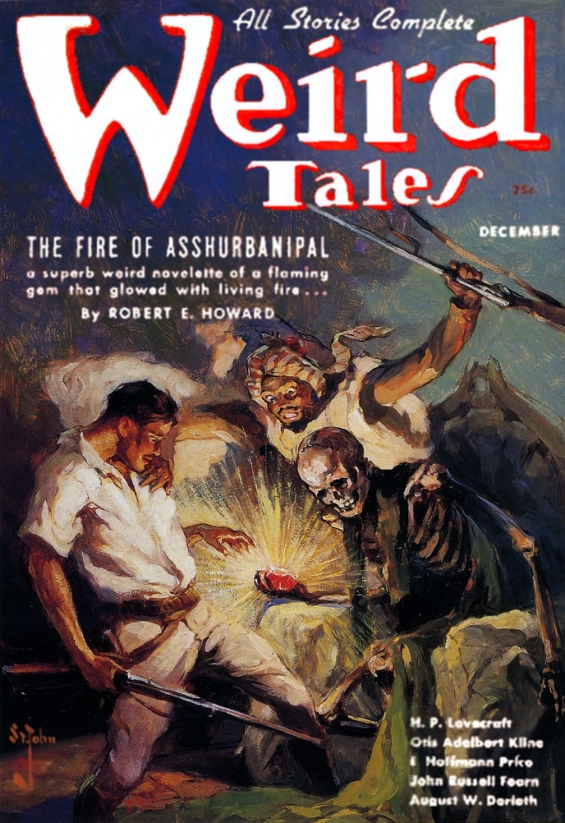
If you’re looking to add a Robert E. Howard story to your reading library, but don’t want to get started down the Conan path, look no farther than The Fire Of Asshurbanipal. It was the cover story for the December 1936 issue of Weird Tales!

Weird Tales December 1936 - The Fire Of Asshurbanipal by Robert E. Howard

WEIRD TALES The Fire Of Asshurbanipal - illustration by J. Allen St. John

The Fire Of Asshurbanipal was sold posthumously to Weird Tales by Howard’s father, then the only surviving member of Howard’s immediate family. The story features a pair of adventurers. One is an American, named Steve Clarney, and the other is an Afghan named Yar Ali. They make a fun pair.

Eric Wilkerson‘s depiction of Clarney, for the Call of Cthulhu Collectible Card Game, makes Clarney look like Indiana Jones (minus the whip), and that’s not wholly wrong. But Clarney isn’t an archaeologist, though he and Yar Ali are treasure hunters, and the period and setting is pretty close.

Eric Wilkerson's depiction of Steve Clarney

It is available in print as a part of easily the Ballantine Del Rey collection called The Horror Stories Of Robert E. Howard (ISBN: 0345490207); there was also a pair of deluxe releases by Subterranean Press. And most importantly there is a wonderful professionally narrated audiobook edition available from Tantor Media (it’s read by the talented Robertson Dean):

Horror Audiobook - The Horror Stories of Robert E. Howard by Robert E. HowardThe Horror Stories of Robert E. Howard
By Robert E. Howard; Read by Robertson Dean
2 MP3-CDs – Approx. 24 hours [UNABRIDGED]
Publisher: Tantor Audiobooks
Published: 2010
ISBN:
Sample |MP3|

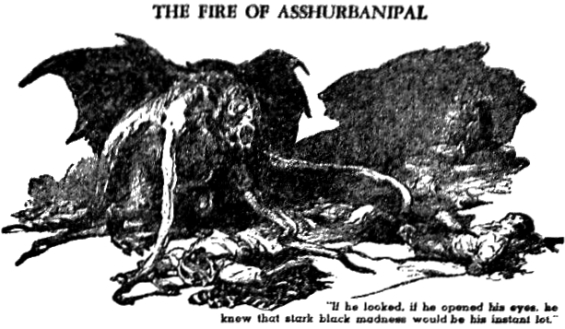
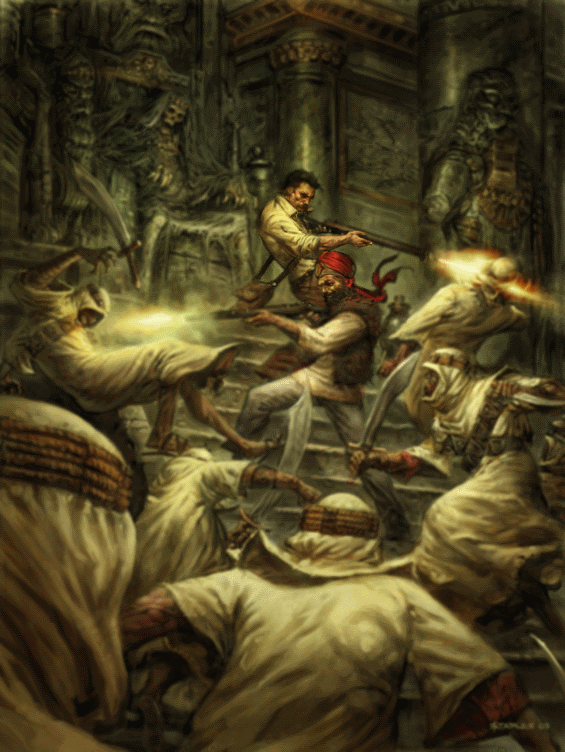
The paper editions feature two stunning images from the story by Greg Staples.

The Fire Of Asshurbanipal as illustrated by Greg Staples

The Fire Of Asshurbanipal art by Greg Staples

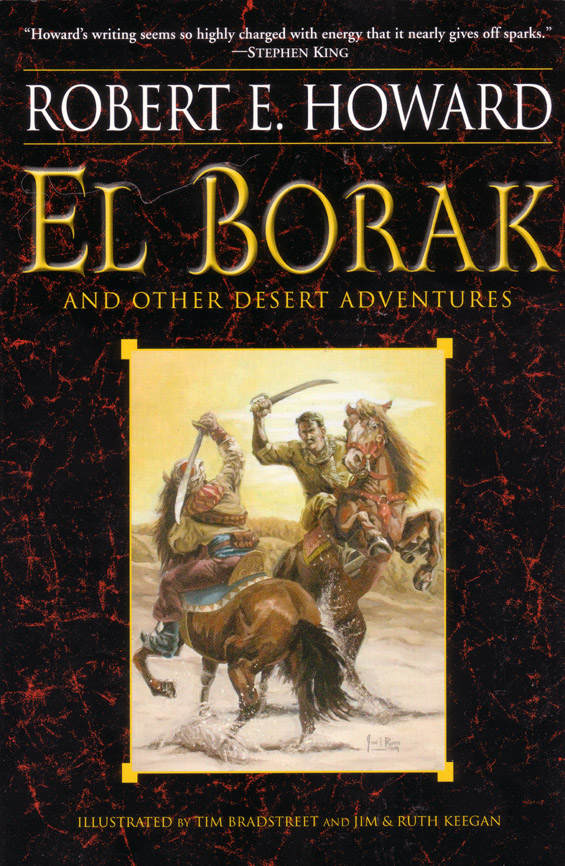
Interestingly, a different version of the same novelette, The Fire of Asshurbanipal, was published in more recent times as a straight adventure story (same characters but minus the supernatural elements). That fantasy-free version and can be found in another Ballantine Del-Rey collection entitled El Borak And Other Desert Adventures (ISBN: 034550545X).

El Borak And Other Desert Adventures

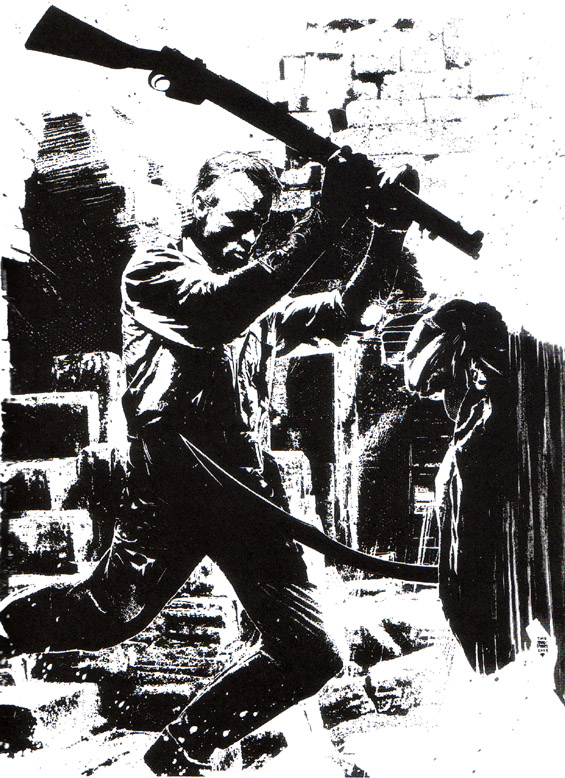
And that one includes wondrous illustrations by the master of comic book covers Tim Bradstreet.

The Fire Of Asshurbanipal illustration by Tim Bradstreet

The Fire Of Asshurbanipal illustration by Tim Bradstreet

And the version available on Gutenberg Australia’s website is, of course, the original Weird Tales version, complete with references to the Necronomicon, Yog-Sothoth and other sundry Cthulhu mythos details. And that’s the version which has recently been podcast by FNH’s Cthulhu Podcast.

Cthulhu PodcastThe Fire of Asshurbanipal
By Robert E. Howard; Read by FNH
2 MP3 files – Approx. 54 Minutes [UNABRIDGED]
Podcaster: Cthulhu Podcast
Podcast: June 2011
|ETEXT|
First published in the December 1936 issue of Weird Tales.
Part 1 |MP3| Part 2 |MP3|

I think I first read this story about twenty-five years ago, and remembered it as a gripping adventure yarn with a fairly strong Lovecraftian feel. I picked it up second hand, in a used bookstore in a handsomely covered collection of ‘weird’ Howard stories called Wolfshead (ISBN: 055312353X). In that 1979 book, there is an excellent introduction by Robert Bloch in which he argues that the “stylistic excesses” found in Howard’s stories, like The Fire Of Asshurbanipal, can be “easily excused” because within Howard’s writing “lurks a dark poetry, and the timeless truth of dreams.”

That still sounds right to me. The Fire Of Asshurbanipal is exciting, happily and ornately adjectival, and carries about with it a heft that most adventure fiction can’t really come close to matching. Listening to this podcast edition I’ll admit it possesses a raw power that I still appreciate even today, much later in life. What jars most, of course, is the prominent position given to race, the reliance on instinctual knowledge, and the repeated use of jungle cat metaphors (which feel particularly out of place in the Arabian desert setting).

Over on the Black Gate blog Ryan Harvey argues that The Fire Of Asshurbanipal is cut from the same cloth as H. Rider Haggard’s King Solomon’s Mines and Rudyard Kipling’s The Man Who Would Be King. I agree.

If you’re looking for more stories like The Fire Of Asshurbanipal I highly recommend another novelette, of more recent vintage, that follows in the tradition very well – That’d be Charles Ardai’s Nor Idolatry Blind the Eye (available in audio as a part of the Audio Realms audiobook Hunt Through The Cradle Of Fear |READ OUR REVIEW| and as an |ETEXT|).

For those who are more comics inclined, check out Joseph Remy’s 40 page webcomic adaptation of The Fire Of Asshurbanipal which begins |HERE|.

And in case you were wondering, the Asshurbanipal of the title was a 7th century BC Neo-Assyrian king famed for the creation of the Library of Ashurbanipal which held among its collection the Epic Of Gilgamesh. It is reported that Alexander the Great, upon seeing the great library of Ashurbanipal in Nineveh, was himself inspired to create his own library and that one became perhaps the most famous library of all.

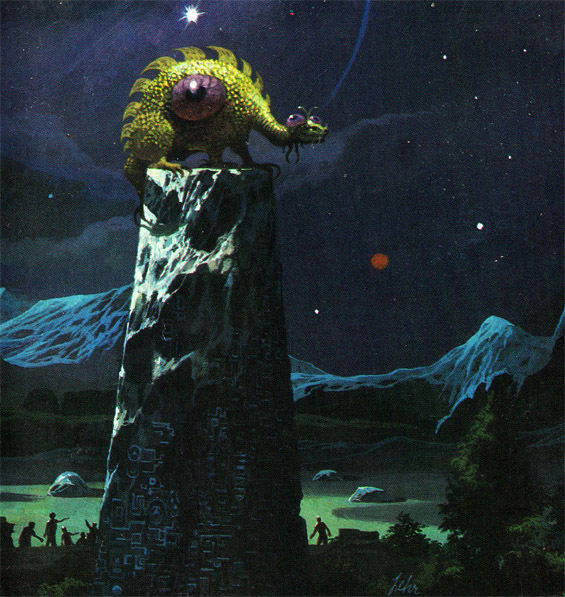
Detail from the Paul Lehr’s cover for Wolfshead:

Wolfshead cover illustration by Paul Lehr

Posted by Jesse Willis