News, Reviews, and Commentary on all forms of science fiction, fantasy, and horror audio. Audiobooks, audio drama, podcasts; we discuss all of it here. Mystery, crime, and noir audio are also fair game.
The Star is yet another plank in the theory supporting the idea that Science Fiction was almost single-handedly created by H.G. Wells. The Star, is a tale of the ultimate in habitat destruction (poof goes the planet). Here’s part of the current Wikipedia entry for this generative tale of planet cracking:
“[The Star] can be credited with having created a Science Fiction sub-genre depicting a planet or star colliding, or near-colliding with Earth – such as the 1933 novel When Worlds Collide by Philip Wylie and Edwin Balmer, (made into a film in 1951), Fritz Leiber’s The Wanderer (1965), and Lucifer’s Hammer by Larry Niven and Jerry Pournelle (1977).”
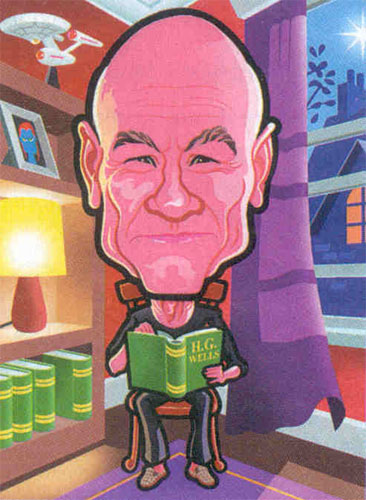
The Star
By H.G. Wells; Read by Sir Patrick Stewart
1 |MP3| – Approx. 21 Minutes [UNABRIDGED?]
Broadcaster: BBC Radio 3
Broadcast: Tuesday 7 September 2004
Provider: Radio Mensa Astronomers discover a bright new star in the heavens rushing headlong towards the Earth on a collision course. First published in 1897.
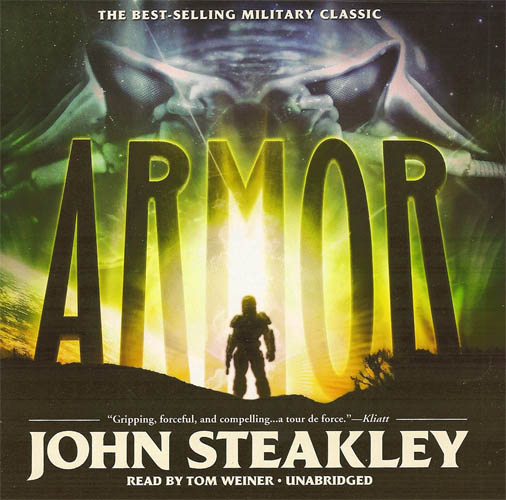
Armor
By John Steakley; Read by Tom Weiner
11 CDs – Approx. 13.5 Hours [UNABRIDGED]
Publisher: Blackstone Audio
Published: 2009
ISBN: 1433294834
Themes: / Science Fiction / Military SF / War / Leadership / Drugs / Psychology /
The planet is called Banshee. The air is unbreathable, the water poisonous. It is the home of the most implacable enemies that humanity, in all its interstellar expansion, has ever encountered. Felix is a scout in A-team Two. Highly competent, he is the sole survivor of mission after mission. Yet he is a man consumed by fear and hatred. And he is protected not only by his custom-fitted body armor, the culmination of ten thousand years of the armorers’ craft, but also by an odd being which seems to live with him, a cold killing machine he calls “the Engine.” This best-selling science-fiction classic is a story of the horror, the courage, and the aftermath of combat and also of how strength of spirit can be the greatest armor of all.
Armor is a novel that was clearly inspired by Robert A. Heinlein’s Starship Troopers. It makes use of both powered exoskeletons and insect-like alien enemies. But, instead of being a novel of politics and leadership it is a very different kind of story. At first I thought it was about the psychological effects of violence and the various kinds of heroism that can exist within a person. I was wrong because that isn’t enough. This novel is not one or two things. It isn’t the normal kind of idea driven SF that I so love – instead its ideas flow more through the emotions, eliciting our sympathies. I think this was acomplished by it changing, turning over and over, with it’s many plot surprises.
Early on Felix, our viewpoint character, refers to something he calls an “engine.” I thought he was describing the powered armor of the title. That would make sense, there was a video game called Heavy Gear that, like than Mechwarrior, had men and women doing battle in humanoid shaped tanks. I think it refereed to its “mechs” as “engines.” Felix seems pretty much like any of the other soldiers he’s been dropped with on planet Banshee. Maybe he’s a bit more of a hick – he doesn’t know the names of the winners at the Powered Olympics. Felix makes no waves, volunteers for nothing. He just wants to survive the battle to come. But when the waves of enemy aliens pour out of their holes only Felix survives – and keeps on surviving.
Armor has taut battle scenes, flowing exposition, and realistic dialogue. Had John Steakley written more, and his other novel Vampire$ |READ OUR REVIEW|, I think he’d be a very well known author.
The first third (or so) of the novel follows Felix, a low ranking scout in the invasion of the planet Banshee. Here the action somewhat resembles that of Starship Troopers. Then there is an abrupt switch – the novel seems to lurch into an an entirely different scene and setting. Set a few years later and following in first person perspective this time we meet a man named Jack Crow. Crow is a notorious galactic scoundrel. A well known thief, pirate, and adventurer – his legend is long and precedes him even to an obscure research station on a planet called Sanction. Crow is there to infiltrate, but eventually finds himself involved in an experiment – one that drains him of his half-hearted bravado and changes his life. If were talking about where this novel fits in the SF library I’ll say this: Armor synthesizes the action of Heinlein’s Troopers with the emotional impact of Haldeman’s The Forever War – but still comes off as a completely unique story.
Tom Weiner, who seems to be narrating almost every Blackstone Audio audiobook that I’m listening to these days, delivers his usual letter perfect narration. Weiner animates Felix with a weary melancholy of a veteran scout, brightens audibly with the cocksure Crow, pulls a vocal Tom Bombadil with Louis, feminizes for Lya, and geeks it all up for Holly (a star-struck scientist). That’s pretty impressive. Check this audiobook out!
If I asked you to think about “Shakespeare and Science Fiction” you’d probably go with Forbidden Planet (a spacey version of The Tempest). If you’re more TV inclined you’d probably go with Star Trek, maybe even name the episode entitled “The Conscience of the King” outright. That’s the one that features a near perfect inversion of the traveling actors sequence in Hamlet (as well as part of the production of the play itself).
And yeah, Shakespeare himself may appear as a character in Science Fiction stories. Isaac Asimov’s The Immortal Bard is perhaps my favourite example of that. But no actual Science Fiction can be found in any play by William Shakespeare. Right?
Shakespeare’s plays have many fantastic elements (ghosts, magic, witches, prophecy), but those are all Fantasy tropes, not SF. Not one the the plays of William Shakespeare could possibly qualify as Science Fiction outright. Right?
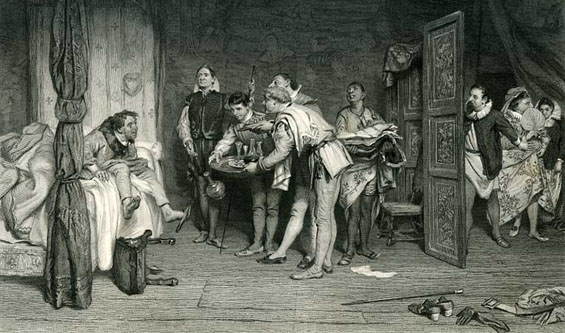
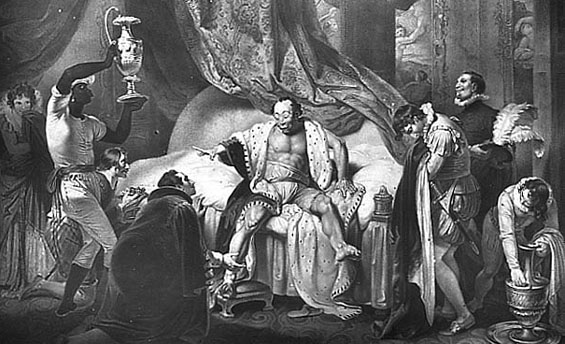
But then, I was thinking about the very Philip K. Dickness of the opening sequence of Shakespeare’s farcical romp called The Taming Of The Shrew. It’s called “The Induction” and features a character named Christopher Sly, a drunkard, who while unconscious, is abducted from the street where he lays and is taken into a mischievous Lord’s home. There, he’s put to bed, and when awakened, is told by the household’s servants that he’s been “asleep” for fifteen years, that he is the lord of the manor, and that he has a beautiful young wife! All the household’s servants are in on the jape and obey his every command. The Lord who arranged this practical joke says,
Persuade him that he hath been lunatic;
And when he says he is, say that he dreams,
For he is nothing but a mighty lord.
This do and do it kindly, gentle sirs:
It will be pastime passing excellent,
If it be husbanded with modesty.
Only then, once the ridiculous question of identity is hatched does The Taming of the Shrew begin (performed by a troupe of traveling actors who visit Christopher Sly’s manor). We’ve talked about Fictional Fictional Characters, on the SFFaudio Podcast before, this is a case of a fictional fictional play. The actors in the play are playing actors in a play.
“Christopher Sly’s presence as a spectator in Shakespeare’s The Taming Of The Shrew makes the entire drama of wife-taming into a mere science fiction spectacle of household order.” -From the introduction to Poor Women in Shakespeare by Fiona McNeill
I’m betting that’s as close as The Taming Of The Shrew gets to Science Fiction.
This is all apropos of some recent reading of the play proper and a visit to RadioArchive.cc where you’ll be able to find a terrific sounding 1988, BBC Radio 3 dramatization that faithfully adapts the play to audio.
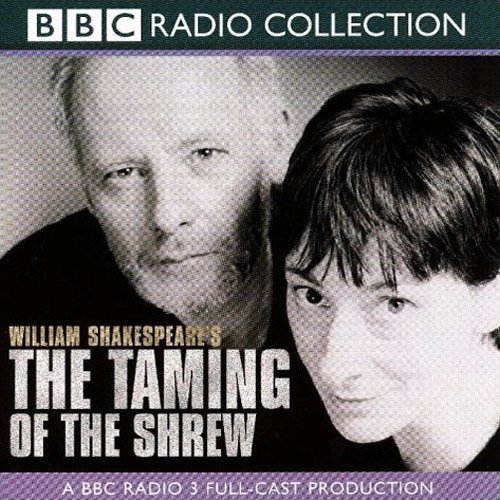
The Taming of the Shrew
By William Shakespeare; Adapted by Jeremy Mortimer; Performed by a full cast
CD or MP3 (via TORRENT) – Approx. 2 Hours [RADIO PLAY]
Broadcaster: BBC Radio 3 / BBC Radio 7
Broadcast: 1988 / 2005
Publisher: BBC Audio
Published: 1999
ISBN: 056355391X This hearty comedy has always been a favourite with audiences. Three suitors pursue Bianca Minola, but her father won’t let her marry until her older sister, Katherine, is married. Kate is wilful, loud, volatile and above all, shrewish. Her suitor Petruchio is stern, jolly, and somewhat odd. A match made in heaven? Cast:
Bob Peck, Cheryl Campbell, Moira Leslie, Robert Glenister, Stephen Tompkinson, Douglas Hodge, Christopher Fairbank, Michael Deacon, Anthony Jackson, Willam Simons, John Badley, and Paul Copley Crew:
Directed by Jeremy Mortimer
Music composed by Mia Soteriou
If there’s one public domain novel I don’t mind seeing endless re-releases and re-recordings of it’s this one…
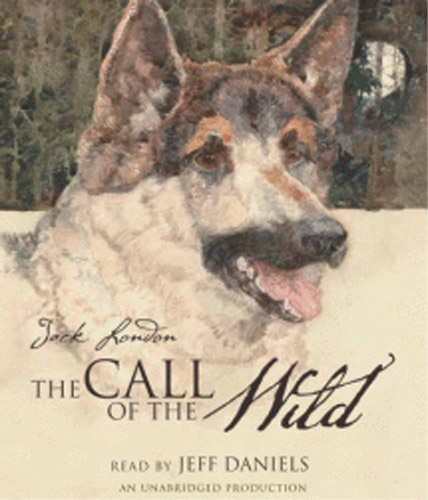
The Call Of The Wild
By Jack London; Read by Jeff Daniels
CDs – Approx. 3 Hours 12 Minutes [UNABRIDGED]
Publisher: Random House Audio
Published: May 25, 2010
ISBN: 9780307710260
Sample |MP3| Jack London’s The Call Of The Wild was written in 1903, but Buck’s gripping adventure makes for a thrilling listen on audio more than 100 years after it was first published. This gripping story follows the adventures of the loyal dog Buck, who is stolen from his comfortable family home and forced into the harsh life of an Alaskan sled dog. Passed from master to master, Buck embarks on an extraordinary journey that ends with his becoming the legendary leader of a wolf pack.
Now this should be interesting…
Wolf: The Lives of Jack London
By James L. Haley; Read by Bronson Pinchot
10 CDs or 1 Mp3-CD – Approx. 13 Hours [UNABRIDGED]
Publisher: Blackstone Audio
Published: May 25, 2010
ISBN: 9781441758965 (cd), 9781441758972 (mp3-cd) Jack London was born a working-class, fatherless San Franciscan in 1876. In his youth, he was a boundlessly energetic adventurer on the bustling west coast—by and by playing the role of hobo, sailor, and oyster pirate. From his vantage point at the margins of Gilded Age America, he witnessed such iniquity and abuses that he became a life long socialist and advocate for reform. His adventures in the American wilderness and underworld informed his fiction, and his writing came to captivate the nation as it defined his era. Within his own short lifetime, London became the most popular, and bestselling, author of his generation. By adulthood he had matured into the iconic American author of such still-universally loved books as The Call Of The Wild, White Fang, and Sea Wolf, but in spite of his success, he was at war with himself. The highest-paid writer in America, he was constantly broke. Famous as he was for conjuring the brutality of nature in story after story and novel after novel, upon the actual deaths of his favorite animals he would dissolve into helpless tears. Sick, angry, and disillusioned, after a short, breathless life, he passed away at age forty, but he left behind him a glorious literary legacy. Award-winning author James L. Haley explores the forgotten Jack London—a man bristling with ideas, whose passion for social justice roared until the day he died. In Wolf, Haley returns Jack London to his proper place in the American pantheon, resurrecting the author of White Fang in his full fire and glory.
Made by makers…
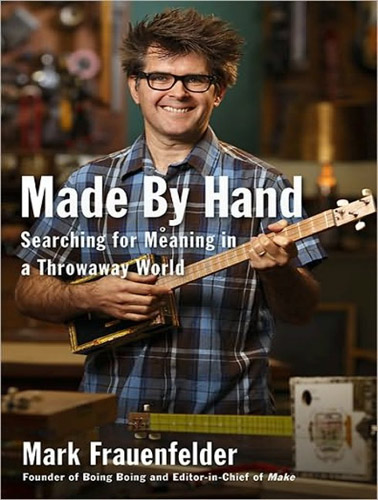
Made by Hand: Searching for Meaning in a Throwaway World
By Mark Frauenfelder; Read by Kirby Heyborne
7 CDs or 1 MP3-CD – Approx. 8 Hours [UNABRIDGED]
Publisher: Tantor Media
Published: June 07, 2010
ISBN: 9781400117819 (cd), 9781400167814 (mp3-cd) From his unique vantage point as editor in chief of Make magazine, the hub of the newly invigorated do-it-yourself (DIY) movement, Mark Frauenfelder takes listeners on an inspiring and surprising tour of the vibrant world of DIY. The Internet has brought together large communities of people who share ideas, tips, and blueprints for making everything from unmanned aerial vehicles to pedal-powered iPhone chargers to an automatic cat feeder jury-rigged from a VCR. DIY is a direct reflection of our basic human desire to invent and improve, long suppressed by the availability of cheap, mass-produced products that have drowned us in bland convenience and cultivated our most wasteful habits. Frauenfelder spent a year trying a variety of offbeat projects, such as keeping chickens and bees, tricking out his espresso machine, whittling wooden spoons, making guitars out of cigar boxes, and doing citizen science with his daughters in the garage. His whole family found that DIY helped them take control of their lives, offering a path that was simple, direct, and clear. Working with their hands and minds helped them feel more engaged with the world around them.
Frauenfelder reveals how DIY is changing our culture for the better. He profiles fascinating “alpha makers” leading various DIY movements and grills them for their best tips and insights. Beginning his journey with hands as smooth as those of a typical geek, Frauenfelder offers a unique perspective on how earning a few calluses can be far more rewarding and satisfying than another trip to the mall.
I always bet on the man with the bigger mustache…
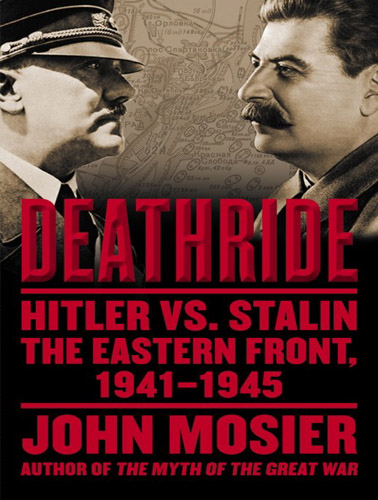
Deathride: Hitler vs. Stalin—the Eastern Front, 1941-1945
By John Mosier; Read by Michael Prichard
10 CDs or 1 MP3-CD – Approx. 12.5 Hours [UNABRIDGED]
Publisher: Tantor Media
Published: June 15, 2010
ISBN: 9781400117369 (cd), 9781400167364 (mp3-cd) John Mosier presents a revisionist retelling of the war on the Eastern Front. Although the Eastern Front was the biggest and most important theater in World War II, it is not well known in the United States, as no American troops participated in the fighting. Yet historians agree that this is where the decisive battles of the war were fought. The conventional wisdom about the Eastern Front is that Hitler was mad to think he could defeat the USSR because of its vast size and population, and that the Battle of Stalingrad marked the turning point of the war. Neither statement is accurate, says Mosier; Hitler came very close to winning outright. Mosier’s history of the Eastern Front will generate considerable controversy both because of his unconventional arguments and because he criticizes historians who have accepted Soviet facts and interpretations. Mosier argues that Soviet accounts are utterly untrustworthy and that accounts relying on them are fantasies. Deathride argues that the war in the East was Hitler’s to lose, that Stalin was in grave jeopardy from the outset of the war, and that it was the Allied victories in North Africa and consequent threat to Italy that forced Hitler to change his plans and saved Stalin from near-certain defeat. Stalin’s only real triumph was in creating a legend of victory.
We’ve talked about it on the podcast, and here it is…
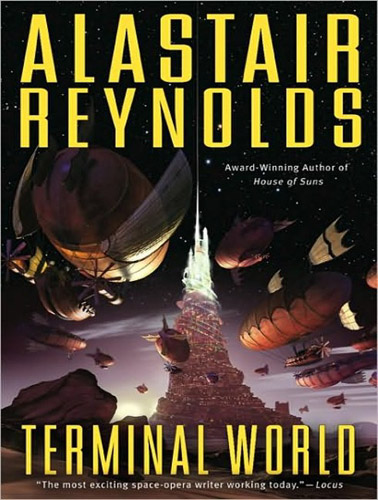
Terminal World
By Alastair Reynolds; Read by John Lee
15 Audio CDs or 2 MP3-CDs – Approx. 19.5 Hours [UNABRIDGED]
Publisher: Tantor Media
Publisher: June 1, 2010
ISBN: 9781400117116(cd), 9781400167111 (mp3-cd) Spearpoint, the last human city, is an atmosphere-piercing spire of vast size. Clinging to its skin are the zones, a series of semi-autonomous city-states, each of which enjoys a different—and rigidly enforced—level of technology. Following an infiltration mission that went tragically wrong, Quillon has been living incognito, working as a pathologist in the district morgue. But when a near-dead angel drops onto his dissecting table, Quillon’s world is wrenched apart one more time. If Quillon is to save his life, he must leave his home and journey into the cold and hostile lands beyond Spearpoint’s base, starting an exile that will take him further than he could ever imagine. But there is far more at stake than just Quillon’s own survival, for the limiting technologies of the zones are determined not by governments or police but by the very nature of reality—and reality itself is showing worrying signs of instability.
Death Cloud is the first in a series of novels in which Sherlock Holmes is re-imagined as “a brilliant, troubled and engaging teenager”…
Young Sherlock Holmes: Death Cloud
By Andrew Lane; Read by Dan Stevens
3 CDs – Approx. 3 Hours [ABRIDGED?]
Publisher: Pan Macmillian Audio
Published: June 2010
ISBN: 9780230745124 The year is 1868, and Sherlock Holmes is fourteen. His life is that of a perfectly ordinary army officer’s son: boarding school, good manners, a classical education – the backbone of the British Empire. But all that is about to change. With his father suddenly posted to India, and his mother mysteriously ‘unwell’, Sherlock is sent to stay with his eccentric uncle and aunt in their vast house in Hampshire. So begins a summer that leads Sherlock to uncover his first murder, a kidnap, corruption and a brilliantly sinister villain of exquisitely malign intent…
Little Fuzzy By H. Beam Piper; read by Jim Roberts Audible Download – 6 hours 45 mins [UNABRIDGED] Publisher: Jincin Recordings
Published: 2010
Themes: / science fiction / philosophy / extraterrestrial / sentience
Little Fuzzy is a poor man’s, a thinking man’s, Avatar. It tells the story of a capitalistic corporation exploring a far-off planet with a classical name, Zarathustra. While harvesting the planet’s unobtanium brightly-colored sunstones, prospector Jack Holloway discovers a stange new species, and makes it his life’s work to defend the new creatures. Missing are Avatar‘s flashes, bangs, and rich world-building, but the novel more than compensates with intriguing storytelling that both challenges the mind and touches the heart.
Events in Little Fuzzy take place on the planet Zarathustra. The Chartered Zarathustra Corporation owns the world in all but name, and harvests its resources for trade on the intergalactic market. The world itself is poorly realized. Apart from anti-gravitational devices, hovering cars, and super-advanced CCTV lie detectors, very little in the novel suggests a science fiction setting. Guns, paper, and cigarettes predominate. The novel hints at a rich and storied history of the galaxy with its mentions of the Atomic Era, but these allusions never find ample explanation. The novel does take place in Piper’s Terro-Human Future Universe, however, so readers eager to learn more can probably do so in other novels and short stories.
The major exception to the book’s lack of world-building is the wild flora and fauna on Zarathustra around which Little Fuzzy ultimately hinges. Prospector Jack Holloway finds one of the titular foot-high golden-furred creatures, and soon realizes that the fuzzy fuzzy Holloway Zarathustra (yes, that becomes its official classification) exhibits behavior that may point to sapient consciousness. One of the fuzzies soon meets its demise at the hands of a Zarathustra Corporation agent, and Jack Holloway kills another agent in the ensuing scuffle. The rest of the novel explores the question of consciousness through the narrative framework of a criminal trial. Like the works of Isaac Asimov, Little Fuzzy abounds with cerebral dialogue that, at times, reads like a philosophical proof, but never drones on long enough to become monotonous.
The real show-stopper is Jack Holloway’s emotional connection to his newly-discovered species. At various points he fulfills the roles of teacher, champion, and father to the beleaguered little fuzzies. Thiis emotional power pulls the reader by the heartstring’s through the book’s one or two bare spots to a satisfying conclusion.
Little Fuzzy is also a brilliantly-written novel. Some of the fathers of science fiction appear to take themselves far too seriously, but this certainly can’t be said of H. Beam Piper. While the novel hardly qualifies as a comedy or satire, colorful splashes of humor indicate that, though the book addresses intriguing intellectual issues, at the end of the day Piper is having fun as a writer and a storyteller.
Jim Roberts’s performance of Little Fuzzy for Jincin Recordings won’t win any awards, but his tone fits the mood and content of the novel. His reading is strong enough that even the book’s few tedious passages won’t put the listener to sleep.
Originally published in 1962, just two years before H. Beam Piper’s suicide, Little Fuzzy was written at the zenith of his writing career, and it shows. As a proof-of-concept novel about the nature of consciousness, the book could have easily crossed the line between fiction novel and science lesson, as do some of the other science fiction novels of Piper’s era. Sprightly writing and emotion that almost, but not quite, verges on sentimentality make Little Fuzzy a stand-out novel of its time, and indeed for all ages.
As a footnote, John Scalzi recently announced that he’s written a reboot of the series with the blessing of the Piper estate, dubbed Fuzzy Nation, and that he’s currently shopping it around to publishers. The franchise is certainly in capable hands.
Also be sure to take a look at Jesse’s review of the Audio Realms edition of Little Fuzzy
The SFFaudio Podcast #059 – Jesse and Scott talk with Science Fiction author David J. Williams about his recently completed Autumn Rain trilogy.
Talked about on today’s show: Mirrored Heavens (book 1 in the Autumn Rain trilogy), The Burning Skies (book 2 in the Autumn Rain trilogy), The Machinery Of Light (book 3 in the Autumn Rain trilogy), writing in the present tense, memory, espionage, using past tense is “privileging the narrative”, cold war, cyberspace, cyberpunk, space as the ultimate high ground, militarizing space, satellites, “rods from god“, the straylight run scene from William Gibson’s Neuromancer, war, Future Of War by David J. Williams |PDF|, WarGames (1983), The Moon Is A Harsh Mistress by Robert A. Heinlein, lagrange points, space elevators, skyhooks, space stations, The Fountains Of Paradise by Arthur C. Clarke, terrorism, Philip K. Dick, the Vietnam War vs. the Korean War, Kahlil Gibran, China, 2008 South Ossetia War, Clarion Workshops, Richard K. Morgan, all good series should end.

 The Star is yet another plank in the theory supporting the idea that Science Fiction was almost single-handedly created by H.G. Wells. The Star, is a tale of the ultimate in habitat destruction (poof goes the planet). Here’s part of the current Wikipedia entry for this generative tale of planet cracking:
 The Star
 Armor
Armor