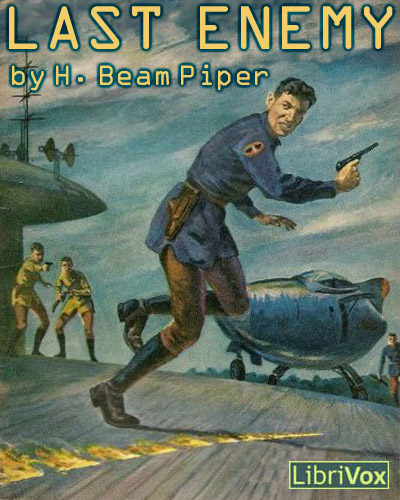
LibriVox: Last Enemy by H. Beam Piper

SFFaudio Online Audio

LibriVoxIf anybody should have his middle name changed to “audiobook” it’s Mark Douglas Nelson. Mark has now completed his sixth H. Beam Piper audiobook.

This story, Last Enemy, is part of Piper’s “Paratime” series. As with all the others this one is a public domain audiobook based on a public domain story. The original publication being in Astounding Science Fiction’s August 1950 issue. Thanks Mark!

LibriVox Science Fiction - Last Enemy by H. Beam PiperLast Enemy
By H. Beam Piper; Read by Mark Douglas Nelson
5 Zipped MP3 Files or Podcast – Approx. 2 Hours 39 Minutes [UNABRIDGED]
Publisher: LibriVox.org
Published: May 9th, 2009
An undercover Paratimer has disappeared on assignment while in an alternate time line, and it’s up to Verkan Vall of the Paratime Police to save her. To do so, he must infiltrate a universe in which assassination is an honorable profession, and reincarnation a scientific fact. Will Verkan Vall survive in a world of killers and the undead?

Podcast feed:

http://librivox.org/bookfeeds/last-enemy-by-h-beam-piperlast-enemy-by-h-beam-piper.xml

iTunes 1-Click |SUBSCRIBE|

Posted by Jesse Willis

LibriVox: Hunters Out of Space by Joseph E. Kelleam

SFFaudio Online Audio

LibriVoxHere’s the latest audiobook to be completed as part of our 3rd Annual SFFaudio Challenge. First published in Amazing Science Fiction Stories May 1960 issue! We can thank narrator Elliot Miller for the reading, Betty (aka LibraryAnne) for the proof-listening, and Mary (aka AmethystA) for organizing it all. This is Elliot’s first solo project but he’s already got his sights set on another Challenge title: Murray Leinster’s The Pirates of Ersatz

LibriVox Science Fiction - The Hunters Out Of Space by Joseph E. KelleamHunters Out of Space
By Joseph E. Kelleam; Read by Elliot Miller
19 Zipped MP3 Files or Podcast – Approx. 4 Hours 29 Minutes [UNABRIDGED]
Publisher: LibriVox.org
Publlished: May 7, 2009
Jack Odin has returned to the world of Opal, the world inside our own world, only to find it in ruins. Many of his friends are gone, the world is flooded, and the woman he swore to protect has been taken by Grim Hagen to the stars. Jack must save her, but the difficulties are great and his allies are few.

Podcast feed: http://librivox.org/bookfeeds/hunters-out-of-space-by-joseph-kelleam.xml

iTunes 1-Click |SUBSCRIBE|

Posted by Jesse Willis

LibriVox: Gulliver Of Mars by Edwin L. Arnold

SFFaudio Online Audio

LibriVoxFirst published as Lieutenant Gullivar Jones: His Vacation, in 1905, this novel is a precursor to, and the likely inspiration for, Edgar Rice Burroughs’s classic A Princess of Mars (1911). Despite my not having heard of it before now the novel has a long history of adaptation. Ace Books reprinted Arnold’s novel in paperback in 1964, retitling it Gulliver of Mars [sic]. A more recent Bison Books paperbook edition (from 2003) called it Gullivar of Mars.

Arnold’s novel bears a number of striking similarities to Burroughs’s. Both Gullivar and Burroughs’s protagonists are American servicemen who arrive on an inhabited planet Mars by apparently magical means.

A 2007 paperbook sequel exists: In Edgar Allan Poe on Mars: The Further adventures of Gullivar Jones Gullivar Jones appears alongside a young Edgar Allan Poe (in a series of two linked stories).

Marvel Comics adapted the character for the comic book feature “Gullivar Jones, Warrior of Mars” in issues #16-21 of Creatures on the Loose (March 1972 – Jan. 1973). The story was written by Conan comics scribe Roy Thomas, Gerry Conway, and SF novelist George Alec Effinger. The series then moved to Marvel’s black and white magazine, Monsters Unleashed #4 and #8 (1974). Marvel’s version modernized the setting, recast Gullivar as a Vietnam War veteran (think Heinlein’s Glory Road).

Did I mention I just picked up the first volume of Alan Moore’s League Of Extraordinary Gentlemen? Apparently the next volume includes cameos by both Gullivar and John Carter!

I love LibriVox!

LibriVox Fantasy - Gulliver Of Mars by Edwin L. ArnoldGulliver Of Mars
By Edwin L. Arnold; Read by James Christopher
20 Zipped MP3 Files or Podcast – Approx. 6 Hours 16 Minutes [UNABRIDGED]
Publisher: LibriVox.org
Published: May 3rd 2009
This escapist novel first published in 1905 as Lieutenant Gullivar Jones: His Vacation follows the exploits of American Navy Lieutenant Gulliver Jones, a bold, if slightly hapless, hero who is magically transported to Mars; where he almost outwits his enemies, almost gets the girl, and almost saves the day. Somewhat of a literary and chronological bridge between H.G. Wells and Edgar Rice Burroughs, Jones’ adventures provide an evocative mix of satire and sword-and-planet adventure.

Podcast feed:

http://librivox.org/bookfeeds/gulliver-of-mars-by-edwin-l-arnold.xml

iTunes 1-Click |SUBSCRIBE|

Posted by Jesse Willis

Review of Daemon by Daniel Suarez

SFFaudio Review

Daemon by Daniel SuarezDaemon
By Daniel Suarez; Read by  Jeff Gurner
Audible Download – approx. 16 hours [UNABRIDGED]
Publisher: Penguin Audiobooks
Published: 2009
Themes: / Science Fiction / Cyberpunk / Techno-Thriller / Virtual Reality / Online Gaming / Politics /

Daemon‘s success as a self-published novel that crossed over to attain mainstream success is a testament to its cultural relevance, especially among the technorati. Suarez, who moonlights (sunlights?) as a systems analyst, promoted the novel to the movers and shakers in the technology community, Its positive reception even among this tech-savvy elite suggests that Daemon has its finger on the pulse of technological developments and their implications for politics and culture.

Daemon opens with the death of game developer Matthew Sobol, acclaimed developer of multiplayer games such as first-person shooter Over the Rhine and RPG The Gate, which bears a strong resemblance to World Of Warcraft. Some successful entrepreneurs leave money to their kids when they die, others give it all away to charity. Not Sobol. His legacy is the book’s eponymous daemon, a background process which through distributed computing has spread itself across the net and continues to carry out the developer’s will through a series of intricate commands. The capabilities of this daemon, and Sobol’s talent as a developer of artificial intelligence, become apparent when the police raid Sobol’s mansion in Thousand Oaks, California, and find themselves outclassed by a network of elaborate automated booby-traps, including an almost-sentient Humvee.

The novel pans cinematically between several characters who, in one way or another, become embroiled in the daemon’s plot, which ultimately proves to be global in scale. Dramatis personae include police detectives, government agents, a gamer, a laid-off fashion reporter, a white-hat hacker, ad a convict. It’s not clear from the outset whether these characters will become heroes or villains as the story progresses, and even when battle lines are more firmly drawn most of them still defy simple caricature, exhibiting complex motives and emotions.

The real show-stopper, of course, is the daemon itself, who possesses a high degree of intelligence and resourcefulness despite residing in lines of code. The novel’s conceit still demands the willing suspension of disbelief, but the concept and the technical specifics are so finely conceived and executed that the reader is left with a small but nagging suspicion that somewhere, sometime in a future that may be all too near, Daemon could become a reality. Suarez achieves this feat by investigating the wider political, economic, and social implications of a self-aware autonomous computer system.

The living Matthew Sobol embedded many elements of his daemon into his multiplayer games, and several characters venture into these online worlds in search of clues. These scenes are among the strongest in the book, and they carry favorable resonances with both the Metaverse in Neal Stephenson’s Snow Crash and the simulator in Orson Scott Card’s Ender’s Game. Like the virtual reality elements in these novels, the online gaming sequences in Daemon succeed because they maintain a strong causal relationship to events in the “real” world.

The action battle sequences in Daemon are high-octane, and like all good action sequences they manage to incorporate the book’s themes rather than standing as mere set pieces. For the most part, the protagonists are fighting against computer-controlled contraptions. Nevertheless, I felt that these ultimately visceral and superficial scenes occupy too much space in the novel, and detract from the book’s otherwise deep and intellectually stimulating themes. Paramount Pictures has optioned the movie rights for Daemon, and I shudder to think that the cultural significance of this novel may be boiled away, leaving only two hours of car chases.

The pacing of Daemon also leaves something to be desired. Suarez has revealed that a sequel is in the works, and the book’s cliffhanger ending promises an exciting continuation to the story. Lots of loose ends also remain dangling free, mostly in the arc of character development. The novel’s ending was certainly climactic, but it somehow failed to provide satisfactory closure. As I’ve said in other reviews, even books in a multi-volume series need to retain a high level of internal cohesion.

Jef Gurner’s narration for Daemon is spot-on. His performance is varied enough that each character’s unique identity extends into the aural sphere. Through some tricks of distortion, Penguin Audio has turned the dialogue of the daemon itself into a performance worthy of classic cinematic computerized villains.

Fans of cyberpunk in particular should consider Daemon essential reading, but any science fiction fan looking for an intriguing and visionary techno-thriller should add this audiobook to their summer reading list. The novel’s fascinating themes make it worth slogging through some scenes of gratuitous violence and tugging in vein on a few loose plot threads. Daemon is an impressive debut novel by Daniel Suarez, hopefully presaging an illustrious writing career.

Posted by Seth Wilson

Review of Slaughterhouse-Five by Kurt Vonnegut

SFFaudio Review

Slaughterhouse Five by Kurt VonnegutSFFaudio EssentialSlaughterhouse-Five
By Kurt Vonnegut; Read by Ethan Hawke
5 CDs – 6 hours – [UNABRIDGED]
Publisher: Blackstone Audio
Published: 2009
ISBN: 9781433269691
Themes: / Science Fiction (or maybe not) / World War II / Time Travel / War / Aliens / Mind /

And Lot’s wife, of course, was told not to look back where all those people and their homes had been. But she did look back, and I love her for that, because it was so human.

So she was turned to a pillar of salt. So it goes.

—Kurt Vonnegut, Slaughterhouse Five

During World War II, author Kurt Vonnegut was taken prisoner by the Germans and held captive in the city of Dresden, which was later reduced to flaming rubble during a harrowing fire-bombing by American forces. According to Vonnegut, the city was a gorgeous center of art, architecture, and fine civilian life; its value as a military target was negligible. “What I’ve said about the firebombing of Dresden is that not one person got out of a concentration camp a microsecond earlier, not one German deserted his defensive position a microsecond earlier,” Vonnegut said.

Somewhere between 25,000 and 120,000 civilians (the upper figure is an early estimate, which has since been revised downward to 25,000-40,000) were killed in the inferno of incendiary and high explosive bombs. As such, Dresden remains a controversial, dark chapter of America’s involvement in the war.

Slaughterhouse-Five is Vonnegut’s look back on this dreadful event. It’s not a traditional biography, but a modified account of his own experiences as seen through the eyes of Billy Pilgrim, a tall, awkward, disconnected dreamer who is drafted into the army and thrust into combat. Pilgrim is a pathetic soul with the appearance of a “filthy flamingo,” involved in tragic events beyond his control.

Captured during the Battle of the Bulge, Pilgrim and 100 other soldiers are shipped to Dresden to serve as prison-labor. At night they sleep in a storage-cave beneath a slaughterhouse amidst the butchered carcasses of animals, and it’s this arrangement that allows them to survive the attack. After the firebombing, they emerge the next morning to find the once-beautiful Dresden so utterly destroyed that it resembles the surface of the moon.

A part of me feels guilty for reviewing Kurt Vonnegut’s Slaughterhouse-Five on a science fiction/fantasy Web site. The connections of this classic anti-war novel to the science fiction genre are tenuous, but it attains this designation (in some circles) due to the presence of the Tralfamadorians, a race of aliens that capture Pilgrim and bring him back to their planet for examination. During his months on Tralfamadore, Pilgrim is placed in a sort of zoo, his body and mind laid bare to the curious aliens.

The Tralfamadorians may be simply the imagination of an unwell, traumatized mind. Pilgrim is emotionally unbalanced, suffers a head injury after the war, and reads voraciously of the novels of science fiction writer Kilgore Trout, one of whose novels concerns an alien abduction that sounds suspiciously like Pilgrim’s own experiences on Trafalmadore. But the Tralfamadorians—real or not—allow Vonnegut to explore the concept of time and our place in it, which is the larger theme of the novel. The Tralfamadorians can see in four dimensions and have no concept of time; life just is, and human existence is a series of events and happenings with no beginnings and ends. Events simply occur; wars are fought, we are powerless to stop them and it’s ridiculous to think we can. Free will is a farce.

Pilgrim’s time among the Tralfamadorians allows him to experience his life in this fourth dimension, moving his mind back and forth to the past and future, seemingly at will. He is able to see his own death, and relive events from his childhood, his marriage, and his career as an optometrist. But Pilgrim’s wandering, time-traveling mind returns again and again to the terrible events of Dresden, an experience so powerful that his mind is unable to make sense of it. It just is, and all he can do with the rest of life is to try and look upon the good times in his life, the moments of joy, and not linger too long over the blackened, shrunken bodies, or a fellow American and friend executed for salvaging a teapot from the ruins.

Actor Ethan Hawke (of Dead Poets Society and Hamlet fame) serves as the narrator and does a nice job reading with an understated, dispassionate voice that perfectly fits the tone of the novel. This Blackstone Audio production also includes an unexpected and enlightening 10-minute interview with Vonnegut on the final disc. Here Vonnegut reveals that Pilgrim’s character was based on a real person, Edward Crone, an American who died in Dresden. “He just didn’t understand the war at all, what was going on, and of course there was nothing to understand—he was right,” Vonnegut says.

Posted by Brian Murphy

StarShipSofa: Aural Delights No. 82 Michael Bishop

SFFaudio Online Audio

Aural Delights No 82 Michael Bishop

Editorial: Michael Bishop by Tony C. Smith

Poetry: Jamie’s Hair by Michael Bishop 02:00

Intro to Main Fiction: Michael Bishop

Main Fiction: Vinegar Peace by Michael Bishop 07:41

Sofa Art Cover: Ed Bellisimo

Narrators: Diane Severson, Dale Manley

Published in the July 2008 issue of Asimov

StarShipSofa narrates Vinegar Peace, an SF story writtten by Michael Bishop for his son Jamie Bishop who died two years ago at the Virginia Tech shooting.

Michael Bishop says:

I wrote “Vinegar Peace” — in August of 2007 — because I had to. Our 35-year-old son, Jamie, died on the morning of April 16, 2007, as one of thirty-two victims of a disturbed shooter on the campus of Virginia Tech in Blacksburg, Virginia.

Jamie, an accomplished digital artist who did lovely covers for four or five of my books, was holding forth in Room 2007 of Norris Hall in his German class more than two hours after his eventual murderer had slain two students in a dormitory on another part of campus. The administration failed to issue a warning — a warning that might well have saved many lives — in a timely fashion. However, some of its members secured their own offices and notified their own family members of this initial event; and so the worst school shooting in the history of the United States claimed our son, four other faculty members (including a man, Dr Librescu, who had survived the Holocaust and who held a table against his classroom door until all own students could escape), four of Jamie’s students, and twenty-one other young people in Norris Hall, not to mention the first two victims in West Ambler-Johnston dorm. Another twenty-eight students were wounded by bullets or injured leaping from upper-story windows. Some of these young people will live with their injuries the rest of their lives.

All of the administrators, with the exception of a woman who later died of a stroke or a heart attack (a death that my wife and I can’t help but attribute partially to the stress of living with the mistakes of the President and the other Policy Group members), remain in their positions. So much for accountability, and so much for justice.

In any case, “Vinegar Peace” grew from this disaster and from a grief that I can’t imagine ever laying totally aside. Jeri and I mourn Jamie’s loss every day in some private way, and we think continually of all the other parents and loved ones of the slain and injured who will carry a similar burden with them until they die. We think, too, of the parents and loved ones of the dead and wounded from the United States’s optional war in Iraq, who long for their dead and who pray for their injured with an intensity not a whit different from our own. How ironic that our son died on American soil. How sad the wasted potential and disfigured lives resulting from violence everywhere. And forgive me the inadequacy of these remarks. Clearly, I wrote a story because I could not address either my outrage or my grief in any other way.

-Mike Bishop

StarShipSofa is very honoured and humbled to be allowed to bring this story to a wider audience. I know I speak for the SF community when I say our hearts and prayers go out to Mike and Jeri and all the families who have to live with this grief every day.

Posted by Tony C. Smith