On Spec: Sticky Wonder Tales by Hugh A.D. Spencer

SFFaudio Online Audio

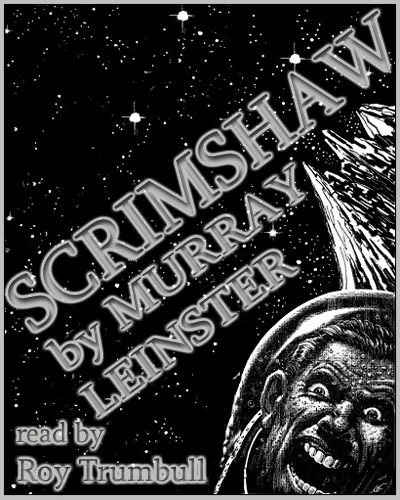
On Spec MultimediaSticky Wonder Tales
By Hugh A.D. Spencer; Dave Nichol and Hugh A.D. Spencer
1 |MP3| – Approx. 25 Minutes [UNABRIDGED]
Publisher: On Spec Magazine
Published: Fall 2006
You have to love a story that opens with: “Squiffy: Sorry to hear about the bowel infection. Even sorrier to hear that itâs one of the intelligent ones.” Through a series of back and forth letters, we follow the evolution of two brothers who, via government sponsorship, undergo physiological and mental changes in order to understand alien telepathy or technology. Stephen is busy turning into an alien turtle with an IQ of 350. Andrew grows breathing pores and tendrils that link him to an alien ship’s software. Neither foresees what happens when government mavens cut their programs. By the end of the story, a worse fate than being shelved looms on their horizon.

[via BoingBoing]

Posted by Jesse Willis

Podiobooks.com: The Black Star Passes by John W. Campbell

SFFaudio Online Audio

Podiobooks.com Podiobooker PodcastScott D. Farquhar‘s latest audiobook effort is COMPLETE!

He’s finished reading, recording, and posting one of our original SFFaudio Challenge titles…

And, don’t forget about Scott Farquhar’s other challenge title… STAR SURGEON!
Both audiobooks are 100% free, but donations made through Podiobooks.com will put $$ into the audiobook kitty – making Scott all the more likely to record another. And that’d be a good thing.

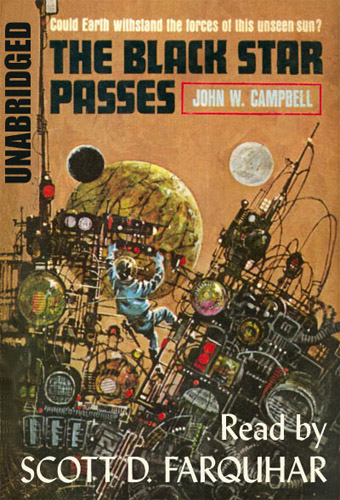
Podiobooks.com - The Black Star Passes by John W. CampbellThe Black Star Passes
By John W. Campbell; Read by Scott D. Farquhar
20 MP3s or Podcast – Approx. 7 Hours 34 Minutes [UNABRIDGED]
Publisher: Podiobooks.com
Published: July 2008 – January 2009
Three separate SF stories by Campbell, written for Amazing Stories magazine: The Black Star Passes, Piracy Preferred, Solarite. These tales are tied together by a recurring cast of characters (Arcot, Morey and Wade).

For those interested in a collectible hardcopy Scott says:

“I’m intending to do an MP3 data disc version of both Star Surgeon and The Black Star Passes on a single disc which should be ready and available in a couple of weeks.”

Posted by Jesse Willis

The SFFaudio Podcast #023

Podcast

The SFFaudio PodcastThe SFFaudio Podcast #023 – Jesse and Scott are joined by Rick Jackson (aka The Time Traveler) and talk to him about his podcast (The Time Traveler Show) and audiobook company (Wonder Audio).

Talked about on today’s show:
The Time Traveler Show podcast, Scott Brick, William Dufris, Mark Douglas Nelson, Sam Mowry, Arthur C. Clarke, Stefan Rudnicki, Wonder Audio, Mac Kelly, Status Civilization by Robert Sheckley, Audible.com/wonderaudio, ebook, Frank Herbert, Alfred Bester, Pat Bottino, The Cimmerian blog, Pride And Prejudice And Zombies by Jane Austen and Seth Grahame-Smith, Chronicle Books, Macmillan Audio, fantasy, Lamentation by Ken Scholes, multiple narrators, Full Cast Audio, Elmore Leonard, Jim Dale, Stephen Fry, Harry Potter, Graphic Audio, Anathem by Neal Stephenson, The Demolished Man by Alfred Bester (ISIS Audio ISBN: 1856955435), Phantoms by Dean Koontz, Mel Blanc, Billy West, Tara Platt, Yuri Lowenthal, Bill Hollweg, the public domain status of Clark Ashton Smith, Robert E. Howard, The Weapon Shops Of Isher by A.E. van Vogt, William Coon, The Quest For Saint Aquin by Anthony Boucher, They Bite by Anthony Boucher, William F. Temple, A Sheckley Trilogy, Worlds Of Wonder edited by Robert Silverberg, The Monsters by Robert Sheckley, A Is For Alien, The Science Fiction Oral History Association, Lloyd Biggle Jr., SFOHA needs volunteers, Worldcon 2009, Macmillan Audio, Sly Mongoose by Tobias Buckell (read by Jonathan Davis), science fiction, aliens, Little Brother by Cory Doctorow |READ OUR REVIEW|, infodumping, Scott Westerfeld, Uglies, Pretties, Extras, A Case Of Conscience by James Blish |READ OUR REVIEW|, The Sparrow by Mary Doria Russell, Finnegan’s Wake by James Joyce, The Star by Arthur C. Clarke, The Cold Equations by Tom Godwin, The Time Machine by H.G. Wells, Penguincon, Penguincon podcast, Spider Robinson, Stephen Eley, Day Million and We Purchased People by Frederik Pohl, Mistakes Were Made (But Not By Me), science as “arrogance control”, transhumanism.

Posted by Jesse Willis

Review of A Case Of Conscience by James Blish

SFFaudio Review

Audible Frontiers - A Case of Conscience by James BlishSFFaudio EssentialA Case Of Conscience
By James Blish; Read by Jay Snyder
Audible Download – 7 Hours 55 Minutes [UNABRIDGED]
Publisher: Audible Frontiers
Published: November 2008
Themes: / Science Fiction / Religion / Catholicism / Aliens / Biology / Evolution /

Father Ruiz-Sanchez is a dedicated man – a priest who is also a scientist, and a scientist who is also a human being. He has found no insoluble conflicts in his beliefs or his ethics…until he is sent to Lithia. There he comes upon a race of aliens who are admirable in every way except for their total reliance on cold reason; they are incapable of faith or belief. Confronted with a profound scientific riddle and ethical quandary, Father Ruiz-Sanchez soon finds himself torn between the teachings of his faith, the teachings of his science, and the inner promptings of his humanity. There is only one solution: He must accept an ancient and unforgivable heresy -and risk the futures of both worlds…

A Peruvian priest is a strange enough protagonist for Science Fiction. Add in an essentially bloodless tale of alien human interaction, a token female, and a bowlful of Catholicism on every page, the fact that it’s clearly inspired, at least in part, by James Joyce’s Finnegans Wake, and what you get is a classic SF novel? Yup! A Case Of Conscience is not quite the greatest SF novel of its era, but it holds up quite well. Blish put a good deal of thought into the original novella, and that pays off mid way through the novel (which is really two novellas put-together). The first half of the book is set on Lithia, a recently discovered alien planet teeming with unusual alien life. Lithia and its intelligent inhabitants are being considered for full human contact. There, judging the planet, are Father Ramon Ruiz-Sanchez a Jesuit biologist, Cleaver, a physicist, Michelis, a chemist, and Agronski, a geologist. Curiously Father Ramon seems to have strong reasons for opposing the opening of Litihia despite the fact that he has befriended one of the intelligent aliens. The fact that the Lithians seem to have an ideal society free of crime, conflict, ignorance and want also seems to worry Ramon. It all comes down to one question: Do the Lithians have souls? Despite his suspicions about the answer, the priest seems to only hold a deep affection for the Lithians.

I was highly impressed with the revelations that Ruiz-Sanchez (and Blish) give for it all. This is excellent idea driven SF. Blish seems to have taken the idea of the Society of Jesus (Jesuits) very much to heart in writing the novel. These are/were the priests that were trained to take on the hardest tasks confronting the Catholic church. Blish has done them proud. But, that’s not the end of it. The turning point of the novel comes when the humans leave Lithia carrying with them a fertilized egg of one of the Litihians, an alien child to be raised on Earth and learn the ways of humans. This is where the second half of the novel begins. Earth is a “shelter society” (everyone lives in massive underground fallout shelters – you can see how it was written in the 1950s). There we follow our protagonist, a few other folks including the requisite token female named “Louella” (but called “Lou”) and the alien baby-cum-juvenile alien (who acts rather unlike his species normally does back on Lithia). Highlights here come when Ruiz-Sanchez is requested for a Papal audience! Again, some clever revelations occur in this second half, though they are generally weaker than the first. But, all together, and with the ending quite well done as it is, it’s very solid.

Included in the audiobook edition is the six page appendix, which is a ‘special preliminary report on the planet Lithia’ by Ruiz-Sanchez. As far as I can tell the narrator, Jay Snyder, has completely followed Blish’s own pronunciation guide for the book (which is not actually included in the audiobook). I’ve done a little comparing of the written text in the paperbook with the way Snyder says the alien names in the audiobook. It all sounds pretty accurate to me. Kudos to Audible Frontiers for carefully audiobooking this Hugo Award novel (and Retro Hugo Award winning novella). A Case Of Conscience is an SF classic!

Posted by Jesse Willis

Review of The Cat Who Walks Through Walls by Robert A. Heinlein

SFFaudio Review

Science Fiction audiobook - The Cat Who Walks Through Walls by Robert A. HeinleinThe Cat Who Walks Through Walls
By Robert A. Heinlein; Read by Tom Weiner
11 CDs – 13.5 Hours [UNABRIDGED]
Publisher: Blackstone Audiobooks
Published: December 2007
ISBN: 1433212918
Themes: / Science Fiction / Marriage / Time Travel / Parallel Worlds / The Moon / Space Station /

When a stranger attempting to deliver a cryptic message is shot dead at his dinner table, Ames is thrown headfirst into danger, intrigue, and other dimensions where Lazarus Long still thrives, where Jubal Harshaw lives surrounded by beautiful women, and where a daring plot to rescue the sentient computer called Mike can change the direction of all human history.

There are a lot of things to dislike about The Cat Who Walks Through Walls:

1. Characters: Heinlein’s characters are either ultra-confident know-it-alls or utterly buffoonish straw-men. Heinlein will happily spend a good ten minutes explaining to you the workings of suborbital flight in a vacuum, but won’t explain (and worse yet – will have the other characters agree) to highly improbable societal systems in cast off sentences like – ‘all sexual options are invested in women’ (on the moon). Then he follows it up with jury trials of accused rapists lasting 30 seconds. Personally, I suspect that any system that threw away habeas corpus in favour of whatever one gender said was good – wouldn’t last very long. It’s possible to imagine a society in which women play a dominant role – but I don’t find it plausible to find any society in which one gender can say one word “rape” (true or not) – and have the accused rapist be instantly ripped apart. Heinlein ignores the problems of: No evidence, no witnesses, no trial. It doesn’t fly Mr. Heinlein.

2. Things missing: First, the internet, especially email, everyone is still mailing paper letters from Lagrange space stations to the Moon! Second, DNA testing. Talk of positively identifying someone all runs along the lines of “fingerprints” and “blood types.” Third, GPS. On Heinlein’s moon you can only tell where you are by using inertial trackers or getting a starfix.

3. A glaring omission: There’s one more thing missing, the last half of the book. Seriously, this book is all prologue, with lots of interesting action, but the entire build up is concluded on the last disc.

4. Too much: There are also things this book has too much of. First, all the many male characters are always calling themselves, denying that they are, or accusing each other of being “henpecked.” This, no matter what universe or era they come from! I’ve never heard any of my married friends use that term. Second, no matter which continent, planet or timeline, the many husbands in this novel come from, they all playfully joke about “beating” their wives. I just don’t know what to do with that information. Is this common in your marriage?

Now, having stated off this review with the above it may sound as if I dislike the novel. And that’s not strictly true. I don’t, not really. But, on the other hand, this is the third audiobook release of it and some of the novelty is starting to wear off. The Cat Who Walks Through Walls has a crackerjack opening scene, some amazing hard SF early on, and a goodly amount of redeeming entertainment value. This is a novel for the truly die-hard Heinlein fans. It was written with the intent of rewarding them for their many years of dedicated reading. It does that. It contains dozens and dozens of characters, many of whom are cameoing from previous Heinlein novels. Lazarus Long (Methusela’s Children), and Hazel Stone (The Rolling Stones) both play substantial roles in the novel. Other characters making appearances include Jubal Harshaw (Stranger In A Strange Land) and Manuel Garcia O’Kelly Davis aka Manny (The Moon Is A Harsh Mistress). In fact, as a reward to loyal readers, The Cat Who Walks Through Walls pairs rather nicely with Heinlein’s The Number Of The Beast in that both it and The Cat Who Walks Through Walls are fond examinations of both the Science Fiction/Fantasy genre and Heinlein’s own career. The key that ties both together is Heinlein’s idea of “pantheistic solipsism.” The idea behind which is that many universes exist under an explanation of ‘the world is myth.’ “The World as Myth” means that influential authors, like L. Frank Baum, Edgar Rice Burroughs, and Heinlein himself are actually creating real parallel universes simply by writing vividly about them. In other words, the fictional stories we really enjoy, ARE ACTUALLY REAL. It’s a neat idea, but it’s better explored in The Number Of The Beast. The Cat Who Walks Through Walls, other than being a rewarding odyssey for fans, is more about marriage than any particular SF idea. Richard Ames gets married in chapter two, and honeymoons on Luna – all the while being chased by assassins and hounded by officious bureaucrats. And that’s where the schism comes in. Heinlein has a no-nonsense, no compromises attitude towards bureaucracy, every situation is black or white. And that holds true for marriage too. Except when it doesn’t. Robert Heinlein Richard Ames will put his foot down, draw a line in the sand, and say “this far no farther”. He’ll hold fast, when confronted by social or bureaucratic interaction not too his liking. He’ll do the same in marriage… and then redraw the lines of his convictions to preserve the marriage. I find the latter rather realistic, but the former utterly unrealistic.

Narrator Tom Weiner has been given the thankless task of voicing about three dozen characters. Worse, there are few attributions in the text itself. Pages and pages of dialogue go by without any breaks. This being the third audiobook edition of The Cat Who Walks Through Walls I think back to George Wilson’s solid reading for Recorded Books, and Robert Vaughn’s abridged reading for Simon & Schuster. Vaughn’s is still my favourite, despite it being abridged to hell. Vaughn should have become a professional audiobook narrator. Weiner’s version, Blackstone’s release, is a close second.

Posted by Jesse Willis

New Releases – Wonder Audio, Leiber and Weinbaum

SFFaudio Recent Arrivals

Did you know you can get either of these titles, as well as any other Wonder Audio title for free?  Just sign up at Audible.com/WonderAudio

The Night of the Long KnivesThe Night of the Long Knives
By Fritz Leiber; Read by Mark Douglas Nelson
3hr,  37 min.- [UNABRIDGED]
Publisher: Wonder Audio
Published: 2009

Available at Audible & iTunes

A Deathlander’s life is a rough one. Atomic radiation, murder and sex preoccupies the sparse inhabitants of what used to be a great portion of America’s West. Kill or be killed is the law of this sickened land. Multicolored radioactive dusts floats in the atmosphere of this nuclear desert.

When Ray Baker meets a woman on his sojourn, he doesn’t know if he wants to kill her or sleep with her. Ray doesn’t understand his urge to murder. But he feels it like all the other Deathlanders. Just as he knows the girl feels it. Laying down their arsenal of weapons will leave them both vulnerable. The cost of a moment of intimacy may lead to the last moments of their lives. And what to do when the act is over, and both their minds turn back to murder.

Parasite Planet: The Ham & Pat StoriesParasite Planet: The Ham & Pat Stories
By Stanley G. Weinbaum; Read by Mark Douglas Nelson
3hr, 47 min.- [UNABRIDGED]
Publisher: Wonder Audio
Published: 2009

Available at Audible & iTunes

The short and meteoric career of Stanley G. Weinbaum produced many instantly hailed classics. None had the breadth of wonder, and adventure with philosophic insight as the trilogy of stories that feature Ham Hammond and Patricia Burlingame.

Parasite Planet begins with Ham Hammond trekking across the surface of Venus. The environment is parasitic, filled with bizarre alien life forms like the lasso throwing Jack Ketch Trees and the doughpots, a mindless omnivorous ball of animate cells that devour all living things in their path. When Ham meets the contentious Patricia Burlingame, they have to march across Venus to safety. It’s not clear what is going to kill them first, Venus’s hostile environment or each other.

In The Lotus Eaters, Ham and Pat are on a special scientific expedition to the dark-side of Venus. They discover a strange warm-blooded plant. The most disconcerting thing about the plant is when it begins speaking English and waxing philosophically.

The Planet of Doubt brings the duo to Uranus on another special scientific expedition. The cloudy shrouded terrain strikes terror into the heart of Ham as tries to find the lost Pat who he hopes is still be alive!

Posted by The Time Traveler of the Time Traveler Show