Review of V For Vendetta by Steve Moore

SFFaudio Review

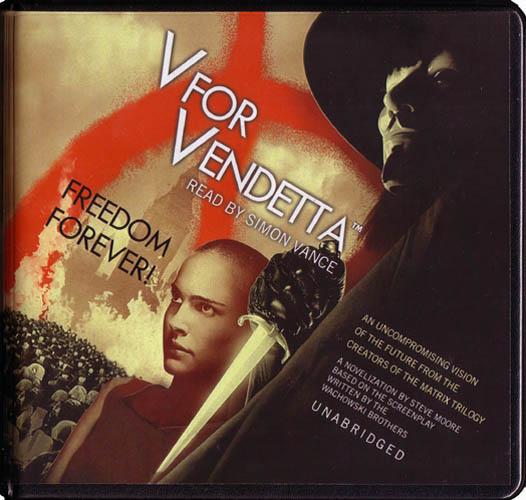
V For Vendetta by Steve MooreV For Vendetta
Novelization by Steve Moore; Read by Simon Vance
11 Cassettes, 8 CDs or 1 MP3-CD – 9.5 Hours [UNABRIDGED]
Publisher: Blackstone Audio
Published: 2006
ISBN: 0786144637 (Cassette), 0786170777 (CDs), 078617711X (MP3-CD)
Themes: / Science Fiction / Dystopia / Terrorism / Anarchy / England /

Click here for an audio sample —

“Remember, remember the fifth of November, The Gunpowder Treason and plot. I know of no reason why The Gunpowder Treason should ever be forgot…”

This audiobook had a long and treacherous road to release. Perhaps even worse, it has a questionable provenance. V For Vendetta, the unabridged audiobook, is several steps removed from the original source material. Worse still, the adapted property has been completely disowned by its original creator, celebrated graphic comics writer Alan Moore. He quite literally had his name removed from the movie credits, the novelization, and consequently this audiobook – in short he wants nothing to do with it.

Alan Moore is a famous figure in comics, and his opinion carries much weight among comic book readers. Because of all this, V For Vendetta, the novelization of the movie of the same name, is in serious jeopardy of being dismissed. But given the original material’s quality and the near classic vintage – the character and setting for “V” was originally birthed in early 1980s – you might be inclined to give this audiobook a try anyway. And for that you will be rewarded.

The road to release began with The Wachowski Brothers, the creators of the film The Matrix, optioned the story. They purchased the rights and scripturally adapted the graphic novel of V For Vendetta for the screen. After the film began production their script was then again adapted, this time as a movie novelization (or as the industry calls it a movie tie-in novel). The novel was written by Steve Moore, who, while no familial relation to Alan Moore, is very much his friend. Then Blackstone Audiobooks stepped in, hiring Simon Vance to voice an unabridged audiobook version of the Steve Moore’s novelization of The Wachowski Brother’s script of their movie which was originally based on Alan Moore’s original comic book series (that was collected into a graphic novel). See what I mean about a treacherous road? At any point along this journey the story could have been ruined. But what happened instead is that it has been IMPROVED! Indeed I think story-wise this is the best version of V For Vendetta

Soon after the opening of the novel a mysterious figure named “V,” who dresses in a Guy Fawkes costume, promises to destroy the British Parliament buildings on November 5th, one year hence. It is a bit unlear at first, is the fascist governing party the target of this threat, or perhaps it is the people of England in general? Only one woman has even a clue. Her name is Evey. With war raging round the world, an English supremacist party called “Norsefire” has fully secured governmental authority in England. Some time ago, Norsefire successfully seized the initiative, and now England’s remaining citizenry are in a stranglehold of their own making. At the start of the novel the government controls media and a petrifying secret police force seemingly made up of little more than street thugs prowls the streets after dark. In the recent past the last of the last of the concentration camps has closed – their grisly work completed. The populace has been lulled into their docility by a combination of mindless television drama, propaganda posing as opinion, and horrifying news stories about how much worse everywhere else is. So when an anarchic revolutionary destroys London’s Saint Paul’s Catherdral in pyrotechnic display, the compliant populace is only slightly stirred. The government explains that it was just a “scheduled demolition” and many Britons even believe it. But when “V,” a seeming superhero/supervillan goes on BTN the sole governmental television network, and announces a violent campaign to be capped in by the destruction of parliament buildings in one year’s time the populace begins to question if “England shall prevail” or whether it even should.

Like George Orwell‘s classic dystopia 1984 the totalitarian regime in V For Vendetta rose to power by exploiting people’s worst fears and firing-up their prejudices. Interestingly the viewpoint character is not V himself. V’s personal history, past a certain point, remains mysterious right to the end. Despite a completely third person perspective we basically follow a young woman named Evey through this tale. V saves Evey early on in the novel from a rape by government agents known as “Fingermen.” Evey’s journey is not unlike that of the population, for which she can serve as an emotional example. One other character, a police Inspector named Finch, as dutiful and honest a detective as one’d want, offers another view of that same populace coming to grips with the type of society in which it lives. Finch is assigned to pursue the mystery of V, and in so doing unravels the history of the party’s origins and V’s vendetta. About two-thirds of the way through Evey’s journey with V and his vendetta Evey is captured and tortured. Her only solace during her ordeal is a scrap of toliet paper with a moving biography of her neighboring victim. The payoff from this is extremely surprising, utterly transendant and I think probably even true. There isn’t enough praise to go round for this one, Alan Moore for originally writing it of course, the Wachowski Brothers for recognizing it and popularizing it and Steve Moore for preserving and enhancing it. They all deserve major public honours here.

On the audiobook end, Simon Vance is my new favorite British narrator. The Shakespearean inspired “V-speech” that he delivers near the beginning of this audiobook is without parallel in my experience. It’s deliciously composed, elegantly constructed and with Vance’s performance, wonderfully delivered. The film version of this same speech is very good too, but I actually found myself better able to follow it via Vance’s excellent enunciated delivery. Steve Moore, the adaptor of the film’s script, has done something special. He’s taken many inspired liberties with the script by filling in as much detail as he could to flesh out the story – nearly every effective new addition to the story was taken from the original source material the comic book version of V For Vendetta. Finally, I can thankfully say that the plot detail involving the destruction of the British parliament buildings (including London’s Big Ben) is preserved from the film version. This is extremely important. To be sure there is a scene of the destruction of the British parliament buildings in the original graphic novel but the timing of it there is far less effective in terms of a story’s arc. Though it might be controversial to say, I think it is true: The Wachowski Brothers, in their adaptation of Alan Moore’s story, clearly understood the power of terrorism better than Alan Moore himself did at the time of the comic’s writing. The goal of terrorists is to show that an authority cannot control the terrorists. When a terrorist threat, like the destruction of a weighty architechtural symbol, is made and then carried out that effect is achieved. Some fear comes from a lurking dread of some muzzy non-specific threat but true political power stems from being able to call every shot, make the predictions on destruction and have them all come true every single time. In rejigging the story to make the destruction of the British parliament buildings happen near the end instead of the start, the already powerful story of V For Vendetta is vastly improved. An SFFaudio Essential.

Posted by Jesse Willis
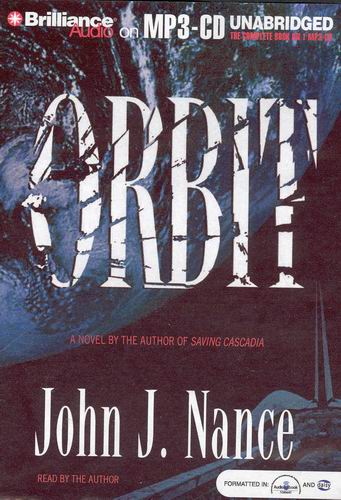
Review of Orbit by John J. Nance

Science Fiction Audiobook Review

Science Fiction Audiobook - Orbit by John J. NanceOrbit
By John J. Nance, read by the author
1 MP3-CD, Approx. 9 hours [UNABRIDGED]
Publisher: Brilliance Audio
Published: 2005
ISBN: 1593356919
Themes: / Science Fiction / Near Future / Space Flight

Poor Kip Dawson, not only is he saddled with a shrewish wife who doesn’t support his aspirations, an estranged son who doesn’t understand him, and a humdrum job he doesn’t enjoy, but when he finally realizes his one true dream of flying into space on a private space-tourism ship as the winner of an international contest, he finds himself stranded there with a dead pilot and no way to start the engines or contact the earth. Even worse, he seems completely unaware that he is nothing but a static clip-art character dragged and dropped into a dull exercise in word processing.

The story has the potential to accomplish so much: Thrilling adventures as those on the ground seek to help our man in space by shooting down a large piece of space debris headed his way and scrambling not one but four spacecraft to reach him before his air scrubbers give out; gripping human drama as he spins out his entire sexual history, his shallow self-reflections, and his talk-show psychologist advice to the world in a blog he doesn’t know is being sent live to the ground; and even a hint of heart-warming romance with the head of PR for the private space tourism company. Alas, John Nance’s handling of this potential reads like a To Do list scrawled in the margins of an outline. The tale is boosted by a few interesting complications and the feeling that it could technically all happen tomorrow, but it is brought crashing back to the launch pad by an infantile understanding of the politics of the space program, an even more infantile understanding of men and their desires and fears, and a supremely infantile understanding of women and love.

I’ll give the audio version this: At least it’s brief. This is due to Nance’s remarkable ability to produce syllables rapidly. But there is a distracting microphone lisp throughout, and a remarkable sameness to the delivery of the dialog, the exposition, the inner thoughts of the characters, and the chapter numbers. Nance shows he’s a good sport with his hilarious rendition of father and son Australian accents, but other than that, there isn’t much you hear that you won’t soon gladly forget.

This book aims high, and for that I can forgive a lot. But it is betrayed by haste and inattention. The moments that should be the most involving and emotionally satisfying instead read like the author would rather be somewhere else, doing something else. And that’s how you’ll feel too, should you be unfortunate enough to listen. Take my advice: Don’t.

Posted by Kurt Dietz

The Time Traveler Show Podcast # 3 : Arena by Frederic Brown

SFFaudio Online Audio

Podcast - The Time Traveler ShowArena by Frederic BrownThe Time Traveler Show podcast #3 is available now! The main content is an unabridged reading of Frederic Brown’s often adapted (though not always attributed) classic SF tale Arena. Originally published in the June 1944 issue of Astounding Science Fiction magazine this tale was first adapted as an episode of the original Outer Limits in 1964, then in 1967 for the original Star Trek television series (the infamous “Gorn” episode), and even as a comic in Marvel Comics magazine Unknown Worlds of Science Fiction in 1976. You can read the complete show notes for podcast #3 HERE or download the show HERE.

And if you haven’t already be sure to subscribe using this feed:

http://www.timetravelershow.com/shows/feed.xml

Review of The Incredible Shrinking Man by Richard Matheson

SFFaudio Review

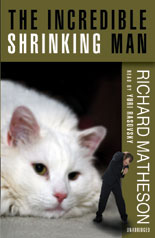
Science Fiction Audiobooks - The Incredible Shrinking Man by Richard MathesonThe Incredible Shrinking Man
By Richard Matheson; Read by Yuri Rasovsky
1 MP3 disc, 7 CDs, 6 cassettes – 8 hours [UNABRIDGED]
Publisher: Blackstone Audio
Published: 2006
ISBN: 0786178515(MP3), 0786175761(CD), 0786137924 (cassettes)
Themes: / Science Fiction / Atomic Radiation / Illness / Transcendence / Miniaturization / Horror

Scott Carey is a man suffering from a freak accident during which he was exposed to radiation dust and pesticides. He begins to slowly shrink. He finds not only the physical challenges of getting smaller but the social as well. In fact it is in this social arena where must of the intensity of the book comes from.

Scott Carey has a good life with his beautiful wife, Lou. When he begins to shrink tension between him and his wife grows, and their relationship begins to change. Although we feel sympathy for Scott’s plight, we don’t necessarily like him. He’s one pissed-off little guy. Ultimately this is a story of impotence. Not just sexually but for all aspects of his life. He can no longer satisfy his wife sexually (even though he still has his sex drive). He cannot meet his family’s economic needs except by selling his story to tabloid-styled newspapers. And he has a daughter that he has to fear because she may crush him just by playing with him.

Yuri Rasovsky does a great job on the audiobook. In an early dialogue scene with Scott and his wife Lou, the character voices sounded very much the same. My first response was that Yuri didn’t differentiate between characters much. On second reflection, I realized this was intentional. Later in the book as Scott is shrinking, he begins to sound like a little boy when talking with his wife. This helps create the vulnerable and impotent stature of Scott, making him less of a man. It was no accident that Matheson used “Lou” as a nickname for Scott’s wife, Louise. It demeans Scott’s masculinity even more.

Richard Matheson is a wonderfully expressive author, drawing emotion out with every turn. Granted, they are mostly dark emotions.

Matheson also adapted this novel to a screenplay for the classic movie. I watched the movie right after finishing the audiobook to see how a master adapts his own work to screen. It’s an experience I strongly recommend. Some of the most powerful scenes in the book do not make it into the movie. There’s a gang of youths that beat Scott. There’s the drunken child molester that picks up Scott hitchhiking and mistakes him for a boy.

And there are scenes that work better in the movie than in the book. These are the action scenes when Scott is fighting cats and spiders. Those scenes in the book become tedious because they take so long to explain.

But the book surpasses the movie again with an ending that is more poignantly transcendent.

The Time Traveler Show Podcast # 2 : With Stories by G.C. Edmondson And Frederic Brown

SFFaudio Online Audio

Podcast - The Time Traveler ShowThe Magazine Of Fantasy And Science Fiction February 1957The Time Traveler Show podcast #2 is LIVE from the future! In this episode the eponymous Time Traveler waxes nostalgic for his favorite old time podcasts; Dragon Page Cover-To-Cover, Escape Pod, and Spaceship Radio. Even better, podcast #2 has two complete and unabridged stories from the February 1957 issue of The Magazine Of Fantasy And Science Fiction! First up is a short story, The Inferlab Project by G.C. Edmondson (read by Terry Lenz). Next is a flash fiction story called Expedition by the legendary Fredric Brown (read by The Time Traveler himself). You can read the complete show notes HERE or download the show HERE.

Better yet, subscribe using this feed:

http://www.timetravelershow.com/shows/feed.xml

Review of A Scanner Darkly by Philip K. Dick

SFFaudio Review

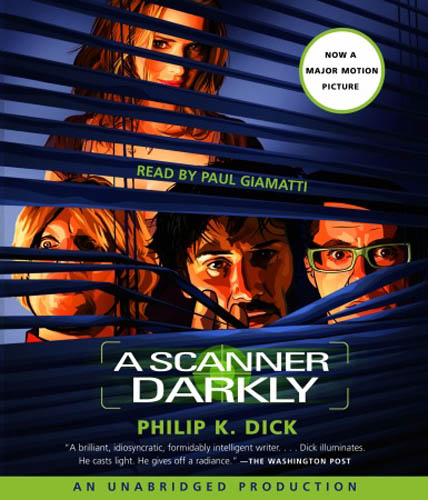
Science Fiction Audiobook - A Scanner Darkly by Philip K. DickA Scanner Darkly
By Philip K. Dick; Read by Paul Giamatti
8 CDs – Approx. 9.5 Hours [UNABRIDGED]
Publisher: Random House Audio
Published: 2006
ISBN: 073932392X
Themes: / Science Fiction / Drugs / Consciousness / Identity / Paranoia / Law Enforcement /

“I myself? I am not a character in this novel, I am the novel.”
-Philip K. Dick A Scanner Darkly

Bob Arctor is the owner of a ramshackle Orange County, California bungalow that houses a small group of drug users. The police think Bob is a dealer in the dangerously addictive drug called Substance-D but Bob really isn’t. Or is he? Fred thinks so, Fred is a deep-cover police agent assigned to surveil Bob’s every move by means of holoscanners and upclose undercover investigation – but Fred’s job is made more difficult because it requires him to take Substance-D, the effects of which have been to gradually split his brain into two very distinct and mutually combative conciousnesses. Fred schizm is so bad that he now doesn’t realize that he is also Bob Arctor and that he has in fact been narcing on himself! Fred/Bob’s only hope is to convince his/their dealer, a druggie named Donna, to get him to the source of Substance-D. Yep it is another typical Dickian plot, the downtrodden protagonist/s finds him/themselves at odds with complicated plot, which while not specifically aimed against him, is something in which he/they have become inadvertently entangled. Unfortunately when survival is the object of the game, Dick’s poor characters don’t know that doubling-down only multiplies the jeopardy by a factor of two.

Dick was no stranger to paranoid drug fantasies. Back in 1972 with his fourth marriage in ruins, an unsolved burglary in his Marin County home and a serious amphetamine addiction Dick travelled to Vancouver, British Columbia to be Guest of Honor at V-Con. After delivering a landmark speech he attempted suicide. Desperate for help, Dick begged and gained entrance to an exclusive heroin addiction treatment center called X-Kalay. This despite the fact he wasn’t addicted to heroin. When he eventually retuned to California he started work on a new novel. A Scanner Darkly was the result. Now 33 years later Dick’s novel has been adapted for audio as a result of the new film version. The good news is, no matter what you think of the film you’ll dig the audiobook. Despite what mayu sound like a downer, you’ll dig this book, A Scanner Darkly has some of the funniest scenes in all of Science Fiction. One section about a suicide gone wrong showcases Dick’s absurdist intellect… “[Charles Freck] spent several days deciding on the artifacts [that would be found by the archaeologists who discovered his dead body]….He would be found lying on his back, on his bed, with a copy of Ayn Rand’s The Fountainhead (which would prove he had been a misunderstood superman rejected by the masses and so, in a sense, murdered by their scorn) and an unfinished letter to Exxon protesting the cancellation of his gas credit card.” Even better, the ending is masterful, giving up the same Science Fiction satisfaction as did his Hugo winning The Man In The High Castle.

Actor Paul Giamatti (who had a supporting role in the film version of PKD’s Paycheck) was the perfect choice to read A Scanner Darkly. Giamatti’s on-screen characters only hint at his range and it took this audiobook to showcase all that talent. This is an excellent performance, Giamatti has said that Steve Bucemi should have been cast in the Tom Cruise role of the Minority Report film but I’m thinking it should have been Giamatti. His sympathetic portrayal of these drugged-out hippies and drugged-up cops makes this Random House’s A Scanner Darkly the definitive reading of a Dick novel. Giamatti ably gives distinction to the cast of losers and even carries off the German sequences without a hitch. What blows me away about this production is that Giamatti had expresed interest* in being in the Linklater film version of the same name, Giamatti has stated in multiple interviews that he is a fan of PKD’s work. Giamatti has even been approached to play PKD in a film adaptation of Dick’s life! That’d be a hoot.

Two Seeing Ear Theater alumni, Brian Smith and John Colluci, produced and directed Giamatti’s performance. The audiobook also includes intro music and the complete coda; a list by Dick of many of his closest friends who died or were severely damaged by drug use. I heartily endorse this unabridged audiobook and we in our influenced wisdom have seen fit to grant it a hallowed place in the hall of SFFaudio Essentials. This is a book to be long remembered and a reading never to be forgotten.

*Entertainment Weekly (issue #884/885 Summer 2006 Double Issue – page 117)

Posted by Jesse Willis