Review of Caedmon’s Science Fiction Soundbook

SFFaudio Review

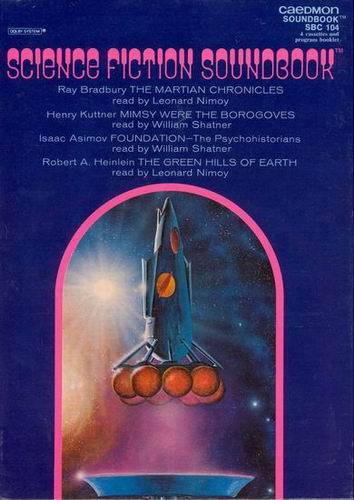
Science Fiction Audiobook - Caedmon Science Fiction SoundbookScience Fiction Soundbook
By Ray Bradbury, Isaac Asimov, and Robert A. Heinlein
Read By Leonard Nimoy and William Shatner
4 hours – 4 Cassettes [UNABRIDGED]
Publisher: Caedmon
Published: 1977
Themes: / Science Fiction / Mars / Edgar Allan Poe / Computers / Mathematics / Sociology / Space Travel /

This out-of-print Caedmon set was a wonderful find (thanks, Esther!) because it contains two cassettes (four stories) that are amongst the earliest science fiction audio I ever heard. The stories are “The Green Hills of Earth” and “Gentlemen, Be Seated” by Robert A. Heinlein, and “There Come Soft Rains” and “Usher II” by Ray Bradbury, all read by Leonard Nimoy. Also included here is “The Psychohistorians” by Isaac Asimov and “Mimsy Are the Borogroves” by Henry Kuttner, both read by William Shatner. The audio was originally published in 1977.

I found Leonard Nimoy’s readings to be excellent. In Bradbury’s “Usher II”, he delivers a passionate speech about the evils of book burning with perfection. In “Gentlemen, Be Seated” and “The Green Hills of Earth” he portrays working class spacemen with complete success.

William Shatner, though, was disappointing. I’ve heard him read some Star Trek titles, and felt his delivery was pretty good, but here, on both cassettes, he reads as if he needs to be across town in fifteen minutes. He zips through the text, sometimes fast enough to affect my comprehension.

The stories are all bona-fide 5-star classics:

“There Will Come Soft Rains” by Ray Bradbury, read by Leonard Nimoy
This famous story is about a house. That’s it, just a house. An automatic, programmed house that keeps running and running… but where are its inhabitants? Bradbury manages to tell a very human tale without any actual people.

“Usher II” by Ray Bradbury, read by Leonard Nimoy
A fantastic story, passionately read, about a man who builds Poe’s House of Usher on Mars. Because of the social climate on Earth, it would be illegal to build such a fantastic structure, because stories of fantasy are simply no longer allowed. If you agree with that policy, this fellow would be happy to show you around, and he does get that opportunity. As I mentioned earlier, a highlight is a speech on censorship that was an obvious precursor to Bradbury’s Fahrenheit 451.

“The Psychohistorians” by Isaac Asimov, read by William Shatner
This is the first novelette in the first book of Asimov’s Foundation trilogy. In it, you meet Hari Seldon and Gaal Dornick in an introduction to some of the key elements of the Foundation story, including the Empire in decline and the mathematics of psychohistory. However, I did have difficulty get into Shatner’s narration.

“The Green Hills of Earth” by Robert A. Heinlein, read by Leonard Nimoy
Rhysling is a Spacer who lost his eyesight in a reactor pile accident. Now, he’s a famous bard, and this is his story. The story is an excellent portrayal of what spaceflight might be like from the working stiff’s point of view, once flight becomes common. At least from the perspective of a science fiction writer in 1948. No NASA engineers here.

“Gentlemen, Be Seated” by Robert A. Heinlein, read by Leonard Nimoy
This story is similar to “Green Hills” in that the characters are working class spacemen. One agrees to take a reporter through some new buildings on the moon (yes, he does get overtime pay for it), but an accident occurs during the tour. Another story from the late 1940’s, which is the part of Heinlein’s long career that I enjoy most.

“Mimsy Were the Borogroves” by Henry Kuttner, read by William Shatner
This story fared better under Shatner’s cadence than did “The Psychohistorians”. I was captured by it within 5 minutes or so of concentrated listening, and Kuttner’s story held my attention even when Shatner didn’t. The story involves some toys that were sent back in time by a far-future scientist with too much time on his hands. The toys are found by some kids, who play with them, and are changed by them. The story plays with the ideas of how people think – how kids think, how adults think, and how it could possibly be different. I found it a well-written and entertaining exploration of these ideas. Great science fiction.

Posted by Scott D. Danielson
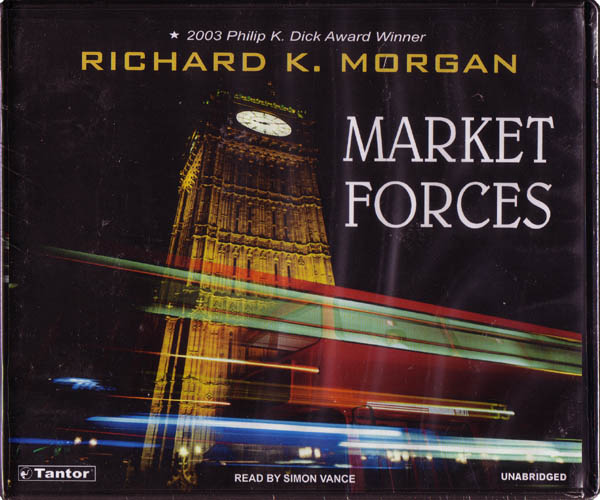
Review of Market Forces by Richard K. Morgan

SFFaudio Review

Science Fiction Audiobook - Market Forces by Richard K. MorganMarket Forces
By Richard K. Morgan; Read by Simon Vance
13 CDs – 16 Hours [UNABRIDGED]
Publisher: Tantor Media
Published: 2005
ISBN: 1400101395 (Retail CD), 1400131395 (Library CD), 1400151392 (MP3-CD)
Themes: / Science Fiction / Dystopia / Economics / Satire /

“Human beings have been fighting wars as long as history recalls. It is in our nature, … last century the peacemakers, the governments of this world, did not end war. They simply managed it, and they managed it badly. They poured money without thought of return into conflicts and guerrilla armies abroad, and then into tortuous peace processes that more often than not left the situation no better. They were partisan, dogmatic, and inefficient. Billions wasted in poorly assessed wars that no sane investor would have looked at twice. Huge, unwieldy national armies and clumsy international alliances in short a huge public sector drain on our economic systems. Hundreds of thousands of young people killed in parts of the world they could not even pronounce properly. Decisions based on political dogma and doctrine alone. Well, this model is no more.”

In an interview with Rick Kleffel of The Agony Column Richard K. Morgan describes the motivaton behind Market Forces – ‘there’s a scene’ he said, ‘in the movie Lethal Weapon‘ a scene in which the suicidal cop Martin Riggs (played by Mel Gibson) is atop a roof, ironically, trying to talk down an suicidal citizen who claims he’s going to jump. Frustrated at the indecision that grips them both Riggs snaps – he handcuffs the citizen to his own wrist and then asks him “Do you really wan’t to jump? Do you wanna?” – then dragging the citizen with him Riggs jumps off the roof. It’s a scene designed to show the inner demons that haunt Riggs, who is, after all, the “Lethal Weapon” of the film’s title. So what does that have to do with Market Forces? This novel is Richard Morgan’s response to the right-wing think tanks which have for years been constantly murmuring in the media soundbites of “let the market decide,” “government is in the way of business,” “the invisible hand can regulate better.” Morgan’s frustration with these ideologues is answered by dystopian satire, a kind of Wall Street meets Mad Max. This is an England in which the gap between the rich and poor has widened. At the top are an elite, an upper-class of executives, driving armoured cars and carrying firearms in their briefcases. At the bottom are the unemployed, disenfranchized and living in deserted slums without access to public transportation, their only escape is to join the police or Special Air Service, both privatized and in mercenary service of the executive class. The commodited investment houses have morphed into “Conflict Investment” houses. It’s a powerful setting, a critical look at where we are now, as 1984 and Farenheit 451 were critical looks at where we used to be – a place we must still fight from going. In essence Morgan says ‘This is what happens when you look at what we’re doing now and then project ahead. This is what happens if you listen to the right-wing think tanks. This is what happens when you jump.’

As a primer let me explain how “conflict investment” works. You find a country, one torn by civil war or revolution. You decide who, amongst the many factions within that country could win, given the right resources and then you back them. In return for providing the arms, equipment and intelligence to win a “small war” the faction must commit to give you a cut of their country’s gross domesitc product for a quarter century or so. Our viewpoint character, Chris Faulkner, has recently been hired on as a junior associate by one of the top conflict investment firms, Shorn Associates – this happened in large part because of Chris’ reputation for savage road duelling. Meanwhile, Chris’ wife, a mechanic from Sweden, (a country with one of the last socialist governments around) is encouraging him to seek more peaceful pastures by defecting to a struggling international peace movement. With rebels in Guatemala to support and a growing record of auto-duel kills Chris is a hot number, but it increasingly seems like someone is setting him up for a fall. It’s up to Chris to decide whether he’s going to be the person his wife wants him to be or if he’s going to continue on his road to corporate partnership.

I ended up really liking Market Forces. There was a time there when I wasn’t sure, the first third of the novel is quite depressing, Morgan’s world has gone to shit and the people in it smell, and smell bad. Part of my problem was with how the world got to be this way. A corporate world full of scum? I can understand that, but a corprate world full of armed scum? It seemed a bit proposterous. Then it came to me, between discs 4 and 5 I realized, “this is a satire”. Like American Pyshco or that corporate raiders sequence in Monty Python’s The Meaning Of Life. Eventually Morgan does give an explanation of how we got from where we are now to the fifty or so years from now setting of Market Forces and that explanation works in a ‘give me an inch and I’ll give you a novel’ sort of way. The real explanation however is that to be the story it needed to be actual market forces really had to play into every human transaction. The brutal reality of competitive of an unregulated capitalism working at full force would likely still be insulated by an old boys network, an oligarchy that said it wanted unrestricted competition, but really just wanted power. In arming and glorifying the auto duels Morgan has made Chris Faulkner confront the reality of the world he is making. Ultimately the decision he faces is as terrible as those made by Winston Smith in Nineteen Eighty-Four and Guy Montag in Fahrenheit 451. It remains to be seen whether Market Forces will be as enduring as those dystopian novels, but it stands among them, bare face in the portrayal of a brutal tommorow based on the unchecked trends of today.

This is a gloomy book marked by several scenes of jagged action and carnal sex, it is a good thing Tantor Media chose a versatile reader. Narrator Simon Vance used his precise English accents to portray the undertones of resentment many of the characters didn’t even realize they had – it carried me through the gloomy bits to the dramatic conclusion. Tantor issued us another of the library retail bound CD editions, though it had identical packaging to Altered Carbon (recently reviewed) two of the indivudal pages came loose in this one while I was pawing through. UPDATE: The good folks at Tantor have informed me that they actually sent the retail edition to us. The library edition is higher priced and comes in a white box with a metal ring binder (as well as a free lifetime CD replacement guarantee).

In researching for the review I found out that Market Forces is based on an unpublished seedling of a short story, entitled Some Serious Driving. Apparently it was originally submitted to Interzone magazine, they rejected it as full of ‘unlikable characters’ – something the novel has too. In an ideal world I’d have liked to see Some Serious Driving bundled in as an extra, perhaps Tantor Media can gather together all of the Richard K. Morgan unpublished shorts to tide us over until the 5th RKM novel comes out?

One last thing, given my description of the plot you might think Market Forces a standalone novel and indeed it does stand nicely on its own- the thing is I found strong evidence that Market Forces is set in the same universe as that of the Takeshi Kovach novels, the books Richard Morgan is best known for. There’s a number of references to conflict investment in general and the Shorn corporation in particular in Broken Angels, the second Takeshi Kovach novel. Cool huh?

Posted by Jesse Willis

Review of Ringworld by Larry Niven

Science Fiction Audiobook - Ringworld by Larry NivenRingworld
By Larry Niven; Read by Tom Parker
Audible Download – 11 hours [UNABRIDGED]
Publisher: Blackstone Audio
Published: 1999
ISBN:
Themes: / Science Fiction / Hard science fiction / Physics / Space travel / Aliens /

I’ve started this review several times. I’m honestly not sure what to say about this classic novel. In a word, it’s wonderful. What else can I say? It was originally published in 1970, and won both the Hugo and Nebula Awards for Best Novel. Of course, the awards and all the accolades since were well deserved.

Blackstone Audio published this unabridged version in 1999, and I found it on Audible. Tom Parker does a fine job with this straight narration of the material. Not fantastic, but better than adequate. Once I eased into his flow, I had no problem maintaining attention, but I think a bit more could be asked in the characterization department.

The main character in Ringworld is a 200 year old human named Louis Wu, who is approached by a Puppeteer (one of an alien race) who in turn is building a team to visit a star system that has an fabricated ring around it. The complete team includes Louis Wu, the Puppeteer, a Kzin, and a human female. The reasons for all these choices become clear during the novel.

Niven’s style is such that you can be awed then amused on the same page. His characters are very comfortable with life. They talk physics like we discuss where to have dinner. After more than thirty years, the story remains interesting and the ideas fascinating.

I highly recommend this audiobook, whether you’ve experienced Ringworld already or not.

Posted by Scott D. Danielson

The OTR Plot Spot has posted a cool adaptation …

Online Audio

The OTR Plot Spot Logo The OTR Plot Spot has posted a cool adaptation of a classic Science Fiction story up for a very limited time. If you don’t want to miss hearing it check out this week’s LISTENING BOOTH right away. There you’ll find The Wall Of Darkness by Arthur C. Clarke posted in MP3 format. This rare broadcast was created by SciFi Radio a series broadcast on NPR in 1989 and 1990. A new character was added to the plot but the drama is faithful to the original short story. Enjoy.

Science Fiction Radio Drama - The Wall Of Darkness by Arthur C. ClarkeThe Wall Of Darkness
By Arthur C. Clarke; Performed by a Full Cast
1 MP3 Files – 28 Minutes 50 Seconds [RADIO DRAMA]
Broadcaster: NPR / Sci-Fi Radio
Broadcast: December 3rd 1989
The universe consists of only one star and one planet. Circumscribing the planet is a mysterious impenetrable wall. When a rich man living on that planet engages his wealth into a project to scale and find out what is on the other side he’ll find out what lies beyond and also the reason why it was constructed in the first place.

Review of How to Survive a Robot Uprising by Daniel H. Wilson

Science Audiobook - How To Survive a Robot Uprising by Daniel H. WilsonHow to Survive a Robot Uprising: Tips on Defending Yourself Against the Coming Rebellion
By Daniel H. Wilson; Read by Stefan Rudnicki
1 MP3-CD – 3 hours – [UNABRIDGED]
Publisher: Blackstone Audio
Published: 2006
ISBN: 0786177128
Themes: / Science Fiction / Science Fact / Humor / Robots / Computers /

Today, scientists are working hard to bring these artificial creations to life. In Japan, fuzzy little real robots are delivering much appreciated hug therapy to the elderly. Children are frolicking with smiling robot toys. It all seems so innocuous… and yet, how can so many Hollywood scripts be wrong? How could millions of dollars of special effects lead us astray? So take no chances. Arm yourself with expert knowledge for the sake of humanity. Listen to serious advice from real robotics experts. How else will you survive the inevitable future in which robots rebel against their human masters?
— Daniel H. Wilson

If you’ve been sitting up nights, concerned about this dangerous uprising of robots and other computerized gadgets against the human race, then this book is for you. In here, you’ll find tips on how to outrun a two-legged robot and how to survive a high speed chase involving a robot car. The tools you’ll learn to use will allow you to confuse, distract, and escape from all kinds of robots, from “toaster to Terminator”.

Daniel H. Wilson, the author, is a Ph.D. candidate at the Robotics Institute of Carnegie Mellon University. He’s written a fabulous, funny book that is both entertaining and informative. “Every scenario in these pages,” he says, “is either possible or already being realized.” In each section, Wilson describes the current state of a certain type of robotics, then, by describing how a human can defeat the technology, he reveals the limitations.

I loved this audiobook. Stefan Rudnicki did an excellent job capturing the mock-seriousness of the subject matter. How To Survive a Robot Uprising is both a primer on the current state of robotics science, and a hilarious send-up of science fiction involving robot rebellions. Rarely has science fact been mixed with science fiction to providing such an entertaining book. I’m eager to hear it again, and will as soon as I’m done typing.

Posted by Scott D. Danielson

Review of Merian C. Cooper’s King Kong by Joe DeVito and Brad Stickland

Horror Audiobook - Merian C. Cooper's King KongMerian C. Cooper’s King Kong
By Joe DeVito and Brad Stickland; Read by a Full Cast
6 CDs – 6.75 Hours [UNABRIDGED]
Publisher: Full Cast Audio
Published: 2005
ISBN: 1933322497
Themes: / Science Fiction / Horror / Movie making / Gorillas / Dinosaurs /

Full Cast Audio has really perfected their style. The first audio I listened to by them was back in 2002 – I reviewed it for SFSite, and you can find it here. Their Full Cast style of audiobook narration was new to me, I was a little put off by it, though I enjoyed the book (as did my son).

Here we are in 2006, and Full Cast Audio presents Merian C. Cooper’s King Kong, during which I marveled at the expert production. The skillful acting, the flawless editing, and the classic story make this a title not to be missed. Nobody does Full Cast Unabridged narration better than Full Cast Audio.

The story is familiar to nearly all of us. Carl Denham is a recklessly ambitious filmmaker in 1930’s New York City. He gathers a crew and an actress (Ann Darrow) to sail to a secret destination where he can film his masterpiece. The crew finds the mysterious island, where they find King Kong in an adventure that turns dangerous in a big hurry.

I haven’t seen the original King Kong film for many years, and it didn’t have the effect on me that it did on so many others, including Peter Jackson. I have seen Peter Jackson’s version, though. This version of the story is not a novelization of the Peter Jackson script. It is an expansion of the original novelization of Cooper’s original Kong story.

Posted by Scott D. Danielson