Review of Ecotopia – An Audio Novel By Ernest Callenbach

Science Fiction Audiobooks - Ecotopia by Ernest CallenbachEcotopia – An Audio Novel
By Ernest Callenbach, Read by Ernest Callenbach and Edwin Newman
2 cassettes – 3 hours [UNABRIDGED AUDIO ADAPTATION]
Publisher: Audio Renaissance
Date Published: April 1990 – Out of Print
ISBN: 1559270527
Themes: Science Fiction / Utopias / Environmentalism / Ecology /

Dateline — the early 21st Century. The nation of Ecotopia — made up of what was once Washington, Oregon and Northern California — has been independent of the United States for 20 years. Now, for the first time since its secession, this mysterious society is allowing an outsider to enter its borders and report on its way of life.

William Weston is a journalist from the eastern United States, the first person to be granted permission to enter Ecotopia since its breakaway from the rest of the USA 20 years earlier. The news reports he transmits from Ecotopia describe the strange customs, practices and beliefs of the Ecotopians. Meanwhile, his personal journal doesn’t try to remain objective as he comes to terms with his personal response to this strange new society.

Ecotopia is less a novel than it is an extended essay on how we could live if we would just all become environmentalists. The basic premise is simply an environmentalist version of Sir Thomas More’s literary classic Utopia. While listening to the story I never once got lost in the tale. I was always aware that this was directly inspired by More’s famous work – heck, even the title jars the suspension of disbelief, its like naming the first moon colony “Moonbase Alpha” and then expecting us all to take it seriously. But Ecotopia isn’t exactly a modern retelling of More’s work. Unlike his utopia, Ecotopia is earnest, real earnest – and in a way only a true environmentalist or an evangelical vegetarian can be. But don’t get me wrong, I enjoyed the story and liked a lot of the ideas in it. But the story is a complete daydream, with no chance of it ever happening, at least any sort of revolutionary way as Callenbach has it. I shouldn’t overstate the flaws. Ecotopia was written in 1975, and here nearly three decades later a significant portion of the population has adopted at least some of the mindset set out in the novel.

I must tell you I’m no true-believing granola-cruncher myself, but I concede that much of the novel has great power and is persuasive. Ecotopians enjoy 20-hour work weeks, have a stake in the product of their labor and live in a society that has abolished patriarchy. The greatest criticism that I can have against the story is that it’s completely unrealistic – it ain’t gonna happen, not like he’s written it. Now normally this wouldn’t be an issue at all. Many fantasy novels are set in worlds which are absolutely physically impossible, but nobody says “elves don’t exist so I can’t accept the story”, but in this case I think the criticism is apt. Ecotopia isn’t fantasy fiction, it’s utopian fiction – and the charge of implausibility is much much stickier when it comes to utopian stories especially when they’re earnest. Dystopian tales on the other hand, like George Orwell’s 1984 need not be plausible. They are vaccinations against future problems. By taking our modern moral and technological problems to an extreme in utopian/dystopia stories like Aldous Huxley’s Brave New World or Ira Levin’s This Perfect Day we are immersed in a complex vision of the problems and benefits such a society would have. Utopian dystopias demonstrate how good ideas can be ruined by unforeseen consequences and how taking some of the bad with the good might not be such a bad thing. But straight earnest utopian literature has to be laid out in such a way as to explain how we get there from here. Author Ernest Callenbach doesn’t do that. He doesn’t even wave his hands or use a throwaway excuse, and that shortcoming is a huge hurdle. All his characters are true believers, no one rails against the obvious implausibility of it all, so it is we, the listener who must. In Kim Stanley Robinson’s utopian novel Pacific Edge (1988), for example, a similar ecological balanced society is pondered, but it manages to explain how the self same human nature that we have in a consumer mad society like ours can also become an ecological utopia and it does it in a much more plausible and immersive fashion.

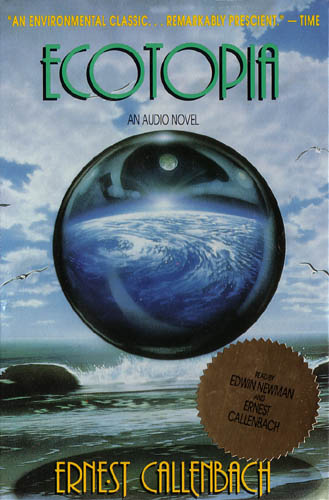
Callenbach himself narrates Ecotopia with help from Edwin Newman, they take turns reading the first person account of William Weston’s journey through Ecotopia and the dispatched news reports respectively. Both do very competent work presenting the story and have pleasant reading voices. The original cover art is attractive, the packaging adequate. Overall, this is a good package but not exceptional. Worth a listen but by no means a classic.

Review of A Song Before Sunset By David Rowland Grigg

A Song Before Sunset
By David Rowland Grigg; Read by Alexander Wilson
MP3 DOWNLOAD – 28 minutes, 22 seconds [UNABRIDGED]
Publisher: Telltale Weekly
Published: 2004
Themes: / Science Fiction / Post-apocalypse / Music /

In a post-apocalyptic city, an old man seeks to recreate his past as a concert pianist. First published in 1976 in the Australian anthology entitled: Beyond Tomorrow – An Anthology of Modern Science Fiction edited by Lee Harding, this story has been languishing unreprinted until this exceptional audio edition was released. Production value is high, the sound is exceptionally clear and the reading is lightly, and appropriately accented with music. Alexander Wilson’s reading is haunting and restrained, matching the mournful tone of this short story. Available online at www.telltaleweekly.com for only $1.00 USD, “A Song Before Sunset” is an excellent value and a great listen!

Posted by Jesse Willis

Review of Sci-Fi Private Eye edited by Isaac Asimov and Martin H. Greenberg

Science Fiction Audiobooks - Sci-Fi Private Eye edited by Isaac Asimov and Martin H. GreenbergSci-Fi Private Eye
Edited by Isaac Asimov and Martin Greenberg; Read by Bill Fantini and Nelson Runger
4 cassettes – 6 hours [UNABRIDGED]
Publisher: Dercum Audio
Published: August 1997
ISBN: 155656273X
Themes: / Science Fiction / Mystery / Utopia / Dystpoia / Sherlock Holmes / Mars / Berzerker / Time Travel / Artificial Intelligence / Covert Warfare /

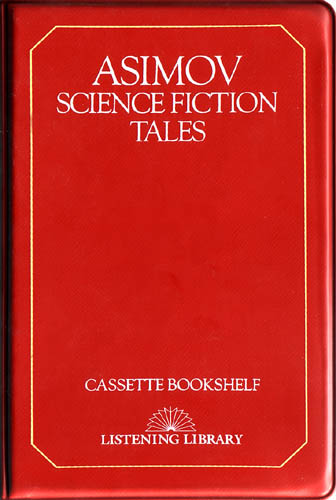
Decades ago, SF grandmaster Isaac Asimov noted the similarity between detective “whodunit” stories and science fiction “puzzle” stories. Avoiding some of the obvious pitfalls, he began to write stories that contain elements of both of these popular genres. Later as an anthologist, Asimov teamed up with Martin H. Greenberg to collect the best of this subgenre. Sci-Fi Private Eye was the happy result. Though obviously not recorded under perfect conditions, you can literally hear the pages turning, I was flabbergasted by the love and care that went into the recording of this audiobook. It starts off with a haunting original musical score, then, instead of simply reading the first story, as is typical with nearly every audiobook, it introduces the anthology with a brief but well composed essay on the subject of mystery science fiction! The packaging is not as good, while in a sturdy enough case, the original cover art falls into a category I call “computer designed abstract boring”. Even worse, they spelled Asimov’s name wrong. The cassettes themselves also lack important details (what story starts where and ends where). The stories though are so good that I’ve got to summarize and review them individually:

Stories Included:
Introduction written and read by Isaac Asimov
“Getting Across” by Robert Silverberg
“The Martian Crown Jewels” by Poul Anderson
“Of The Metal Murderer” by Fred Saberhagen
“Mouthpiece” by Edward Wellen
“War Game” by Philip K. Dick

Robert Silverberg’s “Getting Across” is a terrific SF short story told in the first person. It was originally published in the anthology entitled Future City (1973). A future society is in danger. To house the engorged human race, the Earth is entirely covered by one large metropolis. But it isn’t one big city so much as it is a million city-states abutting one another. Each district has its own government, its own customs and industries, and it’s own way of life. Contact between districts is restricted and often dangerous to those who attempt it. All districts rely on a master computer program for the smooth operation of these automated communities. So when Ganfield’s master computer program is stolen, things start to deteriorate quickly. Garbage starts piling up uncollected, food stops being delivered, the climate control system stops working, and the deactivated robotic police force cannot prevent the cannibalism that is only weeks away. The man whose “month-wife” stole the program is sent to find her and bring it back. His task is nearly impossible because even if he can get out of his district getting across will only be the first hurdle. Typical of Silverberg’s great work in the 1970s.

Poul Anderson’s “The Martian Crown Jewels” was first published in A Treasury of Great Science Fiction, Vol. 1 (1959). The Martian Crown Jewels have been stolen! The theft threatens to destroy diplomatic relations between Mars and Earth. Inspector Gregg, of the Earth police force stationed on Mars, is stumped. Who can solve the baffling locked spaceship mystery and avert a galactic catastrophe of cataclysmic proportions? None other than Mars’ greatest consulting detective, Syaloch, a seven-foot feathered Martian who lives at 221B “Street of Those who Prepare Nourishment in Ovens.” Most entertaining.

Edward Wellen’s “Mouthpiece” first saw print in the pages of Fantasy & Science Fiction Magazine’s February 1974’s issue. Most of the stories I’ve read by Edward Wellen tend to be focused on the workings of the human mind, and this one is no exception. This one fictionalizes a fascinating historical curiosity regarding the final hours of “Dutch” Schultz and takes it just that bit farther – into artificial intelligence – leaving us pondering the nature of personality, memory and thought. It’s also a great little mystery to boot!

Fred Saberhagen’s “The Adventure Of The Metal Murderer” was first published in Omni Magazine’s January 1980 issue, and is another in Saberhagen’s long running series of Berzerker short stories. It’s a time travel story that starts in the distant future and then goes back to 19th century London, England. A clever tale that will remind you of Michael Moorcock’s “Behold The Man”.

Philip K. Dick’s “War Game” was first published in Galaxy Science Fiction Magazine’s December 1959 issue. Earth’s traditional enemy, Ganymede, is at it again. They are trying to subvert and soften up the good people of Earth by selling potentially dangerous toys and games as a prelude to invasion. One toy appears to assemble itself over time into a nuclear weapon, another convinces the user that the virtual reality he or she is in is actual reality, and a third is a harmless variation on the board game Monopoly. But the market demand for the inventive Ganymedian games is pressuring the Earth customs to clear the toys for stocking in time for Christmas. If they follow the rules only one will get through to the store shelves. Typically Dickian and thus very entertaining.

Posted by Jesse Willis

Review of The Callahan Chronicals by Spider Robinson

Science Fiction Audiobooks - The Callahan Chronicals by Spider RobinsonThe Callahan Chronicals
By Spider Robinson; read by Barrett Whitener
12 cassettes – 18 hours [UNABRIDGED]
Publisher: Blackstone Audio
Published: 2003
ISBN: 0786124601
Themes: / Science Fiction / Telepathy / Empathy / Callahan’s Place / Extraterrestrials / Time Travel

There is nothing which has been contrived by man by which so much happiness has been produced as by a good tavern or inn. — Samuel Johnson

With that quote begins Spider Robinson’s omnibus collection of short stories entitled The Callahan Chronicals. Included in this audiobook are the collections Callahan’s Crosstime Saloon, Time Travelers Strictly Cash, and Callahan’s Secret. Time Travelers is not included complete – in the original paperback, some non-Callahan stories appeared that are not collected here.

The stories center around a bunch of very good folks that spend quite a bit of time at Callahan’s Place, a bar owned and tended by Mike Callahan. In the author’s words, Callahan’s is “an environment in which shared pain is lessened, shared joy is increased, and the puns really suck.” It’s a place that a person can bring his or her troubles, and find people that are willing to listen – and believe. A typical story finds the patrons enjoying each other’s company (often tossing horrible puns at each other) when someone enters and tells his or her story. This person is changed by the experience of sharing his or her troubles.

Some of the stories are marginally science fiction, but most involve some kind of science fiction idea engendered in one of the characters. Telepaths, time travellers, extra-terrestrials, and even Spider Robinson himself are among the bar’s visitors. Robinson is able to reach an emotional depth not often seen in science fiction. Each story is touching in its own way, and they often reach peaks of joy and depths of pain, all within minutes of audio. In short, these stories pack an emotional punch. I found them difficult to listen to one after the other, as a person can only feel so much. They would be better heard individually, with a bit of time to digest and reflect in-between. I plan to revisit them in this way – they are worth listening to again, and are worth the pause.

Barrett Whitener is exceptional here. He understands the material and adds just the right touch in nearly every story. No easy task with these touching stories. A job very well done.

At the beginning of the audio, there are three introductions. The first is titled “Backward”, written by Spider Robinson for the entire volume. Next is “Spider Robinson: The SF Writer as Empath” by Ben Bova, which provides a look into the life of an editor as he describes Spider’s first sale to Analog. Then comes a forward written by Robinson for the original version of Callahan’s Crosstime Saloon. All of them were interesting, and I’m glad Blackstone left them in there.

I was disappointed only by the fact that there are no breaks between these stories. The final sentence of a story is read, immediately followed by the title of the next, and straight on till morning. I would have appreciated some kind of break there.

Posted by Scott D. Danielson

Review of Have Spacesuit, Will Travel by Robert A. Heinlein

Science Fiction Audiobooks - Have Spacesuit Will Travel by Robert A. HeinleinHave Spacesuit, Will Travel
By Robert A. Heinlein; Performed By A Full Cast
8 CDs – 8 Hours [UNABRIDGED]
Published by Full Cast Audio
Published: 2003
ISBN: 1932076417
Themes: / Science Fiction / Young Adult / The Moon / Galactic Civilization /

One minute Kip Russell was walking about in his backyard, testing out an old space suit and dreaming about going to the Moon — and the next he was out cold, the captive of an insidious space pirate. The whole thing seemed like a bad dream until Kip discovered there were other prisoners on board, and they were all on their way to the Moon — and a fate worse than death!

When Kip Russell wins a runner’s up prize in a soap jingle contest, an intergalactic journey to decide the fate of humanity results. Kip goes from soda jerk to spacesuit winner to alien abductee. Along the way Kip is joined by a pint-sized genius named PeeWee and an empathetic alien known as “the Mother Thing” who together must overcome the alien invaders who want to colonize the Earth. A far-fetched Hard Science Fiction story chock full of pathos and fun! First published in 1958, Have Spacesuit, Will Travel was nominated for a Hugo Award and has steadily remained in print for over 45 years. Though originally marketed as a book for teenage boys, it has found legions of admirers in many other age groups since then. I personally know of a high school English teacher who still uses it to get his students interested in reading! And like most science fiction fans, Robert Heinlein’s juvenile novels hold a special place in my own pantheon of SF novels. They speak to the excitable youth in us like few other books do.

When I heard about this particular adaptation I was skeptical. It uses multiple actors, music, and sound effects – this all sounded more like a radio dramatization to me than a straight reading. I’ve been disappointed by many audio dramatizations, I’ve found they often try to “improve” the text and end up cutting it to shreds. I figure you don’t mess with perfection, its just asking for trouble. Well the folks at FULL CAST AUDIO have messed with perfection and come away like heroes! This is a faithful adaptation. The only differences between a straight unabridged reading and this production are a few attributives, the “he said” and “she saids” that are redundant with either a versatile single performer or a full cast of actors. The acting is uniformly excellent, the original music and special voice effects enhance their performance. In short, this production truly shines. But that’s not all. The attention to detail found in the audio production extends to the fit and finish of the packaging. The original cover art is really great, rivaling the superb Del Rey paperback cover art. The CD case too is remarkable… it’s a new design and I’d never seen anything like it before. It resembles a thick DVD style case, with the CDs stacked and held in place by two durable plastic clamps – a space saving and efficient design that also pleases the eye. This audiobook is pure unpasteurized goodness and I truly hope FULL CAST AUDIO does some more Heinlein juvenile novels just like it. Have FULL CAST AUDIO, will listen!

Review of Brown Girl in the Ring by Nalo Hopkinson

Science Fiction Audiobooks - Brown Girl in the Ring by Nalo HopkinsonBrown Girl In The Ring
By Nalo Hopkinson; Read by Peter Jay Fernandez
6 Cassettes – 8 Hours [UNABRIDGED]
Publisher: Recorded Books
Published: 2001
ISBN: 0788752286
Themes: / Fantasy / Science Fiction / Dystopia / Organ harvesting / Canada / Caribbean / Voodoo /

To uncover the future voices of science fiction, Time Warner Publishing sponsored a contest that attracted hundreds of submissions. Brown Girl In The Ring was the winning entry, announcing author Nalo Hopkinson to the world as a tremendous new talent. Brown Girl In The Ring is set in a future Toronto. An economic breakdown and a rising crime rate means the middle and upper classes have left and only the underclass remains there – a significant portion of which is of Carribean descent. Toronto’s citizens have been walled away from the rest of Canada, but now the upper classes need something from the untouchables within Toronto city limits – they need their orphans. If you think of the New York in the movie “Escape From New York”, move it a few miles North and East, you’ll get an idea of the general setting. This is a “what would the world be like if…” story, which makes it sort of SF, but there is also magic or more properly magics (both good and bad) that influence the character’s lives, and deaths too, and this is certainly not plausible in my buttoned down scientist’s hat worldview (scientists do wear hats right?). Which tends to make me think it must be fantasy, kind of like Star Wars with its “force” must be fantasy.

I think I’ve thought of a term to describe it too, you’ve heard of Cyberpunk and Steampunk right? Well maybe Brown Girl In The Ring is Voodoopunk? I wasn’t sure what I was getting into with this audiobook, it has a vocabulary and an outlook I’d never experienced in a novel before. But on the other hand it did have some things that I recognized. It has a story – a very strong story – that was told as if the author had told dozens like it before and she guided me through it with a sure hand. What’s even better is it has a strong finish. I was worried I wasn’t going to be satisfied with where the story was going, I was happily surprised. Nalo Hopkinson knew what she was doing. I didnt anticipate the dénouement, but it makes sense and is very satisfying even though it is subtle. Maybe it makes it even more satisfying because it is subtle.

As for the production, it’s a Recorded Books audiobook so of course every word of the novel’s text is present. A very good thing too! It would have been a mistake to abridge a story as complex as this one. The cover art is perfect, I think it even surpasses the original paperback artwork!

Not being from the Caribbean myself I thought Peter Jay Fernandez did a great job with the accents and voices. I have been informed however that Fernadez is definitely mis-reading some of the phrases, so badly in some cases that he accidently changes their meaning. It didn’t detract from the experience for me, but if you are at all familiar with Carribean pronounciation and accents it may make it somewhat distracting.