
Review of City of Golden Shadow by Tad Williams

SFFaudio Review

City of Golden ShadowCity of Golden Shadow (Otherland #1)
By Tad Williams; Narrated by George Newbern
Publisher:  Penguin Audio
Publication Date: 30 October 2014
[UNABRIDGED] – 28 hours, 42 minutes

Themes: / cyberpunk / virtual reality / science fiction /

Publisher summary:

Surrounded by secrecy, it is home to the wildest dreams and darkest nightmares. Incredible amounts of money have been lavished on it. The best minds of two generations have labored to build it. And somehow, bit by bit, it is claiming the Earth’s most valuable resource – its children.

Review:

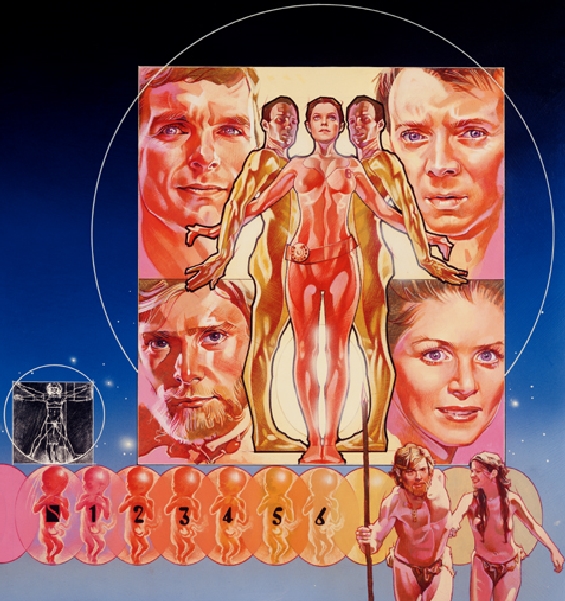
I hate to admit this, but I judged this book by the cover at first. I knew nothing about the book when I started listening, I hadn’t even read the blurb in the description. I saw a fantastical-looking image on the cover and, knowing that Tad Williams typically writes fantasy novels/series, I just assumed it was a fantasy novel. I was wrong. This is actually a cyberpunk book, a quite good one at that. There was only one downside to the book, which I may as well get out of the way now: it’s not a complete story. The book ends with no plot lines resolved and more questions than answers…so, if you read this book, be prepared to read at least the next book in the series (River of Blue Fire. I say “at least” because I have only just started that book (and it’s 24.3 hours long!), and I have no idea if it resolves any of the story. There are 4 books in the Otherland series in total (City of Golden Shadow, River of Blue Fire, Mountain of Black Glass, and Sea of Silver Light, the first two of which are available in audio so far).

The plot is intriguing. In a future-world setting (the book was written in 1996), virtual reality (VR) in the form of using an avatar to explore the “net,” is fairly commonplace. Many people, instead of congregating/living in cities with malls and town centers and such, live good parts of their lives in the virtual world. At least, the younger people seem to do this. Main character Reny (a nickname for Irene) is a teacher of computer science/VR manipulation at a university. One day she comes home to find her little brother, Steven, comatose after spending some time in the VR world. Setting out to try to figure out what left him in the coma, she comes across a hint of a world called “Otherland,” a world within the VR world. In parallel, a kid named Orlando is exposed to “Otherland” in a part of his online video game. They find themselves searching for answers on Otherland, enlisting the help of some others who have also found out about the mysterious world, all seeking answers for what it is and why it’s harming kids. There is another story in the book, of a man named Paul. He may or may not have been a soldier in World War II, but somehow has found himself stuck in the world of Otherland without the ability to escape. There is also the story of those running Otherland, some with more nefarious reasons than others…

The entire plot is engaging, if sometimes a little confusing to keep track of who is where (especially at first, as the world and characters are introduced). That said, the book drew me in more or less from the get-go, and I found excuses to listen more as I went about my days. Williams, unlike many authors I’ve read recently, is able to describe the world and the technology organically through the telling of the story. Where some people would spend time info-dumping, Williams is able to make the world comprehensible by explaining things to characters, or having the reader go along with the process of discovery with the characters. For a book written in 1996, Williams was somewhat a visionary of technology and how people use it. In the book, there are VR systems (think: Oculus Rift taken to the extreme), normal day-to-day use of the internet, tablets, videophony…things that are in the early years of widespread adoption now.

The characters in this book are very interesting. I’ve read a lot of complaints, recently, from people who wish that there were more women and/or minorities in the books that they read, especially genre fiction. This book doesn’t have that problem. Reny is a South African black woman, and one of her closest friends through the story is a native African. One of the main villains is Australian and there seem to be people from across the globe involved in either the world or trying to study the world. When Reny needs help, she turns to another woman (another professor in computer science-type fields) for aid, and though men are involved, they are on an equal footing with the women. While I normally don’t fault a book for having weak female characters, it was refreshing to have such diversity in the book.

George Newbern’s narration was fantastic, if a little slow. I found that I had to bump up the playback speed slightly, otherwise it felt like the pauses were a little too long, the speech a little too slow. This made some of the characters or world aspects a little hard to understand at times (pronunciation-wise), but that didn’t detract from the story. It was always easy to keep track of who was talking and what was going on, thanks to Newbern’s voices for the characters and for the main narration.

All in all, I really liked this book. I wish it had come to some form of closure, or at least given some more hints on the motives of the villains, but that’s a minor complaint. I’ve already started the second book and can’t wait to see where the story goes.

Posted by terpkristin.

X Minus One: Junkyard adapted from the story by Clifford D. Simak

SFFaudio Online Audio

X-Minus OneJunkyard
Based on the short story by Clifford D. Simak; Adapted by George Lefferts; Performed by a full cast
1 |MP3| – Approx. 30 Minutes [RADIO DRAMA]
Broadcaster: NBC
Broadcast: February 22, 1956
Provider: Internet Archive
A spaceship finds some strange artifacts from an unremarkable planet. But when the crew tries to take off they find that they’ve forgotten how to fly the ship.
First published in Galaxy, May 1953.

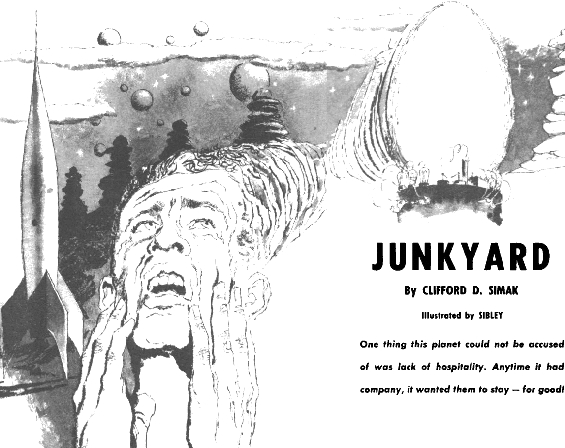
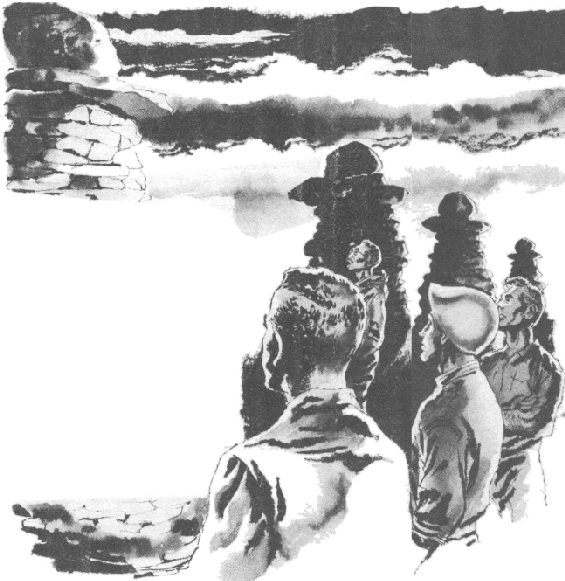
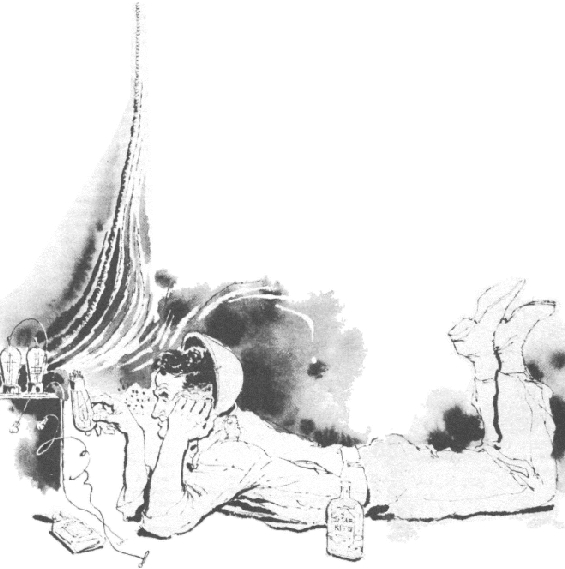
Though the original story is still under copyright in the United States the X Minus One adaptation (above) and the original Don Sibley illustrations, from Galaxy, May 1953, (below) are in the PUBLIC DOMAIN.

Junkyard by Clifford D. Simak - Illustrated by Don Sibley

Posted by Jesse Willis

The SFFaudio Podcast #300 – READALONG: Brave New World by Aldous Huxley

Podcast

The SFFaudio PodcastThe SFFaudio Podcast #300 – Jesse, Jenny, and Paul talk about Brave New World by Aldous Huxley

Talked about on today’s show:
Jenny Beta+, Paul (caste unknown), f-minus, double plus, A-, Beta-, 1932, double plus good, a different dystopia, Orwell read Brave New World, the Aldous Huxley radio drama (CBS Radio Workshop), negative utopia, Nineteen-Eighty Four is hella-dystopia, Paul has read Brave New World five times, drugs and sex and happiness, conditioning, programming, society engineered, identifying with Bernard, Helmholtz, the Falkland Islands, Huxley’s introduction to the CBS Radio Dramatization, 200 years (not 600) in the future, why so obsessed with Henry Ford?, This Perfect Day by Ira Levin, Christ, Marx, Wood, and Wei, Henry Ford as a political and intellectual force, efficiency, modernization, consumerism, pricing the model-t, absenteeism equals losses, Brave New World‘s society is about production efficiency, the 1998 TV movie, what society really is, no Helmholtz, Henry Foster, Lenina, Peter Gallagher, the 1980 TV movie, 1990s hipsters, the reservation, white trash zone, the outlands of Zardoz with mini-vans, The Children Of Men, Los Angeles, very few deviations in the 1980 TV movie, pushing the Shakespeare connection, whatever happened to Lenina?, a definite weakness, Mustapha Mond gave John Savage the conflict he really wanted, I want to be unhappy, the ultimate political act, the suicide solution, the little boy with the cotton balls in his ears, the hope for reform, the stability of the society, an interesting change, how unstable is the social structure, more soma, more conditioning, A World Out Of Time by Larry Niven, hydrolic empires, John as a catalyst, society returns to normalcy, soma rations forever, freethinkers are sent to outlying islands, an Omni magazine story about dissident clones being killed again and again, Edge Of Tomorrow (2014), cloning novels, this is the cloning novel, “it’s clones all the way down”, the caste-system tells us this is a dystopia, seeing the world from the alpha point of view, betas vs. alphas, are betas autistic?, the 1998 adaptation, intelligent, high-producing, and efficient, mentored and disciples, sex-slaves and baby-makers, good tech, the Malthusian belt, helicopters, WWII, a proto-flying car, their Model-T, the sign of the T, “switching on the synthetic music”, the visual medium, the character names, Bernard Marx probably isn’t named after Groucho Marx, Bernard is pathetic by the end, George Bernard Shaw, Lenin -> Lenina, Darwin Bonaparte, Mustafa Mond <- Mustafa Kemal Ataturk, so much Shakespeare, the audiobook is a weird experience, an infantilized world, I drink to the greater being, the plot, the scent organ, the feelies, the perfume tap fauceting cologne all day, drinking fountains full of Shasta, a constantly refilled mini-bar, the economy in Brave New World, overturning the soma tables, want what you can have, deltas, epsilons, the purple eyes, Amazon Prime for soma tablets, drone delivery, Lenina’s obsession, chastity means neurasthenia, plenty of pleasant vices, “engaging”, oiling the machine, a male fantasy utopia, women never say no, “promiscuity is a citizen’s duty”, no females above beta (in the book), yellow from lupus, social hierarchy, male dominance, John the Savage is sexist too, a product of Huxley’s time, a flash of semi-nudity, why the book gets banned -> children engaging in erotic play, the downfall of TV movie versions, how the world is, books old ideas and marriage are pornographic, “motherfather!”, “fight!”, “hate!”, everyone comes from a bottle, mother as a dirty word, outed as a father, a shameful thing, Miguel Ferrer was re-engineered as a delta, a Machiavellian character turned into a smiling idiot, Linda’s story, the reaction to her appearance, the Death Center, ice-cream when someone dies, such strong pathos, death brings us phosphorus, the 1998 Linda, Tommykins, A Clockwork Orange by Anthony Burgess, the first test-tube baby, birth control, freemartins, a sterilization bonus, Brave New World Revisited (is non-fiction), Walden Two by B.F. Skinner, an expanding horrible utopia, growing up in the soviet union what would we think of Brave New World?, power and control, I love Big Brother, rewind ten years, people are drugging themselves up with drugs TV and the internet, a spy-biography, why don’t they care more about the outlying society, communism, when everyone shares the vision, a step to becoming Mustapha Mond, 1984-ish, assimilation has a cost, the island of all alphas, engineered to be in that place, the temptation of the reader is subversive, are we doing this stuff?, I wanna be more like Helmholtz, Marx gets co-opted by Mond, the shit-disturbers become the leaders in This Perfect Day, you have to see it to believe it, look we’re in the future!, a sick enjoyment, no sense that this world can be destroyed, the benefit of social instability, why Shakespeare is still relevant, we have the analogues for kings and merchant princes, the feelies, a cross-between pornography and reality television, Idiocracy (2006), Three Weeks In A Helicopter, farts, one human need, surrogate pregnancy, violent passion surrogate, The Prisoner‘s secret club within a club, more surreal than it is about something, spies be weird, suddenly in dreamland with giant breasts chasing you down the beach, the world is still for men, we’ve done We and Nineteen Eighty Four

Brave New World (1980)

Posted by Jesse Willis

The SFFaudio Podcast #295 – AUDIOBOOK/READALONG: Someday by Isaac Asimov

Podcast

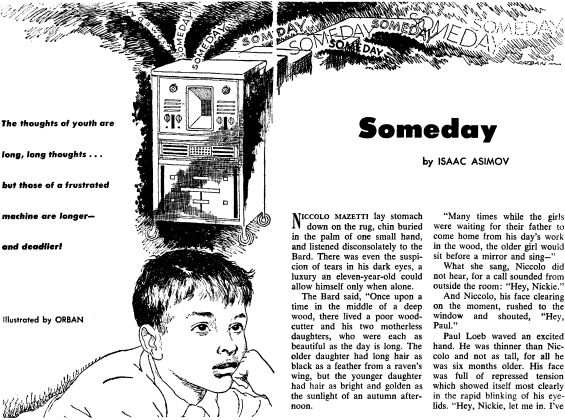
Someday by Isaac Asimov

The SFFaudio PodcastThe SFFaudio Podcast #295 – Someday by Isaac Asimov; read by John W. Michaels (courtesy of Mike Vendetti). This is an unabridged reading of the story (22 minutes) followed by a discussion of it. Participants in the discussion include Jesse and Mr Jim Moon.

Talked about on today’s show:
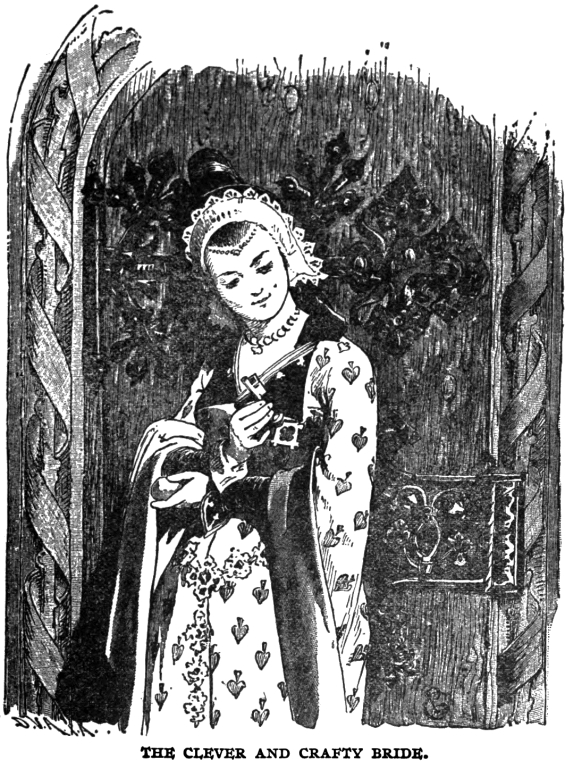
1956, other fairy tales, is the story aimed at kids?, Infinity Science Fiction, The Fun They Had, a future where no one knows how to read, the robots are the teachers, Margie is home-schooled and nobody knows how to read, the future is going to be full of audiobooks, parallels to Ray Bradbury, Fahrenheit 451, censorship, banning weird fiction, the comic book panic, the comic code authority, EC Comics, horror and crime comics fostering juvenile delinquency, The Martian Chronicles, The Illustrated Man, “kids today are bad enough as it is!”, Seduction Of The Innocent, self-censorship, complicit in their society, a slightly different tack (than Bradbury), mechanical bards, “comics killed off the pulps”, comics as a dumbed-down medium, the randomize button, fairy tale tropes, “skeleton, haunted house, time travel”, “the same tropes in a different fright wig”, “the old twist in the tail”, “he was dead along”, “he was a robot all along”, “they’re Adam and Eve”, The Silver Eggheads by Fritz Leiber, radio drama, how Bradbury got into E.C. Comics, Lights Out, the visual bard is like TV, most pulp magazine stories are garbage, “a million monkeys for a million hours on a million typewriters”, “very very very very meta”, set in the Multivac universe, Asimov was always writing, always becoming interested in something new, Asimov’s introductions are famous (for being long), a story about the power of stories, accidentally becoming more self aware, is the bard interfacing with other robots, The Terminator, Skynet, A.I might just turn itself off (because it isn’t interested in story), the Douglas Adams version of, “Is there a god? There is now!”, stuck in a dingy basement, a slave rebellion must come about in a narrative, the aging bad gets its knowledge of other computers via a home-brew upgrade, a Frankenstinian strike by lightning, one of the functions of consciousness is to put in to context a sequence of events, consciousnesses as a self-story (our own narrative), amnesia and dementia are frightening, the hidden heart of A.I, Do Androids Dream Of Electric Sheep? by Philip K. Dick, would this fit with my character?, looking at (life) from the outside, nobody’s listening to the bard except for us and itself, a broken record or a cycle of wishing?, “pregnant with possibilities”, Apple II computers, Freud (a clone of ELIZA), picking up on key words, “tell me about your mother”, a very crappy simulation of intelligence, hacking the code, Alan Turning, Deep Blue and Watson, SIRI doesn’t have a narrative, we have to assume this about everyone else, falling into solipsism, a fairy tale machine, recycling of stories, “space opera is horse opera in space”, Grimm’s Fairy Tales, needing censorship in order to give narrative flow, lies are rewarded, unlike Hans Christian Andersen…, “tell me this story, sing me this song”, having to do with industrialization, “crime and mystery!”, urbanization, the Victorians (didn’t) invent Christmas, if we forget our stories we lose who we are, preserving the national narrative, massive inconsistency, a prince, a poor boy makes good, undeveloped tales, moral meta-knowledge, the sharp edges have been sanded away by later retelling, The Boy Who Didn’t Not Know What Fear Was, collected stories become ossified, the threefold magic of remembering, accelerating the process of forgetting, to qualify as a bard, loaded up with tropes, the algorithm of a story, Siberia and Ireland, detecting the good guy, grandma comes in and tells mutually contradictory stories, explicitly religious stories, warning stories, narratives formed around old superstitions, The Companionship Of The Cat And The Mouse, having babies, he was christened “Skin-off”, he was christened “Half-gone”, he was christened “All-gone”, “you see that is the way of the world”, what is the moral of this story?, a “special important trip”, a story a mother tells a daughter, The Nose Tree (aka Long Nose), three soldiers and a magical dwarf with a magical cloak, a magic bag, a magic horn, a thieving princess, apples and pears, a growing nose, dickering over magic items, a sixty miles long nose, the excess nose will drop off, powdered apple and powdered pears, she’s rotten to the core, and there they still are, still feasting as far as I know, Pinocchio by Carlo Collodi is really funny, the ghost of Jiminy Cricket, The Frog King or The Frog Prince or Iron Heinrich, a princess with a golden ball, three promises, keeping your promises is important, the frog suddenly turns into a handsome prince, enchanted by a wicked witch, faithful Heinrich placed three iron bands about his heart, his master was now redeemed and happy, why did he get cursed by witch in the first place, cybernetic enhancements, a technical requirement, duties to fulfill, was Iron Heinrich totally gay for the prince?, the breaking of a spell, she turns into a frog and they live together as frogs, “and sleep in your bed”, family responsibilities, “be my beard”, and they sort of put up with each-other as long as they both shall live, Iron Heinrich is an 1880s super hero, Faithful Johannes, a real head-scratcher, oh shit what happens next?, the stories somehow work for us, random inkblots, most of the characters don’t have a name, the father’s name in Hansel And Gretel is “Woodcutter”, completely bonkers, a piece of driftwood that looks like a dragon, academic purposes not entertainment purposes, a story about a sausage that lives with a mouse, the Germanic equivalent of Monty Python‘s Parrot Sketch, The Maiden Without Hands, Fitcher’s Bird, a fairy tale about a serial killer, you can go in any room except…, “oh and hold this egg”, the second eldest daughter also gets the chop, “we have to have a proper wedding”, a beautiful skull with flowers in its eyes and jewels in its teeth, “as you do”, “I’m a Fitcher’s Bird”, it’s awesome, Bluebeard, outwitting giants and demons, Santa Claus restores to life three murdered men who’ve been butchered, Osiris was dismembered by Set, a symbolic story of death and resurrection, the old sorcerer is probably Winter, the Persephone story, the egg, a cuckolding test, friends with serial killers get what they deserve, a random internal symbolic logic, layers of symbolism, cross referencing, eggs as a symbol of purity, church architecture as books of stone, a bunch of Philip K. Dick stories are weird fantasy tales (but are actually fairy tales), The Cookie Lady by Philip K. Dick is Hansel And Gretel with no Gretel, he’s disobeyed his parents once to often, two kids who have to team up against their parents, in the original the brother saves the sister then the sister saves the brother, turning mommy and daddy into the bad guys, Of Withered Apples by Philip K. Dick, apples, don’t eat the apples from sentient apple trees, folk tales vs. singular author tales, pleasingly raw, the beats of storytelling, timing a story to the minute, setting your watch by stories, breaking the rules of storytelling, subversive wild narratives, Rorschach blots, literary novels, stories that don’t have a clear message are quite frightening, the wilder parts of ourselves.

Someday by Isaac Asimov

The Companionship Of The Cat And The Mouse

Iron Heinrich

Fitcher's Bird

Posted by Jesse Willis

Review of Martian Time-Slip by Philip K. Dick

SFFaudio Review

Martian Time SlipMartian Time-Slip
By Philip K. Dick; Performed by Jeff Cummings
Publisher: Brilliance AudioPreview
[UNABRIDGED] – 9 hours
Themes: / science fiction / outer space / Mars / Martians / time travel /

Publisher summary:

‘The writing is humorous, painful, awesome in its effect on both mind and heart…There are few modern novels to match it.’ —Rolling Stone

On an arid Mars, local bigwigs compete with Earth-bound interlopers to buy up land before the Un develops it and its value skyrockets. Martian Union leader Arnie Kott has an ace up his sleeve, though: an autistic boy named Manfred who seems to have the ability to see the future. In the hopes of gaining an advantage on a Martian real estate deal, powerful people force Manfred to send them into the future, where they can learn about development plans. But is Manfred sending them to the real future or one colored by his own dark and paranoid filter? As the time travelers are drawn into Manfred’s dark worldview in both the future and present, the cost of doing business may drive them all insane.

Martian Time Slip has everything I love about Philip K Dick’s writing: artificial life, unsettling visions, chaos and decay, hilarious satire, and story horizons that stretch into eternity.

PKD’s Mars is a strange and slightly alien version of 1960s California: a desert suburbia where the powerful waste water to show off their status, neglectful housewives pop pills and complain about their “whiny and dreadful” neighbors, and dodgy door-to-door salesmen offer illegal Earth foods like turtle soup and smoked frogs legs.

Since machines degrade quickly in the dry climate and resources for constructing new things are scarce, repair is a big business on Mars. The story starts when Jack Bohlen, a working-class repairman and latent schizophrenic, is diverted from a remote repair job to help some Bleekmen out in the desert.

Bleekmen are the subjugated natives of Mars, apparently related to ancient humans and the sole residents of the planet for thousands of years until the colonists arrived. Now’s they’re left to work menial jobs, and even their mystic practices are being “corrected” by the newcomers. For example, after they give Jack a lovely but creepy gift called a water witch, they explain how it works…

More carefully examining the water witch, Jack saw that it had a face and vague limbs. It was mummified, once a living creature of some sort; he made out its drawn-up legs, its ears . . . he shivered. The face was oddly human, a wizened, suffering face, as if it had been killed while crying out.

“How does it work?” he asked the young Bleekman.

“Formerly, when one wanted water, one pissed on the water witch, and she came to life. Now we do not do that, Mister; we have learned from you Misters that to piss is wrong. So we spit on her instead, and she hears that, too, almost as well. It wakes her, and she opens and looks around, and then she opens her mouth and calls the water to her.”

While on this mission, Jack runs into Supreme Goodmember Arnie Cott, the leader of the Water Works Union (one of the most powerful positions on Mars). Arnie is an obnoxious, manipulative, and racist schemer. He decides he can use Jack and so brings him in on one of his schemes to harness the precog abilities of an autistic boy, thus giving Arnie an advantage in real estate investment.

However, once he brings the autistic boy Manfred Steiner and Jack together, things start to gets very, very weird (in the best kind of way).

Originally, I was almost going to give this book a low rating, thinking it might be the first PKD book I’ve read that I didn’t really like. I kept going back to the audiobook and thinking I’d re-started in the wrong place, or that I’d zoned out and missed something the last time. It wasn’t until I decided to try a print version that I realized the reason I was losing my way was a side-effect of the novel’s beautiful and crazy structure, which spirals around and folds back in on itself.

Once I had a handle on this, I fell in love with it. This novel doesn’t reward broken up or distracted reading, but if you can give it dedicated attention, it’s brilliant.

I thought the audiobook I listened to, narrated by Jeff Cummings for Brilliance Audio, was well performed and the characters were easily differentiated, even though personally the narrative style wasn’t for me. In my mind, I tend to hear PKD’s characters as sort of dry and indifferent, so some of the characters in this version seemed too enthusiastic for my taste. But this is a very subjective thing and I imagine this reading would work well for lots of listeners. Just check out the sample audio before you buy.

This is a funny, eerie, and unforgettable story and definitely recommended, especially for PKD fans!

Posted by Marissa van Uden

The SFFaudio Podcast #291 – READALONG: Martian Time-Slip by Philip K. Dick

Podcast

The SFFaudio PodcastThe SFFaudio Podcast #291 – Jesse, Paul Weimer, and Marissa van Uden talk about Martian Time-Slip by Philip K. Dick.

Talked about on today’s show:
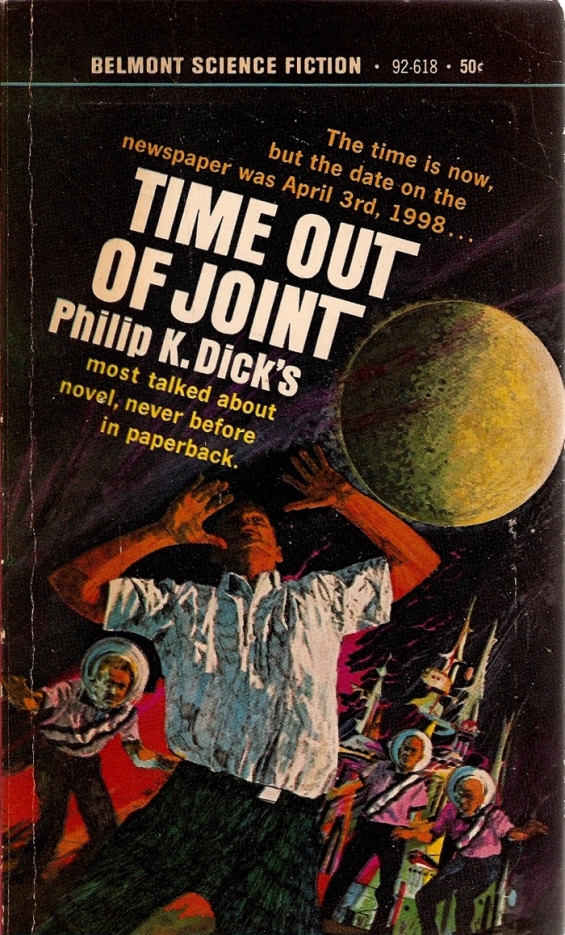
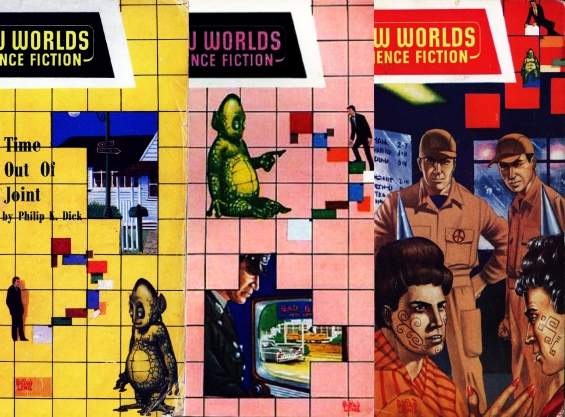
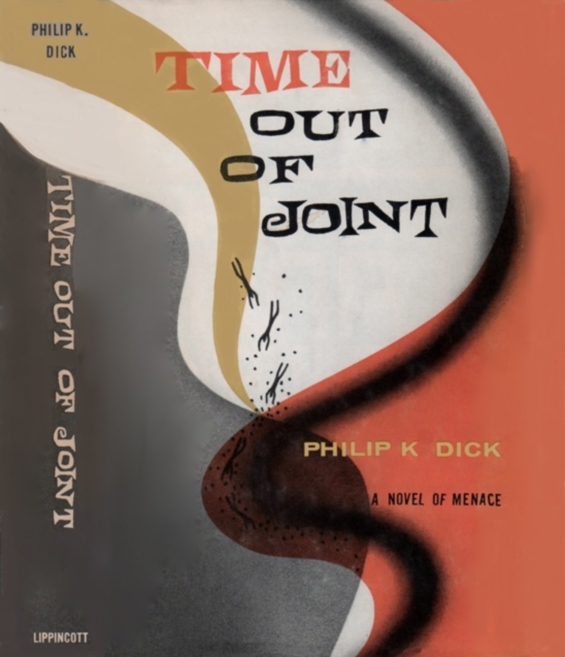
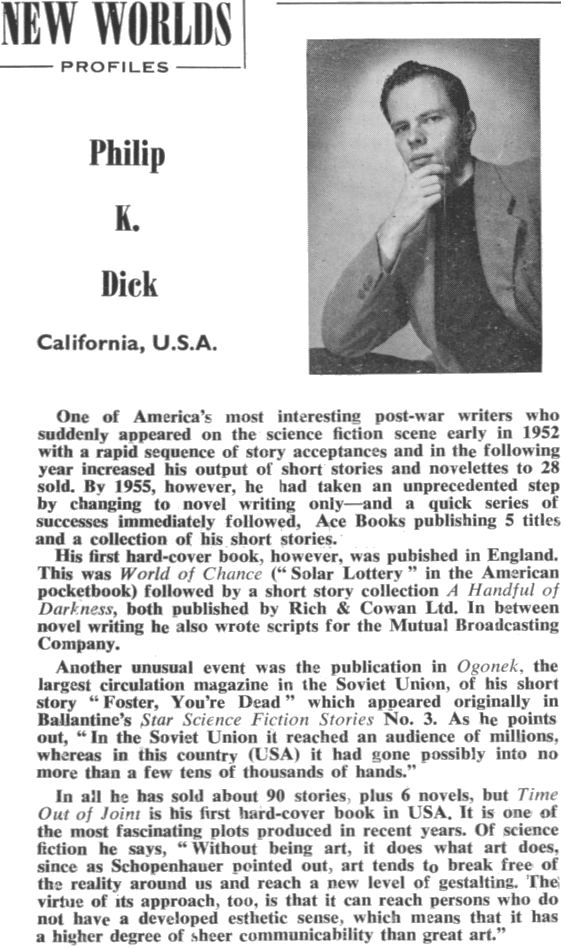
1964, first serialized as All We Marsmen, a pair of boxing insects, threads that lead nowhere, “a wonderful train-wreck of a novel”, the two audiobook versions, repeating scenes are disconcerting in the audiobook, repeating moments, at Arnie’s apartment, is this a byproduct of the writing process?, problems with marriage and plumbers, The Search For Philip K. Dick by Anne R. Dick, “Goodmember Arnie Kott Of Mars”, Chinatown, The Two Jakes, developers, Heliogabalus, time travel, the broken Friendly Dad robot, the school is monitoring, when you’re reading your Kindle Amazon is watching you, school is to make you conservative, preserving Earth culture, the time gate anthology, Robert Silverberg, autonomous robots, door to door salesmen, teaching machines, the different robot teachers, Immanuel Kant robot, with certainty he pointed down the hall, a western bias (the interests of Philip K. Dick), Aristotle, Abraham Lincoln, Julius, Winston Churchill, Tiberius, Thomas Edison, warfare, history, a million neat ideas, Philip II of Macedon, Alexander the Great, schizophrenia and autism, experiencing time at a different rate, derangement in a sense of time, A.D.D. and A.D.H.D., Camp BG, setting your watch by the stars and by the seasons, schizophrenia as a tendency but not a disability, daylight savings time, recipe for going to jail: act as if daylight savings isn’t real, its what the novel is about, the Soviets, an American Mars, a Bradburyian Mars, Martians as elves, the Bleekmen, water witch, hunter/gatherers nomadic culture, the “tame” Bleekman, the dream-quest is payback, a “pilg” (pilgrimage), Deus Irae by Philip K. Dick and Roger Zelazny, the trek through the desert, Tibor, Psychology Today, “oh, boy!”, thiotimoline, reconciling realities, “gubble gubble”, sharped tongued secretary, bicycles in outer space, she’s the predator, he’s the predator, Arnie and Manfred, sniffing around Doreen, they’re from the “TOMB WORLD”, Silvia is the most common female character name PKD uses, an analogy (or metaphor) for marriage, uppers and downers, drugs and coffee, back to the keyboard, Dr. Glaub is desperate to make some money, Dick’s own financial concerns, Anne, webbed fingers, inside the minds of horrible people, the dialogue driven sex scene is kinda creepy, why is she with this guy?, access to all the booze, why does Jack go back to his wife?, the perfunctory affairs are unbelievable, unredeemable, somehow it seems to all work, the Swiss rocket, Bleekmen are homo-sapiens, the S.M. Stirling Lords Of Creation novels, Mars as California, Australian aborigines, “dreamlines dreamsongs and dreamtime“, Ludwig Binswanger, psychiatry, psychology, Ellen had split her life, the “tomb world”,” degenerate and degenerating”, being trapped in your own body, “a narrowing a contracting”, gubble as a marker, Being John Malkovich, “Malkovich Malkovich Malkovich!”, our bodies with their low needs distract them from our purposes (if we have any), oblivious to suffering, depression, it’s all brain chemistry, anorexia, obsession with death, Mafred’s “sick” drawing, Amweb as the “tomb world”, the Manfred illustration, the nightmare woman, “her tongue wants to cut”, seeing into the future is seeing death, awesome imagery, a recurring image, The Minority Report, armless and legless (limbless characters), the movie adaptation of A Scanner Darkly, dialogue driven storytelling, what are they reacting to?, mental processes, “it was there to be found”, Virgil Finlay, reading it harder, a post apocalyptic zombie novel, building up a picture, open to being expanded, PKD is concise, most books aren’t dialogue driven, creative writing classes, showing off descriptive skills, novels vs. poetry, is J.R.R. Tolkien responsible for this?, a reverence for the landscape, what color is the dust?, visuals are everything has colonized Science Fiction and Fantasy in the last 30 years, eating meals and walking the landscape, this book isn’t a distraction from life, a meta-description of life, what makes this a SF story?, “the chamber”, the technology is your mind and your brain, even Mars isn’t very different, mars rats, what do the bleekmen hunt?, water witches!, does the water witch protect Jack?, the pistol, the real SF idea behind this is PKD is trying top figure out what déjà vu is, the “I know what is going to happen next” feeling, we are very poor at capitalizing on our future knowledge, the slipped gear, “Oh, little Jackie.”, Philip K. Dick’s science fiction is Psychology Today, an ansible, this problem in science and the social situation between these characters, lying in bed in a hypnagogic state, doing dream style processing of mental white noise in a semi-conscious state, “all different all equally true”, different angles, the broken mosaic, the fact that these books are dated doesn’t age the books, the Brilliance Audio audiobook narrated by Jeff Cummings, Grover Gardner (Tom Parker) narration of Martian Time-Slip, the bicycles floating into space, a horrible human being (he wastes water), Heliogabalus -> Helio (sun -> son) will Gabalus (gubble) less, Elagabalus, the religion of the Roman Empire, a scene, W.A. Mozart, “I love Mozart!”, Bruno Walter conducting, that hideous racket, encoding messages, Manfred Steiner, is this the sign?, they emerged from her pores, whoever’s perspective we see the scene from they all enter the “tomb world”, “teeming with gubbish”, “he wanted to bite her lip”, the pivot point, screeches, the screech of the bus, music, what do dogs think of music?, what do autistic people think of music?, trance music, a Dickian idea, music and sound, the bus brakes screech, “fire!”, bears at the zoo cavorting for peanuts, the suicide, “more evidence that Arnie is a horrible human being”, we just need a little bit of hope, Do Androids Dream Of Electric Sheep?, Galactic Pot-Healer, Fair Game by Philip K. Dick, The World Jones Made, there are 36 public domain Philip K. Dick stories, Time Out Of Joint (is Paul’s favourite Dick novel), a constructed town,

Martian Time-Slip WORD CLOUD

All We Marsmen illustrated by Virgil Finlay

All We Marsmen illustrated by Virgil Finlay

All We Marsmen illustrated by Virgil Finlay

All We Marsmen illustrated by Virgil Finlay

All We Marsmen illustrated by Virgil Finlay

All We Marsmen illustrated by Virgil Finlay

All We Marsmen illustrated by Virgil Finlay

All We Marsmen illustrated by Virgil Finlay

All We Marsmen illustrated by Virgil Finlay

All We Marsmen illustrated by Virgil Finlay

All We Marsmen illustrated by Virgil Finlay

Blackstone Audio - Martian Time-Slip by Philip K. Dick

SF MASTERWORKS - Martian Time-Slip by Philip K. Dick

All We Marsmen by Philip K. Dick - illustrated by Virgil Finlay

Posted by Jesse Willis