CBSRMT: A God Named Smith by Henry Slesar [RADIO DRAMA]

SFFaudio Online Audio

A God Named Smith by Henry Slesar

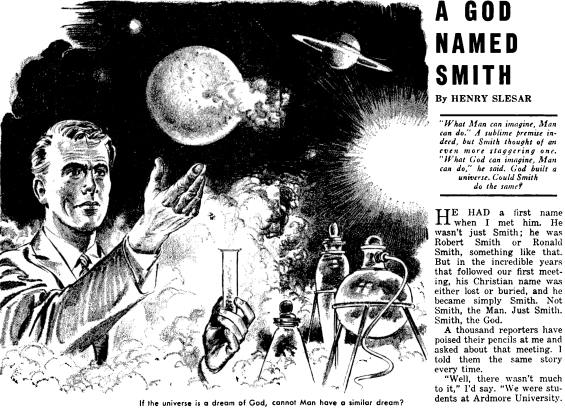
Henry Slesar was one of the most prolific scripters for the late-1970s early-1980s CBS Radio Mystery Theater. But before his career in radio drama Slesar was an author of Science Fiction. Like Alfred Bester, who also wrote for CBSRMT, Slesar was in the habit of recycling his earlier stories for the hour long anthology series (even though the show calimed to have such episodes written “especially for the Mystery Theater”). One such episode is A God Named Smith. It was first published in Amazing Stories, July 1957. And precisely 20 years later it was an episode of one of the last old time radio dramas.

CBS Radio Mystery TheaterCBSRMT #0658 – A God Named Smith
1 |MP3| – Approx. 44 Minutes [RADIO DRAMA]
Broadcaster: CBS
Broadcast: June 2, 1977
Source: CBSRMT.com
A young child prodigy creates an entire planet of his own, intending it to be a better world than earth. He finds volunteers to populate it, and establishes himself as a god.

Cast:
Russell Horton
Evie Juster
Robert Kaliban
Norman Rose

And here’s a |PDF| of the original story.

Posted by Jesse Willis

The SFFaudio Podcast #263 – AUDIOBOOK/READALONG: The Colour Out Of Space by H.P. Lovecraft

Podcast

The SFFaudio PodcastThe SFFaudio Podcast #263 – The Colour Out Of Space by H.P. Lovecraft, read by Donal Buckley. This is a complete and unabridged reading of the short story (68 minutes) followed by a discussion of it. Participants in the discussion include Jesse, Mirko, and Huan Vu (the director of the movie adaptation, Die Farbe).

Talked about on today’s show:
Arkham Insiders, Die Farbe (aka The Color), The Atlanta Radio Theatre Company adaptation, The H.P.L.H.S., Die Farbe gets a shout-out in the Dark Adventure Radio Theater adaptation, the novella/novelette, Amazing Stories, September 1927, science fiction and horror together, The Whisperer In Darkness, the framing story, American soldiers running away from the colour, unjustified punishment, cosmic horror, pre-WWII Germany, the symbology, the endings, mind control, zombie ants, parasites, the science of The Colour Out Of Space, The H.P. Lovecraft Literary Podcast, a pocket spectroscope, how do we see a new color?, discovering a new color, infra-red light, the blind and the colorblind, the black and white, film doing something an audio drama never could, a companion piece to The Whisperer In Darkness, the wasp, Formicula (aka Them!), an explanation for what the colour is, The Voice In The Night by William Hope Hodgson, anthropocentric aliens, an analogy, is The Colour Of Of Space SF?, alien flapjacks, spores, a sentient cloud of gas, “the Horla” (woops I mean the Horta), Star Trek‘s The Devil In The Dark, an alien (in much of SF is really about people), alien aliens, a corrective, John W. Campbell Who Goes There?, The Thing, whose who and whats what, it’s insidious, what will happen when you flood that valley?, Arkham Springs water, fear of radiation, a nuclear contamination story, “the blasted heat” is like Chernobyl, Macbeth, the meteor, dry ice, too creepy for night reading, Lovecraft’s opinion, The Willows by Algernon Blackwood, alien mind control, stealthy listening, the horror in the attic, The White People by Arthur Machen, the comic undercutting in The Dreams In The Witch-House, a mood study, Die Farbe is a wonderful adaptation of The Colour Out Of Space, the changes in the film version, the character names, Robert M. Price, a biblical reading of The Colour Out Of Space, He Am Himself, comets, reproduction, Monsters, cosmic bug spray, expanding your perspective, From Beyond, the running time, the chosen colour, Schindler’s List, you shouldn’t make evil that colour, taupe?, khaki?, a striking contrast, Sin City, color theory, signal colors, Ancient Greece, The Odyssey, “the wine dark sea”, “rosy fingered dawn”, what if my blue is your red?”, science over experience, dark matter/dark energy are placeholder words, science is mostly failure, “not optimistic at all”, if this happened in reality, the way out, The Dream Cycle Stories, going to The Dreamlands, Celephaïs by H.P. Lovecraft, To A Dreamer by H.P. Lovecraft, it’s not horror, The Dream-Quest For Unknown Kadath by H.P. Lovecraft, Lovecraft isn’t only horror, the IndieGoGo page for The Dream-Lands, The-Dreamlands.com, Die-Farbe.com, Gary Lovisi, the matchmaker.

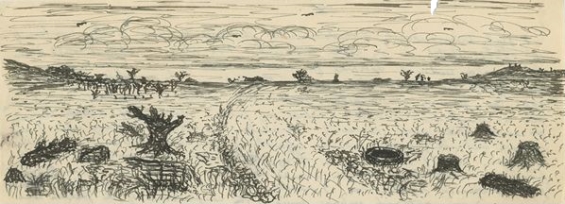
"blasted heath" illustrated by H.P.  Lovecraft in a letter to F.  Lee Baldwin March 27, 1934

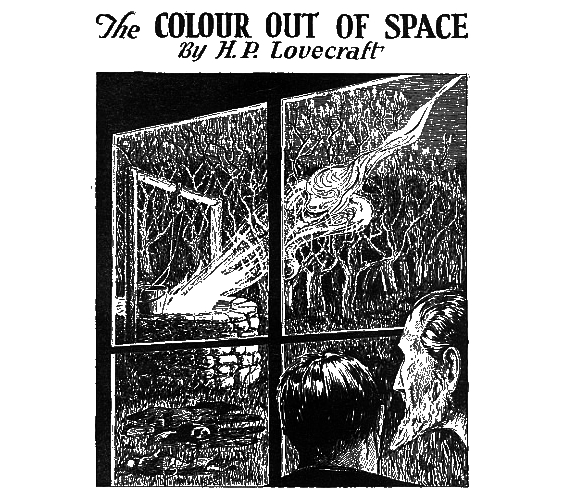
The Colour Out Of Space by H.P. Lovecraft

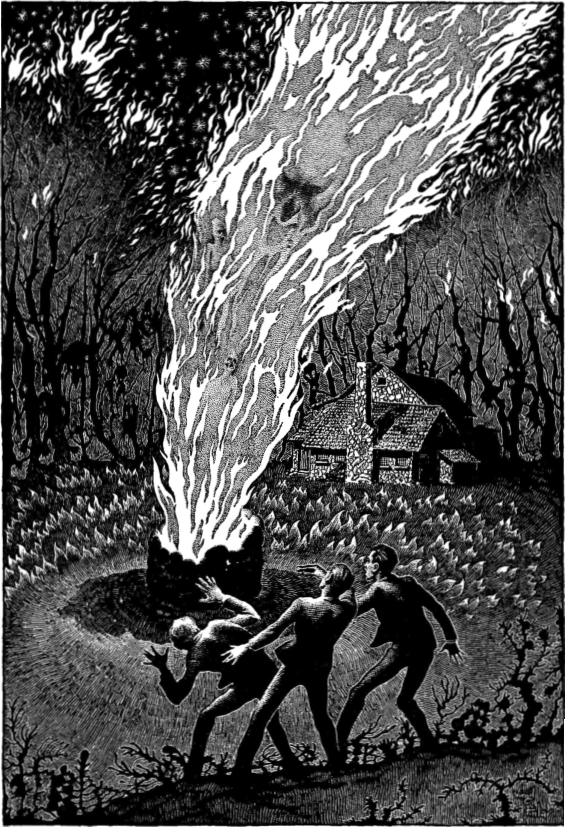
The Colour Out Of Space - illustration by Virgil Finlay

The Colour Out Of Space by H.P. Lovecraft

Die Farbe

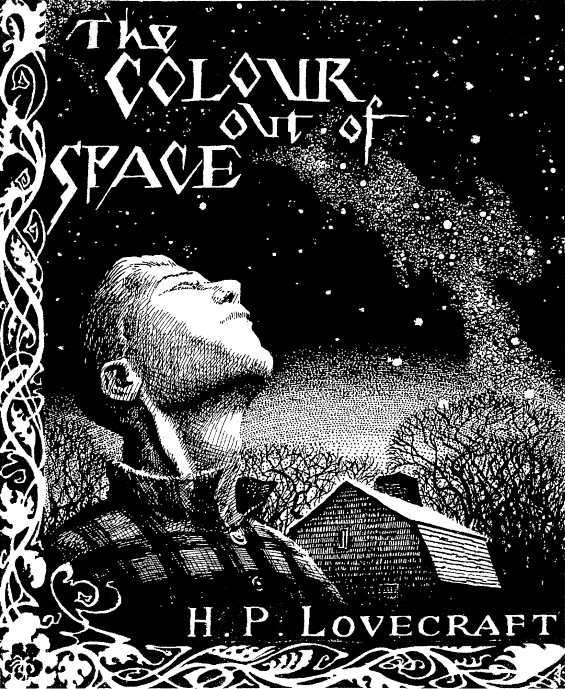
The Colour Out Of Space - Illustrated by Jason Eckhart

Posted by Jesse Willis

The Fun They Had by Isaac Asimov

SFFaudio News

Set in a post-paperbook future in which children attend school in their own homes, The Fun They Had is a wonderful short story by Isaac Asimov. First published in December 1951, in a newspaper, here’s a |PDF| made from the subsequent publication in The Magazine of Fantasy & Science Fiction, February 1954.

And here’s Caden Vaughn Clegg’s audiobook of it:

Posted by Jesse Willis

Someday by Isaac Asimov

SFFaudio News

Last night I discovered that Someday, a wonderful short story by Isaac Asimov, is PUBLIC DOMAIN.

I’ve posted the |PDF| from the original mag to our PDF PAGE (there’re hundreds more there by the way).

Someday set in a future in which everyone is illiterate (Asimov has another story, The Fun They Had, that has a similar premise). It talks about audio vs. video, robotics, artificial intelligence, creativity, empathy, and it has a terrific twist ending.

I think you’ll treasure it as much as I have over the years.

And here’s an audiobook version:

Part 1 of 3:

Part 2 of 3:

Part 3 of 3:

Posted by Jesse Willis

The Little Black Bag by C.M. Kornbluth

SFFaudio Online Audio

The Little Black Bag is a highly regarded C.M. Kornbluth novelette. It was undeniably influential and popular. It won the 2001 Retro-Hugo Award for “Best Novelette” (of 1951), was voted the 13th best all-time short science fiction story (in a 1971 Analog Science Fact & Fiction poll), and was anthologized in The Science Fiction Hall of Fame Volume One, 1929-1964. Philip K. Dick himself seems to have read it (he had a 1964 short story entitled The Little Black Box).

In his introduction to The Best of C.M. Kornbluth, Frederik Pohl, a friend and frequent collaborator of Kornbluth’s, states that The Marching Morons (see SFFaudio Podcast #112) is a direct sequel to The Little Black Bag. The titular bag is a time-traveled artifact from a future in which the majority of the population is genetically stupid and must be supported by a minority of geniuses who masquerade as assistants to the morons. Thus the bag of the title is filled with self-driven instruments enabling even a complete moron to act as a highly competent doctor.

Three television adaptations of The Little Black Bag have been made: Tales of Tomorrow (1952), Out Of The Unknown (1969), and Night Gallery (1970).

Myself, I think The Little Black Bag is both too well regarded and too popular. It’s popularity suggests that many readers think of themselves as one of the geniuses surrounded by morons. And its being regarded as highly as it is by those geniuses makes me think they are rather stupider than they think.

I invite you to come to your own conclusions.

Escape PodEscape Pod #429 Little Black Bag
by C.M. Kornbluth; Read by Mat Weller
1 |MP3| – Approx. 1 Hour 16 Minutes [UNABRIDGED]
Podcaster: Escape Pod
Podcast: January 5, 2014
First published in Astounding, July 1950

Here’s a |PDF| made from it’s original publication.

|ETEXT|

Posted by Jesse Willis

The SFFaudio Podcast #258 – READALONG: The Star Rover by Jack London

Podcast

The SFFaudio PodcastThe SFFaudio Podcast #258 – Jesse, Seth, and Maissa discuss The Star Rover (aka The Jacket) by Jack London.

Talked about on today’s show:
titled The Jacket in the UK; astral projection; what about alien past lives; the primordial ooze; the book is a laundry list of Jack London’s interests; structure resembles television flashbacks; knuckle-rap Morse Code; The Count of Monte Cristo; Seth recounts his own past-life story; Jesse and Maissa debate plausibility of reincarnation; Plato and the Land of the Forms; “little death” means something else in French; Ragnar Lodbrok based on Norse Mythology; anachronism; Korean history and turtle ships; Jesse attempts to use the Napoleon Complex to debunk reincarnation; everyman (and everywoman); does reincarnation extend beyond humanity?; “there’s only one soul”; Lucretius, star dust, and the recovery of scrolls from Herculaneum; “souls are totally bogus”; past lives as a metaphor for reading widely; prevalence of the number 40; hallucination; Jack London on surfing; multilingual reference as an indicator of fame; prison reform; interrogation, torture, and Guantanamo Bay; loosely adapted in 2005 film The Jacket; the 1923 silent film adaptation is sadly lost; comparing and contrasting with The Iron Heel; T.C. Boyle’s The Relive Box in The New YorkerUntil the End of the World, a film about reliving dreams; on cultivating sleep; frame narrative; sexism; historical basis for character names; H.P. Lovecraft, Samuel Taylor Coleridge, and the creative power of dreams; confabulation; Total Recall; “faith in the lordship of my mind”; the odd importance of tobacco; The Island of Doctor Moreau by H.G. Wells.

The Star Rover by Jack London

The Star Rover by Jack London

The Star Rover by Jack London

The Star Rover by Jack London

The Star Rover by Jack London

from Weird Mystery Tales, issue 6, 1973

from Weird Mystery Tales, issue 6, 1973

from Weird Mystery Tales, issue 6, 1973

from Weird Mystery Tales, issue 6, 1973

Ed Morrell - from Famous Fantastic Mysteries, August 1947

Ed Morrell - from Famous Fantastic Mysteries, August 1947

GHOSTS, March 1977, - The Secret Of The Living Corpse by Alfredo Alcala

Posted by Jesse Willis