The SFFaudio Podcast #139 – AUDIOBOOK/READALONG: The Pyramid Of Amirah by James Patrick Kelly

Podcast

The SFFaudio PodcastThe SFFaudio Podcast #139 – The Pyramid Of Amirah by James Patrick Kelly, read by James Patrick Kelly. This is a complete and unabridged reading of the short story (16 Minutes) followed by a discussion of it (by Jesse, Tamahome, and James Patrick Kelly himself). Here’s the ETEXT.

Talked about on today’s show:
Call him Jim!, James Patrick Kelly’s FREE READS podcast, “a gift story”, PBS, Mayan temples, ancient Mayan empire, Copán (Honduras), “time passes”, “2,000 words of nothing happening and 200 words of everything changes”, is it Science Fiction or Fantasy?, David G. Hartwell, Katherine Cramer Year’s Best Fantasy 3, 3D TV, the Earstone is the iPod Nano’s successor, Catholicism, religion, it’s a Horror story, sacrificial victims who volunteer, is Amirah hallucinating?, David Hume on miracles, take a miracle and make it a recipe, Memphis (Egypt), is religion a fantasy?, what is slipstream?, proto-slipstream, “Kelly Link is a goddess”, Feeling Very Strange: The Slipstream Anthology edited by James Patrick Kelly and John Kessel, cognitive dissonance, slipstream encourages cognitive dissonance, “for every religion there is an equal and opposite religion”, “making the familiar strange and the strange familiar”, horror, comedy, Fantasy, The Lord Of The Rings, Science Fiction, Nine Billion Names Of God by Arthur C. Clarke, The Crawling Chaos, James Patrick Kelly doesn’t fully understand The Pyramid Of Amirah, is the Dalai Lama happy?, stay in your god tombs, The Girl Detective, Karen Joy Fowler, Carol Emshwiller, Franz Kafka, readers are happier when they’re really really surprised, most readers don’t re-reread stories, slipstream is a balcony on the house of fiction, behind the push of science is the turbulence of religion and the fantastic, Bruce Sterling, Ted Chiang is slipstream?, J.R.R. Tolkien, some short stories are Rorschach tests, Bruce Coville’s Full Cast Audio, Robert A. Heinlein’s juvenile novels, the love hate relationship with Heinlein, Heinlein’s villains are all straw men, Starship Troopers, The Moon Is A Harsh Mistress, Heinlein’s sexy mother, Heinlein’s late career needed editing, Stranger In A Strange Land, stories in dialogue with other stories, Think Like A Dinosaur is in dialogue with The Cold Equations by Tom Godwin (and the controversy about it), The New York Review Of Science Fiction, not all problems are institutional problems (you are going to die), institutional facts vs. brute facts, John W. Campbell, was Campbell a terrible editor?, “all stories must have telepathy”, the story that must not be named (in Galaxy SF April 1975), Jim Baen, religious Science Fiction, Death Therapy by James Patrick Kelly, Terry Carr, The Best Science Fiction of the Year #8, collaborations, John Kessel, Jonathan Lethem, Robert Frazier, ISFDB, The Omega Egg, Mike Resnick, Kafkaesque: Stories Inspired by Franz Kafka, Tachyon Publications, The Secret History Of Science Fiction, The Drowned Giant by J.G. Ballard, The Lottery Of Babylon by Jorge Luis Borges, Max Brod, Joe Hill, Heart Shaped Box, You Will Hear The Locust Sing by Joe Hill, T.C. Boyle, Michael Chabon, Carter Scholz, Don DeLillo, Lucius Shepard, The Nine Billion Names Of God by Carter Scholz, A Recursion In Metastories by Arthur C. Clarke, post-cyberpunk stories, what is post-cyberpunk?, Mirrorshades: The Cyberpunk Anthology, Cheap Truth, the way technology changes the way we are, Cory Doctorow, Charles Stross, a new cyberpunk anthology is in the works, is there pre-cyberpunk?, Blade Runner, Philip K. Dick isn’t really cyberpunky, steampunk has a vision, what is the ethos of a steampunk story?, alternate history, goggles and zeppelins vs. computer hacking and mirror-shades, Pavane by Keith Roberts, William Gibson, Boneshaker by Cherie Priest, Bernardo’s House is an iconically Jim Kelly short story, Isaac Asimov, robots, a post-cyberpunk character, a prim and proper sex doll, There Will Come Soft Rains by Ray Bradbury, Mary Robinette Kowal, puppets, a stage adaptation of There Will Come Soft Rains.

A Recursion In Metastories by Arthur C. Clarke (Galaxy SF, October 1966 - Page 78)

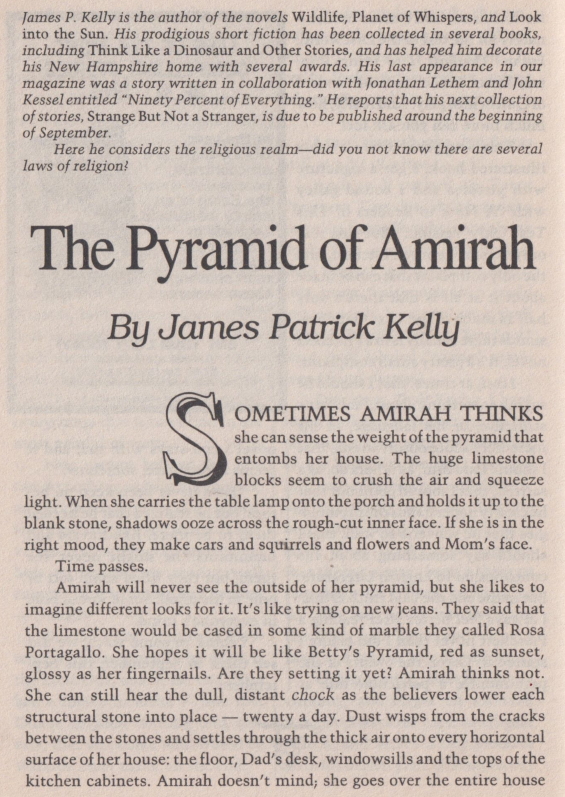
The Pyramid Of Amirah by James Patrick Kelly - from Fantasy & Science Fiction, March 2002

Posted by Jesse Willis

Lastborn (aka The Ugly Little Boy) by Isaac Asimov

SFFaudio Online Audio

Perhaps Isaac Asimov’s most famous novella, certainly one of his best, Lastborn (aka The Ugly Little Boy) is in the public domain and narrated by the wonderful Gregg Margarite!

The Drama PodGregg Margarite
2 MP3 Files – Approx. 1 Hour 35 Minutes [UNABRIDGED]
Podcaster: The Drama Pod
Podcast: November 2011
ETEXT from Archive.org
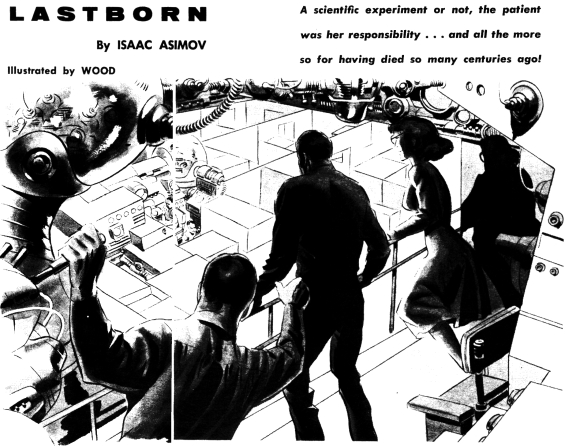
A scientific experiment or not, the patient was her responsibility … and all the more
so for having died so many centuries ago!
First published in the September 1958 issue of Galaxy Science Fiction.

Part 1 |MP3| Part 2 |MP3|

That entire issue, including Lastborn, is available as a |PDF|.

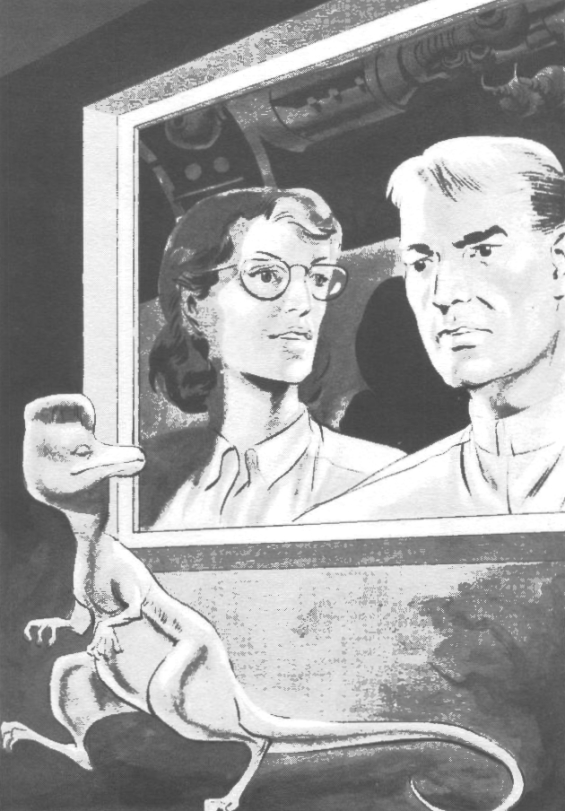
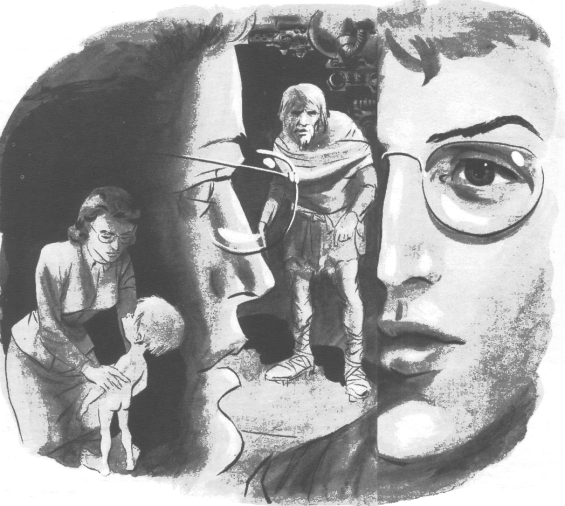
Lastborn by Isaac Asimov - illustration by Wood

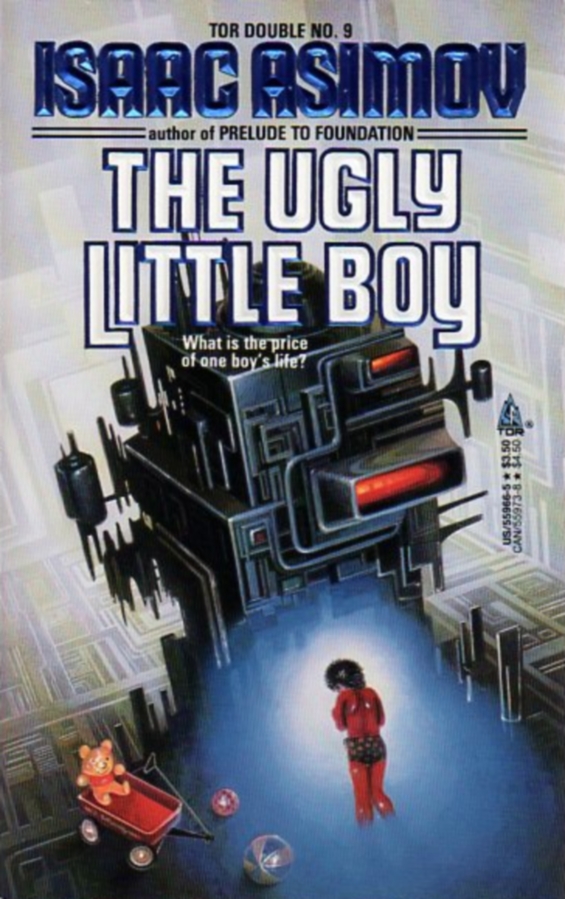
The Ugly Little Boy was also released as one half of Tor Double No. 8:
TOR Double No. 8: The Ugly Little Boy by Isaac Asimov

There was a 1977 television adaptation (available for purchase HERE). It is noteworthy for its fidelity to the text:

Posted by Jesse Willis

A Princess Of Mars by Edgar Rice Burroughs COMPLETE, UNABRIDGED and FREE – Read by a professional actor!

SFFaudio Online Audio

SFFaudio Podcast #137, out today, it is a discussion of A Princess Of Mars. If you’d like to prepare, we’ve got the perfect audiobook version for you to check out. It’s narrated David Stifel, of Marsbooks.libsyn.com. David is actually reading all of the public domain Barsoom books, under the collected title of “The Fantastic Worlds of Edgar Rice Burroughs“, and in the process he’s become something of a Burroughs expert. I think you’ll be mightily impressed by the first audiobook because we sure were!

A Princess Of Mars by Edgar Rice BurroughsA Princess Of Mars
By Edgar Rice Burroughs; Read by David Stifel
16 Podcast Episodes – Approx. 8 Hours 38 Minutes [UNABRIDGED]
Podcaster: Marsbooks.libsyn.com
Podcast: May 2011 – July 2011
John Carter, a veteran American Civil War, goes to Arizona at the war’s end. But when he runs afoul of the Apaches he attempts to evade their pursuit by hiding in a strange cave. The cave has strange properties though as Carter finds himself mysteriously transported to Mars! There, Carter discovers that he possess incredible strength, which he uses to escape imprisonment from a fierce tribe of Green Martians. The aliens soon capture the beautiful Dejah Thoris, Princess of Helium and Carter’s mission becomes clear. He’ll need to free himself, his newly found love and save the entire planet from a coming doom.

Episode 01 |MP3| Episode 02 |MP3| Episode 03 |MP3| Episode 04 |MP3|
Episode 05 |MP3| Episode 06 |MP3| Episode 07 |MP3| Episode 08 |MP3|
Episode 09 |MP3| Episode 10 |MP3| Episode 11 |MP3| Episode 12 |MP3|
Episode 13 |MP3| Episode 14 |MP3| Episode 15 |MP3| Episode 16 |MP3|

Podcast feed: http://www.marsbooks.libsyn.com/rss

Posted by Jesse Willis

The Colour Out Of Space by H.P. Lovecraft

SFFaudio Online Audio

H.P. Lovecraft considered it one of his best…

The Colour Out Of Space by H.P. Lovecraft

The Colour Out Of Space
By H.P. Lovecraft; Read by Donalb
1 |MP3| – Approx. 68 Minutes [UNABRIDGED]
Provider: Archive.org
Produced: 2009
A horror past men’s understanding lurked in the dark New England valley and all life withered before its creeping stain of evil. First published in Amazing Stories, September 1927.

The Colour Out Of Space by H.P. Lovecraft : SFFaudio on Huffduffer

Virgil Finlay illustration for The Colour Out Of Space (from Famous Fantastic Mysteries):
The Colour Out Of Space - illustration by Virgil Finlay

Posted by Jesse Willis

Writing Class by Robert Sheckley

SFFaudio Online Audio

In a provocative move (for a novice) one of Robert Sheckley’s earliest stories, Writing Class, is 1,000 word wonder about the proper construction of stories. This story came at the beginning of a career that would later produce 250 short stories. It took more than fifty years for it to get reprinted.

The audiobook for it was narrated by our friend William Coon for SFFaudio Challenge #6. Thanks Bill!

Eloquent VoiceWriting Class
By Robert Sheckley; Read by William Coon
1 |MP3| – Approx. 7 Minutes [UNABRIDGED]
Provider: Eloquent Voice
Recorded: November 13, 2011
Etext: |RTF|
“Never use cliches in describing alien life-forms,” Professor Carner admonished his class. But Eddie persisted—with good reason! First published in Imagination, December 1952.

And here’s the |PDF|!

Imagination December 1952 - Table Of Contents - includes Writing Class by Robert Sheckley

Posted by Jesse Willis

The SFFaudio Podcast #136 – READALONG: Neuromancer by William Gibson

Podcast

NEUROMANCER
The SFFaudio PodcastThe SFFaudio Podcast #136 – Jesse, Tamahome, Eric S. Rabkin, and Jenny talk about Neuromancer by William Gibson.

Talked about on today’s show:
What was really going on in 1984, the introduction to the audiobook, 3 MB of RAM, Commodore 64, Apple IIe, TI-99/4A, the 10 Year Anniversary Edition of Neuromancer, video arcade vs. arcade, Tank War Europa, Spy Hunter, Sinistar, BBC audio drama adaptation of Neuromancer, cyberpunk, Jenny couldn’t connect with Case the first time, Alfred Bester, the revolutionary effect of Neuromancer, “a very special book”, Mexico City, “an important novel”, Yevgeny Zamyatin’s We, The New Yorker’s parody of Neuromancer, the New Wave, “one great new idea per book”, Samuel “Chip” Delany, The Einstein Intersection, The Lovesong Of J. Alfred Prufrock by T.S. Eliot, “The sky above the port…”, Blade Runner, “time to murder and create”, Hesiod, “And he never saw Molly again.”, an untethered morality, the Rastafarian religion, WWI, virtual worlds, Second Life, Gibson’s intentions, Gravity’s Rainbow by Thomas Pynchon, conspiracy, The Crying Of Lot 49, William S. Burroughs, Naked Lunch, “the silent frequency of junk”, The Wonderful Wizard Of Oz, Dorothy’s shoes, L. Frank Baum, “the face of evil is the face of total need”, The Electric Kool-Aid Acid Test by Tom Wolfe, “slouching through the streets of Paris”, Case is a “man of decided inaction”, God was Adam’s employer, Dixie Flatline wants to die, Free Will, Eric felt for Case, 1980s, Watergate, a totemic fascination with color and material, branding, Pattern Recognition, the Sanyo spacesuit, Hosaka is a computer?, a dead channel would be blue (today), Ian Fleming, James Bond, Walther PPK, “elegance and cosmopolitanism”, John Brunner’s Stand On Zanzibar, Escape From New York, Johnny Mnemonic, the fear of what technology is going to bring, Case’s youth, detritus vs. kipple, Philip K. Dick, Martian Time-Slip, Galactic Pot-Healer, “you can’t prove that the United States exists” in Neuromancer, Case was a street-kid, Gibson has built something that has mythic power, the lame Braun robot, Molly -> Mother -> Mary, SSN vs. SIN, a Case study (pun), he has been assigned a SIN, Oedipus, they function as if they were physical, Case: “You know you repeat yourself man.” Dixie: “Yeah, it’s my nature.”, the Sprawl trilogy and “when it changed”, when is Neuromancer set?, “a rich kid’s hideout”, real kipple vs. fake kipple, “built by carpenters to look rustic”, 18th century fake ruins, Versailles (and the Hameau de la reine), the Tessier-Ashpool are fucked up, Mona Lisa Overdrive, cloning, Count Zero, “they dumped themselves into this matrix”, communication technologies begin with porn, A Chorus Line, SimStim gets short shrift in Neuromancer, Strange Days, Molly’s meat-puppet memories, 1-900 numbers, the lotus eaters, Circe, the Sirens song, The Lion of Comarre by Arthur C. Clarke, the heisters are motivated or moved by their A.I. puppet-master, Case’s motivation, Molly’s motivation, Corto/Armitage’s motivation, like Rabbit in Vernor Vinge’s Rainbow’s End, these characters want to believe in their own free will, Neuromancer‘s motivation, “who’s the bad guy in this book?”, “who isn’t?”, the shuriken is the only moral totem in the book, dystopia vs. dystopic, “the wavelength of amphetamine”, spit instead of cry, Jenny is kind of cheating (because she’s read the sequels), is Molly wrong for Case?, Eric questions the new pancreas, it’s Noir (because everyone smokes), Jo Walton’s review of Neuromancer (see the top and comment 59.), Jesse appreciates the world (and the great motivation of the plot), Eric likes Case (in part) because he’s the only one who doesn’t want to physically hurt anyone else, O’Neil colony, the fake French youths, Case is not Neo, The Matrix is a fairy tale with a prophecy whereas Neuromancer is Science Fiction, the Sprawl Trilogy vs. The Matrix Trilogy, Star Wars, “stuck in bullet time”, V: For Vendetta is a fantastic movie, Jenny thinks we should listen to the soundtrack to The Matrix, “the machine and the moment”, Tama thought the second half of Neuromancer dragged, Mary Shelley’s Frankenstein is also Necromancer‘s antecedent ,”what do we owe to what we create?”

Neuromancer

Julian Assange has a copy of Neuromancer by William Gibson

NEUROMANCER - illustration by Barclay Shaw

Posted by Jesse Willis