
CBC: Ideas: The Swerve: How the World Became Modern by Stephen Greenblatt

SFFaudio Online Audio

CBC Radio One - IdeasThe Swerve: How the World Became Modern, and its author Stephen Greenblatt, are the subject of the latest CBC Ideas podcast. The Swerve is the story of the recovery of a lost epic Roman poem, by Titus Lucretius Carus, titled On The Nature Of Things – Greenblat makes the case for it being a work that changed the world, made it modern, by bringing ancient philosophy into an age ready for enlightenment. It’s an absolutely fascinating discussion. Host Paul Kennedy, as usual, shows that Canadian tax dollars can be used incredibly well when put in the right hands.

The poem in question is available as a LibriVox audiobook HERE.

And The Swerve: How the World Became Modern is available from Recorded Books (narrated by Edoardo Ballerini).

Here’s the book’s description:

Renowned historian Stephen Greenblatt’s works shoot to the top of the New York Times best-seller list. With The Swerve, Greenblatt transports listeners to the dawn of the Renaissance and chronicles the life of an intrepid book lover who rescued the Roman philosophical text On the Nature Of Things from certain oblivion.

Nearly six hundred years ago, a short, genial, cannily alert man in his late 30s took a very old manuscript off a library shelf, saw with excitement what he had discovered, and ordered that it be copied. That book was the last surviving manuscript of an ancient Roman philosophical epic by Lucretius – a beautiful poem containing the most dangerous ideas: that the universe functioned without the aid of gods, that religious fear was damaging to human life, and that matter was made up of very small particles in eternal motion, colliding and swerving in new directions.

The copying and translation of this ancient book – the greatest discovery of the greatest book-hunter of his age – fueled the Renaissance, inspiring artists such as Botticelli and thinkers such as Giordano Bruno; shaped the thought of Galileo and Freud, Darwin and Einstein; and had a revolutionary influence on writers such as Montaigne and Shakespeare, and even Thomas Jefferson.

Here’s the |MP3|

Podcast feed: http://www.cbc.ca/podcasting/includes/ideas.xml

Posted by Jesse Willis

Blogging Heads TV: interview with Jonathan Haidt

SFFaudio Online Audio

Blogging Heads TVA friend of mine has been considering buying The Righteous Mind: Why Good People Are Divided By Politics And Religion (a new book by Jonathan Haidt). I told him it didn’t appear to exist as an audiobook – at least not yet.

He had said he wanted to read it because he thought it might offer a hope of explaining the behavior of the strange people around him, and how he might better understand it and them.

I guess he wasn’t satisfied with my own hypothesis:

“perhaps hypocrisy can only be seen by people with two brain cells to rub together”

And while there still doesn’t appear to be an audiobook available my friend wrote to me last night saying:

“no need to buy the book, this is better…

http://bloggingheads.tv/videos/9376

I’ll now admit, after hearing the author speak his book’s thesis, it does sound fairly interesting!

|MP3|

Here’s the official description of the book itself:

“Why can’t our political leaders work together as threats loom and problems mount? Why do people so readily assume the worst about the motives of their fellow citizens? In The Righteous Mind, social psychologist Jonathan Haidt explores the origins of our divisions and points the way forward to mutual understanding.

His starting point is moral intuition—the nearly instantaneous perceptions we all have about other people and the things they do. These intuitions feel like self-evident truths, making us righteously certain that those who see things differently are wrong. Haidt shows us how these intuitions differ across cultures, including the cultures of the political left and right. He blends his own research findings with those of anthropologists, historians, and other psychologists to draw a map of the moral domain, and he explains why conservatives can navigate that map more skillfully than can liberals. He then examines the origins of morality, overturning the view that evolution made us fundamentally selfish creatures. But rather than arguing that we are innately altruistic, he makes a more subtle claim—that we are fundamentally groupish. It is our groupishness, he explains, that leads to our greatest joys, our religious divisions, and our political affiliations. In a stunning final chapter on ideology and civility, Haidt shows what each side is right about, and why we need the insights of liberals, conservatives, and libertarians to flourish as a nation.”

Posted by Jesse Willis

BBC Radio 4: In Our Time – a new podcast for every subject with shows from the past 14 years

SFFaudio Online Audio

Our friend Anne has added a wonderful new post to his Anne Is A Man blog about podcasts. Says Anne:

“I used to write that one should always download the In Our Time podcasts and keep for ever. The BBC used to keep only the last episode in the feed. In case one had not kept the episode, the only option to listen was to go to the on-line archive and listen while streaming. While that has become less and less of a bother with WiFi all around and capable smartphones, it still was a pity you had no option. All of this now belongs to the past; the archive is also available for download and one can lay ones hands on any chapter ever.”

The archive has been categorized into five separate feeds, sorted by subject:

BBC Radio 4 - In Our Time - CultureIn Our Time Archive – Culture
Melvyn Bragg and his guests discuss the history of ideas. Topics in the Culture feed include: architecture, the Renaissance, writing forms (like the novel, the sonnett and biography), as well as a multitude of specific persons.

Podcast feed: http://downloads.bbc.co.uk/podcasts/radio4/iotc/rss.xml


BBC Radio 4 - In Our Time - HistoryIn Our Time Archive – History

Melvyn Bragg and his guests discuss the history of ideas. Topics in the History feed include: The Wars of the Roses, specific battles, a multitude of historical personages, as well as the history of tea.

Podcast feed: http://downloads.bbc.co.uk/podcasts/radio4/ioth/rss.xml


BBC Radio 4 - In Our Time - PhilosophyIn Our Time Archive – Philosophy

Melvyn Bragg and his guests discuss the history of ideas. Topics in the Philosophy feed include: just war, rhetoric, great thinkers (Confucius, Popper, Socrates) as well as specific works of philosophy.

Podcast feed: http://downloads.bbc.co.uk/podcasts/radio4/iotp/rss.xml


BBC Radio 4 - In Our Time - ReligionIn Our Time Archive – Religion

Melvyn Bragg and his guests discuss the history of ideas. Topics in the Religion feed include: fundamentalism, prayer, the Devil, paganism, the Holy Grail, and the Spanish Inquisition.

Podcast feed: http://downloads.bbc.co.uk/podcasts/radio4/iotr/rss.xml


BBC Radio 4 - In Our Time - ScienceIn Our Time Archive – Science

Melvyn Bragg and his guests discuss the history of ideas. Topics in the Religion feed include: genetic engineering, artificial intelligence (and regular intelligence), quantum gravity, oceanography, aliens and cryptography.

Podcast feed: http://downloads.bbc.co.uk/podcasts/radio4/iots/rss.xml

Posted by Jesse Willis

Bill Moyers: A World Of Ideas – A conversation between Bill Moyers and Isaac Asimov

SFFaudio Online Audio

Bill Moyers A World Of Ideas

Among the many books in my maternal grandmother’s collection was Bill Moyers – A World Of Ideas which is subtitled “Conversations With Thoughtful Men And Women About American Life Today And The Ideas Shaping Our Future.” I’d read out of it, years ago, at her home and commented on it to her. She had lots of books, lots is a bit of an understatement, and when she died, and it came time to sort through everything, I thought this one was a keeper.

Essentially it is a collection of smart interviews that you can dip into to find fascinating transcriptions of a conversations between Moyers and some other thoughtful person.

My favourite conversation in it, so far, is from 1988, with the inspirational Isaac Asimov. Here’s a |PDF| and here’s an |MP3|

It is also available as a three part YouTube video series:

Posted by Jesse Willis

The Thousand-And-Second Tale Of Scheherazade by Edgar Allan Poe

SFFaudio Online Audio

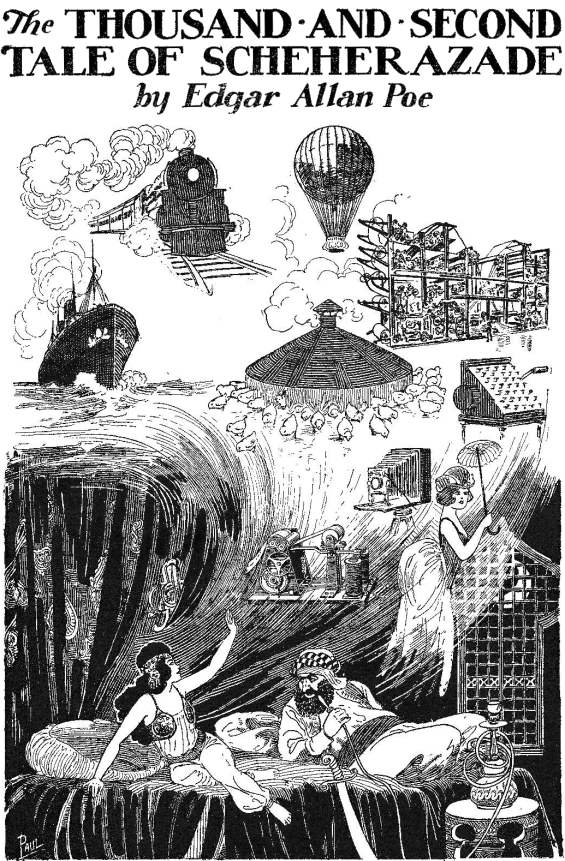
The Thousand-and-Second Tale of Scheherazade by Edgar Allan Poe - illustration by Frank R. Paul

Here’s the uncredited editorial introduction, presumably by Hugo Gernsback himself, to The Thousand-And-Second Tale Of Scheherazade as it appeared in the May 1928 issue of Amazing Stories:

“When we realize that this story was written nearly 100 years ago, we must marvel at the extraordinary fertile imagination of Poe. Poe was probably the inventor of “Scientifiction” as we know it today, and just because the story was written almost a century ago, certainly does not make it less valuable. On the contrary, it becomes more valuable as time passes. It is just as applicable to the modern man, who is mostly in the fog about what goes on around him in science today, as his predecessors were a century ago.”

Indeed, if you read it straight through, without pausing to read the footnotes, you’ll probably only get a vague sense of what’s going on in this story. And though I think I tumbled to the idea pretty early on, I still found myself in many places echoing the king’s many harrumphs. I’m not one to use the term “genius” lightly, but if anyone is worthy of the term, it is certainly Edgar Allan Poe. Even in his lesser works, like The Thousand-And-Second Tale Of Scheherazade, there is a wry brilliance that may be entirely matchless.

LibriVoxThe Thousand-And-Second Tale Of Scheherazade
By Edgar Allan Poe; Read by Gregg Margarite
1 |MP3| – Approx. 55 Minutes [UNABRIDGED]
Publisher: LibriVox
Published: October 1, 2009
First published in the February 1845 issue of Godey’s Lady’s Book.

And here’s the matching |PDF|.

Posted by Jesse Willis

Scientific American – 60-Second Science – Moon Not Made of Cheese

SFFaudio Online Audio

Scientific American  - 60-Second ScienceEvery once in a while I have an surreal conversation. The conversation usually begins when a person says something I misunderstand. They claim something and then proceed to tell me about it. I assume that the person in question’s claim is a claim about the universe (I assume that because that’s the place I’m trying to understand). When the surreality begins is when it turns out that they are actually talking about is a part of the world – I guess that’s their perception of it.

The other day I had one when a friend of mine suggested I read a book called Fringe-ology. He described it as “a good book.”

Was he right? Is Fringe-ology a good book? The title sounded frighteningly unfruitful to me.

The question I then asked myself was: “Must I read it to form my own judgement?”

It was highly rated on Amazon.com (five stars and twenty five reviews). Did that fact make it “a good book?”

The book’s subtitle, How I Tried to Explain Away the Unexplainable-And Couldn’t, didn’t make me want to read it either. Science, as I understand it, isn’t about “explaining away” anything (unless you are speaking metaphorically, which the practice of science certainly doesn’t embrace). And the “unexplainable” is a term that shows some seriously misguided thinking about reality (based on my reading of science history). Perhaps that was just marketing though.

Upon closer examination there is something else that makes me question Fringe-ology being a “good book” – there is a bent spoon on the book’s cover.

That is not a good sign.

To try to convince me to read Fringe-ology: How I Tried to Explain Away the Unexplainable-And Couldn’t my friend said this:

“[the author Steven Volk is a] Hard-nosed news reporter who looks honestly at this stuff. And find he can’t disprove much of it.”

I suggested that no matter how hard one’s proboscis, the act of setting out to disprove something wasn’t science.

My friend then went on to talk about the reams of sworn eyewitness testimony to the existence of UFOs. And that they would be admissible as evidence in a court of law.

I then suggested that “reality is not determined by a judicial process.”

It was at about this point that I twigged to some sort of incommensurability in our communications. I was talking about the world, as discovered by the practice of science, and my friend was talking about some other way of seeing the world (that I think is demonstrably false – but perhaps enjoyable or something).

In the end I may have to accept my friend’s judgement about my character. He said I was a “closed” person. He may be right. I will not read horoscopes, I will not accept sworn eyewitness testimony for paranormal claims, and I don’t expect to be reading Fringe-ology: How I Tried to Explain Away the Unexplainable-And Couldn’t any time soon – at least not without some more compelling reasons than I’ve been given.

There’s another way to put all of the above.

My friend was talking about institutional facts and I was talking about brute facts. He thinks the inexplicable exists, whereas I suggest that a book about the inexplicable is going to be zero pages long.

Which brings me to this extraordinarily boring (but presumably useful to my friend) story from Scientific American’s 60-Second Science podcast: “Moon Not Made of Cheese” – which takes a very pragmatic approach to debunking shitty ideas.

|MP3|

Podcast feed:

http://rss.sciam.com/sciam/60secsciencepodcast

Posted by Jesse Willis