Hypatia of Alexandria

SFFaudio News

If you’re anything like me you’re more than twice as happy to find a small gem to share with a friend than to revel in the worship and praise of something that is already well advertised. Agora is a recently completed movie in the marketplace of filmed ideas.

The posters to promote the film read: “FREEDOM” “PASSION” “POWER” “AMBITION”

Agora Posters

After seeing the movie I can see why the marketers have labeled the characters with the abstract nouns that they did. Freedom, Passion, Power, Ambition. All are probably better at getting more bums in theater seats that the words that I’d like to see on those posters: “HISTORY” “PHILOSOPHY” “SKEPTICISM” “SCIENCE” – I think these words would be more in keeping with the true intellectual spirit of the film – it is a movie about all four of those things.

The audiobook, on the other hand, has yet to have any art made for it because it isn’t completed yet. Underway at LibriVox.org, is an unabridged, multiple narrator reading of Hypatia by Charles Kingsley. This is a historical novel based on the very same life of scientist and philosopher Hypatia of Alexandria. And here’s where you come in. The project is still in need of narrators and proof listeners. To get involved head on over to the LibriVox Forum reader thread or the LibriVox Forum proof listener thread and help bring the story of Hypatia back to life.

Posted by Jesse Willis

The SFFaudio Podcast #044 – TALK TO: Professor Eric S. Rabkin

Podcast

The SFFaudio PodcastThe SFFaudio Podcast #044 – Jesse and Scott are joined by Professor Eric S. Rabkin of the University Of Michigan to discuss fairy tales, fantastic literature and Science Fiction.

Talked about on today’s show:
Department Of English Language And Literature @ the University Of Michigan, the Winter 2010 semester: English 342 Science Fiction, English 418/549 Graphic Narrative, hey sign us up!, The Teaching Company, Science Fiction: The Literature Of The Technological Imagination |READ OUR REVIEW|, Masterpieces of the Imaginative Mind: Literature’s Most Fantastic Works, Franz Kafka, H.G. Wells, Edgar Allan Poe, Science Fiction (the most important literature for adults), I, Robot by Isaac Asimov |READ OUR REVIEW|, Brothers Grimm, fairy tales, Neuromancer by William Gibson |READ OUR REVIEW|, Asimov’s three laws of robotics, the conversation that is Science Fiction, humans are pattern seeking animals, Starship Troopers by Robert A. Heinlein |READ OUR REVIEW|, The Forever War by Joe Haldeman |READ OUR REVIEW|, Ender’s Game by Orson Scott Card |READ OUR REVIEW|, the ansible, Armor by John Steakley, Old Man’s War by John Scalzi |READ OUR REVIEW|, Gundam, The Ship Who Sang by Anne McCaffrey, Science Fiction as a form of children’s literature, Thomas Disch, Camp Concentration, 334, Kurt Vonnegut, The Plot Against America by Philip Roth, alternate history, Hugo Gernsback, pulp literature, paperback originals, adolescent power fantasies, Frank Reade and His Steam Man of the Plains by Noname, Ralph 124C 41+ by Hugo Gernsback, pushing science education through Science Fiction, The Time Machine by H.G. Wells |READ OUR REVIEW|, The Facts In The Case Of M. Valdemar by Edgar Allan Poe, From The Earth To The Moon by Jules Verne, Henry James and H.G. Wells in conversation over the future of fiction, The Portrait Of A Lady by Henry James, WWII, the societal effect of the G.I. Bill, tracking an author’s intentions, powerful fiction becomes classic?, Ted Chiang, Blankets by Craig Thompson, has Science Fiction crossed a certain cultural Rubicon?, Momento, Blindness by José Saramago, Briefing for a Descent into Hell by Doris Lessig, Galatea 2.2 by Richard Powers, has our culture become “fully Science Fictionized”?, does SF history begin with Frankenstein and end with Neuromancer?, Alan Moore, Watchmen, The League Of Extraordinary Gentlemen, pattern recognition, allusion (and literary allusion).

Posted by Jesse Willis

Sience News Update: Bisphenol A

SFFaudio Online Audio

Uvula AudioStarShipSofa’s Aural Delights podcast features terrific fiction, funny poems and fantastic scholarly research in nearly every episode. Once a month the podcast features a segment by James J. Campanella. Besides being an excellent audiobook narrator, he’s a university professor (of Biology and Molecular Biology) and a genuine Ph’D scientist. His segment is called “Science News Update.” In each episode Campanella talks about the latest research that’s hitting the journals, explains the cool implications of each, and he answers listeners questions. In a recent show, for example, Campanella discussed a cool experiment that demonstrates a previously unknown taste receptor – we can taste the flavour of carbonation! More on that later.

But, it’s something else in the most recent two segments (the October and November 2009 shows) that I really want to draw your attention to. See Jim answered one of my questions. I’d been wondering about the ‘BPA and plastics threat’ that I’d be hearing about (from my mom).

In his answer to my query Campanella discussed the endocrine disruptor Bisphenol A (BPA), and its distribution in the human ecosystem.

It seems that BPA does pose a threat, a kind of bodily pollution that threatens to ‘impurify our precious bodily fluids!’ Or as Jim put it in his email to me:

“This stuff just scares the hell out of me– all I can think of is that book and movie The Children Of Men.”

Yikes! Is it truly possible that in all the H1N1 hysteria that a more insidious threat can be found in the likes of household plastics and store receipts?

Campanella thinks so. He refers, in the November show, to some research conducted by Bruce Lanphear, a Health Sciences Professor at Simon Fraser University (my old school).

Because of this research Canada has banned plastics containing BPA from use in baby products. But there’s not yet been a ban imposed on BPA lined cash register receipts or number 7 (and some number 3) recyclable plastics. Other plastics, containing other non-Bishpenol A plastics may or may not pose a risk. But given the known leech-rate of glass containers (virtually nil) I’d be willing to stick with glass were it available for reasonable prices (which it mostly isn’t, damn it).

Campanella also reports that not only are some plastics embedded with this dangerous endocrine disruptor but that a larger threat may be looming in the form of the receipt I got when I bought all that plastic crap! Sez Campanella:

carbonless copy paper credit card and store receipts have a reported average of 50-100mg of free BPA. That is receipts using this bisphenol A technology have a loose coating of unbound BPA ready for uptake on the fingers or even possibly through direct skin absorption!’

So, mom, I guess you were right? Except that it’s not so much the plastics now that I’m worried about!

Listen to the October |MP3| and November |MP3| Science News Update shows.

Podcast feed:

http://www.uvulaaudio.com/Podcasts/Podcasts.xml


My solutions BTW:

-Avoid plastics (especially number 7 and number 3)

-Avoid receipts

-And given the news about carbonation and plastics, I’ll try to be more like this guy…

Posted by Jesse Willis

Review of Terminal Freeze by Lincoln Child

SFFaudio Review

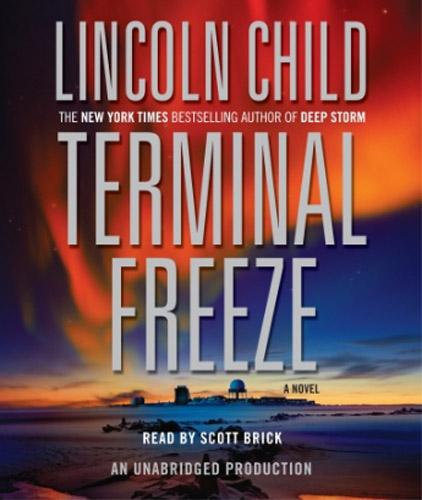
Random House Audio - Terminal Freeze by Lincoln ChildTerminal Freeze
By Lincoln Child; Read by Scott Brick
9 CDs – Approx. 10 Hours 30 Minutes [UNABRIDGED]
Publisher: Random House Audio
Published: February 2009
ISBN: 9780739382028
Themes: / Horror / Thriller / Techno-thriller / Science / Biology / Evolution / Paleoecology / Alaska / Ice / Ice Road Trucking /

Four hundred miles north of the Arctic Circle lies Alaska’s Federal Wilderness Zone, one of the most remote places on Earth. But for paleoecologist Evan Marshall and a small group of fellow scientists, an expedition to the Zone represents the opportunity of a lifetime to study the effects of global warming. The expedition changes suddenly, however, with an astonishing find. On a routine exploration of a glacial ice cave, the group discovers an enormous ancient animal encased in solid ice. The media conglomerate sponsoring their research immediately intervenes and arranges the ultimate spectacle—the animal will be cut from the ice, thawed, and revealed live on television. Despite dire warnings of a local Native American village, and the scientific concerns of Marshall and his team, the “docudrama” plows ahead—until the scientists make one more horrifying discovery. The beast is no regular specimen…it may be an ancient killing machine. And they may be wrong in presuming it dead.

Lincoln child begins Terminal Freeze by quoting all but the last couple sentences of THIS. It’s not exactly a scholarly article, more of a “fun science facts” story. But like Child there are plenty of other folks willing to proffer their own answers to this “mystery.” AboveTopSecret.com (a forum devoted to “conspiracies, UFO’s, paranormal, secret societies, political scandals, new world order, terrorism”) and AnswersInGenesis.org (a site about Young Earth creationism and a literal interpretation of the Book of Genesis) both have explanations for the seemingly flash frozen mammoth that fit into other “theories.” If Child’s solution to the mystery, this novel, wasn’t presented as fiction it’d be just as ridiculous.

So, this isn’t really a Science Fiction novel. At first I had a hard time figuring out what it was. I clued in about the time I started hearing the scientists protags talking about something called “the Callisto Effect” – it sounded like utter bunk – so I looked it up. Yup it is bunk, it’s a fictional theory first invented for the Lincon Child/Douglas Preston novel The Relic (which got turned into a pretty good horror movie). The Callisto Effect is a Child/Preston invention, a kind of a fictional spin-off of the saltation hypothesis. As one other reviewer of this book noted the Callisto Effect can be summed up like this:

“…when a species becomes too numerous or starts to lose evolutionary vigor a monstrous superpredator suddenly appears and kills until it can kill no more.”

So ya, like I was saying, there are scientists in Terminal Freeze, and they talk about pseudo-scientific ideas, but this is just window dressing for the plot of a monster hunt.

We might think of the “techno-thriller” as a kind of a modern gothic novel. Even as far back as the 19th century, Edgar Allan Poe and Jules Verne, were setting their “fantastic tales in the remaining unexplored regions of the world. By the early 20th the likes of H.P. Lovecraft, and John W. Campbell only had one unexplored continent: Antarctica. The same would be true for a modern audience but now that even Antarctica has been laregly de-mystified we’re having to place our monster horror stories in inaccessible caves and hidden military bases (at least that’s the route Terminal Freeze takes).

The story is rather drawn out, with a number of blandish stock characters brought in seemingly only to be picked off one by one (which surpringly both does and doesn’t happen). The scientists, none of whom are particularly interesting, end up working with a local native, who was also co-incidentally a former soldier at Fear Base, and also a former junior scientist there, and also a co-discoverer of the original monster (back in the 1950s). Given those credentials you’d think then that he’d be absolutely instrumental in solving the mystery of what the frozen monster is and how it escaped. But no, he just gives a highly ineffectual and unrealistically cryptic warning (at the beginning of the novel) is promptly ignored – shuffles off the stage only to be brought back later, like Chekhov’s gun, jumbling around a bag of religious artifacts – which do nothing. Apparently the gun on the mantle was just a prop. Child added in an absolutely unnecessary batch of TV documentary people. The only reason I can think they’re there for is that it’d make for some good visuals should they make a movie of this novel. They’re all there when the monster in the ice escapes from the mysteriously melted ice. And of course their there when people start dying grizzly deaths as they wander off alone. But they don’t do much with those cameras and they end up leaving before the end.

After finishing the novel I was kind of interested in finding out if any of the locations in this novel were real. In the book there is a mountain called “Mount Fear,” a glacier called “Fear Glacier,” and a “Fear Base” (a D.E.W. Line style military facility). It turns out that they all don’t really exist, they are all made up.

One thing I did like about the novel was the discussion about the different types of ice. When the scientist are sitting around trying to explain how the creature in the ice escaped they briefly discuss different ways water crystallizes into ice, how these different types of ice are formed, and their differing properties. This briefly re-invigorates the mystery – but it is ultimately thrown away – discarded and replaced with a less than satisfactory explanation.

Scott Brick, who probably reads more books than any other audiobook narrator working today, does his best with what he’s given. The baddies come off badish, the heroes come off goodish, the monster comes off monsterish. The most interesting portion of the novel is actually a bit, almost completely tangential to the monster plot when an “ice road trucker” has to drive the survivors to safety. Brick works hard to make the cracking of the ice and the freezing cold compelling. And that’s the part of the novel is more believable.

Posted by Jesse Willis
Review of Simon Bloom: The Octopus Effect by Michael Reisman

SFFaudio Review

Fantasy Audiobook - Simon Bloom The Octopus Effect by Michael ReismanSimon Bloom: The Octopus Effect
By Michael Reisman; Read by Nicholas Hormann
9.5 Hours – [UNABRIDGED]
Publisher: Listening Library
Published: 2009
ISBN: 9780739382387
Themes: / Science Fiction / YA / Science / biology /

|LISTEN TO AN EXCERPT|

As another chronicle begins Simon Bloom and his friends are thrust back into mortal peril. This time the gang heads to the Order of Biology’s headquarters. When the gang gets there they find an unexpected surprise – it’s underwater! Simon and his friends must prepare themselves for battle against the evil Sirabetta (unsure on spelling) who somehow has regained her memory. Simon and his friends face enemies from other orders and the Order of Biology’s domain itself!

One of the things I liked most about this story was the author’s use of humor for the oddest things. When something gross or funny is described in the book it is described by using words like “air ripping”, or “vacuum cleaner bag smell”. I think that it is brilliant.

The reader, Nicholas Hormann, makes the experience of listening to this book all the more interesting. The way he reads just makes me laugh, you have to listen to the book to know what I mean. He is excellent with accents. When he reads characters in the story like Flangello (again not sure about spelling) he speaks with a very good Italian accent. Nicholas is not the most emotional reader, but this fact does not detract from the story one bit.

I encourage everyone to listen to this audio book, providing that one has read the first book (Simon Bloom: The Gravity Keeper), otherwise one might not understand the book in its full context. I absolutely loved this audiobook and I am sure any person that enjoys science will feel the same way.

Posted by DanielsonKid

Science Fiction and Politics University Course (has new lectures)

SFFaudio Online Audio

Science Fiction and PoliticsCourtney Brown has added some new classes to his Science Fiction and Politics podcast. Brown is a professor of Political Science at Emory University who posts many of his lectures to his website (he’s actually been podcasting since 2006).

For the first two lectures of the Spring 2009 semester Brown, and class, are talking about Lee Smolin’s The Trouble with Physics. That’s a non-fiction book that bashes the various untestable string theories that physicists have been spinning over the last couple of decades. The second set of two lectures is about a 1991 “feminist science fiction/cyberpunk novel” called He, She And It by Marge Piercy. Next is just one MP3 discussing Neal Stephenson’s The Diamond Age. And the final two have Courtney and class talking about Philip K. Dick’s Ubik. These are the first new lectures from Courtney Brown talking Science Fiction since 2007.

Here are the new lectures that have been added to course’s podcast:

Lee Smolin’s The Trouble with Physics – Part 1 |MP3|
Lee Smolin’s The Trouble with Physics – Part 2 |MP3|
Marge Piercy’s He, She And It – Part 1|MP3|
Marge Piercy’s He, She And It – Part 2 |MP3|
Neal Stephenson’s The Diamond Age |MP3|
Philip K. Dick’s Ubik – Part 1 |MP3|
Philip K. Dick’s Ubik – Part 2 |MP3|
Podcast feed:

http://www.courtneybrown.com/classes/scifi/mp3/cb_SciFiPoliticsClass1.xml

For previous lectures either check out one of our older posts about Brown and his classes, |HERE|, |HERE| and |HERE|, or visit Professor Brown’s website directly |HERE|.

Posted by Jesse Willis