LibriVox: Short Science Fiction Stories Vol. 19

SFFaudio Online Audio

LibriVoxIt seems LibriVox has started adding a few more credits to its collections starting with this volume. Besides the narrators, this collection was created by the following LibriVox volunteers:

Book Coordinator: Gregg Margarite
Dedicated Proof-Listener: julicarter
Meta-Coordinator/Cataloging: Lucy Burgoyne

Stories new to this collection include:

Stopover by William Gerken. This is a well written but annoying story. It is one of better parapsychology short stories, but that isn’t saying much. John W. Campbell was absolutely obsessed with paraspychological ESP bunk – it makes for very repetitive reading. This story’s setting, in a post-apocalyptic USA, is vivid – and the characters are emotionally realistic -too bad about the ESP crap. Bellona Times, the narrator, has a few missteps in this one – including the reading “psi talents” as “pee-ess-eye talents.”

Something Will Turn Up by David Mason. The beatnik/hippy repairman, and his dialogue, in this tale are a real hoot. It’s more a Fantasy tale than an SF one, but its got a beatnik TV repairman so I’m still happy. Read by Bellona Times again without any serious flaws but with a few little ones here and there. Times snaps his fingers and whistles – which to me is a narrator double no-no. There’s also a word or two improperly read, notably “reversed” read as “reverse.”

The Sargasso Of Space by Edmond Hamilton. This is a fast paced space opera (and mystery) about an interplanetary spacecraft that’s run out of gas. Gregg Margarite continues to kick ass as a narrator. He’s no vocal chameleon but he’s just a few tweaks away from being a pro sounding narrator. He seems to choose some of the better stories too. I think he’s super cool. Maybe he’ll be my friend? That’d be cool.

LibriVox - Short Science Fiction Collection Vol. 019Short Science Fiction Stories Vol. 19
By various; Read by various
10 Zipped MP3 Files or Podcast – Approx. 4 Hours 41 Minutes [UNABRIDGED]
Publisher: LibriVox.org
Published: June 23, 2009
Science Fiction is speculative literature that generally explores the consequences of ideas which are roughly consistent with nature and scientific method, but are not facts of the author’s contemporary world. The stories often represent philosophical thought experiments presented in entertaining ways. Protagonists typically “think” rather than “shoot” their way out of problems, but the definition is flexible because there are no limits on an author’s imagination. The reader-selected stories presented here were written prior to 1962 and became US public domain texts when their copyrights expired.

Podcast feed:

http://librivox.org/bookfeeds/short-science-fiction-collection-19.xml

iTunes 1-Click |SUBSCRIBE|
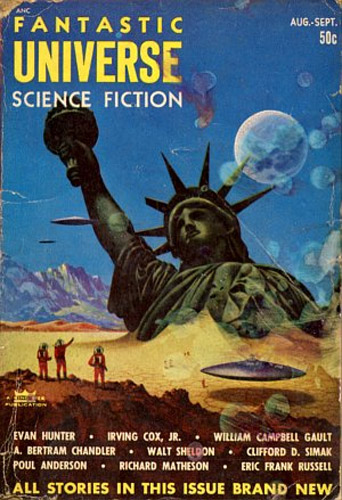
Fantastic Universe August/September 1953All Cats are Gray
By Andre Norton; Read by Gregg Margarite
1 |MP3| – Approx. 16 Minutes [UNABRIDGED]
Publisher: LibriVox.org
Published: June 23, 2009
An odd story, made up of oddly assorted elements that include a man, a woman, a black cat, a treasure—and an invisible being that had to be seen to be believed. – Under normal conditions a whole person has a decided advantage over a handicapped one. But out in deep space the normal may be reversed—for humans at any rate. First published using Norton’s Andrew North pseudonym in Fantastic Universe Science Fiction, August–September 1953.
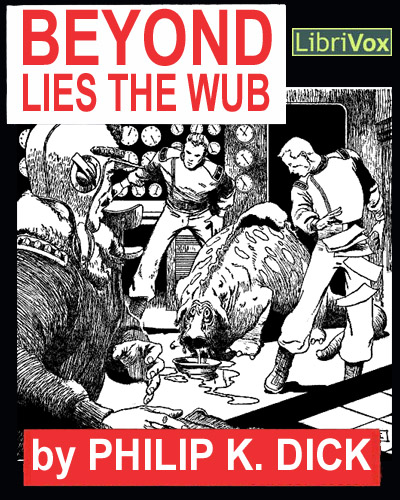
LibriVox - Beyond Lies The Wub by Philip K. DickBeyond Lies The Wub
By Phillip K. Dick; Read by Tom Hackett
1 |MP3| – Approx. 16 Minutes [UNABRIDGED]
Publisher: LibriVox.org
Published: June 23, 2009
The slovenly wub might well have said: Many men talk like philosophers and live like fools. From Planet Stories July 1952.

LibriVox - The Gallery by Rog PhillipsThe Gallery
By Rog Phillips; Read by Ted Ryan
– [UNABRIDGED]
Publisher: LibriVox.org
Published: June 23, 2009
Wherever he went Arthur felt the power behind the lens. – Aunt Matilda needed him desperately, but when he arrived she did not want him and neither did anyone else in his home town. From Amazing Stories January 1959.
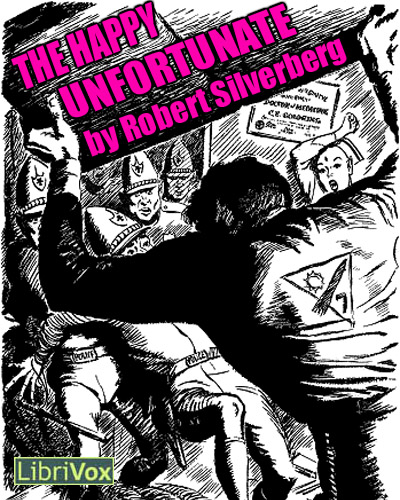
LibriVox - The Happy Unfortunate by Robert SilverbergThe Happy Unfortunate
By Robert Silverberg; Read by Gregg Margarite
1 |MP3| – Approx. 39 Minutes [UNABRIDGED]
Publisher: LibriVox.org
Published: June 23, 2009
Dekker, back from space, found great physical changes in the people of Earth; changes that would have horrified him five years before. But now, he wanted to be like the rest—even if he had to lose an eye and both ears to do it. From Amazing Stories December 1957.

LibriVox - The Man Who Saw The Future by Edmond HamiltonThe Man Who Saw The Future
By Edmond Hamilton; Read by Xanderphilips
1 |MP3| – Approx. [UNABRIDGED]
Publisher: LibriVox.org
Published: June 23, 2009
“Jean de Marselait, Inquisitor Extraordinary of the King of France, raised his head from the parchments that littered the crude desk at which he sat. His glance shifted along the long stone-walled, torchlit room to the file of mail-clad soldiers who stood like steel statues by its door. A word from him and two of them sprang forward.” First published in Amazing Stories, October 1930. Later reprinted in the February 1961 issue of Amazing Stories.

LibriVox - A Matter Of Proportion by Anne WalkerA Matter Of Proportion
By Anne Walker; Read by Dale A. Bade
1 |MP3| – Approx. 37 Minutes [UNABRIDGED]
Publisher: LibriVox.org
Published: June 23, 2009
In order to make a man stop, you must convince him that it’s impossible to go on. Some people, though, just can’t be convinced. From Astounding Science Fiction August 1959.
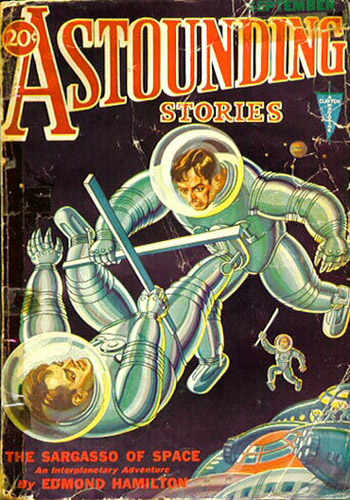
Astounding Stories September 1931Sargasso Of Space
By Edmond Hamilton; Read by Greg Margarite
1 |MP3| – Approx. 50 Minutes [UNABRIDGED]
Publisher: LibriVox.org
Published: June 23, 2009
She was floating along the wreck-pack’s edge. Helpless, doomed, into the graveyard of space floats the wrecked freighter Pallas. From Astounding Stories September 1931.
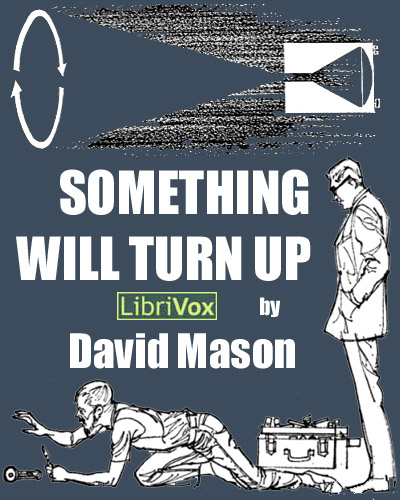

LibriVox - Something Will Turn Up by David MasonSomething Will Turn Up
By David Mason; Read by Bellona Times
1 |MP3| – Approx. 17 Minutes [UNABRIDGED]
Publisher: LibriVox.org
Published: June 23, 2009
Err … maybe it had to do with this being a non-Parity universe, perhaps? Some things can’t be simply inverted, after all… From Analog February 1963.
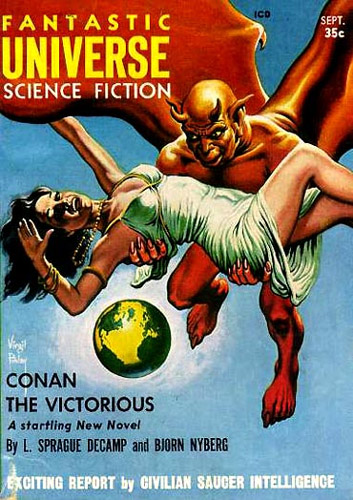

Fantastic Universe September 1957Stopover
By William Gerken; Read by Bellona Times
1 |MP3| – Approx. 23 Minutes [UNABRIDGED]
Publisher: LibriVox.org
Published: June 23, 2009
What will the world be like, the day after Tomorrow, for the lonely ones who will have talents that others will half fear, half envy? William Gerken describes this strange world in which young and old will have to find new values and pursue new dreams, as they search for the answer… From Fantastic Universe September 1957.

LibriVox - Toy Shop by Harry HarrisonToy Shop
By Harry Harrison; Read by Xanderphillips
1 |MP3| – Approx. 10 Minutes [UNABRIDGED]
Publisher: LibriVox.org
Published: June 23, 2009
The gadget was strictly, beyond any question, a toy. Not a real, workable device. Except for the way it could work under a man’s mental skin… From Analog April 1962.

Posted by Jesse Willis
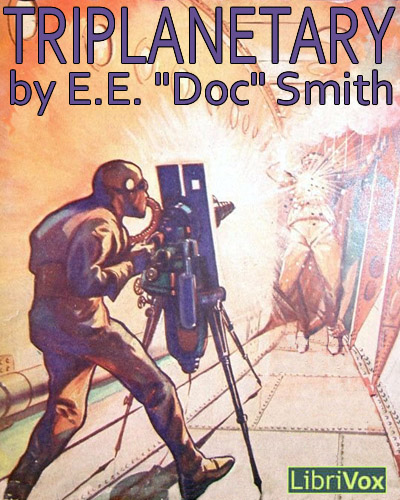
LibriVox: Triplanetary by E.E. “Doc” Smith

SFFaudio Online Audio

LibriVoxThanks go to LibriVox for Triplanetary. This is the first book length public domain audiobook by E.E. “Doc” Smith. Here’s the editorial from the first issue of its serialization in Amazing Stories:

“We are sure that our readers will be highly pleased to have us give the first installment of a story [Triplanetary] by Dr. Smith. It will continue for several numbers and is a worthy follower of the ‘Skylark’ stories which were so much appreciated by our readers. We think that they will find this story superior to the earlier ones. Dr. Smith certainly has the narrative power, and that, joined with his scientific position, makes him an ideal author for our columns.”

LibriVox - Triplanetary by E.E. Doc SmithTriplanetary
By E.E. “Doc” Smith; Read by Mark F. Smith
13 Zipped MP3 Files or Podcast – Approx. 6 Hours 25 Minutes [UNABRIDGED]
Publisher: LibriVox.org
Published: July 21, 2009
E.E. “Doc” Smith virtually invented the space opera sub-genre singelhandedly. In Triplanetary physics, time, and politics never stand in the way of a plot that gallops ahead without letup. The heroes of Smith’s story are all scientists. In their hands the electromagnetic spectrum becomes a raw material to be molded into ever-more amazing and lethal forms, and the speed of light is no bar to their traveling through the interstellar void. Come enjoy this story of yesteryear, set in tomorrow, where real women ignite love at a glance, real men achieve in days what governments manage in decades, and aliens are an ever-present threat to Life-As-We-Know-It! First published in the January, February, March and April 1934 issues of Amazing Stories magazine.

Podcast feed:

http://librivox.org/bookfeeds/triplanetary-by-ee-doc-smith.xml

iTunes 1-Click |SUBSCRIBE|

Additional credit for this audiobook goes to:

Dedicated Proof-Listener: Ans Wink
Meta-Coordinator/Cataloging: David Lawrence

Posted by Jesse Willis

LibriVox: Starman’s Quest by Robert Silverberg

SFFaudio Online Audio

LibriVoxHey now! Check out the FREE audiobook of Robert Silverberg’s second ever novel, a “juvenile” written by a juvenile…

“This was my second novel, which I wrote when I was 19, in my junior year at Columbia. I’ve written better ones since. But readers interested in the archaeology of a writing career will probably find much to explore here.”
-Robert Silverberg 17 May 2008

Starman’s Quest is probably most famously remembered for employing the “twin paradox.” Other elements included in the book include a dystopian/utopian earth of the 37th century. Earth overpopulated and jobs are few and far between for anyone who isn’t in a hereditary guild. There’s also “a kind of enforced consumerism” in which it is considered immoral to save money – “everyone must buy, buy, buy.” The only legal profession open to those without a guild is gambling.


LibriVox - Starman's Quest by Robert Silverberg
Starman’s Quest
By Robert Silverberg; Read by Dawn Larsen
20 Zipped MP3 Files or Podcast – Approx. 5 Hours 17 Minutes [UNABRIDGED]
Publisher: LibriVox.org
Published: June 12, 2009
Traveling at speeds close to that of light, spacemen lived at an accelerated pace. When one of the twin boys left the starship, he grew older while his twin in space barely aged. So the starship twin left the ship to find what happened to his brother who was aging away on earth.

Podcast feed: http://librivox.org/bookfeeds/starmans-quest-by-robert-silverberg.xml

iTunes 1-Click |SUBSCRIBE|

Posted by Jesse Willis

LibriVox: Short Science Fiction Collection Vol. 012

SFFaudio Online Audio

LibriVox - Short Science Fiction Collection Vol. 012Short Science Fiction Collection Vol. 012
By various; Read by various
10 Zipped MP3 Files or Podcast – Approx. 4 Hours 22 Minutes [UNABRIDGED]
Publisher: LibriVox.org
Published: March 12, 2009
Science fiction (abbreviated SF or sci-fi with varying punctuation and case) is a broad genre of fiction that often involves sociological and technical speculations based on current or future science or technology. This is a reader-selected collection of short stories that entered the US public domain when their copyright was not renewed.

Podcast feed:

http://librivox.org/bookfeeds/short-science-fiction-collection-vol-012.xml

iTunes 1-Click |SUBSCRIBE|

LibriVox Science Fiction - As Long As You Wish by John O'KeefeAs Long As You Wish
By John O’Keefe; Read by Joelle Peebles
1 |MP3| – Approx. 11 Minutes [UNABRIDGED]
Publisher: LibriVox.org
Published: March 12, 2009
From Astounding Science Fiction, June, 1955.
If, somehow, you get trapped in a circular time system . . . how long is the circumference of an infinitely retraced circle?

LibriVox - The Big Fix by George O. SmithThe Big Fix
By George O. Smith; Read by Alan Winterrowd
1 |MP3| – Approx. 58 Minutes [UNABRIDGED]
Publisher: LibriVox.org
Published: March 12, 2009
Anyone who holds that telepathy and psi powers would mean an end to crime quite obviously underestimates the ingenuity of the human race. Now consider a horserace that had to be fixed…
From Astounding Science Fiction December 1959.

Future Science Fiction No. 30, 1956The Fourth Invasion
By Henry Josephs; Read by Tibbi Scott
1 |MP3| – Approx. 10 Minutes [UNABRIDGED]
Publisher: LibriVox.org
Published: March 12, 2009
Psychopathology has offered possible answers to why, from time to time, people in large quantities “see” strange things in the sky which manage to evade trained scientific observers, or conform to what is known about the behavior of falling or flying bodies. And mass hysteria is by no means a product of the present century. But—what if these human foibles were deliberately being exploited? From Future Science Fiction No. 30 1956.

Goliah
By Jack London; Read by Gregg Margarite
1 |MP3| – Approx. 57 Minutes [UNABRIDGED]
Publisher: LibriVox.org
Published: March 12, 2009

LibriVox - The Man Who Saw The Future by Edmond HamiltonThe Man Who Saw The Future
By Edmond Hamilton; Read by Gregg Margarite
1 |MP3| – Approx. 31 Minutes [UNABRIDGED]
Publisher: LibriVox.org
Published: March 12, 2009
“Jean de Marselait, Inquisitor Extraordinary of the King of France, raised his head from the parchments that littered the crude desk at which he sat. His glance shifted along the long stone-walled, torchlit room to the file of mail-clad soldiers who stood like steel statues by its door. A word from him and two of them sprang forward.” First published in Amazing Stories, October 1930. Later reprinted in the February 1961 issue of Amazing Stories.

LibriVox Science Fiction - The Nothing Equation by Tom GodwinThe Nothing Equation
By Tom Godwin; Read by Janet Moursund
1 |MP3| – Approx. 20 Minutes [UNABRIDGED]
Publisher: LibriVox.org
Published: March 12, 2009
From Amazing Stories December 1957. The space ships were miracles of power and precision; the men who manned them, rich in endurance and courage. Every detail had been checked and double checked; every detail except—

LibriVox - The Putnam Tradition by Sonya DormanThe Putnam Tradition
By Sonya Dorman; Read by Tibbi Scott
1 |MP3| -Approx. 15 Minutes [UNABRIDGED]
Publisher: LibriVox.org
Published: March 12, 2009
Through generations the power has descended, now weaker, now stronger. And which way did the power run in the four-year-old in the garden, playing with a pie plate? From Amazing Stories January 1963.

Astounding Stories November 1932A Scientist Rises
By D.W. Hall; Read by David Adamson
1 |MP3| – Approx. 19 Minutes [UNABRIDGED]
Publisher: LibriVox.org
Published: March 12, 2009
All gazed, transfixed, at the vast form that towered above them. From the November 1932 issue of Astounding Stories.

The Shadow And the Flash
By Jack London; Read by Gregg Margarite
1 |MP3| – Approx. 34 Minutes [UNABRIDGED]
Publisher: LibriVox.org
Published: March 12, 2009

LibriVox - We Didn't Do Anything Wrong, Hardly by Roger KuykendallWe Didn’t Do Anything Wrong, Hardly
By Roger Kuykendall; Read by Joelle Peebles
1 |MP3| – Approx. 8 Hours 55 Minutes [UNABRIDGED]
Publisher: LibriVox.org
Published: March 12, 2009
After all—they only borrowed it a little while, just to fix it— From Astounding Science Fiction May 1959.


Posted by Jesse Willis

Review of Dune by Frank Herbert (Macmillan Audio)

SFFaudio Review

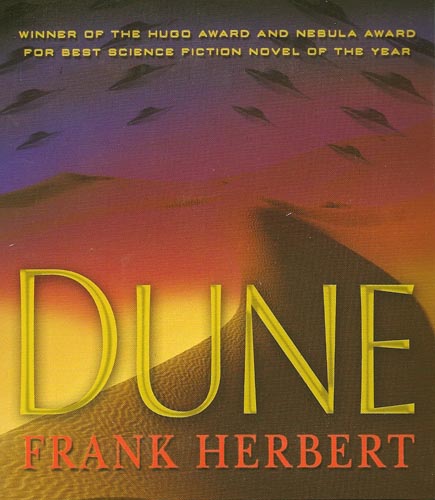
Science Fiction Audiobook - Dune by Frank HerbertSFFaudio EssentialDune
By Frank Herbert, Performed by Simon Vance
18 CDs – 22 hours – [UNABRIDGED]
Publisher: Macmillan Audio
Published: 2007
ISBN: 9781427201430
Themes: / Science Fiction / Politics / Space travel / Culture / Ecology /

Dune. Arrakis. Desert Planet.

I first read Dune when I was in college (late 1980’s), after a few false starts. I desperately wanted to read it, so I made it the only thing I took with me on a 30 hour bus ride from Tucson, Arizona to Idaho Falls, Idaho. It was a long trip. I smelled like cigarettes. But I got that book read, and loved it.

Years later, I reviewed an unabridged recording of Dune for SFFaudio that was read by George Guidall. Loved that one, too. Revisiting the book was a treat and Guidall is the Yoda of audiobook narration, so win-win.

Now, years after that, I’ve heard yet another unabridged version of Dune, this time a multi-voice presentation from Macmillan Audio. And again, I loved it. Frank Herbert’s novel remains one of the finest examples of world-building the genre has to offer. The political intrigue is delicious, the implied history deep and satisfying, and the characters smart.

Simon Vance is the main narrator. Each character’s dialogue is performed by actors, and skilled actors at that. I can’t find a list of the entire cast, but it includes Scott Brick, Katherine Kellgren, Orlagh Cassidy, and Euan Morton. I enjoyed it thoroughly. The actors were allowed to perform, and most of the time the attributives were dropped. Vance’s narration bridges the conversations, and the book is immersive and engaging.

I’m not certain why, but there are long passages that Simon Vance narrates himself. Vance is right up there with Guidall, so it’s an excellent reading. I’m just not certain why the audiobook wasn’t done with a full cast all they way through. I point this out as a curiosity rather than a flaw.

A few short years ago, if a person had asked me if I prefer a single narrator to a full cast recording, there wouldn’t have been any hesitation. Single narrator, definitely. But now, I’d have a difficult time choosing between a full cast narration and a single narrator, assuming the single narrator is good, the actors in the full cast narration are good, and – this is very important – the attributives in the full cast narration are dropped so I don’t have to hear the maddening “he said angrily” after an actor has made it quite clear that a character is angry. The problem is that most full cast narrations lean too far toward audio drama, adding too much sound and music. I love audio drama, but audio drama and audiobooks are very different experiences. Most productions that aim somewhere between the two fail in my opinion. Because of this leaning, there aren’t many full cast narrations I’ve enjoyed, but this production from Macmillan Audio and anything from Full Cast Audio are top-notch.

Despite my enjoyment of Dune, I have never read past it. I can’t explain why. I’ve owned a copies of Dune Messiah and Children of Dune for years, but have never read them. Brian Herbert and Kevin J. Anderson published a book called The Road to Dune (SFFaudio Review), which presented the history of the creation of the Dune books. In there it said that Frank Herbert intended Dune, Dune Messiah, and Children of Dune to be one story. It’s long past time I try more of these novels. Lucky for me, all six of Frank Herbert’s original books have been completed and released by Macmillan Audio, all as full cast productions.

 
On to Dune Messiah!

Posted by Scott D. Danielson

Review of Starman Jones by Robert A. Heinlein

SFFaudio Review

Blackstone Audio - Starman Jones by Robert A. HeinleinStarman Jones
By Robert A. Heinlein; Read by Paul Michael Garcia
7 CDs – 8.5 Hours [UNABRIDGED]
Publisher: Blackstone Audio
Published: 2008
ISBN: 9781433230387
Themes: / Science Fiction / Space Travel / Aliens / Dystopia /

It was a desperate time, when one’s next meal and the comforts of home couldn’t be taken for granted. Max Jones, a practical, hard-working young man, found his escape in his beloved astronomy books. When reality comes crashing in and his troubled home life forces him out on the road, Max finds himself adrift in a downtrodden land. Until an unexpected, ultimate adventure carries him away as a stowaway aboard an intergalactic spaceship—but to where? And when? And how could he ever get back? With the ship’s pilot dead and his charts and tables all destroyed, Max must call upon all of his untested knowledge and skills in order to survive.

There’s nothing like going back to that old-time Science Fiction. Heinlein’s novels are steeped in the inspissate brew of American idealism. Puritanical hard work, honesty and humility are mixed with the libertarian and the liberal, the conservative and the anarchistic. These aren’t just the bywords of Heinleinian characters, they’re the fundamentals of their character – all that, and tempered too with happy portions of both skepticism and hucksterism. A Heinlein character is just as likely to be a gruff middle aged con-man (honest in his own fashion) as a naive wundderkind. The naive wundderkind is often found with a variously doting, tolerant, and even brighter sweetheart. We find all three, the canny conman, the boy genius and his devoted young woman, along with a whole lot more in Starman Jones.

There are three main sections of Starman Jones. Most of the folks who talk about the novel talk about the middle section – where Max works his way up the chain of command in a luxury spaceliner. Indeed, this is what gives the novel its title. The third section, set on board a primitive alien planet has some nicely interesting aliens (a whole novel could have been done there). Personally I liked the first third, set on a vaguely dystopic planet Earth. This is a land of no-opportunity, in order to get a decent job you have to inherit it. Vested interests, taking the form of professional guilds, seem to have staked out every possible avenue for advancement. Sure, there are people there willing to bend the rules to kind-hearted kids like Jones, but the general rule is a complacency towards pervasive corruption. At one point during this first third a kindly truck driver, hopped up on amphetamines, gets Max to help him break the rules of the road (that you have to pull over and sleep once in a while). That scene and another, gives an odd kind of atmosphere of low-level-corruption that Heinlein seems fairly comfortable with. Later still, with the only ticket off the sewed-up planet Earth is via false documents and bribery – Max goes for it, to the detriment of his conscience only after the fact.

In other juvenile novels, like Citizen Of The Galaxy, a Heinleinian protagonist will stay “dirtside” where he’ll grift and finagle his way through life – justifying each action step by step – here and frankly in every single Heinlein story that I’ve ever read, the bad guys are never bad because of the greed or corruption per se, but rather because they are dumb, ignorant and vain.This is a Heinlein failing I think. His cardboard cut-out villians are too dim, too dull-humored and too officious to be any real threat. There are at least two of these lame-brains in this novel. That got me to thinking. If one were to rewrite a Heinlein novel from the strawman’s point of view – it’d be extremely obvious who Heinlein had meant the hero to be [namely Heinlein’s own ideas and values – however ambivalent they are]. But, don’t let this criticism let you think I don’t like Starman Jones because, warts and all, I really did enjoy it.

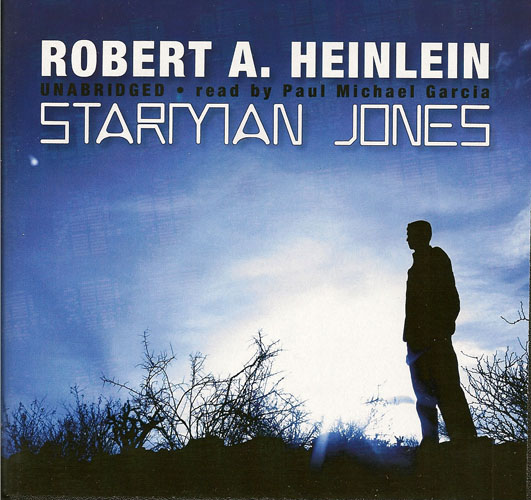
Paul Michael Garcia is ably suited to reading Heinlein’s well chosen words – giving the dialogue-heavy prose a banter-like give and take. Garcia’s range too is very impressive, voicing Max Jones as youthful and energetic, his older pal Sam as languid and confident, the girl, the mom, the step-dad, the alien spacepet, and everyone else – all in unique voice. It really is the ideal reading. I’ve been a fan of Garcia’s narration since Blackstone picked him for Kirinyaga. Despite a lot of technical jargon, especially while talking astrogation, I only heard one tiny mispronunciation in the whole novel. Concomitant meaning “occurring or existing concurrently.” Garcia read it as “konk-mittant.” The original art that Blackstone has given Starman Jones looks good, if a bit generic, but a closer inspection – past the silhouetted landscape and into the roiling clouds will admit a bit more detail in the night’s overcast sky.

Posted by Jesse Willis