News, Reviews, and Commentary on all forms of science fiction, fantasy, and horror audio. Audiobooks, audio drama, podcasts; we discuss all of it here. Mystery, crime, and noir audio are also fair game.
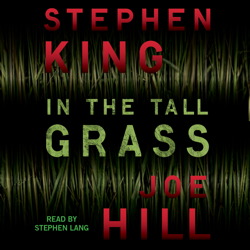
In the Tall Grass
By Stephen King and Joe Hill; Read by Stephen Lang
Approx. 90 Minutes [UNABRIDGED]
Publisher: Simon and Schuster Audio
Published: 2012
Themes: / Horror / Separation / Supernatural /
Cal and Becky are brother and sister, born 18 months apart, and inseparable. It’s said that there was never a cross word between them. They stop by the side of the road one day after hearing a cry for help from a field full of tall grass. They go into the field to help, but the moment they do they are supernaturally unable to find each other. They can’t find the person that cried for help either, but they are not alone in the grass.
Some stories stay with you. This is one of those. By creating main characters that were so emotionally close, Stephen King and Joe Hill delivered an experience of the horror of separation to their readers. This story would be tough to watch if it were a film – it’s grisly, gory, and this is a terrifying situation.
Stephen Lang narrated admirably. He had my attention to the very last sentence.
The SFFaudio Podcast #182 – Scott and Jesse talk, in the sixth of a six part series, about the books XXI, XXII, XXIII and XXIV of The Odyssey by Homer.
Talked about on today’s show:
The E.V. Rieu translation and the , The Great Bow, Odysseus Strings His Bow, The Battle In The Hall, Slaughter In The Hall, Odysseus And Penelope, The Great Rooted Bed, The Feud Is Ended, Peace, flexing that bow, canny suitors, does Penelope know what’s going on?, the Wikipedia entry for The Odyssey (and the Slaying Of The Suitors):
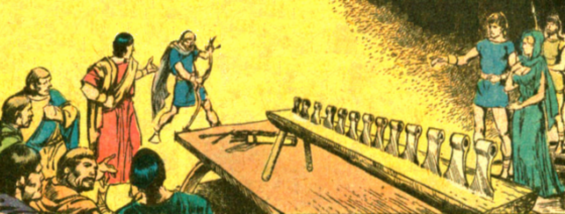
The next day, at Athena’s prompting, Penelope maneuvers the Suitors into competing for her hand with an archery competition using Odysseus’ bow. The man who can string the bow and shoot it through a dozen axe heads would win. Odysseus takes part in the competition himself: he alone is strong enough to string the bow and shoot it through the dozen axe heads, making him the winner. He then turns his arrows on the Suitors and with the help of Athena, Telemachus, Eumaeus and Philoteus the cowherd, he kills all the Suitors. Odysseus and Telemachus hang twelve of their household maids, who had betrayed Penelope or had sex with the Suitors, or both; they mutilate and kill the goatherd Melanthius, who had mocked and abused Odysseus. Now at last, Odysseus identifies himself to Penelope. She is hesitant, but accepts him when he mentions that their bed was made from an olive tree still rooted to the ground. Many modern and ancient scholars take this to be the original ending of the Odyssey, and the rest to be an interpolation.
The next day he and Telemachus visit the country farm of his old father Laertes, who likewise accepts his identity only when Odysseus correctly describes the orchard that Laertes had previously given him.
The citizens of Ithaca have followed Odysseus on the road, planning to avenge the killing of the Suitors, their sons. Their leader points out that Odysseus has now caused the deaths of two generations of the men of Ithaca: his sailors, not one of whom survived; and the Suitors, whom he has now executed. The goddess Athena intervenes and persuades both sides to give up the vendetta, a deus ex machina. After this, Ithaca is at peace once more, concluding the Odyssey.
Melanthius prompts his own mutilation, a mutilating evil dude, “horror swept through the suitors”, on the question of the axe heads, the “battle master”, “cased in bronze”, a “turbid jet” of blood, how awesome would it be to see a bardic performance of The Odyssey?, Sir Ian McKellen, the compliant bard, the ancient Greek holy books, the host-guest relationship, the morality of killing your house-guests, why should you read The Odyssey? Because it doesn’t present a world classifiable into good and evil, the inviolability, Iranian hospitality, how Iranians talk (a circuitous path to making a point), why can’t Odysseus even trust his dad?, the primacy of patriarch, the killing of the twelve maidens, what is the moral message?, an unjustified liar, Agamemnon ghost, “that Penelope’s pretty great”, “talk about odd behavior”, the immovable (marriage) bed, an olive tree, “the gods have made you daft”, The Odyssey: A Modern Sequel, Odysseus in Antarctica?, Odysseus runs his life crazily, Odysseus’ name means “trouble”, impiety to Polyphemus, the Trojan War was Odysseus’s fault, a kind of comedy like Voltaire’s Candide, a satire of The Odysseus, True History by Lucian of Samosata, “the natural ending”?, Athena’s solution, the end of The Stand by Stephen King, is the deus ex machina ending satisfying?, Poseidon’s rage, the Norweigan version of The Odyssey (Beowulf), the Beowulf movie, Beowulf is tough braggart but is not wise, melancholy gods, the hero is the villain, the merciless Odysseus, the unquestionable Odysseus.
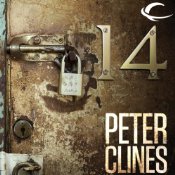
14
By Peter Clines; Read by Ray Porter Audible Download – 12 Hours 42 Minutes [UNABRIDGED]
Publisher: Audible Frontiers
Published: 2012
Themes: / Mystery / Science Fiction / Horror
As you might be able to tell from the diverse yet vague range of themes listed above, 14 is a difficult book to classify or review. Much like The Matrix, you can’t really be told what 14 is; you simply have to experience it for yourself. The blurb–or perhaps the term log line would be more appropriate–reads:
There are some odd things about Nate’s new apartment. Of course, he has other things on his mind. He hates his job. He has no money in the bank. No girlfriend. No plans for the future. So while his new home isn’t perfect, it’s livable. The rent is low, the property managers are friendly, and the odd little mysteries don’t nag at him too much. At least, not until he meets Mandy, his neighbor across the hall, and notices something unusual about her apartment. And Xela’s apartment. And Tim’s. And Veek’s. Because every room in this old Los Angeles brownstone has a mystery or two. Mysteries that stretch back over a hundred years. Some of them are in plain sight. Some are behind locked doors. And all together these mysteries could mean the end of Nate and his friends. Or the end of everything….
Aside from giving off a subtle Stephen King vibe, this synopsis doesn’t much help categorize the book either. And yet, in precisely the way book cover pitches are supposed to do, it offers just enough tantalizing hints to draw you in. If I had to pick a single overriding genre for the novel, I would choose mystery. There are indeed some strange goings-on in the Kavach Building, which houses the novel’s motley assortment of tenanets as well as the eponymous apartment number 14. Some of these things are creepy, hence the horror; some are paranormal, hence the science fiction. But ever driving the plot forward is protagonist Nate Tucker’s desire to get to the bottom of it all. The mystery theme is underscored by repeated, almost overdone, references to Scooby Doo. But in terms of literary and historical allusions Scooby and Shaggy are kept good company by the likes of Nikola Tesla and H. P. Lovecraft. Yes, the book is that weird.
What makes it all work and flow so smoothly is Clines’s knack for characterization. The listless protagonist Nate Tucker, the artist Xela with nudist tendencies, the Hindi hacker Veek, the hardcore Christian Andy, and virtually every other character, major or minor, are people whose stories are minor mysteries in their own right. When, pardon my French, shit gets weird, you’re always anchored by this (mostly) likable ensemble. Clines’s writing is also excellent. His background in Hollywood is evident in the novel’s setting and characters, and the third-person narration is likewise cinematic in pacing. It would be easy to see 14 adapted into a movie or, preferably, a miniseries. The novel excels, as a good mystery should, in dropping tantalizing plot hints, only to cut away to more chapters on characterization, spurring the reader to read on and find out what happens next. In the hands of less capable writers this technique can feel like a cheap trick, but fortunately Clines doesn’t overdo it.
The diverse cast of characters poses a potential challenge for narrator Ray Porter, from the feminine cadence of Veek’s Indian accent to the clipped, harried German accent of Oskar the building manager. Fortunately, Porter is mostly up to the task. He handles these characters, as well as a broad range of accents from our own continent, nearly flawlessly. With a few exceptions near the end, his narration manages to feel unobtrusive, almost as if there were no narrator at all and the listener is simply telepathically absorbing the words from the page. I don’t believe I’ve listened to Ray Porter’s work before, but I’ll certainly watch for him from now on.
The book puts a neat little bow on most mysteries, but there are still a few loose tendrils that could serve as springboards for another novel in the same universe. It really was difficult to say goodbye to the characters and the world. In his review for Fantasy Book Critic, Mihir Wanchoo draws several apt comparisons between 14 and the television series Lost. The resemblance is indeed strong. If you enjoy strong characterization and a whirlwind of genre-bending mysteries, you’ll probably love the hell out of 14. And–sorry J.J. Abrams et al.–Peter Clines actually knew where the plot was going.
The SFFaudio Podcast #181 – The Beckoning Fair One by Oliver Onions, read by Julie Davis (of Forgotten Classics and A Good Story Is Hard To Find). This is a complete and unabridged reading of the novella (2 Hours 40 Minutes) followed by a discussion of it. Participants in the discussion include Scott, Jesse, and Julie Davis!
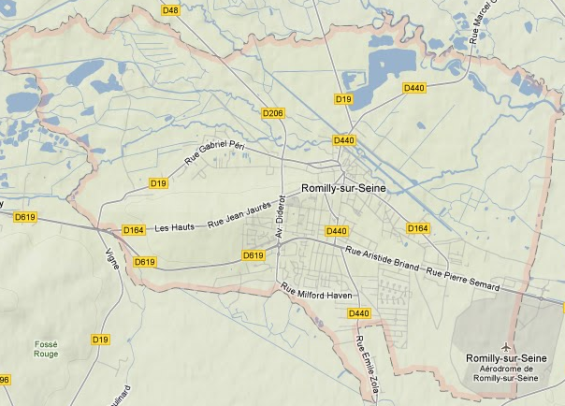
Talked about on today’s show: Yay!, Scott has another busy year, The Odyssey, Beowulf, length vs. content, is The Beckoning Fair One too long for it’s material?, modern colloquial terms (for 1910), Stephen King, The Forbidden Books Group Presents, Necronomipod: The Lair Of The Bookish Worm did a podcast discussion of The Beckoning Fair One, The Shining, writer protagonists, Bag Of Bones, The Haunting Of Hill House by Shirley Jackson, The Turn Of The Screw by Henry James, surprise endings, ambiguity, a writer’s point of view, Julie’s sister can see ghosts, now is the time in the podcast for a personal ghost story, the ghosts of Logan, Utah, troubled or troublesome nuns, are ghostly experiences possible during the daylight?, doppelgänger, an urban phenomena, a haunted hotel room, a vivid vision of a drowning, a disappearing maid, nightmares, a premonition, Christine, why are there no haunted beach?, haunted cars, gremlins, hiking, a haunted hiking trail, machete vs. axe, ‘there’s something wrong with that bedroom’, there’s something wrong with that, the ontological argument, House, M.D., between the ultraviolet and the infrared, a great title, the dripping of a faucet, The Sarah Bennett Quintet, suicide, Oleron is unconscious of the things that he’s conscious of, who’s sleeping in my bed?, a ghostly brushing, “he wakes up to himself”, a harp cover, Oléron is an island in France, and Romilly is a city in France, is the house playing him like a harp?, the final chapter, Jesse’s not super swift, a shut in, vegetable refuse, wig-stands, a large lumpy pudding, the recurring “triangle”, it has esoteric meaning to Freemasons, how did Elsie end up in the closet?, “you get to decide”, an alternative suspect, the tramp in the basement, the Hobo marks, “don’t push the religious angle”, firemarks (fire insurance marks), starving artists, why men have to get married, a Jonathan Swift shout-out, Elsie had a Brobdingnagian complexion, “I need you and I want you to marry me.”, sticking with the spooky, maybe Julie’s in an insane asylum?, Community, Red Dwarf is an excellent Science Fiction show, The Booth At The End, H.P. Lovecraft, Dagon, The Colour Out Of Space, The Statement Of Randolph Carter, The Dunwich Horror, amorphous horror, a gelatinous voice, Gregg Margarite, The Facts In The Case Of M. Valdemar by Edgar Allan Poe, this podcast is making me hurry for rosewater pudding, The Sixth Sense, Signs, Joaquin Phoenix, The Master, Baron Münchhausen, The Takeaway Movie Date, The Big Book Of Ghost Stories edited by Otto Penzler, Donald E. Westlake, the ghost of the paperback, Jesse has a guardian angel?, Parker, Jason Statham is a modern action movie star like they had in the 1980s, The Bank Job, Anarchaos by Curt Clark (aka Donald E. Westlake), Smoke, Humans, Firebird by Jack McDevitt, Will Duquette, Hans Christian Andersen, Oscar Wilde.
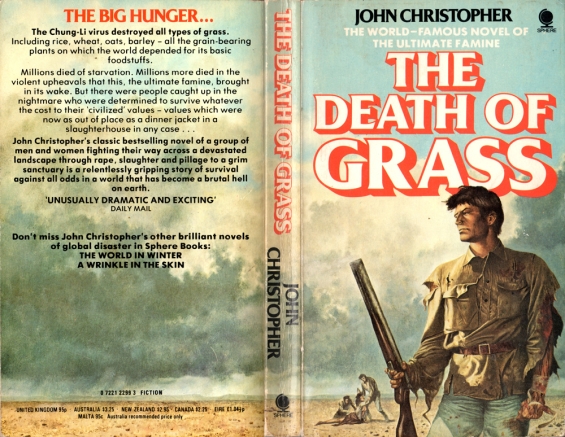
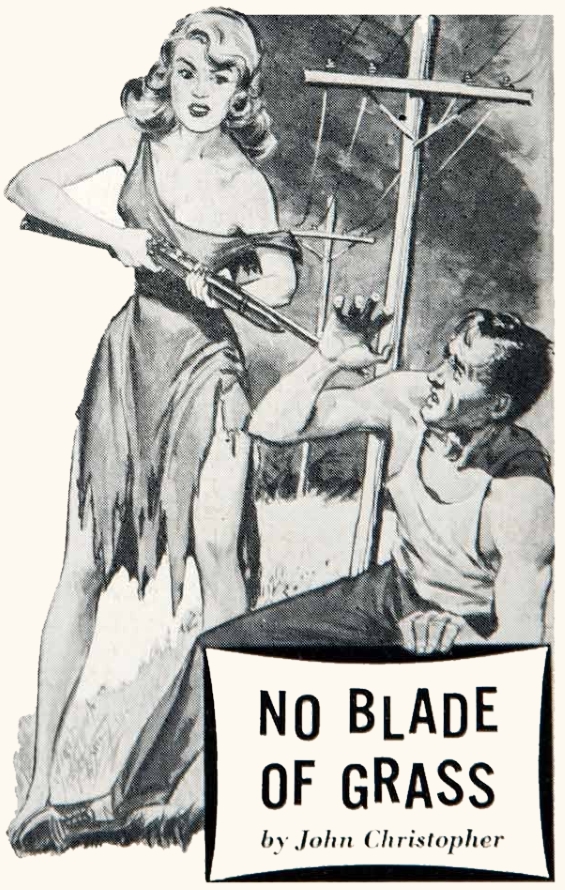
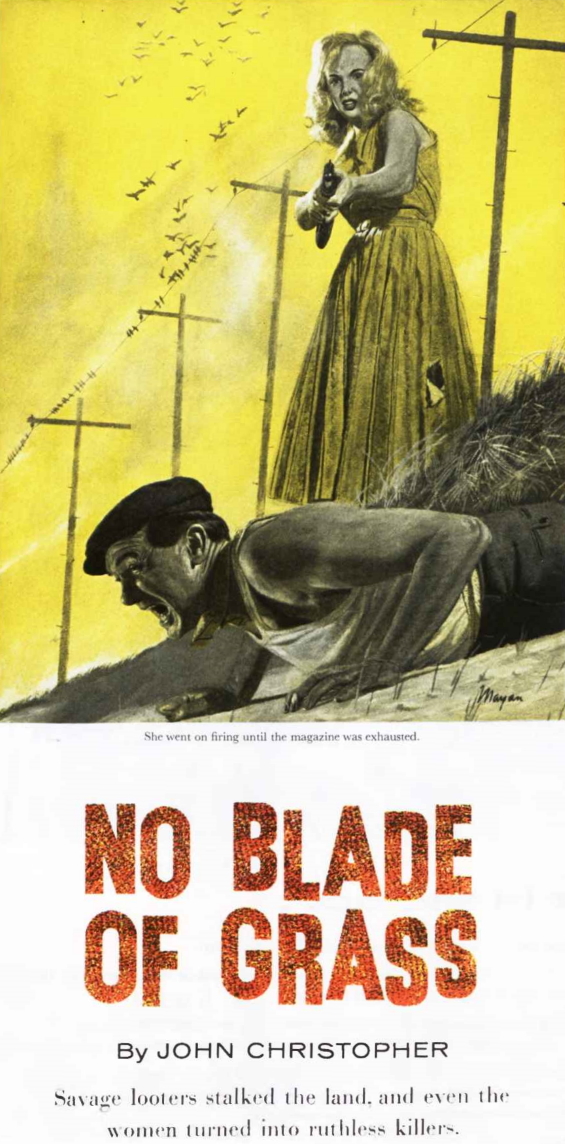
The SFFaudio Podcast #180 – Jesse, Tamahome, and Jenny Colvin talk about The Death Of Grass by John Christopher.
Talked about on today’s show:
post-apocalyptic, John Christopher’s real name was Samuel Youd, also known as No Blade of Grass, an anti-pot novel?, “it’s not my idea of a good time”, Stephen King’s The Stand, it’s almost like a play, there is a BBC audio drama adaptation, why not fish?, the Inuit, apocalyptic expert Jenny weighs in, John is like a feudal lord, moral lines are crossed, John’s transformation, the terrible 1970 movie version, “why hello I think I will come with you”, the cons of agriculture, Jenny’s quinoa granola, just drop a few bombs, can’t they make Soylent Green?, potatoes can let you down, real African grass virus, Paolo Bacigalupi’s Windup Girl, famines today, George R. Stewart’s Earth Abides |OUR READALONG|, David Pringle’s Science Fiction: The Best 100 Novels 1949-1984 and The Ultimate Encyclopedia Of Science Fiction, John Joseph Adams’s Wastelands, Pat Frank’s Alas, Babylon, Science Fiction: The 101 Best Novels 1985-2010, Octavia Butler’s Parable of the Sower, LeVar Burton loves it, women in the novel, Stockholm syndrome, The Walking Dead, “Dun dun dun!”, “maybe Luke can re-edit it”, Starship Troopers, Doomsday Preppers
The SFFaudio Podcast #177 – Jesse, Tamahome, Jenny, talk about the latest NEW RELEASES and RECENT ARRIVALS in audiobooks and paperbooks.
Talked about on today’s show:
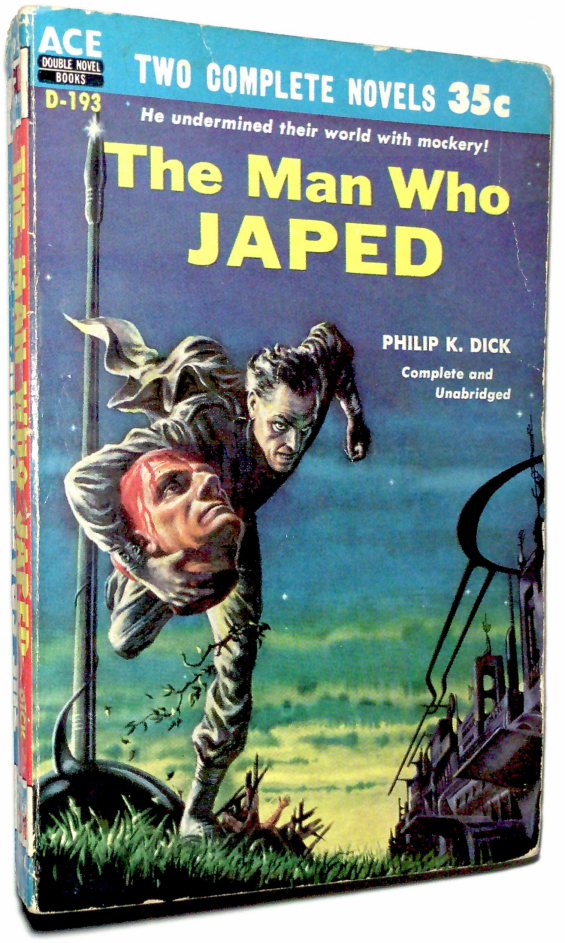
Jenny’s beagle Bailey loves audiobooks, breed vs. brand, “Space Drama”, The Prankster by James Polster (from Brilliance Audio), stranded on Earth, novellas, Luke Daniels is everywhere, Space Cadet by Robert A. Heinlein, Between Planets by Robert A. Heinlein (Full Cast Audio), Ace Tachyon (aka Abner Senries), Methuselah’s Children by Robert A. Heinlein, immortality, Universe by Robert A. Heinlein, “Future History”, 1941, “the guy with the two heads”, Lazarus Long, The Notebooks Of Lazurus Long, kilted spacemen, Fate of Worlds: Return from the Ringworld by Larry Niven and Edward M. Lerner (Blackstone Audio), Ringworld, “big dumb object” (and the blog of the same name), space elevator, Energized by Edward M. Lerner, a NASA engineer is the main character!, Grover Gardner, terpkristin, geopolitical intrigue, hard SF, Larry Niven and Gregory Benford “bowl-world?”, Dyson’s sphere, library of congress subject headings, Dewey Decimal Classification, Grover Cleveland, a librarian’s license, are librarians born or trained?, “on the square and on the level”, Trucker Ghost Stories edited by Annie Wilder (Macmillan Audio), Tavia Gilbert, Peter Ganim, 21st Century Dead: A Zombie Anthology edited by Christopher Golden (Blackstone Audio), Simon R. Green, Ken Bruen, Daniel H. Wilson, Brian Keene, zombies are taking over, The Walking Dead (comic), Locke & Key, Joe Hill, Stephen King, “gears and robots” or “steamy robots”, Clockwork Angels: The Novel by Kevin J. Anderson, Neil Peart (of Rush), steampunk, steampunk music?, The Steampunk Bible edited by Jeff Vandermeer, Mr Jupitus In The Age Of Steampunk, maker stuff with tophats, is there a good steampunk book to wow Tam?, Murdoch Mysteries, Tesla vs Edison, steampunky, 1950s kitchen appliances, golden age SF, Boneshaker by Cherie Priest, Sword & Laser, VN by Madeline Ashby, Von Neumann machine, “she stopped being able to not harm humans”, gynoid vs. android, a girlnoid, guynoid vs. gynoid, Angry Robot, Saturn’s Children by Charles Stross |READ OUR REVIEW|, Exhalation by Ted Chiang, non-human main characters, Cloud Atlas by David Mitchell, post-apocalyptic Hawaii, “a hard entry point”, The Curious Incident Of The Dog In The Nighttime, fantastical, “fantasy noir”, “a noir cannot be series”, “investigative fantasy” or “hardboiled fantasy?”, darker than you think by Jack Williamson (Blackstone Audio), Jim Meskimen, embroiled in hardboiled?, The Humanoids, With Folded Hands, setee vs. seetee, Technomancer (Unspeakable Things: Book 1) by B.V. Larson (Brilliance Audio), space-kilt!, Red Planet by Robert A. Heinlein, naked on a frozen planet, Saint City Sinners by Lilith Saintcrow, Tanya Eby, Battle Royale by Koushun Takami, Morning Glories (comic), Midnight (Nightingale Trilogy: #2) by Stephen Leather, Ralph Lister, “supernatural noir”, hardboiled vs. noir, Philip Marlowe is hardboiled (perhaps with noir elements), Kiss Me Deadly by Mickey Spillane, noir as a visual vs. noir as a story, Hamlet, noir stories don’t need detectives (and usually don’t have them), femme fatale, James M. Cain, Body Heat, Chinatown, “it’s chinatown Jake” = things are so fucked up you should walk away, “kitty kat”, “fantasy adventure”, Wake of the Bloody Angel: An Eddie LaCrosse Novel by Alex Bledsoe, pirates!, Stefan Rudnicki, The Hammer And the Blade by Paul S. Kemp, Nick Podehl, Functional Nerds, Fritz Leiber’s Fafhrd and the Gray Mouser, the trouble with fish-gods, a buddy movie (book), dragons, Sky Dragons (Dragonriders of Pern) by Anne McCaffrey and Todd McCaffrey, Emily Durante, Brilliance Audio, Blood of the Emperor (The Annals of Drakis: Book Three) by Tracy Hickman, Margaret Weis, PKD!, Counter Clock World by Philip K. Dick, Gather Yourselves Together by Philip K. Dick (mainstream PKD) <-published posthumously, Eye In The Sky by Philip K. Dick, Dan John Miller (Brilliance Audio), The Zap Gun by Philip K. Dick (Brilliance Audio) <-an expansion of The GunProject Plowshare, Mel Foster, Anthony Boucher liked it, The Man Who Japed by Philip K. Dick (Brilliance Audio), Repent Harlequin Said The Ticktock-man by Harlan Ellison, Dick was a crazy autodidact, didacticism, A World Of Talent and Other Stories (Eloquent Voice), Total Recall (aka We Can Remember It For You Wholesale), public domain Philip K. Dick stories, a strange dedication, Geek’s Guide To The Galaxy, John Joseph Adams, The Reel Stuff edited by Brian Thomsen and Martin H. Greenberg, Mimic by Donald A. Wollheim, the Total Recall remake is terrible and stupid, Inception, are “sci-fi” movies are opera for Americans?, Air Raid by John Varley, Loopers, time travel, many new Stanisław Lem audiobooks are up on Audible.com!, Lem READALONG!, Tam is always “Lemming”, Lemistry: A Celebration of the Work of Stanisław Lem, Eric S. Rabkin, Cyberiad, Luke Burrage’s review of Solaris, Noise: A Novel by Darin Bradley, Chris Patton, dystopias are refreshing, The Hunger Games by Suzanne Collins, Spider Robinson, The Road by Cormac McCarthy, Jesse is completely wrong, does a lack of engagement with the society in The Hunger Games make it not really SF?, science fictiony vs. Science Fiction, 1984, an ever evolving book of rules about idea fiction, Arguably: Essays by Christopher Hitchens, George MacDonald Fraser’s Flashman, The New York Review Of Books, arguing with books, Jenny’s favourite part of the NYRoB, the New York Review Of Books blog, academic writing vs. literary writing, Vanity Fair and Vanity Fair online, Simon Prebble has captured Chrisopher Hitchen’s voice, Jo Walton, the Booker Prize longlist, Bring Up The Bodies by Hilary Mantel (historical fiction), history, I, Claudius by Robert Graves, fictionalized history vs. historical fiction, Luke Burrage’s review of Wool by Hugh Howey, Jenny makes friends with all the authors.

 In the Tall Grass