Review of The Broken Sword by Poul Anderson

SFFaudio Review

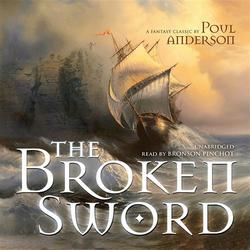
Fantasy Audiobook - The Broken Sword by Poul AndersonThe Broken Sword
By Poul Anderson; Read by Bronson Pinchot
7 CDs – 8 Hours – [UNABRIDGED]
Publisher: Blackstone Audio
Published: 2011
ISBN: 9781441786876
Themes: / Fantasy / Vikings / Myth / Battle /

The Viking Age of England offers fertile ground for storytelling. It was a time of strong men, beautiful fair-haired women, and bloody raids for plunder. Christianity was the new religion on the block, striving to make inroads on the old pagan beliefs—and often at the point of a sword. Gods were said to mingle with men and the world lay poised on the edge of Ragnarok, a final battle and fiery conflagration that would end the world.

Poul Anderson drew on the best of this wild and poetic age, stirred it up with myth and fantasy, and the result was his 1954 novel The Broken Sword. Its like has rarely been matched in the annals of fantasy literature.

I’ve read The Broken Sword previously and knew what a wonderful book it was, but TV and film actor Bronson Pinchot’s narration in this new Blackstone Audio, Inc. production added a new dimension to the novel. I had first heard Pinchot in a reading of Stephen King’s Eyes of the Dragon. While he was wonderful there he ups his game in The Broken Sword, reading with a spite and fury in his voice that perfectly matches the book’s unrelenting grimness and battle fury. Pinchot breathes life into beautiful maidens and proud warriors, deep-throated trolls, and ancient elven warrior-kings whose voices are like winds sighing through treeless leaves.

Oddly enough there is exactly one sound effect in the entire recording—an echo effect used to convey the cold, cruel laughter of Odin—and it’s on the final disc. It was cool but rather jarring, considering it’s on the last disc and there’s no precursor. But on to the tale.

In The Broken Sword the land of Faerie exists alongside the lands of men, invisible save to those with the witch sight. Faerie is a land of bright castles and achingly lovely elves, of the gods of Odin and Tyr, the giants of Jotunheim, black-eyed trolls, and other, fouler monsters.

Pride and ambition touches off the events of The Broken Sword. Orm the Strong is the fifth son of Ketil Asmundsson and thus low in the totem pole of inheritance. Rather than accept a smaller share of wealth Orm seeks his own fortune by going a–viking. On one of his raids he kills a husband and his sons, burning their hall to the ground. The man’s mother, a witch, escapes and swears revenge: She bestows a curse that Orm’s eldest son will be fostered beyond the world of men, while he in turn will foster a wolf that will one day rend him.

The elf-earl Imric travels to the lands of men and sets the witch’s curse in motion. Imric takes Orm’s unbaptized infant son Skafloc and replaces him with Valgard, a changeling, whom Imric himself has fathered by raping a captive troll woman. Valgard’s dark ancestry is evident when he bites his unknowing mother’s breast and grows restless and violent in Orm’s care. Skafloc, raised among the elves, is fair haired and fair of spirit, though equally mighty and otherwise a mirror image of his dark changeling “brother.”

After he discovers his true half troll, half-elf heritage, Valgard embarks on a mission of revenge, killing several members of his foster family. Aided with an army of trolls he then launches a war of annihilation on the elven lands of Alfheim. Skafloc and the elves are beaten back by the initial assaults and all seems lost. Only by going on a quest to reforge a powerful ancient weapon—the eponymous broken sword, a weapon of terrible demonic power that demands blood each time it is drawn and ultimately turns on its wielder—can Skafloc save Alfheim and avenge his family.

Though The Broken Sword seems largely forgotten these days it remains influential. The elf Imric for example reveals the clear stylistic (and thematic) influence The Broken Sword had on subsequent authors like Michael Moorcock. Moorcock (a big fan of the book, who once wrote thatThe Broken Sword “knocked The Lord of the Rings into a cocked hat”) based his Melniboneans heavily on Anderson’s elves. Imric is (largely) Elric of Melnibone, not only in similarity of name, but in appearance and even character. Anderson’s Elves are darker than those in The Lord of the Rings (though I would point out that Tolkien’s elves closely resembled Anderson’s in his source material; see the prideful warrior Feanor from The Silmarillion). They are haughty, prideful, shun the sunlight, and if not malicious are certainly mischievous. These traits have their roots in Norse myth, which both Tolkien and Anderson drew upon.

Everything about the book is wonderfully northern. Characters mingle soaring verse with common speech in conversation. Anderson weaves old northern vocabulary into the tale, evocative words like “Fetch,” “Fey,” and “Weird” (the latter is a fate from which no man escapes), which lend The Broken Sword a hard northern ethos to match its flavor. In this pagan hierarchy the Norns are higher than the towering Jotuns or even the Aesir. Even the gods will die in the fires of Ragnarok at their appointed time. That grimness bleeds through into The Broken Sword as its protagonists are slowly crushed beneath the merciless wheel of fate.

“Throw not your life away for a lost love,” pleaded Mananaan. “You are young yet.”

“All men are born fey,” said Skafloc, and there the matter stood.

This is hard stuff and an unforgiving outlook on life, though not incompatible with that other somewhat famous work that debuted in 1954—Tolkien’s Fellowship of the Ring. No matter what Moorcock—he of the tin ear when it comes to Tolkien analysis—may tell you.

The writing in The Broken Sword is top-notch, really and truly great stuff. A small sample of dialogue uttered by the troll-woman Gora:

“The world is flesh dissolving off a dead skull,” mumbled the troll-woman. She clanked her chain and lay back, shuddering. “Birth is but the breeding of maggots in the crumbling flesh. Already the skull’s teeth leer forth and black crows have left its eye sockets empty. Soon a barren window will blow through its bare white bones.”

One final, important note about the Blackstone recording: The text is Anderson’s original from the 1954 version of the book, which Anderson updated in 1971 for republication in the Ballantine Adult Fantasy line. This is not immediately apparent from the description on the Blackstone website. I’ve only read the 1971 version, so for those who haven’t had the chance to experience The Broken Sword in its earliest and rawest incarnation you now have another chance.

Posted by Brian Murphy

LibriVox: Eric Brighteyes by H. Rider Haggard

SFFaudio Online Audio

LibriVoxBack in April my friend Brian Murphy wrote a wonderful essay generally extolling the virtues of Viking Age Fantasy, and particularly recommending H. Rider Haggard’s Eric Brighteyes as one of the best of the genre. Here’s a taste:

“…I would unhesitatingly declare it [Eric Brighteyes] among the finest works in the genre, better than [Bernard] Cornwell and at least as good as [Poul] Anderson’s best. It may not be as much a household name as Haggard’s more famous works King Solomon’s Mines and She, but it’s nevertheless rightly considered a classic in some quarters and one of Haggard’s best.”

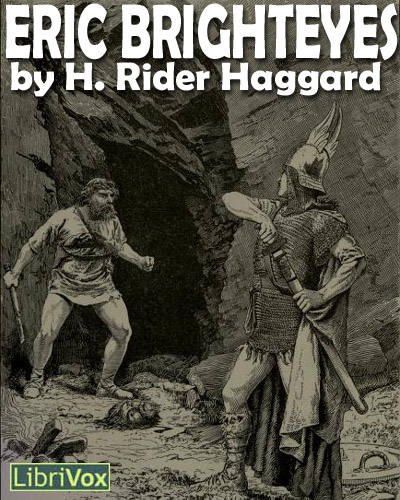
The entire in-depth review can be read over on The Cimmerian. And if you’re looking for more of Lancelot Speed‘s wonderful illustrations (like the one I used for the art below), check out Archive.org’s scan of the 1891 edition HERE. It is wonderful!

LIBRIVOX - Eric Brighteyes by H. Rider HaggardEric Brighteyes
By H. Rider Haggard; Read by Brett W. Downey
33 Zipped MP3 Files or Podcast – Approx. 10 Hours 17 Minutes [UNABRIDGED]
Publisher: LibriVox.org
Published: November 2, 2010
Eric Brighteyes is the title of an epic viking novel by H. Rider Haggard, and concerns the adventures of its eponymous principal character in 10th century Iceland. Eric Thorgrimursson (nicknamed ‘Brighteyes’ for his most notable trait), strives to win the hand of his beloved, Gudruda the Fair. Her father Asmund, a priest of the old Norse gods, opposes the match, thinking Eric a man without prospects. But deadlier by far are the intrigues of Swanhild, Gudruda’s half-sister and a sorceress who desires Eric for herself. She persuades the chieftain Ospakar Blacktooth to woo Gudrida, making the two men enemies. Battles, intrigues, and treachery follow. First published in 1890.

Podcast feed: http://librivox.org/rss/4317

iTunes 1-Click |SUBSCRIBE|

[Thanks also to Theresa L. Downey and Diana Majlinger ]

Posted by Jesse Willis

BBCR4 + RA.cc: Harry Harrison’s The Technicolour Time Machine

SFFaudio Online Audio

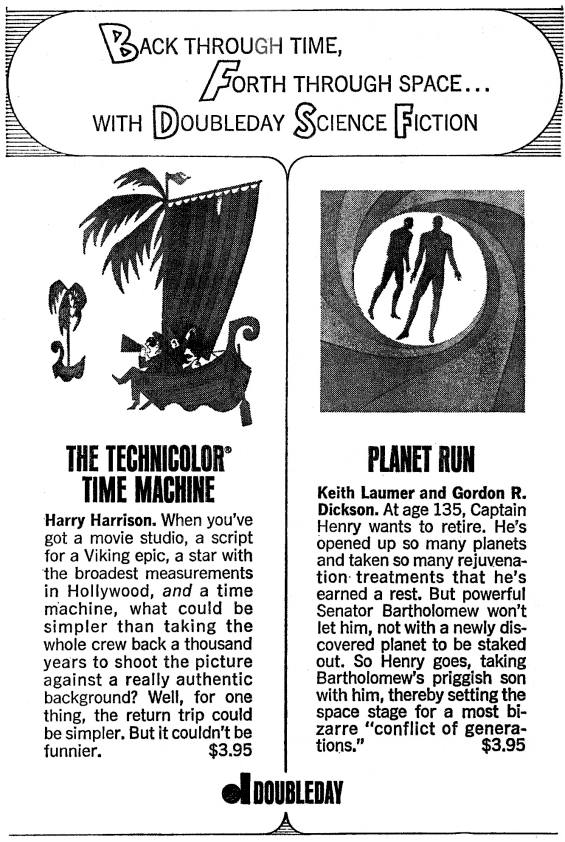
BBC Radio 4RadioArchives.ccHere is a very cool find, Harry Harrison’s The Technicolour Time Machine, adapted by the BBC Radio 4 program entitled Saturday Night Theatre from the 1967 novel of the same name! It’s a clever tale that plays within the “restricted action resolution” tradition of the grandfather paradox. Here’s my description:

Barney Hendrickson is a mediocre movie producer in Hollywood, California. His employer, Climactic Studios, is in financial trouble, mostly due to some unforeseeable circumstances (a combination of a series of cinematic flops and regular embezzlement by L.M. Greenspans, the studio’s head). The only possible thing that can save the studio, and Barney’s job, would be to have a guaranteed box office sensation in the can before Monday. Unfortunately, there isn’t nearly enough time or money to write the script, build the sets or even film the movie. Except, Barney has a cunning plan. He’ll take advantage of recently invented time machine that he happens to know about.

Narrated by Barney, The Technicolour Time Machine tells the tale of the filming of Viking Columbus a giant rollercoaster of a movie – a saga of high adventure shot on location in the tenth century, with some hot shield maidens and angry skraelings thrown in. The story plays it all with a smirk and is fun stuff!

If you want to find it, head on over to RadioArchive.cc and grab the torrent!

Harry Harrison's The Technicolour Time MachineSaturday Night Theatre – The Technicolor Time Machine
Adapted from the novel by Harry Harrison; Adapted by Chris Boucher; Performed by a full cast
1 MP3 – Approx. 1 Hour 29 Minutes[RADIO DRAMA]
Broadcaster: BBC Radio 4
Broadcast: September 5, 1981
Provider: RadioArchive.cc
A down its heels Hollywood film production company employs a time machine to send a film crew to the 10th Century to make a schlock film about the Vikings.
Cast:
Lee Montague as Barney Hendrickson
Richard Pearson as Professor Hewitt
John Bay as L.M. Greenspan
David March as Doctor Ghans Nun
Michael Kilgarriff as Ottar
Karen Archer as Slidey Toe
Alexander John as Ross Polk
Barry Denham as Charley Chang
William Rogers as Tex
Crawford Logan as Darrows
Don Fellows as Eviemarie
Sean Barrett as Gino
Andrew Secombe as Drudy
Patience Tomlinson as Betty
John Lidsey as Sam
Directed by Glyn Dearman

Advertizement for The Technicolor Time Machine from Galaxy Oct. 1967

[Thanks much to spafon7e]

Posted by Jesse Willis

Review of Eaters of the Dead by Michael Crichton

Fantasy Audiobooks - Eaters of the Dead by Michael CrichtonEaters of The Dead
By Michael Crichton; Read by Victor Garber and Michael Crichton
2 cassettes – 3 hours [ABRIDGED]
Publisher: Random House Audiobooks
Published: 1998
ISBN: 0679460330
Themes: / Fantasy / Historical Fiction / Alternate History / Vikings / Arabs / Mythology / Neanderthals / Epic /

In the year A.D. 922, Ibn Fadlan, a devout Muslim nobleman, left his home in Baghdad on a mission to the King of the Bulgars. During his journey, he met various groups of “barbarians” who he reported as having varying degrees of bad hygiene and alcoholism. It was a classic clash of cultures story that revealed more about both societies than any other type of narrative could. Whilst encamped in a Norseman trading village word came of a request for warriors to return to Scandinavia to battle an unnamed foe. Because the Norsemen were so superstitious, Fadlan was shanghaied as the “13th warrior”, a necessary foreigner, and forced to accompany the war party. Under the leadership of Buliwyf, Fadlan and eleven other Norsemen journeyed far to the North, to a land where the nights last only a few minutes, where sea monsters abound in the oceans and where shimmering lights in the sky are a nightly occurrence. Once there he and his companions must fight a battle against the Eaters Of The Dead.

If the premise is familiar it may be because you’ve seen the movie “The 13th Warrior,” which is based upon this novel. Supposedly this is a true story taken from the journals of an Arab courtier named Ahmad Ibn Fadlan. In reality it is only partially based on those writings. Crichton wrote Eaters Of The Dead based on a bet. He argued that Beowulf, the oldest surviving epic in British literature, could be successfully turned into a satisfying adventure story. In the real life writings of Ibn Fadlan Crichton found a viewpoint chracater who’d be able to witness the adventure of Beowulf and his fight against Grendel first hand. Starting with actual journal entries from Ibn Fadlan, Eaters Of The Dead begins as non-fiction. About a third of the way into the reading, Crichton stops using Fadlan’s journals, starts writing in the style of Fadlan, and begins telling his version of Beowulf. Sounds simple, but because Crichton doesn’t tell us any of this in his introduction, it isnt.

Confusing things further, Victor Garber’s reading of the story is interupted every so often by commentary by Michael Crichton! Crichton doing commentary on Crichton confuses things to a high degree, and yet somehow it works! This is a compelling story, likely because it draws so heavily from the deeply rooted mythology including snippets of ideas from everything from J.R.R. Tolkien’s The Hobbit to modern anthropological theories regarding the extinction of the Neanderthals.

Victor Garber does a good job reading, his only flaw is that his Arbaic accent sounds a bit to much like a Punjabi accent. Crichton too reads his commentaries well. As with many abridgments this one leaves the listener wanting more of the story, though thankfully it doesn’t suffer from the equally common failing of being incomprehensible.

As with all Michael Crichton novels, this turns into a Frankestienian morality tale in the vein of “there are some things men wernt meant to know”. For the most part it works, but what bothers me most about Eaters Of The Dead is its fence sitting nature. Not strictly fiction nor strictly non-fiction, Crichton has chosen to deliberately blend the reality and the fantasy without any disclaimer of even the most generous “based on a true story” or even the weaker “inspired by true events”. Instead he deliberately tricks us into thinking this is a true story by interspersing his own commentaries about the translation! True stories are inherently more interesting than fiction, no doubt Crichton chose to capitalize on this by deliberately obscuring the fact that he basically made up the whole last 2/3rds of the book! Had there been a disclaimer about this at the beginning of the book I’d have been much happier with it. That said, the story is fun, an interesting ride, and certainly one of Crichton’s best novels, but it isn’t even in the same class as say Robert Silverberg’s terrific A Hero Of The Empire, which also deals with historical figures in ancient Arabia.. If you absolutely insist on reading Michael Crichton novels I’d recommend you actually NOT read his Science Fiction! Read his fantasy, read Eaters of The Dead and then if you want a non-SFF treat try Crichton’s admirable The Great Train Robbery (also based on a true story), which is far better than his constant rehashing of Frankensteinian plots about cloning, time travel, etc.