News, Reviews, and Commentary on all forms of science fiction, fantasy, and horror audio. Audiobooks, audio drama, podcasts; we discuss all of it here. Mystery, crime, and noir audio are also fair game.
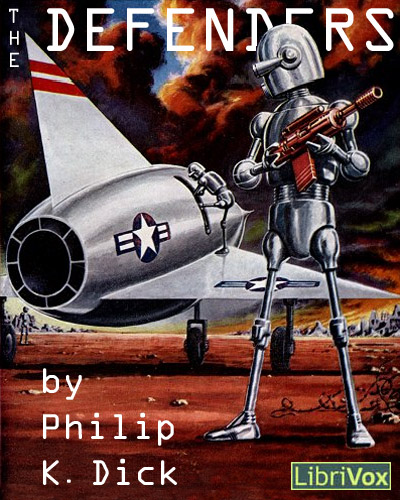
Did you know that Philip K. Dick’s fifth published story, The Defenders, is public domain? It is!
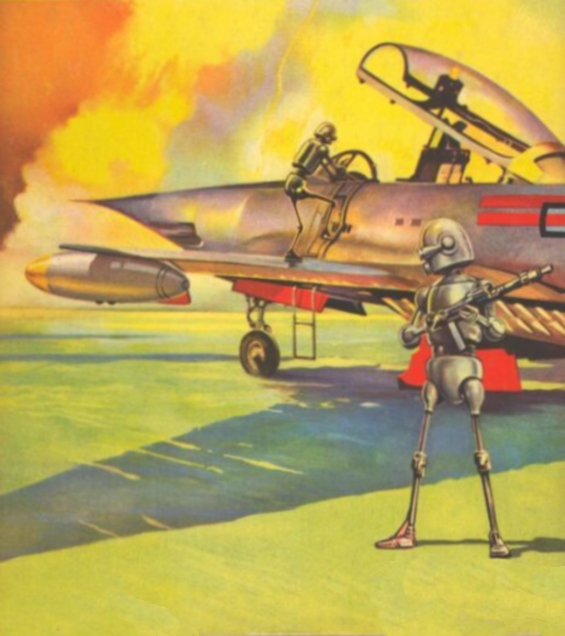
Like many of Dick’s tales The Defenders this is a post-atomic war story. The planet’s surface devastated, flushed with radioactivity, and has been abandoned. The population now lives in vast underground cities. In their place intelligent robots fight in their place.
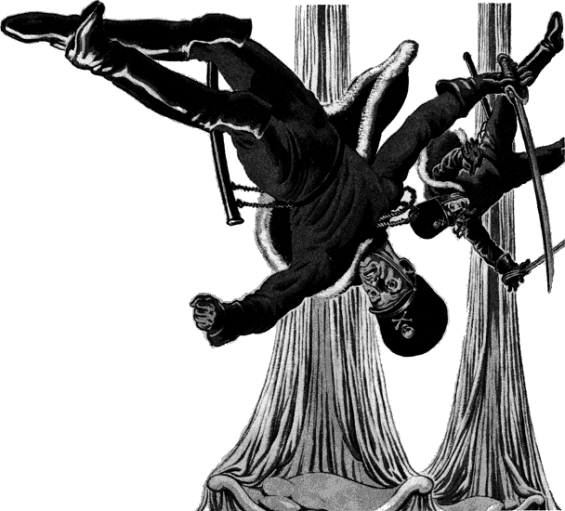
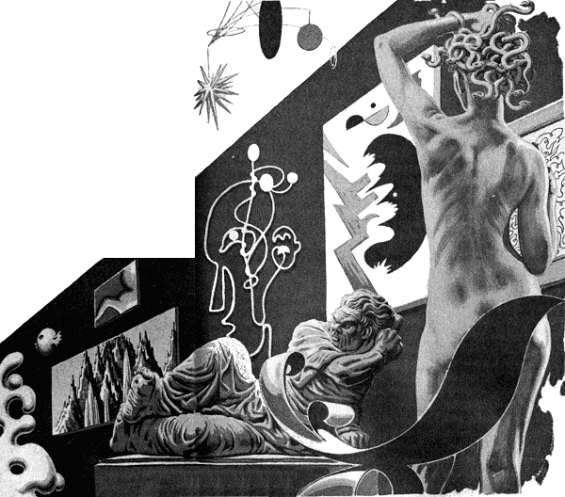
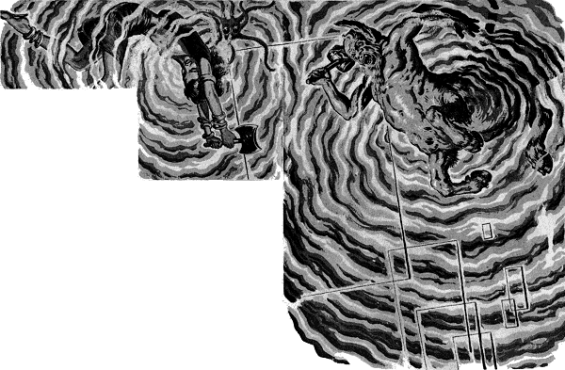
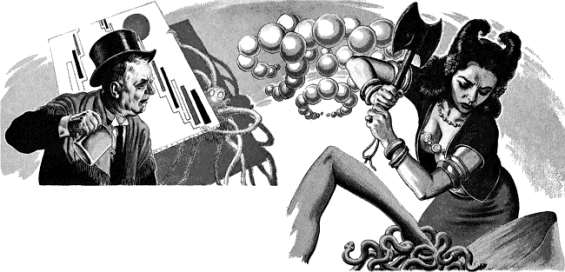
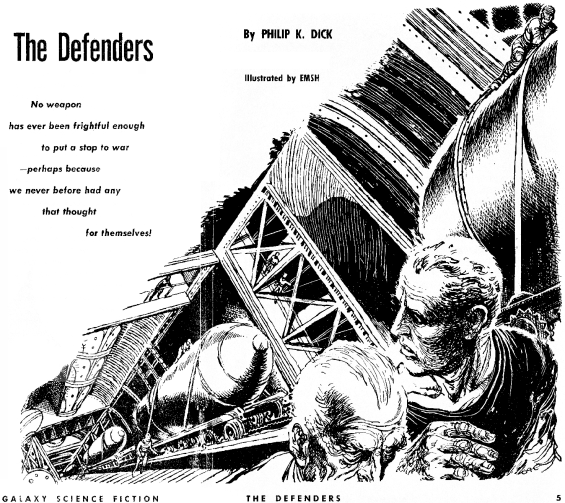
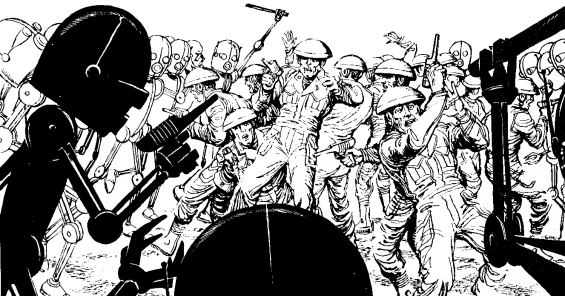
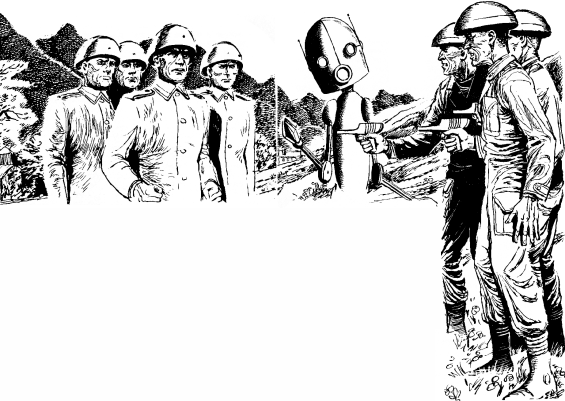
I’ve put together a |PDF| from the original publication in Galaxy Science Fiction, which includes terrific illustrations by Ed Emshwiller. And there’s a complete ETEXT version available through Project Gutenberg. And LibriVox has the audiobook edition. Enjoy!
The Defenders
By Philip K. Dick; Read by Gregg Margarite
1 |MP3| – Approx. 50 Minutes [UNABRIDGED]
Publisher: LibriVox.org
Published: May 21, 2009 No weapon has ever been frightful enough to put a stop to war—perhaps because we never before had any that thought for themselves! From Galaxy Science Fiction January 1953.
And here’s the radio drama adaptation:
X Minus One – The Defenders
Based on the story by Philip K. Dick; Adapted by George Lefferts; Performed by a full cast
1 |MP3| – Approx. 28 Minutes [RADIO DRAMA]
Broadcaster: NBC
Broadcast: May 22, 1956
Provider: Internet Archive East and West make war above ground with robots while both sides live underground … or do they?
Cast:
Lydia Bruce
Warren Parker
Grant Richards
Mike Ingram
Stan Early
Here’s the X Minus One adaptation that I’ve put together with the original art from its publication in the Galaxy Science Fiction, January 1953 issue:
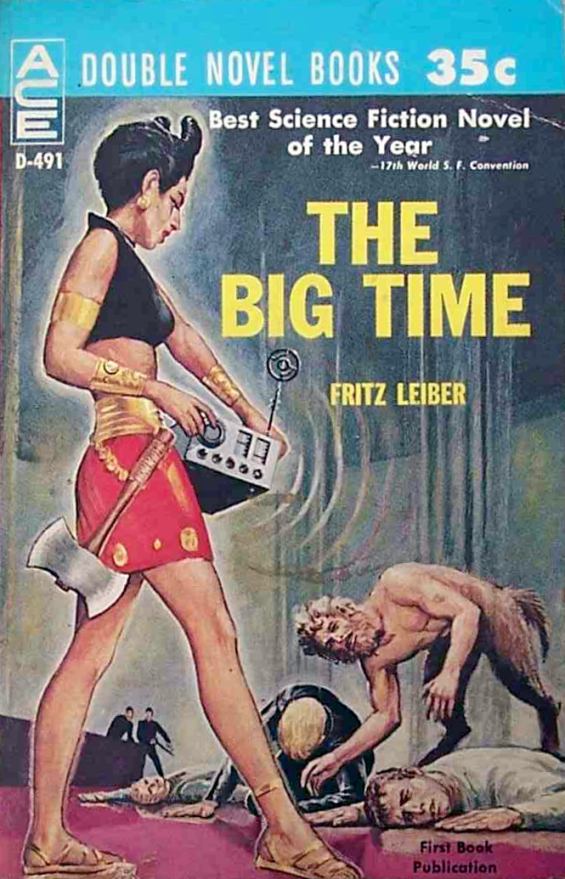
Narrator Karen Savage has finished her SFFaudio Challenge #5 audiobook, calling The Big Time, by Fritz Leiber, “A classic locked room mystery, in a not-so-classic setting.” And she’s right about that, this is an SF/Mystery classic.
Fritz Leiber says, in his 1982 introduction to The Big Time, that the novella was written over the course of exactly 100 days in 1956 and 1957.
For more on the plot |READ OUR REVIEW| of the Audible Frontiers edition. Savage has a great voice, this is an amazingly clear recording, and she affects a very serviceable set of intonations and accents for the half dozen or so characters with speaking parts in this excellent reading. My only complaint, as with the Audible edition, Savage does not use the tune of Lili Marlene for the reading of the lyrics at the end of chapter 3. Oh well.
The Big Time
By Fritz Leiber; Read by Karen Savage 16 Zipped MP3 Files or Podcast – Approx. 3 Hours 44 Minutes [UNABRIDGED]
Publisher: LibriVox.org
Published: September 16, 2011
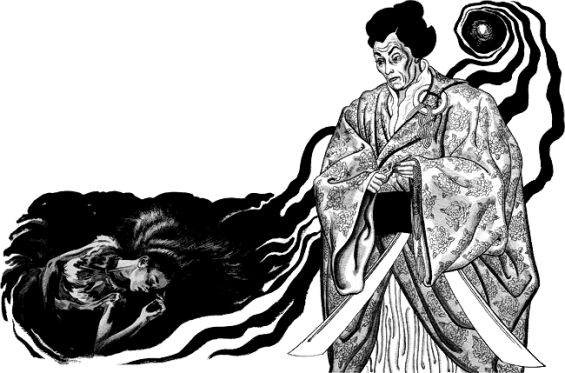
|ETEXT| You can’t know there’s a war on—for the Snakes coil and Spiders weave to keep you from knowing it’s being fought over your live and dead body! First published in Galaxy Science Fiction’s March and April 1958 issues.
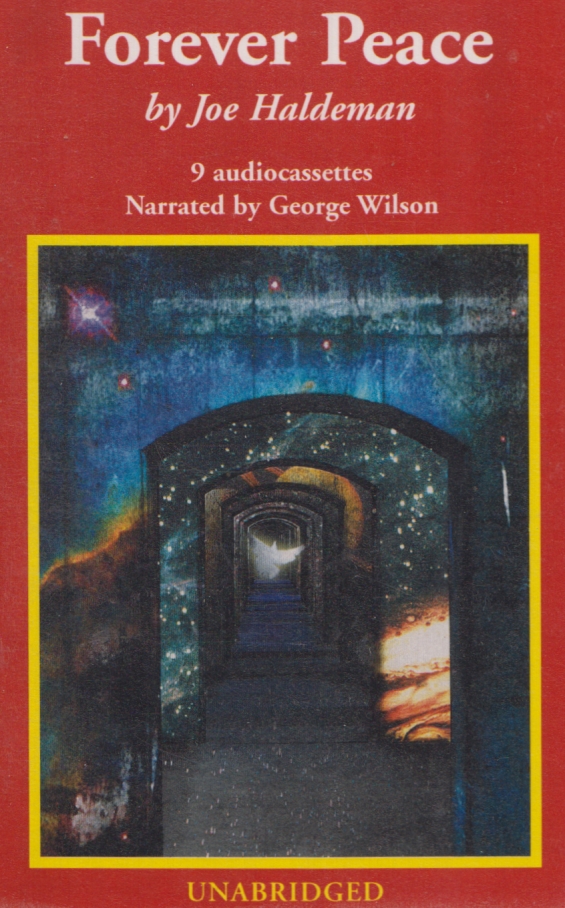
The SFFaudio Podcast #121 – Scott, Jesse, Tamahome and Gregg Margarite talk about Joe Haldeman’s novel Forever Peace.
Talked about on today’s show: The Forever War, Forever Peace, Forever Free, Haldeman’s experiences in South-East Asia (during the Vietnam War), William Mandella, Mandala, Julian Class, Philip Klass (William Tenn), racism, remotely controlled soldier robots, jacks, empathy, sharing menstruation, baldness as a fashion, the nanoforge (a molecular nanotechnology), caper, Stranger In A Stranger Land, heist, “two novellas smushed together”, John W. Campbell, Ben Bova, self help groups, one conceit that remains unexamined, magic machine (aka a sub-atomic replicator), Mack Reynolds, telepathy, asymmetric warfare, prescience, Libya, Pakistan, the two peaces of Forever Peace, what of the aftermath?, applying Isaac Asimov’s Three Laws of Robotics to people, Gregg is a creature capable of killing, not everyone wants to be the black sheep, is 98% of humanity humanizable?, the earth where everyone is gay, the earth where everyone is a clone, “a giant of SF”, The Memory Of Earth by Orson Scott Card, The Moon Is A Harsh Mistress, do you grok the group?, “The Hammer of God”, Jonestown, David Koresh, a religion that requires you believe in evolution, punctuated equilibrium, treating the bible like a science book (is problematic), we’re gonna drill into you brain and then you won’t have those feelings anymore, a utopian dystopia, Malthusian theory, the singularity, A Clockwork Orange, moral conviction vs. physical restriction, Gregg needs his murderer (and we do too), Starship Troopers, false consciousness, Women’s Studies, The Tea Party,
“False consciousness is the Marxist thesis that material and institutional processes in capitalist society are misleading to the proletariat, and to other classes. These processes betray the true relations of forces between those classes, and the real state of affairs regarding the development of pre-socialist society”,
following orders (as false consciousness), Stockholm syndrome, identifying with your oppressor, why do people do things that are against their own interests?, Costa Rica, withholding technology vs. holding resources hostage, Plato’s cave, “from each according to his ability, to each according to his need”, is Jesse making an argument for absolute truth?, what is truth?, “one person’s murder is another person’s dinner”, “God exists or he doesn’t exist”, “assuming we agree on the definition of God”, “we have a bedrock of truth”, Aristotle’s law of non-contradiction, “we’re here and we’re invading your software”, our perception of reality changes, “how can it not always be this way?”, “it’s The Matrix“, Gregg can find reasonable doubt in his own existence, Cogito Ergo Sum (I think therefore I am), René Descartes, “I doubt therefore I am”, Tama has no take, good and bad vs. right and wrong, a mass of conflicting impulses (ambivalence), Heinlein’s militaristic thinking vs. Haldeman’s militaristic thinking, Heinlein’s Future History series, religious conversion, telepathy vs. total immersion, Jonathan Swift, “you can’t reasons someone out of something they weren’t reasoned into”, there are two tenets in Greggism, what you believe doesn’t has to be true, Alan Moore’s personal made-up religion, Scott isn’t a Catholic because of feeling alone, Joseph Campbell “everything is true”, “he was born with a plowshare”, magical thinking, “that’s true for you and that’s fine”, a religious wacko who wants to end the world seems like a tired villain, Source Code, Moon is fantastic (but Source Code is not), the Norwegian whack job, can’t we find another kind of religion, Carl von Clausewitz, The Operative from Serenity (played by Chiwetel Ejiofor), effective villains, Robert E. Lee, Adolph Hitler vs. Joseph Stalin vs. Mao Zedong, the Tehran Conference, “Uncle Joe”, Stalin’s ending was noir, Pandora’s Star by Peter F. Hamilton has a great (and dirty) villain, Orson Scott Card’s Buggers, Speaker For The Dead, Ender’s Game, zombies are like a force of nature, Heinleinian villains are not diabolical, the ultimate orbital platform, the English Empire, “besides we’re better than you”, why do English actors always play villains? American accents = movie stars, Vancouver is a science fiction ghetto, iambk audio, the proper pronunciation of “about” in Canada, shock vs. shark, accents are lazy ways of speaking, George Wilson (the narrator of Forever Peace), P.G. Wodehouse, Bertie and Jeeves, the secret language of (drunken) Cockneys, no stupid voices please (in audiobooks), if you hire Nicholson for you movie your movie is a Jack Nicholson movie, Gregg’s signature voice may lose him work, why does the narrative switch between first and third person throughout Forever Peace, Yes, Minister, Goodreads.com, senior civil servant (3rd person) vs. elected official (1st person), The Long Habit Of Living by Joe Haldeman, The Forever War is told in first person (right?)
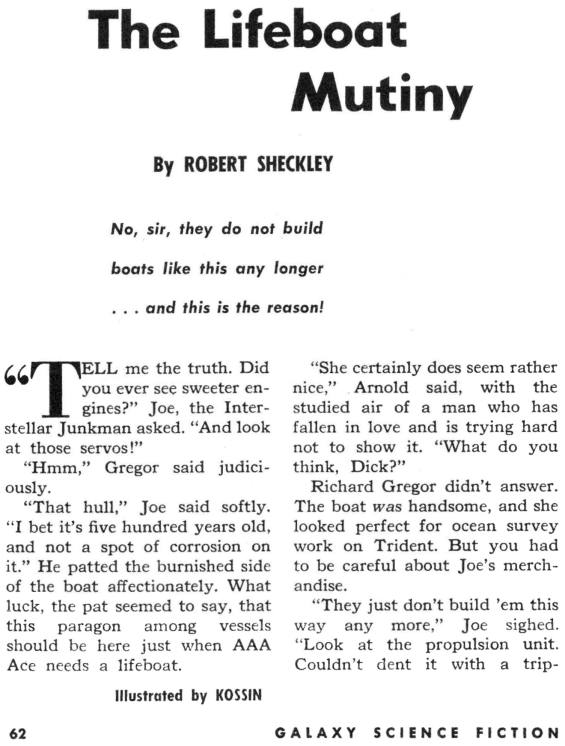
The Lifeboat Mutiny is a part of Robert Sheckley’s “AAA Ace Series.” The series has eight stories, each involving two partners in the far future encountering various unusual problems. One fan on LibraryThing described the series as being about “two of the unluckiest fellas who ever set out to make a fortune” – I’m still exploring the series, but I note that some non-AAA Ace Sheckley stories also seem to fit into that category – stories like Warrior Race and Untouched By Human Hands!
I find X-Minus One’s shows to be very hit or miss, but this Robert Sheckley story completely works. In fact, I’ve used the script for The Lifeboat Mutiny in school. Kids love it, adults love it. My only nit-pick with this adaptation is that the actor playing the lifeboat is not nearly emotional enough – he totally underplays the scripted dialogue – when I do this part, I always play the lifeboat as highly emotional.
X-Minus One – The Lifeboat Mutiny
Based on the story by Robert Sheckley; Adapted by Ernest Kinoy; Performed by a full cast
1 |MP3| – Approx. 28 Minutes [UNABRIDGED]
Broadcaster: NBC Radio
Broadcast: September 11, 1956
Provider: Archive.org Two planetary surveyors purchase a second-hand lifeboat to survey a water planet not knowing that the ship contains an artificial intelligence created for a war five hundred years in the past.
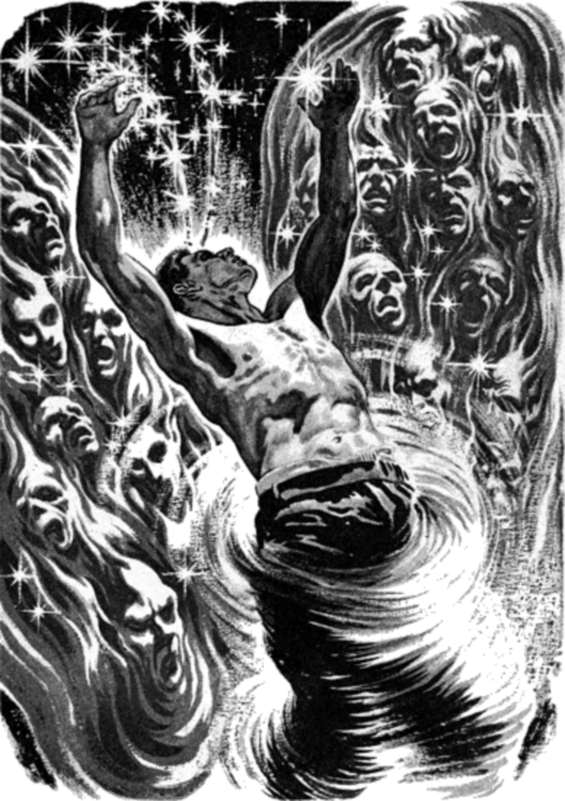
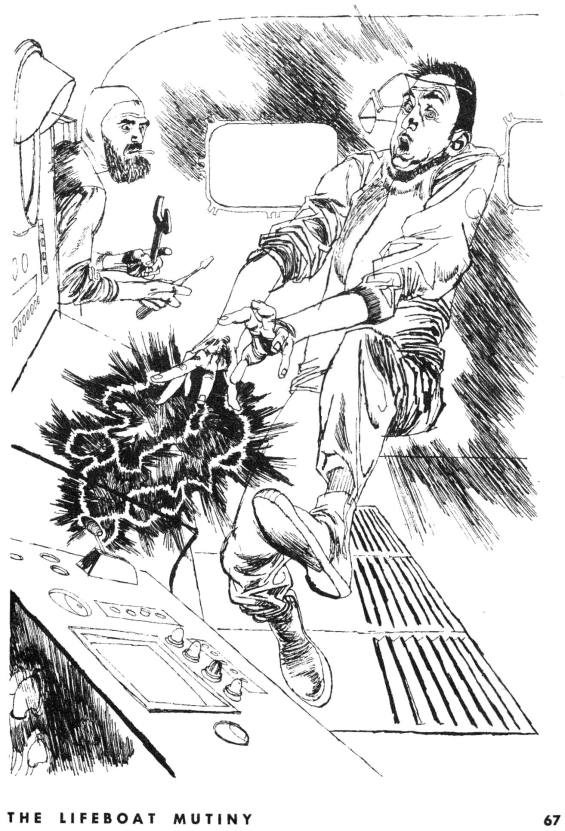
First published in Galaxy Science Fiction’s 1955 issue with an illustration by Kossin:
Here’s The Middlebury Radio Theater‘s recording of the script too:
Confessor By Terry Goodkind; Read by Sam Tsoutsouvas
20 CDs – 24 Hours [UNABRIDGED]
Publisher: Brilliance Audio Published: 2007
ISBN: 9781423316589
Themes: / Fantasy / Series / Magic / War
The final novel in Terry Goodkind’s Sword of Truth series begins in near-hopeless darkness. The hero of the series, Richard Rahl is not only a slave to the black hole of evil known as the Emperor Jagang, but he’s also been stripped of his magical powers, forced to play a murderous game rigged against him, and wakes to find an unhealthily devoted fan of another team trying to stab him to death. How can he possibly get free, save his wife, his friends, and his kingdom from millions of life-hating fanatics of the Imperial Order come to burn his followers from the earth?
The answer takes some doing to get to. Between you and the final resolution lie some brilliant set pieces; epic sequences of pulse-pounding battle action (and sports action in a game best described as naked football to the death with rocks); and some of the most glaciated, pace-killing, engine-gumming dialogue ever laid out on the slab of an otherwise well-paced story. Some of the characters are interesting and likable, but lord, don’t get them talking! They blather on about the principles of a well-lived life, the course of prophesy, and the evils of mindless devotion to religion so long, you wish you could conjure a little Wizard’s Fire to shorten the book.
Completing the tale also takes a healthy dose of credulity to accept a non-magical mensch getting up after two nights without sleep to play a brutal blood-sport for hours on end and then slice his way through a million-man army before hiking to the top of a mountain to fight his way through a packed room of elite warriors. But even more so, it takes a strong stomach for clinically detailed, lavishly prolonged violence against women. Apparently, it isn’t sufficient for Jagang to be bad; he has to be over-the-top, heinously Dark-Lord evil. What should be a quick, stark characterization draws on so long, it begins to feel like a creepy fetish.
This is the only novel of the entire series I have read, and I’m certainly glad of it. It was entertaining, overall, but I can’t imagine wading through ten-thousand pages of Goodkind’s uneven prose only to get to the slightly anticlimactic climax that Confessor brings. In sum, it wasn’t bad, but it isn’t good enough to be great, and certainly not good enough to cap a dozen books in a way I would have found satisfying.
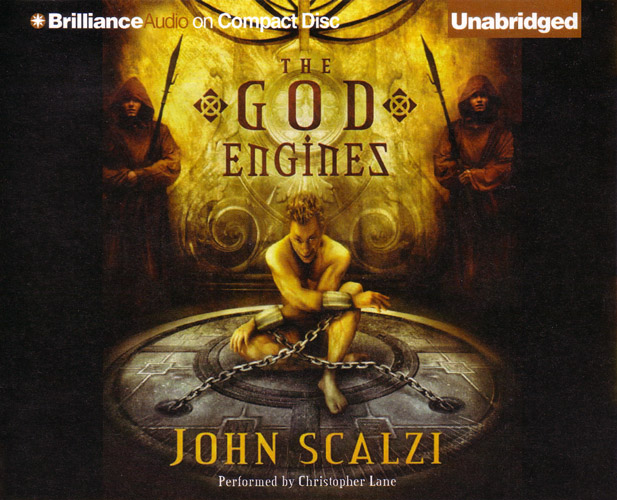
The God Engines
By John Scalzi; Read by Christopher Lane
3 CDs – Approx. 3 Hours 15 Minutes [UNABRIDGED]
Publisher: Brilliance Audio
Published: December 2010
ISBN: 9781441890795
Themes: / Science Fiction / Fantasy / Religion / Galactic Civilization / Space Travel / War /
Captain Ean Tephe is a man of faith, whose allegiance to his lord and to his ship is uncontested. The Bishopry Militant knows this — and so, when it needs a ship and crew to undertake a secret, sacred mission to a hidden land, Tephe is the captain to whom the task is given. Tephe knows from the start that his mission will be a test of his skill as a leader of men and as a devout follower of his god. It’s what he doesn’t know that matters: to what ends his faith and his ship will ultimately be put — and that the tests he will face will come not only from his god and the Bishopry Militant, but from another, more malevolent source entirely… Author John Scalzi has ascended to the top ranks of modern science fiction with the best-selling, Hugo-nominated novels Old Man’s War and Zoe’s Tale. Now he tries his hand at fantasy, with a dark and different novella that takes your expectations of what fantasy is and does, and sends them tumbling. Say your prayers… and behold The God Engines.
The God Engines is the strongest John Scalzi audiobook since Old Man’s War |READ OUR REVIEW|. It provokes thought, flies off in an unexpected direction and doesn’t overstay its welcome. The setting is in an unnamed galaxy, at an unknown time. But space travel, interstellar communication, and bodily healing aren’t technological developments. Instead, they are derived from a rigorous faith in actual, existing gods! These gods are so real, so embodied, that there is one in the center of each starship. It lies their enslaved, guarded and harnessed so as to achieve the ends to which they are put. Command over these powerful beings is achieved by a combination of torture and reward. Their masters are human beings, members of a religion with their own completely manifested god. Their purpose is to war with other religions, enslave new gods and bring more human beings to the worship of their own god. It is an unending holy war, in a fully realized universe, and it works.
I like to see the examination of an interesting idea, without an endless parade of pointless activity to dilute its core of goodness. We have that in this book. There’s something very neat about the running of what is essentially the starship Enterprise on faith. To hear that an officer is changing his prayers to adjust what’s showing up on the viewscreen – that’s something definitely worth seeing. Scalzi’s universe is run on prayer, faith, and relgious belief. It’s a kind of realization of what religions always claim, but shown to be actually functioning in a replicable manner. It’s theology as physics. The whole story feels like it comes from the same place J. Michael Straczynski’s Babylon 5 came from. Where Arthur C. Clarke’s Childhood’s End came from. There’s an indisputable space opera with Lovecraft vibe to it, but unlike so much space opera, the thinking just isn’t mushy and placative. In fact, there was nary a moment where I wasn’t completely engaged with this made up Fantasy/SF tale. The storytelling is expertly intertwined with a careful exposition of the universe’s rules. This works to fully enrich the ideation without coming off as merely a writer going through a checklist. I’d love to see Scalzi, or any other SF writer, write a dozen more books just like this – take a break from the series universe, and write some more idea based SF. Take a simple little premise or vignette, throw in a few characters and have them explore the concomitant interestingness of that idea. The God Engines does exactly that. It shows, very simply what SF storytelling is supposed to look like. This audiobook stands well, on its own, though I could easily imagine it as one half of an old Ace Double. This is very good work. Well done Mr. Scalzi.
Narrator Christopher Lane has about five major characters to play with. The captain is commanding and thoughtful. The second in command is calm and loyal. The ship’s high priest (who also acts as a kind of political commissar) is jealous but clever. The one female role, a rook (which is kind of a cross between a ship’s whore and a priestess), is wise and womanly. But it’s the unnamed god’s voice that is the real standout. Lane’s god is tortured, twisted and devious. It is a very precise performance, one that allows for the sympathy Scalzi was aiming at. The art for the cover comes from Vincent Chong‘s illustration of the Subterranean Press edition.


 The Defenders
 X Minus One – The Defenders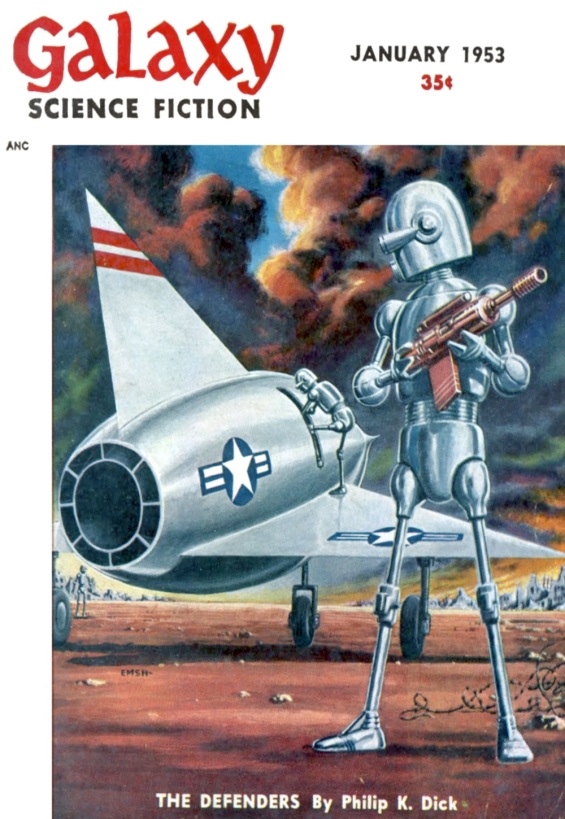
 The Big Time